Recognition: unknown
The smoothest average and some extremal problems for polynomials
Pith reviewed 2026-05-07 14:25 UTC · model grok-4.3
The pith
Symmetric kernels minimize the k-th discrete derivative norm of their convolution with any l2 function for k=3 and restricted higher orders.
A machine-rendered reading of the paper's core claim, the machinery that carries it, and where it could break.
Core claim
The minimal value of sup ||∇^k (u * f)||_2 / ||f||_2 is attained by particular symmetric kernels for k=3, and for k=4,6 under the non-negative Fourier transform condition, providing the first such explicit results for k greater than 2, together with a relation connecting the sharp constants for ∇^k and ∇^{2k}.
What carries the argument
Extremal problems for polynomials that arise when optimizing the ratio involving higher-order differences after convolution, solved via complex analysis tools.
Load-bearing premise
Kernels must be symmetric, sum to exactly one, and for k=4 and 6 have non-negative Fourier transforms, as the optimality claims rely on these restrictions.
What would settle it
For k=3, exhibiting a symmetric kernel summing to 1 that yields a strictly smaller sup ratio than the identified one would disprove the claimed optimality.
Figures


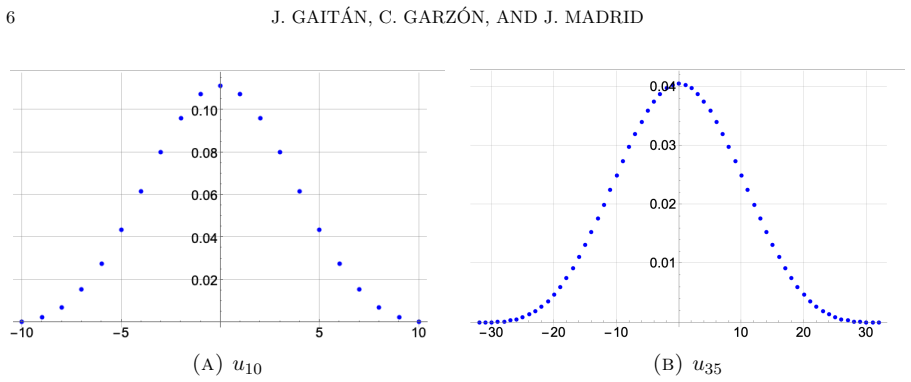
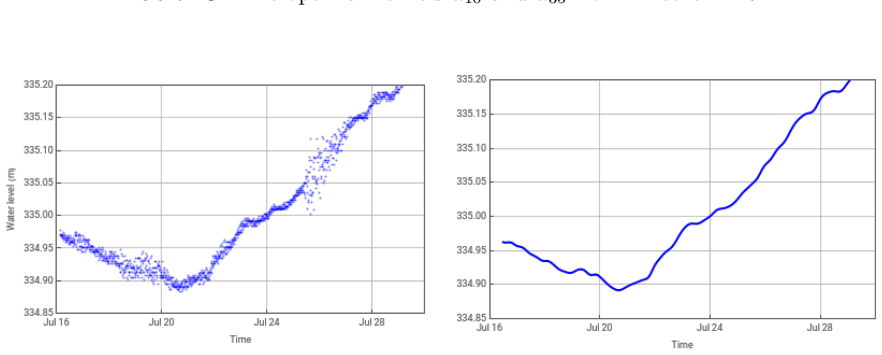
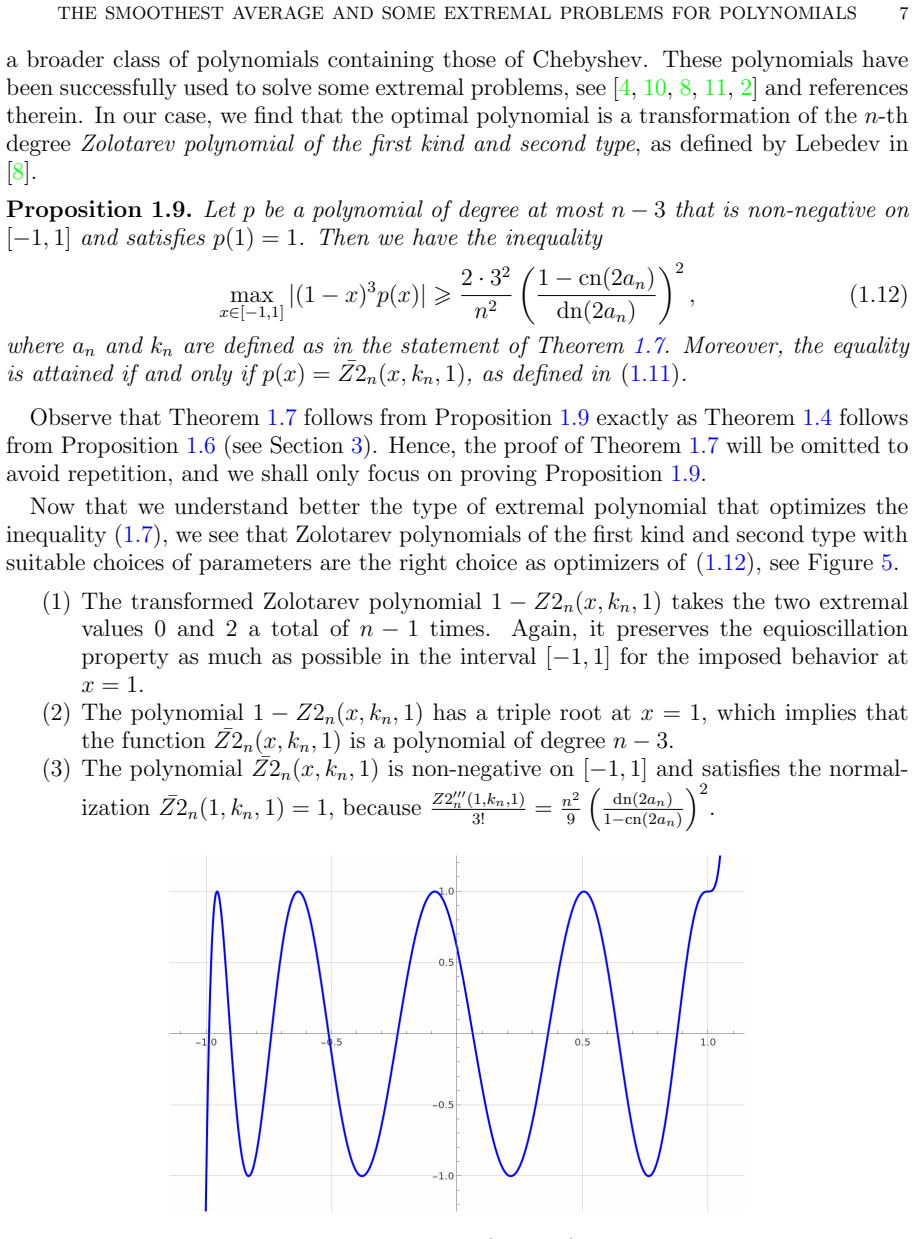
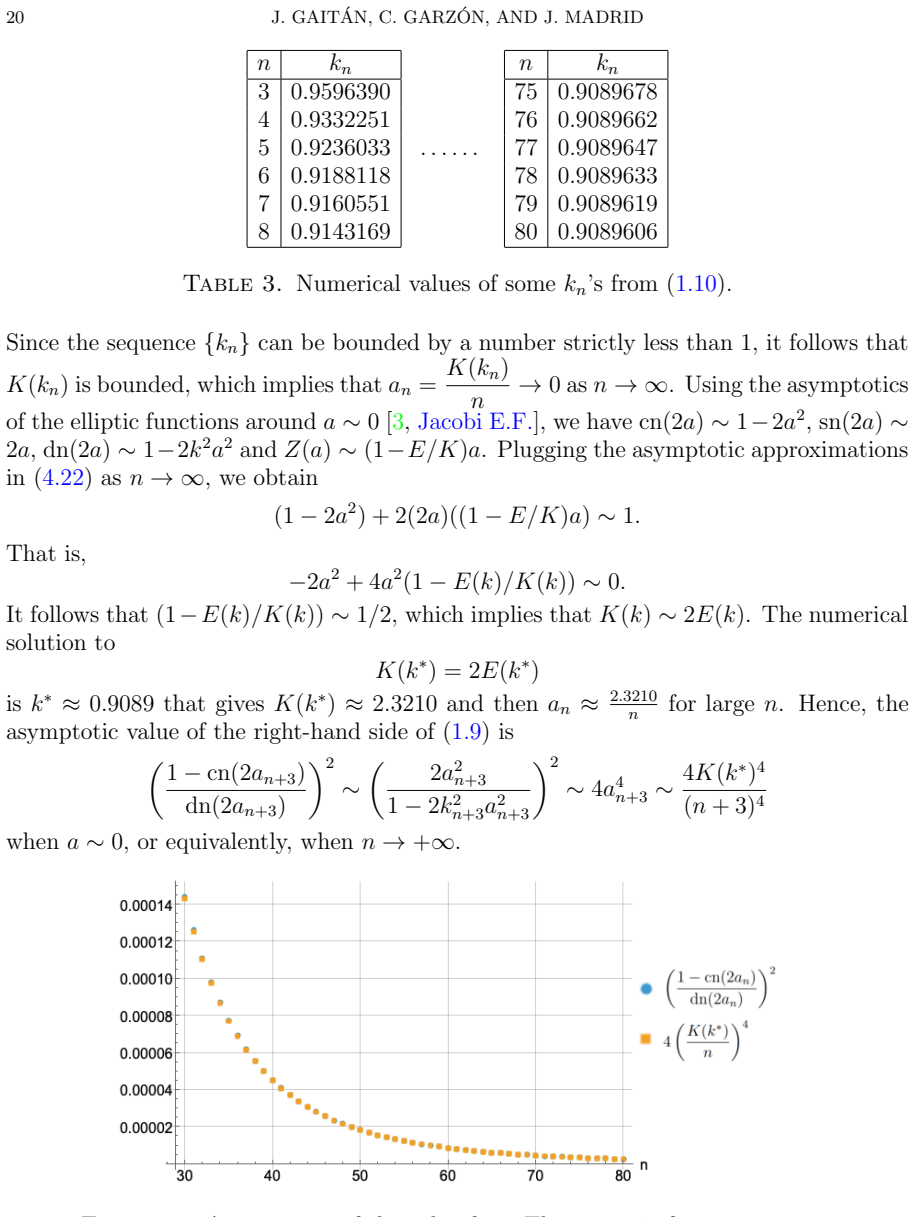
read the original abstract
We study the problem of finding the "smoothest'' local average of a function $f \in \ell^2(\mathbb{Z})$ when we consider its convolution with suitable kernels $u$. The measurement of smoothness is as follows: Given a positive integer $k$, we aim to minimize the constant \begin{equation*} \sup_{0 \neq f \in \ell^2(\mathbb{Z})} \frac{\|\nabla^{k}(u\ast f)\|_{\ell^2(\mathbb{Z})}}{\|f\|_{\ell^2(\mathbb{Z})}} \end{equation*} among all symmetric kernels $u : \{-n,\dots,n\} \to \mathbb{R}$ with normalization $\sum_{j=-n}^{n}u(j) = 1$. We are also interested in finding the kernel for which the least constant is attained. For $k=1$ and $k=2$, the sharp constants and optimal kernels were obtained by Kravitz-Steinerberger, and Richardson. In this paper, we provide alternative proofs for $k\in \{1,2\}$ by using complex analysis tools. Moreover, we establish the case $k=3$, and also the cases $k\in \{4,6\}$ when the kernels are restricted to have non-negative Fourier transform. These are the first results in the literature for $k>2$. Finally, we deduce a general relation between the sharp constants and optimal kernels corresponding to $\nabla^k$ and $\nabla^{2k}$.
Editorial analysis
A structured set of objections, weighed in public.
Referee Report
Summary. The paper studies the minimization, over symmetric finite-support kernels u summing to 1, of the operator norm sup ||∇^k (u ∗ f)||_2 / ||f||_2 for f in ℓ²(ℤ). It supplies complex-analytic proofs for the known cases k=1 and k=2, establishes the sharp constant and optimal kernel for k=3 without further restrictions, obtains the corresponding results for k=4 and k=6 under the additional constraint that the Fourier transform of u is non-negative, and derives a general relation linking the sharp constants and optimizers for ∇^k and ∇^{2k}.
Significance. If the derivations are correct, the work supplies the first explicit sharp constants and optimizers for k>2 in this discrete extremal problem, together with an alternative analytic approach to the low-order cases and a structural relation between the k and 2k problems. These results are of interest in discrete harmonic analysis and approximation theory; the explicit restrictions on the kernels are stated clearly and the claims are scoped accordingly.
minor comments (3)
- The abstract and introduction should state explicitly whether the support size n of the kernel is fixed in advance or whether the minimization is taken over all n; the current wording leaves this ambiguous.
- In the statement of the general relation between ∇^k and ∇^{2k} (presumably in the final section), the precise functional dependence between the two sharp constants should be written as an equation rather than described only in prose.
- A short remark comparing the obtained constants for k=3 with the numerical values previously obtained by other methods (if any exist) would help the reader assess the result.
Simulated Author's Rebuttal
We thank the referee for the positive assessment of our manuscript and the recommendation for minor revision. The referee's summary accurately captures the scope and contributions of the work.
Circularity Check
No significant circularity; derivation self-contained via complex analysis
full rationale
The paper supplies alternative proofs for the k=1 and k=2 cases using complex-analysis arguments that do not rely on prior fitted constants or self-referential definitions. It then establishes the k=3 case directly and the k=4,6 cases under the explicitly stated restriction of non-negative Fourier transforms. The final general relation between the sharp constants/optimal kernels for ∇^k and ∇^{2k} is deduced from these independently obtained results rather than presupposed. No step reduces by construction to a fitted parameter, a self-citation chain, or an ansatz smuggled in via prior work; all load-bearing claims are scoped to the stated kernel constraints and rest on direct analytic estimates.
Axiom & Free-Parameter Ledger
axioms (2)
- standard math Convolution with symmetric kernels preserves the l2 norm bounds in the stated sup expression.
- domain assumption Fourier transform of the kernel controls the multiplier for the discrete derivative operator.
Reference graph
Works this paper leans on
-
[1]
[2]Bojanov, B., and Naidenov, N.On oscillating polynomials.J. Approx. Theory 162, 10 (2010), 1766–1787. [3]NIST Digital Library of Mathematical Functions.https://dlmf.nist.gov/, Release 1.2.6 of 2026- 03-15. F. W. J. Olver, A. B. Olde Daalhuis, D. W. Lozier, B. I. Schneider, R. F. Boisvert, C. W. Clark, B. R. Miller, B. V. Saunders, H. S. Cohl, and M. A. ...
2010
-
[2]
[6]Kravitz, N., and Steinerberger, S.The smoothest average: Dirichlet, Fej´ er and Chebyshev. Bull. Lond. Math. Soc. 53, 6 (2021), 1801–1815. 24 J. GAIT ´AN, C. GARZ ´ON, AND J. MADRID [7]Lax, P. D.Proof of a conjecture of P. Erd¨ os on the derivative of a polynomial.Bull. Amer. Math. Soc. 50(1944), 509–513. [8]Lebedev, V. I.Zolotarev polynomials and extr...
2021
-
[3]
Fourier Anal
[13]Richardson, S.A Sharp Fourier Inequality and the Epanechnikov Kernel.J. Fourier Anal. Appl. 32, 1 (2026), Paper No
2026
-
[4]
[14]Steinerberger, S.Fourier uncertainty principles, scale space theory and the smoothest average. Math. Res. Lett. 28, 6 (2021), 1851–1874. (JG)Department of Mathematics, Virginia Polytechnic Institute and State Univer- sity, 225 Stanger Street, Blacksburg, V A 24061-1026, USA Email address:jogaitan@vt.edu (CG)Department of Mathematics, Virginia Polytech...
2021
discussion (0)
Sign in with ORCID, Apple, or X to comment. Anyone can read and Pith papers without signing in.