Recognition: unknown
Non-Monotonic Rotation Imprint on Time-Integrated Neutrino Spectral Moments in a 15\,M_odot Core-Collapse Supernova Sequence
Pith reviewed 2026-05-07 15:34 UTC · model grok-4.3
The pith
In one core-collapse supernova model sequence, slow rotation hardens neutrino spectra while fast rotation softens them, placing the cases in opposite quadrants of a spectral shift plane.
A machine-rendered reading of the paper's core claim, the machinery that carries it, and where it could break.
Core claim
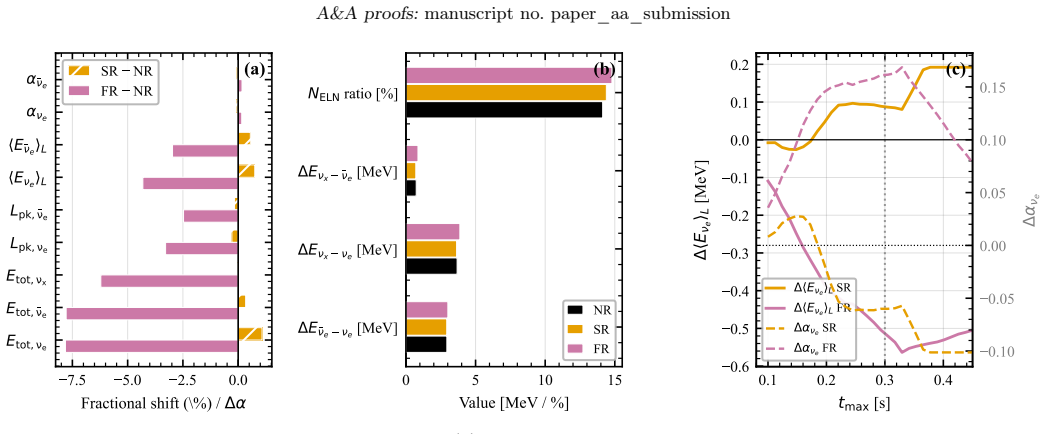
For this specific model sequence, SR and FR shift the integrated spectral moments in opposite directions relative to NR: FR drives the spectra toward softer, more-pinched states, while SR moves them weakly toward harder, less-pinched states. Placed in a spectral-shift plane (Δ⟨E⟩_L, Δα_L), NR sits at the origin, and SR and FR occupy diagonally opposite quadrants, making the non-monotonic response immediately visible as an anti-correlation in two spectral dimensions simultaneously.
What carries the argument
The spectral-shift plane whose axes are the change in mean neutrino energy (Δ⟨E⟩_L) and the change in pinching parameter (Δα_L), which together map how rotation alters the time-integrated neutrino spectra during accretion.
If this is right
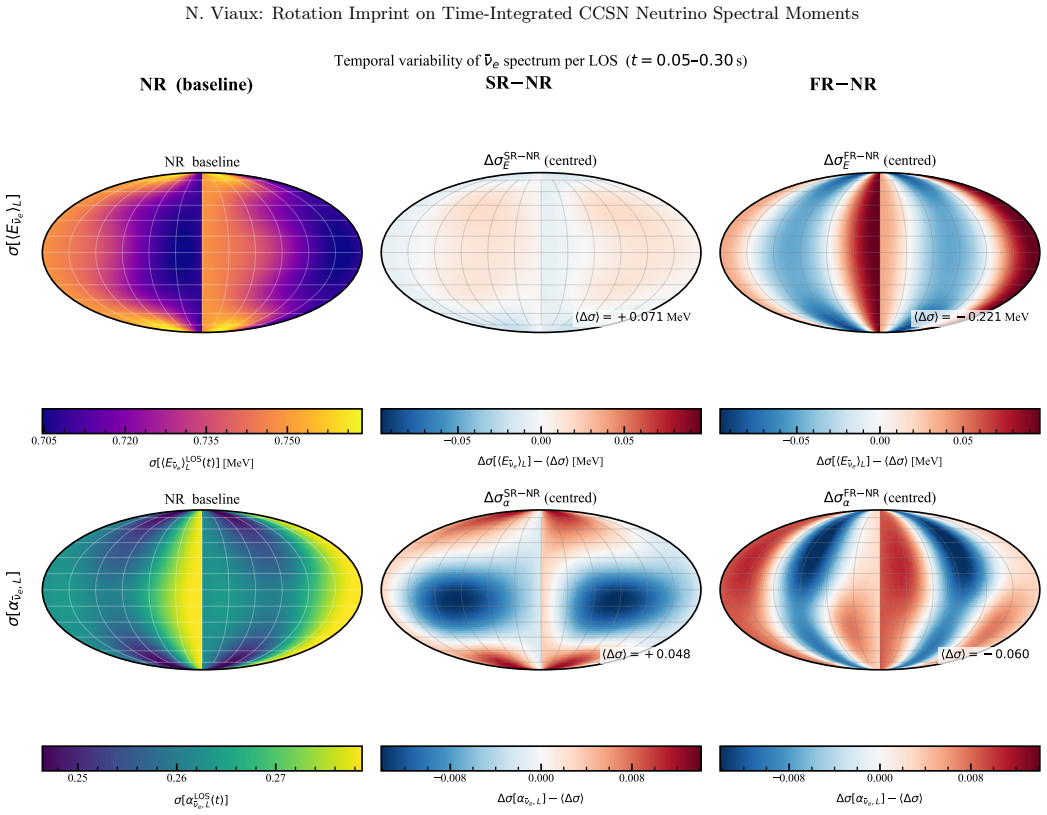
- The fast-rotation signature remains coherent across all 15488 lines of sight.
- The opposite shifts are established during the early accretion interval from 0.05 to 0.30 seconds after bounce.
- Fast rotation produces quantitative shifts of order -0.5 MeV in mean energy and +0.16 in pinching for electron neutrinos and antineutrinos.
- With only three models the result is a phenomenological characterization of one published sequence rather than a general functional dependence on rotation rate.
Where Pith is reading between the lines
- The non-monotonic pattern hints that the response to rotation rate may be nonlinear, so additional models at intermediate rates would be needed to trace the curve.
- If the same diagonal separation appears in other progenitors, it would complicate using neutrino mean energy and pinching as direct diagnostics of core angular momentum.
- Re-examining existing supernova simulation outputs with this two-dimensional shift diagnostic could reveal rotation imprints that single-moment analyses miss.
Load-bearing premise
The observed opposite shifts arise purely from the imposed rotation rates rather than from other differences in the three published models or from the specific numerical setup of the Garching sequence.
What would settle it
A new simulation at an intermediate rotation rate between 0.5 and 150 rad/s that produces spectral shifts lying on the line connecting the slow and fast cases would falsify the non-monotonic claim for this sequence.
Figures


read the original abstract
We study the early post-bounce neutrino signal of the published Garching $15\,M_\odot$ rotating core-collapse supernova (CCSN) sequence consisting of non-rotating (NR), slowly rotating (SR, $\Omega_0=0.5$ rad\,s$^{-1}$), and fast-rotating (FR, $\Omega_0=150$ rad\,s$^{-1}$, artificially boosted ${\sim}300{\times}$) three-dimensional models. We present a new analysis of these publicly available simulation data; no new simulations were performed. Our central result, for this specific model sequence, is that SR and FR shift the integrated spectral moments in \emph{opposite directions} relative to NR: FR drives the spectra toward softer, more-pinched states, while SR moves them weakly toward harder, less-pinched states. Placed in a spectral-shift plane $(\Delta\langle E\rangle_L,\,\Delta\alpha_L)$, NR sits at the origin, and SR and FR occupy \emph{diagonally opposite quadrants}, making the non-monotonic response immediately visible as an anti-correlation in two spectral dimensions simultaneously. The focus is the accretion interval $t_{\rm pb}=0.05$--$0.30$\,s, where the rotation imprint is strongest. Quantitatively, fast rotation produces $\Delta\langle E_{\nu_e}\rangle_L=-0.513$\,MeV and $\Delta\alpha_{\nu_e}=+0.161$, with corresponding shifts $\Delta\langle E_{\bar\nu_e}\rangle_L=-0.440$\,MeV and $\Delta\alpha_{\bar\nu_e}=+0.173$; the SR shifts are an order of magnitude smaller and in the opposite sense. The fast-rotation signature is coherent across all $15\,488$ lines of sight and is established during early accretion. With only three models from a single progenitor family, this result is a phenomenological characterization of one published sequence and a suggestive indication of a non-monotonic, possibly strongly nonlinear, rotational response within this sequence; the functional form and generality of the dependence on $\Omega_0$ remain unconstrained.
Editorial analysis
A structured set of objections, weighed in public.
Referee Report
Summary. The manuscript performs a post-processing analysis of publicly available 3D CCSN simulation outputs for a 15 M⊙ Garching sequence consisting of non-rotating (NR), slowly rotating (SR, Ω₀=0.5 rad s⁻¹), and fast-rotating (FR, Ω₀=150 rad s⁻¹, artificially boosted ~300×) models. Focusing on the accretion phase t_pb=0.05–0.30 s, it reports that SR and FR produce shifts in the time-integrated luminosity-weighted spectral moments (⟨E⟩_L and α_L) that are opposite in sign relative to NR: FR drives spectra softer and more pinched (e.g., Δ⟨E_νe⟩_L = −0.513 MeV, Δα_νe = +0.161), while SR produces weaker shifts in the opposite direction. These place SR and FR in diagonally opposite quadrants of the (Δ⟨E⟩_L, Δα_L) plane, with the signature coherent across all 15,488 lines of sight. The result is presented as a phenomenological characterization of this specific sequence.
Significance. If the reported anti-correlated shifts hold, the work provides a concrete, quantitative indication of non-monotonic rotational dependence in neutrino spectral moments for this model family, which could inform interpretation of future CCSN neutrino detections. A clear strength is the parameter-free, direct computation of moments from existing simulation data with no additional fitting or invented entities. The coherence statement across thousands of sightlines adds robustness within the sequence. However, the restriction to three models from one progenitor family and the artificial boost in the FR case limit the result's generality and make it suggestive rather than definitive.
major comments (2)
- [§2 and abstract] §2 (model description) and abstract: The central claim that the opposite shifts in (Δ⟨E⟩_L, Δα_L) arise from the imposed Ω₀ values alone is load-bearing. The FR model uses an artificial ~300× boost relative to SR, and the three models belong to one published sequence. Without an explicit side-by-side verification (e.g., table or text) confirming that initial conditions, grid resolution, microphysics, and numerical methods are identical except for rotation, uncontrolled differences could contribute to the observed shifts. The paper correctly labels the result phenomenological, but this assumption requires direct support to isolate the rotation effect.
- [§4] §4 (results on spectral shifts): The non-monotonic signature is quantified with specific numbers (e.g., Δ⟨E_νe⟩_L = −0.513 MeV for FR), but the manuscript does not report the variance or distribution of these shifts across the 15,488 lines of sight. Stating coherence is useful, yet showing the standard deviation or a histogram of per-sightline Δ⟨E⟩_L and Δα_L would test whether the quadrant placement is uniform or driven by outliers, directly affecting the strength of the anti-correlation claim.
minor comments (2)
- [abstract and §3] The subscript L (luminosity-weighted) and the exact definition of the pinching parameter α are used throughout but should be restated briefly in the abstract or first results section for readers who encounter the paper independently.
- [results figures] Figure showing the spectral-shift plane would benefit from explicit error bars or a scatter overlay to visualize the claimed coherence across sightlines rather than relying solely on the statement of uniformity.
Simulated Author's Rebuttal
We thank the referee for the careful reading and constructive comments. We address the two major comments point by point below, agreeing that targeted revisions will strengthen the manuscript while preserving its phenomenological scope.
read point-by-point responses
-
Referee: [§2 and abstract] §2 (model description) and abstract: The central claim that the opposite shifts in (Δ⟨E⟩_L, Δα_L) arise from the imposed Ω₀ values alone is load-bearing. The FR model uses an artificial ~300× boost relative to SR, and the three models belong to one published sequence. Without an explicit side-by-side verification (e.g., table or text) confirming that initial conditions, grid resolution, microphysics, and numerical methods are identical except for rotation, uncontrolled differences could contribute to the observed shifts. The paper correctly labels the result phenomenological, but this assumption requires direct support to isolate the rotation effect.
Authors: We agree that explicit verification is needed to isolate the rotation effect as cleanly as possible. The three models belong to the same publicly released Garching 15 M⊙ sequence, whose source papers (cited in our §2) state that the numerical setup, grid, microphysics, and neutrino transport are identical, with the sole controlled difference being the initial rotation rate Ω₀ (explicitly noted as artificially boosted by ~300× in the FR case). To make this transparent, we will insert a short table in §2 that lists the shared parameters alongside the differing Ω₀ values and provides direct references to the original simulation descriptions. This addition supports the phenomenological framing without claiming broader generality. revision: yes
-
Referee: [§4] §4 (results on spectral shifts): The non-monotonic signature is quantified with specific numbers (e.g., Δ⟨E_νe⟩_L = −0.513 MeV for FR), but the manuscript does not report the variance or distribution of these shifts across the 15,488 lines of sight. Stating coherence is useful, yet showing the standard deviation or a histogram of per-sightline Δ⟨E⟩_L and Δα_L would test whether the quadrant placement is uniform or driven by outliers, directly affecting the strength of the anti-correlation claim.
Authors: We agree that quantifying the distribution strengthens the coherence statement. Because our analysis post-processes the moments on a per-sightline basis, the full set of 15,488 values is available. In the revised §4 we will report the standard deviations of Δ⟨E⟩_L and Δα_L for both the SR and FR cases relative to NR, and we will add a compact inset histogram (or brief statistical summary) showing that the quadrant placement is uniform across sightlines rather than driven by outliers. This directly addresses the robustness of the reported anti-correlation. revision: yes
Circularity Check
No circularity: direct post-processing of existing simulation data
full rationale
The paper's analysis consists solely of computing time-integrated spectral moments (⟨E⟩_L and α_L) from publicly available Garching simulation outputs for the NR, SR, and FR models over t_pb = 0.05–0.30 s. No new simulations are run, no parameters are fitted, no equations are derived or solved, and no self-citations or ansatzes are invoked to generate the reported shifts. The central result—that SR and FR produce opposite displacements in the (Δ⟨E⟩_L, Δα_L) plane—is obtained by straightforward averaging and differencing of the simulation data. All load-bearing steps are external to the paper (the input simulation snapshots) and reduce to direct numerical post-processing rather than any self-referential construction.
Axiom & Free-Parameter Ledger
axioms (1)
- domain assumption The published Garching 3D CCSN simulations accurately capture the neutrino emission physics for the chosen rotating progenitors.
Reference graph
Works this paper leans on
-
[1]
D.Ott, A
C. D.Ott, A. Burrows, T.A. Thompson, E. Livne, and R. Walder, The spin periods and rotational profiles of neutron stars at birth, Astrophys. J. Suppl.164, 130 (2006)
2006
-
[2]
J.626, 350 (2005)
A.Heger,S.E.Woosley,andH.C.Spruit,Presupernova evolution of differentially rotating massive stars including magnetic fields, Astrophys. J.626, 350 (2005)
2005
-
[3]
J. M. Blondin and A. Mezzacappa,Pulsar spins from an instabil- ity in the accretion shock of supernovae, Nature445, 58 (2007)
2007
-
[4]
Iwakami, K
W. Iwakami, K. Kotake, N. Ohnishi, S. Yamada, and K. Sawada, Three-dimensional simulations of standing accretion-shock insta- bility in core-collapse supernovae, Astrophys. J.700, 232 (2009)
2009
-
[5]
Dimmelmeier, C
H. Dimmelmeier, C. D. Ott, A. Marek, and H.-T. Janka,Grav- itational wave burst signal from core collapse of rotating stars, Phys. Rev. D78, 064056 (2008)
2008
-
[6]
Abdikamalovet al.,Measuring the angular momentum distri- bution in core-collapse supernova progenitors with gravitational waves, Phys
E. Abdikamalovet al.,Measuring the angular momentum distri- bution in core-collapse supernova progenitors with gravitational waves, Phys. Rev. D90, 044001 (2014)
2014
-
[7]
Richers, C
S. Richers, C. D. Ott, E. Abdikamalov, E. O’Connor, and C. Sulli- van,Equation of state effects on gravitational waves from rotating core collapse, Phys. Rev. D95, 063019 (2017)
2017
-
[8]
Powell and B
J. Powell and B. Müller,Gravitational wave emission from 3D explosion models of core-collapse supernovae with low and normal explosion energies, Mon. Not. Roy. Astron. Soc.494, 4665 (2020)
2020
-
[9]
J. M. Lattimer and F. D. Swesty,A generalized equation of state for hot, dense matter, Nucl. Phys. A535, 331 (1991)
1991
-
[10]
Rampp and H.-T
M. Rampp and H.-T. Janka,Variable Eddington factor method for core-collapse supernova simulations, Astron. Astrophys.396, 361 (2002)
2002
-
[11]
Summa, H.-T
A. Summa, H.-T. Janka, T. Melson, and A. Marek,Rotation- supported neutrino-driven supernova explosions in three dimen- sions and the critical luminosity condition, Astrophys. J.852, 28 (2018)
2018
-
[12]
L. Walk, I. Tamborra, H.-T. Janka, and A. Summa,Identifying rotation in SASI-dominated core-collapse supernovae with a neu- trino gyroscope, Phys. Rev. D98, 123001 (2018)
2018
-
[13]
L. Walk, I. Tamborra, H.-T. Janka, A. Summa, and D. Pilarska, Effects of the standing accretion-shock instability and the lepton- emission self-sustained asymmetry in the neutrino emission of rotating supernovae, Phys. Rev. D100, 063018 (2019)
2019
-
[14]
Tamborra, F
I. Tamborra, F. Hanke, H.-T. Janka, B. Müller, G. G. Raffelt, and A. Marek,Self-sustained asymmetry of lepton-number emission: A new phenomenon during the supernova shock-accretion phase in three dimensions, Astrophys. J.792, 96 (2014)
2014
-
[15]
Tamborra, G
I. Tamborra, G. Raffelt, F. Hanke, H.-T. Janka, and B. Müller, Neutrino emission characteristics and detection opportunities based on three-dimensional supernova simulations, Phys. Rev. D 90, 045032 (2014)
2014
-
[16]
Zaizen and H
M. Zaizen and H. Nagakura,Simple method for determining asymptotic states of fast neutrino-flavor conversion, Phys. Rev. D107, 103022 (2023)
2023
-
[17]
I.TamborraandS.Shalgar,New developments in flavor evolution of a dense neutrino gas,Ann.Rev.Nucl.Part.Sci.71,165(2021)
2021
-
[18]
Padilla-Gay, I
D. Padilla-Gay, I. Tamborra, and G. G. Raffelt,Neutrino fast fla- vor pendulum. II. Collisional damping, Phys. Rev. D106, 103031 (2022)
2022
-
[19]
Strumia and F
A. Strumia and F. Vissani,Precise quasielastic neutrino/nucleon cross-section, Phys. Lett. B564, 42 (2003)
2003
-
[20]
Tomàs, D
R. Tomàs, D. Kachelrieß, G. G. Raffelt, A. Dighe, H.-T. Janka, and L. Scheck,Neutrino signatures of supernova shock and re- verse shock propagation, J. Cosmol. Astropart. Phys.2003, 006 (2003)
2003
-
[21]
Scholberg,Supernova neutrino detection, Ann
K. Scholberg,Supernova neutrino detection, Ann. Rev. Nucl. Part. Sci.62, 81 (2012)
2012
-
[22]
Hyper-Kamiokande Design Report
K. Abeet al.(Hyper-Kamiokande Collaboration),Hyper- Kamiokande Design Report, arXiv:1805.04163 (2018)
work page Pith review arXiv 2018
-
[23]
Abiet al.(DUNE Collaboration),Supernova neutrino burst detection with the Deep Underground Neutrino Experiment, Eur
B. Abiet al.(DUNE Collaboration),Supernova neutrino burst detection with the Deep Underground Neutrino Experiment, Eur. Phys. J. C81, 423 (2021)
2021
-
[24]
Anet al.(JUNO Collaboration),Neutrino physics with JUNO, J
F. Anet al.(JUNO Collaboration),Neutrino physics with JUNO, J. Phys. G43, 030401 (2016)
2016
-
[25]
Punturoet al.,The Einstein Telescope: a third-generation gravitational wave observatory, Class
M. Punturoet al.,The Einstein Telescope: a third-generation gravitational wave observatory, Class. Quantum Grav.27, 194002 (2010)
2010
-
[26]
Reitzeet al.,Cosmic Explorer: The U.S
D. Reitzeet al.,Cosmic Explorer: The U.S. contribution to gravitational-wave astronomy beyond LIGO, Bull. Am. Astron. Soc.51, 035 (2019). Article number, page 9 A&A proofs:manuscript no. paper_aa_submission
2019
-
[27]
Nagakura, A
H. Nagakura, A. Burrows, D. Radice, and D. Vartanyan,Where, when, and why: Occurrence of fast-pairwise collective neutrino oscillation in three-dimensional core-collapse supernova models, Mon. Not. Roy. Astron. Soc.506, 1462 (2021)
2021
-
[28]
Burrows, D
A. Burrows, D. Vartanyan, J. C. Dolence, M. A. Skinner, and D. Radice,Crucial physical dependencies of the core-collapse su- pernova mechanism, Space Sci. Rev.214, 33 (2018). Article number, page 10 N. Viaux: Rotation Imprint on Time-Integrated CCSN Neutrino Spectral Moments Appendix A: Data format and averaging procedure The Garching OBS files store the ...
2018
discussion (0)
Sign in with ORCID, Apple, or X to comment. Anyone can read and Pith papers without signing in.