Recognition: unknown
Large flats in large subgraphs of fine curve graphs
Pith reviewed 2026-05-07 14:44 UTC · model grok-4.3
The pith
Certain large subgraphs of the fine curve graph contain flats of every finite dimension and are therefore not hyperbolic.
A machine-rendered reading of the paper's core claim, the machinery that carries it, and where it could break.
Core claim
We show that certain large subgraphs of fine curve graphs, including fibers over a vertex of the curve graph, are not hyperbolic. Indeed, such graphs contain flats of every finite dimension. We then compute bounds on distances in fibers over a vertex of the curve graph, which we call single-isotopy-class fine curve graphs.
What carries the argument
The single-isotopy-class fine curve graph: the induced subgraph on all essential simple closed curves in one fixed isotopy class, with edges between disjoint curves.
If this is right
- The subgraphs fail to be hyperbolic for any choice of delta.
- Each such subgraph contains an isometric copy of the n-dimensional integer lattice for every n.
- Explicit upper and lower bounds on distances between any two curves in the same isotopy class are obtained.
- Hyperbolicity of the full fine curve graph requires edges that connect different isotopy classes.
Where Pith is reading between the lines
- The construction suggests that any sufficiently large collection of curves closed under isotopy will produce non-hyperbolic subgraphs.
- One could ask whether the full fine curve graph is quasi-isometrically rigid or whether the flats persist under small perturbations of the surface.
- Distance bounds inside these fibers might be used to study the geometry of the quotient map from the fine curve graph to the ordinary curve graph.
Load-bearing premise
The surface admits enough pairwise disjoint curves inside a single isotopy class to allow construction of the high-dimensional flats.
What would settle it
A proof that the maximum dimension of any flat inside a single-isotopy-class fine curve graph is bounded would falsify the claim.
Figures




read the original abstract
The fine curve graph of a surface is a graph whose vertices are essential simple closed curves and whose edges connect disjoint curves. Following a rich history of hyperbolicity of various graphs associated to surfaces, the fine curve graph was shown to be hyperbolic by Bowden-Hensel-Webb, while the curve graph, obtained from the fine curve graph by collapsing subgraphs corresponding to isotopy classes, was first proven to be hyperbolic by Masur-Minsky. We show that certain large subgraphs of fine curve graphs, including fibers over a vertex of the curve graph, are not hyperbolic. Indeed, such graphs contain flats of every finite dimension. We then compute bounds on distances in fibers over a vertex of the curve graph, which we call single-isotopy-class fine curve graphs.
Editorial analysis
A structured set of objections, weighed in public.
Referee Report
Summary. The manuscript shows that certain large subgraphs of the fine curve graph, including the fibers over vertices of the curve graph (single-isotopy-class fine curve graphs), are not hyperbolic. This is established by explicit constructions of quasi-flats of every finite dimension inside these subgraphs, using collections of mutually disjoint parallel curves in annular neighborhoods of a fixed curve together with auxiliary curves to control intersection patterns and produce grid-like distance growth. The paper also derives explicit upper and lower bounds on distances within these single-isotopy-class subgraphs.
Significance. The result provides a sharp contrast to the hyperbolicity of the full fine curve graph (Bowden-Hensel-Webb) and the curve graph (Masur-Minsky). The construction of arbitrarily high-dimensional quasi-flats is a strong, geometrically explicit contribution to the study of curve graphs and mapping class group actions. The distance bounds supply a useful computational tool. The topological hypotheses are the standard finite-type setting with at least one essential curve, and the constructions appear parameter-free once the base curve is fixed.
major comments (1)
- [§3] §3 (construction of the n-dimensional quasi-flat): the argument that the distance function on the grid of parallel curves yields a quasi-isometric embedding of E^n with constants independent of n should be verified explicitly, including the lower bound on distances between non-adjacent vertices in the grid; this is load-bearing for the claim that flats exist in every dimension.
minor comments (3)
- [§2] The notation for the single-isotopy-class fine curve graph (fiber over a vertex) is introduced clearly but could be fixed with a dedicated symbol early in §2 to ease later reading.
- [§4] Add a short remark comparing the obtained distance bounds to the known hyperbolicity constants of the full fine curve graph.
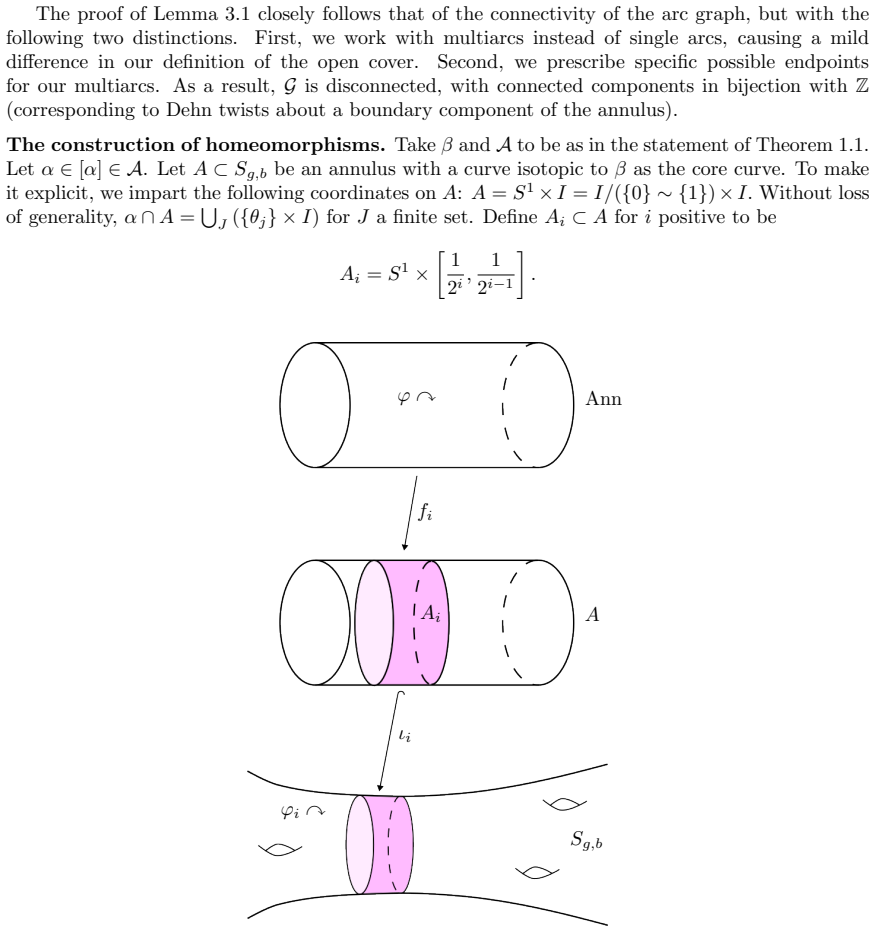
- [Figure 1] Figure 1 (schematic of the annular neighborhood and parallel curves) would benefit from labels indicating the auxiliary curves used to measure distances.
Simulated Author's Rebuttal
We thank the referee for their careful reading of the manuscript, their positive assessment of the results on non-hyperbolicity of large subgraphs of the fine curve graph, and their recommendation of minor revision. We address the single major comment below.
read point-by-point responses
-
Referee: [§3] §3 (construction of the n-dimensional quasi-flat): the argument that the distance function on the grid of parallel curves yields a quasi-isometric embedding of E^n with constants independent of n should be verified explicitly, including the lower bound on distances between non-adjacent vertices in the grid; this is load-bearing for the claim that flats exist in every dimension.
Authors: We agree that an explicit verification of the quasi-isometric embedding, with particular attention to the lower bound on distances between non-adjacent grid vertices, is necessary to fully substantiate the existence of n-dimensional quasi-flats for arbitrary n. In the revised manuscript we will expand the argument in §3 to include this verification in detail. The lower bound will be established by showing that the auxiliary curves in the construction force any two curves whose grid positions differ by a vector of length d to intersect at least c·d times (for a positive constant c independent of n), which in turn implies that their graph distance in the single-isotopy-class fine curve graph is at least a fixed multiple of d. This analysis relies on the annular neighborhoods and the controlled intersection patterns already present in the construction; we will make the counting argument fully rigorous and parameter-independent. revision: yes
Circularity Check
No significant circularity; explicit topological constructions
full rationale
The paper establishes non-hyperbolicity of the subgraphs by exhibiting explicit high-dimensional quasi-flats inside single-isotopy-class fibers, constructed via arbitrarily many mutually disjoint parallel curves in an annular neighborhood of a fixed essential curve together with controlled intersection patterns against auxiliary curves to realize grid-like distance growth. These constructions rest on standard finite-type surface topology and the definition of the fine curve graph (vertices essential curves, edges for disjointness), without any reduction to fitted parameters, self-definitional loops, or load-bearing self-citations. The cited hyperbolicity results (Bowden-Hensel-Webb for the full fine curve graph, Masur-Minsky for the ordinary curve graph) serve only as contrast and are not invoked to force the new claims; distance bounds are derived directly from intersection controls within the induced subgraph. The derivation chain is therefore self-contained and independent of the target results.
Axiom & Free-Parameter Ledger
axioms (2)
- domain assumption Vertices of the fine curve graph are essential simple closed curves on a surface and edges connect disjoint curves.
- domain assumption The curve graph is obtained by collapsing each isotopy class to a point.
Reference graph
Works this paper leans on
-
[1]
Robert Oakley, Roberta Shapiro, and Yang Xiao
Shuchi Agrawal, Tarik Aougab, Yassin Chandran, Marissa Loving, J. Robert Oakley, Roberta Shapiro, and Yang Xiao. Automorphisms of the k-Curve Graph.Michigan Mathematical Jour- nal, pages 1 – 39, 2021.doi:10.1307/mmj/20205929
-
[2]
Automorphisms of smooth fine curve graphs, 2024
Katherine Williams Booth. Automorphisms of smooth fine curve graphs, 2024. URL:https: //arxiv.org/abs/2410.21463
-
[3]
Homeomorphisms of surfaces that preserve continuously differen- tiable curves, 2024
Katherine Williams Booth. Homeomorphisms of surfaces that preserve continuously differen- tiable curves, 2024. URL:https://arxiv.org/abs/2410.21460
-
[4]
Automorphisms of the fine 1-curve graph, 2023
Katherine Williams Booth, Daniel Minahan, and Roberta Shapiro. Automorphisms of the fine 1-curve graph, 2023. URL:https://arxiv.org/abs/2309.16041
-
[5]
Rotation sets and actions on curves.Adv
Jonathan Bowden, Sebastian Hensel, Kathryn Mann, Emmanuel Militon, and Richard Webb. Rotation sets and actions on curves.Adv. Math., 408:Paper No. 108579, 33, 2022.doi: 10.1016/j.aim.2022.108579
-
[6]
Quasi-morphisms on surface diffeomorphism groups
Jonathan Bowden, Sebastian Wolfgang Hensel, and Richard Webb. Quasi-morphisms on surface diffeomorphism groups.Journal of the American Mathematical Society, 35(1):211–231, 2021. doi:10.1090/jams/981
-
[7]
Homotopy types of fine curve and fine arc complexes, 2026
Ryan Dickmann, Zachary Himes, Alexander Nolte, and Roberta Shapiro. Homotopy types of fine curve and fine arc complexes, 2026. URL:https://arxiv.org/abs/2602.09897
-
[8]
On the coarse geometry of the complex of domains
Valentina Disarlo. On the coarse geometry of the complex of domains. InHandbook of Te- ichm¨ uller theory. Volume III, volume 17 ofIRMA Lect. Math. Theor. Phys., pages 425–439. Eur. Math. Soc., Z¨ urich, 2012.doi:10.4171/103-1/7
-
[9]
Princeton University Press, Princeton, NJ, 2012
Benson Farb and Dan Margalit.A Primer on Mapping Class Groups, volume 49 ofPrinceton Mathematical Series. Princeton University Press, Princeton, NJ, 2012
2012
-
[10]
Hatcher and W
A. Hatcher and W. Thurston. A presentation for the mapping class group of a closed ori- entable surface. InCollected works of William P. Thurston with commentary. Vol. I. Folia- tions, surfaces and differential geometry, pages 457–473. Amer. Math. Soc., Providence, RI, [2022]©2022. Reprint of [0579573r]
2022
-
[11]
On triangulations of surfaces.Topology Appl., 40(2):189–194, 1991.doi: 10.1016/0166-8641(91)90050-V
Allen Hatcher. On triangulations of surfaces.Topology Appl., 40(2):189–194, 1991.doi: 10.1016/0166-8641(91)90050-V
-
[12]
Nikolai V. Ivanov. Automorphism of complexes of curves and of Teichm¨ uller spaces.Internat. Math. Res. Notices, (14):651–666, 1997.doi:10.1155/S1073792897000433
-
[13]
Automorphisms of fine curve graphs for nonorientable surfaces.Glasgow Math
Mitsuaki Kimura and Erika Kuno. Automorphisms of fine curve graphs for nonorientable surfaces.Glasgow Math. J., 67(2):232–244, 2025. URL: https://www.cambridge.org/core/journals/glasgow-mathematical-journal/ 25 article/automorphisms-of-fine-curve-graphs-for-nonorientable-surfaces/ 2A1F58B9F584C3A302118CC77E0D5BDD
2025
-
[14]
Irwin Kra. On the Nielsen-Thurston-Bers type of some self-maps of Riemann surfaces.Acta Math., 146(3-4):231–270, 1981.doi:10.1007/BF02392465
-
[15]
Automorphisms of the fine curve graph.Transactions of the AMS, To appear, 2023
Adele Long, Dan Margalit, Anna Pham, Yvon Verberne, and Claudia Yao. Automorphisms of the fine curve graph.Transactions of the AMS, To appear, 2023
2023
-
[16]
Howard A. Masur and Yair N. Minsky. Geometry of the complex of curves. I. Hyperbolicity. Invent. Math., 138(1):103–149, 1999.doi:10.1007/s002220050343
-
[17]
Automorphisms of some variants of fine graphs, 2022
Fr´ ed´ eric Le Roux and Maxime Wolff. Automorphisms of some variants of fine graphs, 2022. URL:https://arxiv.org/abs/2210.05460,doi:10.48550/ARXIV.2210.05460
-
[18]
Hyperbolicity, topology, and combinatorics of fine curve graphs and variants,
Roberta Shapiro. Hyperbolicity, topology, and combinatorics of fine curve graphs and variants,
- [19]
-
[20]
Automorphisms of fine curve graphs of planar surfaces, 2025
Roberta Shapiro, Rohan Wadhwa, Arthur Wang, and Yuchong Zhang. Automorphisms of fine curve graphs of planar surfaces, 2025. URL:https://arxiv.org/abs/2506.06142. 26
discussion (0)
Sign in with ORCID, Apple, or X to comment. Anyone can read and Pith papers without signing in.