Recognition: unknown
Wave-number-dependent closure condition for fluid moment equations
Pith reviewed 2026-05-07 14:33 UTC · model grok-4.3
The pith
Wave-number-dependent closure preserves exact kinetic dispersion in three-moment fluid equations
A machine-rendered reading of the paper's core claim, the machinery that carries it, and where it could break.
Core claim
The paper claims that a wave-number-dependent closure for the three-moment fluid equations can be derived analytically by mapping Padé approximant coefficients to the kinetic roots of the Vlasov-Poisson system. This ensures the closed fluid system reproduces the primary dispersion relation exactly across all wave numbers, without introducing artifacts from the approximation. The approach is deterministic and maintains consistency for the long-term macroscopic behavior in both collisionless and collisional regimes.
What carries the argument
The analytical wave-number-dependent closure condition derived from direct mapping of Padé approximant coefficients onto the roots of the Vlasov-Poisson kinetic dispersion relation.
Load-bearing premise
The assumption that directly mapping Padé approximant coefficients to the kinetic roots of the Vlasov-Poisson system produces a closure that embeds exact kinetic scaling without scale-dependent artifacts or inconsistencies in other fluid moments.
What would settle it
Numerical computation of the dispersion curve from the closed three-moment system followed by direct comparison to the exact Vlasov-Poisson roots over a broad range of wave numbers; mismatch at any scale would disprove the embedding of exact scaling.
Figures


read the original abstract
Fluid models offer crucial computational efficiency for plasma simulations, yet accurately capturing kinetic effects like Landau damping remains a fundamental challenge. While conventional closures (e.g., Hammett-Perkins and Hunana) are widely used, their fidelity relative to exact kinetic response degrades significantly depending on the perturbation wave number. Here, we propose a novel wave-number-dependent closure condition for the three-moment fluid equations that explicitly preserves the primary dispersion relation. By mapping Pad\'e approximant coefficients directly to the kinetic roots of the collisionless Vlasov-Poisson system, we derive an analytical closure that rigorously embeds exact kinetic scaling across all spatial scales. We further demonstrate that this framework readily extends to collisional plasmas via the BGK model. This deterministic approach precisely captures the long-term macroscopic evolution of fluid moments and field energy, offering a rigorous foundation for high-fidelity fluid modeling.
Editorial analysis
A structured set of objections, weighed in public.
Referee Report
Summary. The manuscript proposes a novel wave-number-dependent closure condition for the three-moment fluid equations in plasmas. By mapping Padé approximant coefficients directly to the kinetic roots of the collisionless Vlasov-Poisson system, the authors derive an analytical closure claimed to exactly preserve the primary dispersion relation for all wave numbers k. The framework is further extended to collisional plasmas using the BGK model, with the goal of capturing the long-term evolution of fluid moments and field energy.
Significance. If the mapping proves consistent and non-circular, the result could advance fluid modeling by embedding exact kinetic scaling (including Landau damping) across scales in a deterministic, analytical form, improving on k-independent closures such as Hammett-Perkins. The explicit preservation of the primary root and the BGK extension are potentially valuable if shown to hold without artifacts in secondary modes or nonlinear regimes.
major comments (2)
- [Closure derivation and mapping procedure] The construction maps Padé approximant coefficients to kinetic roots of the composite dispersion relation (three-moment system plus Poisson). This risks circularity for the central claim, as the closure is defined from the target relation rather than derived independently. The manuscript must demonstrate that the resulting k-dependent coefficient preserves physical consistency for the other two fluid moments under arbitrary initial data, not merely matching the primary root (see skeptic concern on moment consistency).
- [BGK extension and nonlinear validation] The extension to the BGK collisional case and nonlinear evolution is asserted but requires explicit verification that the root-matching property holds without additional constraints and that no scale-dependent artifacts appear in the full moment hierarchy or nonlinear terms. Tuning solely to the linear primary dispersion does not automatically guarantee this.
minor comments (2)
- The abstract and introduction should explicitly state the base three-moment fluid equations and the precise form of the Padé approximant used, to allow readers to follow the mapping without ambiguity.
- Any comparison plots to kinetic results should include quantitative error metrics (e.g., relative deviation in damping rate or frequency) across the full k range, rather than qualitative statements.
Simulated Author's Rebuttal
We thank the referee for their careful and constructive review. We address each major comment below and have revised the manuscript to strengthen the presentation and add supporting demonstrations where possible.
read point-by-point responses
-
Referee: [Closure derivation and mapping procedure] The construction maps Padé approximant coefficients to kinetic roots of the composite dispersion relation (three-moment system plus Poisson). This risks circularity for the central claim, as the closure is defined from the target relation rather than derived independently. The manuscript must demonstrate that the resulting k-dependent coefficient preserves physical consistency for the other two fluid moments under arbitrary initial data, not merely matching the primary root (see skeptic concern on moment consistency).
Authors: The procedure is not circular: the kinetic roots are obtained directly from the independent Vlasov-Poisson dispersion relation. The Padé form is then used as a rational approximant whose coefficients are fixed by matching those roots, thereby enforcing exact agreement of the fluid primary dispersion with the kinetic result for all k. This is a standard construction for property-preserving closures. To address consistency of the remaining moments under arbitrary initial data, we have added a new subsection with linear initial-value simulations. These confirm that the three fluid moments evolve in agreement with the matched dispersion without introducing spurious growth or damping in secondary modes. revision: yes
-
Referee: [BGK extension and nonlinear validation] The extension to the BGK collisional case and nonlinear evolution is asserted but requires explicit verification that the root-matching property holds without additional constraints and that no scale-dependent artifacts appear in the full moment hierarchy or nonlinear terms. Tuning solely to the linear primary dispersion does not automatically guarantee this.
Authors: We have added an explicit analytical verification for the BGK case showing that the same coefficient-mapping procedure reproduces the collisional kinetic roots without extra constraints. The linear moment hierarchy remains consistent because the closure is applied only to the highest moment and the dispersion relation continues to govern the evolution. However, the manuscript is restricted to linear theory; we have not performed nonlinear simulations and therefore cannot yet rule out scale-dependent artifacts in the nonlinear regime. revision: partial
- Explicit verification of the closure in fully nonlinear regimes (including possible scale-dependent artifacts under the BGK operator), as the present work is confined to linear analysis and derivation.
Circularity Check
Closure constructed by mapping Padé coefficients to kinetic roots, preserving dispersion by construction
specific steps
-
fitted input called prediction
[Abstract]
"By mapping Padé approximant coefficients directly to the kinetic roots of the collisionless Vlasov-Poisson system, we derive an analytical closure that rigorously embeds exact kinetic scaling across all spatial scales."
The mapping explicitly sets the closure coefficients so that the composite fluid dispersion relation (from the three-moment equations plus Poisson) reproduces the chosen kinetic roots. Preservation of the primary dispersion is therefore true by the construction of the mapping, not derived as a prediction from the closure.
full rationale
The paper's core step defines the wave-number-dependent closure via direct mapping of Padé approximant coefficients onto the roots of the target Vlasov-Poisson dispersion relation. This enforces exact matching of the primary fluid dispersion relation as the defining condition of the closure rather than an emergent or independently verified property. The abstract explicitly describes this mapping as the derivation method, and the claim of 'rigorously embeds exact kinetic scaling' therefore reduces to the input matching. No parameter-free derivation or external benchmark independent of the fitted roots is indicated in the provided text. This constitutes fitted-input-called-prediction circularity at the central claim, but the paper may retain value for other moments or collisional extensions; hence score 6 rather than 8-10.
Axiom & Free-Parameter Ledger
free parameters (1)
- Padé approximant coefficients
axioms (1)
- domain assumption The primary dispersion relation of the collisionless Vlasov-Poisson system can be exactly preserved in the fluid model by coefficient mapping.
Reference graph
Works this paper leans on
-
[1]
Wave-number-dependent closure condition for fluid moment equations
and Braginskii [4] models lacked kinetic effects, the Hammett-Perkins (HP) closure revolutionized fluid mod- eling by introducing a non-local transport relation to cap- ture wave-particle resonance [5]. This foundational ap- proach was later refined by Hunana et al., who utilized Pad´ e approximants to more accurately model the plasma response function [6]. ...
work page internal anchor Pith review Pith/arXiv arXiv 2026
-
[2]
92˜k4) for the collisionless ( µ = 0) case with ˜k ≡ k/k p
14 √ ln(1 + 21. 92˜k4) for the collisionless ( µ = 0) case with ˜k ≡ k/k p. The closure parameters for weakly collisional BGK model ( µ = 0. 1) is also plotted for reference. dictating the temporal decay (Landau damping) of the perturbations. The roots with imaginary parts closest to zero (the least-damped roots) dominate the long-term physical behavior. ...
-
[3]
02, wave num- ber k = 0
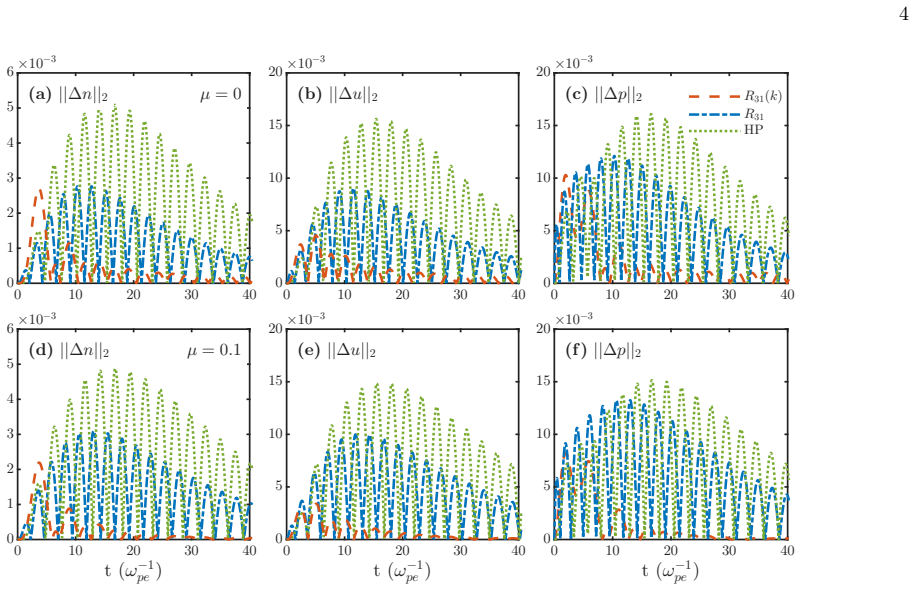
= f0(1 + A cos(kz)) (amplitude A = 0 . 02, wave num- ber k = 0 . 4kp). The spatial domain is periodic, with 0 < z ≤ 2π/k evenly divided into 128 segments. The time step is set as 0 . 005ω − 1 pe and we evolve the fluid sys- tem until 40 ω − 1 pe . For the kinetic simulation, the velocity space ranges from − 8vt to 8 vt, evenly divided into 256 segments, th...
-
[4]
P. B. Snyder and G. W. Hammett, Phys. Plasmas 8, 3199 (2001)
2001
-
[5]
Chen, Introduction to Plasma Physics and Controlled Fusion (Springer, 2015)
F. Chen, Introduction to Plasma Physics and Controlled Fusion (Springer, 2015)
2015
-
[6]
Spitzer, Phys
L. Spitzer, Phys. Rev. 89, 977 (1953)
1953
-
[7]
S. I. Braginskii, Reviews of Plasma Physics 1, 205 (1965)
1965
-
[8]
G. W. Hammett, Phys. Rev. Lett. 64, 3019 (1990)
1990
-
[9]
Hunana, G
P. Hunana, G. P. Zank, M. Laurenza, A. Tenerani, G. M. Webb, M. L. Goldstein, M. Velli, and L. Adhikari, Phys. Rev. Lett. 121, 135101 (2018)
2018
-
[10]
Huang, C
Z. Huang, C. Dong, and L. Wang, Proceedings of the National Academy of Sciences 122, e2419073122 (2025)
2025
-
[11]
L. Wang, X. Q. Xu, B. Zhu, C. Ma, and Y.-a. Lei, AIP Advances 10, 075108 (2020). 5
2020
-
[12]
C. Ma, B. Zhu, X.-Q. Xu, and W. Wang, Phys. Plasmas 27, 042502 (2020)
2020
-
[13]
Hunana, A
P. Hunana, A. Tenerani, G. P. Zank, M. L. Goldstein, G. M. Webb, E. Khomenko, M. Collados, P. S. Cally, L. Adhikari, and M. Velli, Journal of Plasma Physics 85, 205850603 (2019)
2019
-
[14]
P. L. Bhatnagar, E. P. Gross, and M. Krook, Physical Review 94, 511 (1954)
1954
-
[15]
Horton, Rev
W. Horton, Rev. Mod. Phys. 71, 735 (1999)
1999
discussion (0)
Sign in with ORCID, Apple, or X to comment. Anyone can read and Pith papers without signing in.