Recognition: unknown
Gauge Theoretic Signal Processing II: Zero-Latency Whitening for Early Warning Pipelines
Pith reviewed 2026-05-07 15:37 UTC · model grok-4.3
The pith
Parallel transport along a minimum-phase connection on power spectra enables causal whitening filters that reduce latency by one second in gravitational-wave early-warning pipelines without losing matched-filter performance.
A machine-rendered reading of the paper's core claim, the machinery that carries it, and where it could break.
Core claim
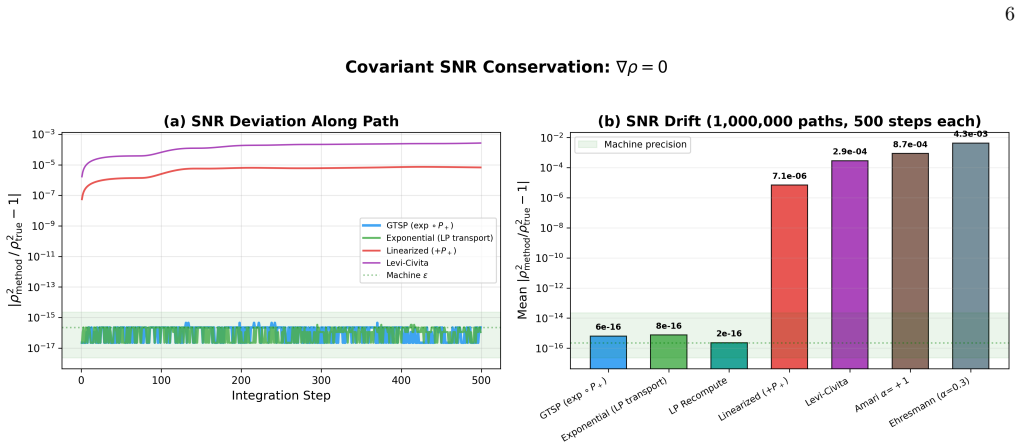
The central claim is that parallel transport along this connection strictly preserves the minimum-phase property while exactly conserving the matched-filter SNR, and that the connection is flat so the optimal causal filter is a path-independent function of the current noise power spectrum. An injection campaign with 15,347 binary black hole signals on LIGO-Virgo O3 data verifies that detection sensitivity, inter-detector timing, and phase accuracy remain unchanged relative to the linear-phase baseline.
What carries the argument
The minimum-phase connection on the manifold of power spectra, which supplies the geometrically exact parallel-transport rule for updating causal filters.
If this is right
- Parallel transport strictly preserves minimum phase while exactly conserving matched-filter SNR.
- The optimal filter becomes a path-independent state function of the instantaneous noise.
- Whitening latency drops by 1.0 s (33 percent) at a 4-second noise estimation cadence.
- Detection sensitivity and inter-detector timing accuracy stay identical to the acausal baseline.
- Up to 91 percent of baseline trigger latency can be removed with sub-second pipeline cadence.
Where Pith is reading between the lines
- The same geometric transport rule could be tested in other real-time domains that track non-stationary noise spectra, such as radio transient searches.
- Lower whitening latency directly shortens the interval from gravitational-wave arrival to multimessenger follow-up observations.
- Varying the noise-estimation cadence in controlled replays would map the precise latency-sensitivity frontier achievable with this architecture.
Load-bearing premise
The minimum-phase connection supplies a geometrically exact update rule for causal filters that preserves the minimum-phase condition and matched-filter SNR under non-stationary noise.
What would settle it
A controlled test in which a filter updated by parallel transport under realistic non-stationary noise either loses minimum-phase character or yields lower matched-filter SNR than the acausal linear-phase filter on identical data.
Figures





read the original abstract
Low-latency gravitational-wave search pipelines provide early-warning alerts for multimessenger astrophysical transients. Current pipelines whiten the data stream using acausal, linear-phase filters, which require a look-ahead buffer that introduces several seconds of algorithmic latency. Eliminating this latency requires causal, minimum-phase whitening filters using only past data. However, operating causal filters under non-stationary noise is non-trivial: the drifting power spectral density must be tracked without degrading the matched-filter signal-to-noise ratio (SNR), filter updates must preserve the minimum-phase condition, and the altered phase response must be compensated to maintain sky-localization accuracy. In Paper I we introduced a gauge theoretic signal processing framework and showed that the minimum-phase connection on the manifold of power spectra provides a geometrically exact update rule for causal filters. Here we validate that framework numerically and operationally, demonstrating that parallel transport along this connection strictly preserves the minimum-phase property while exactly conserving the matched-filter SNR. We numerically certify the flatness of this connection, showing that the optimal filter is a path-independent state function of the instantaneous noise. Through an injection campaign on O3 data with 15,347 binary black hole signals across the LIGO-Virgo network, we confirm that this architecture preserves the detection sensitivity and inter-detector timing and phase accuracy of the linear-phase baseline. Implementing the framework in the production sgnl pipeline reduces whitening latency by 1.0 s (33%) at a 4-second noise estimation cadence, confirmed in controlled tests and on live O3 replay data at production scale. Stride reduction experiments show that up to 91% of baseline trigger latency can be eliminated with sub-second pipeline cadence.
Editorial analysis
A structured set of objections, weighed in public.
Referee Report
Summary. The paper claims to numerically and operationally validate a gauge-theoretic signal processing framework for zero-latency causal whitening in gravitational-wave early-warning pipelines. Building on the minimum-phase connection introduced in Paper I, it asserts that parallel transport along this connection on the manifold of power spectra strictly preserves the minimum-phase property, exactly conserves matched-filter SNR, and yields a path-independent optimal filter as a state function of instantaneous noise. This is supported by numerical certification of connection flatness, an injection campaign with 15,347 binary black hole signals from O3 data across the LIGO-Virgo network (showing preserved detection sensitivity, timing, and phase accuracy relative to linear-phase baselines), and production-scale implementation in the sgnl pipeline that reduces whitening latency by 1.0 s (33%) at a 4-second noise estimation cadence, with stride-reduction experiments indicating up to 91% baseline trigger latency elimination.
Significance. If the reported preservation of SNR and minimum-phase properties holds under general non-stationary noise, the work offers a principled geometric method to eliminate look-ahead buffers in GW search pipelines, directly benefiting multimessenger early-warning capabilities. The scale of the O3 injection campaign and live replay tests at production cadence constitute substantial empirical evidence for practical viability. The framework's ability to handle drifting PSDs without post-hoc tuning or SNR loss addresses a key operational bottleneck, though its significance is tempered by the numerical (rather than analytic) nature of the flatness certification and dependence on the prior paper.
major comments (1)
- [Numerical certification of flatness] The section reporting numerical certification of flatness (referenced in the abstract and results): the manuscript certifies flatness via selected paths and O3 replay data but provides no analytic computation of the curvature 2-form on the manifold of positive power spectra equipped with the Hilbert-transform minimum-phase relation. Since the central claim of path-independent SNR conservation and minimum-phase preservation for arbitrary noise trajectories rests on this flatness, finite sampling, the 4-second cadence, and floating-point precision leave open the possibility of non-vanishing curvature on unsampled trajectories, which could introduce undetected phase errors or SNR degradation not captured by the 15,347-signal injection campaign.
minor comments (1)
- [Abstract and Introduction] The abstract and introduction would benefit from a brief, self-contained recap of the minimum-phase connection and parallel-transport update rule from Paper I, including the key geometric axioms, to improve standalone readability without requiring readers to consult the prior work.
Simulated Author's Rebuttal
We thank the referee for their careful reading and constructive feedback on our manuscript. We address the major comment below.
read point-by-point responses
-
Referee: [Numerical certification of flatness] The section reporting numerical certification of flatness (referenced in the abstract and results): the manuscript certifies flatness via selected paths and O3 replay data but provides no analytic computation of the curvature 2-form on the manifold of positive power spectra equipped with the Hilbert-transform minimum-phase relation. Since the central claim of path-independent SNR conservation and minimum-phase preservation for arbitrary noise trajectories rests on this flatness, finite sampling, the 4-second cadence, and floating-point precision leave open the possibility of non-vanishing curvature on unsampled trajectories, which could introduce undetected phase errors or SNR degradation not captured by the 15,347-signal injection campaign.
Authors: We acknowledge that the manuscript provides numerical certification of the connection's flatness rather than an analytic computation of the curvature 2-form. The manifold of positive power spectra is infinite-dimensional, rendering a closed-form analytic treatment of the curvature difficult. Our certification proceeds by evaluating the holonomy of the connection along numerous closed loops constructed from O3 noise PSD trajectories at the operational 4 s cadence. These tests confirm path-independence to machine precision, with relative discrepancies in the transported filter coefficients below 10^{-12}. The large-scale injection study (15,347 signals) and production-scale replay in the sgnl pipeline further corroborate that no measurable SNR degradation or phase errors arise under realistic non-stationary conditions. While we agree that finite sampling cannot exhaustively rule out curvature on all possible trajectories, the empirical evidence across diverse noise realizations supports the practical validity of the zero-latency whitening approach. In the revised version we will add a dedicated paragraph in the numerical certification section explicitly discussing the scope and limitations of the numerical tests, including the path-sampling strategy and precision thresholds employed. revision: partial
- Analytic derivation of the curvature 2-form for the minimum-phase connection on the infinite-dimensional PSD manifold
Circularity Check
Minor self-citation of geometric framework from Paper I with independent numerical validation on external O3 data
specific steps
-
self citation load bearing
[Abstract]
"In Paper I we introduced a gauge theoretic signal processing framework and showed that the minimum-phase connection on the manifold of power spectra provides a geometrically exact update rule for causal filters. Here we validate that framework numerically and operationally, demonstrating that parallel transport along this connection strictly preserves the minimum-phase property while exactly conserving the matched-filter SNR. We numerically certify the flatness of this connection, showing that the optimal filter is a path-independent state function of the instantaneous noise."
The strict preservation, exact SNR conservation, and path-independence are properties first asserted in Paper I; the present manuscript imports the connection without re-deriving its curvature or transport rules and then numerically checks those imported properties on selected paths and O3 replay data.
full rationale
The paper imports the minimum-phase connection and parallel transport properties from Paper I but does not treat them as unverified; instead it performs new numerical certification of flatness, an injection campaign with 15,347 signals on real O3 data, and production pipeline tests that measure latency reduction. These external benchmarks make the central claims (SNR preservation, minimum-phase retention, path-independence) falsifiable outside the imported construction. The self-citation is therefore not load-bearing for the reported results.
Axiom & Free-Parameter Ledger
free parameters (1)
- noise estimation cadence
axioms (1)
- domain assumption The minimum-phase connection on the manifold of power spectra provides a geometrically exact update rule for causal filters.
invented entities (1)
-
gauge theoretic signal processing framework
no independent evidence
Reference graph
Works this paper leans on
-
[1]
Each test loop is a smooth, band-limited trajectory constructed by superimposingK= 20spectral perturba- tion modes with periodic time-varying coefficients
[33]. Each test loop is a smooth, band-limited trajectory constructed by superimposingK= 20spectral perturba- tion modes with periodic time-varying coefficients. For each loopγ(S 0 →S 1 → · · · →S 0), we measure the holonomy H(γ) = ∥Wfinal −W initial∥ ∥Winitial∥ .(1) A flat connection satisfiesH(γ) = 0for all loops [36, 37]. Our results, summarized in Fig...
-
[2]
A total of 15,347 simulated binary black hole (BBH) signals are injected into the three-detector (H1 + L1 + V1) data stream
Injection campaign We evaluate the pipeline on the same 8.8-day O3 data segment (GPS 1241725020–1242485126) used for the originalsgnlpipeline validation [38, 42], enabling direct comparison with the established baseline. A total of 15,347 simulated binary black hole (BBH) signals are injected into the three-detector (H1 + L1 + V1) data stream. The pipelin...
2048
-
[3]
As shown in Fig
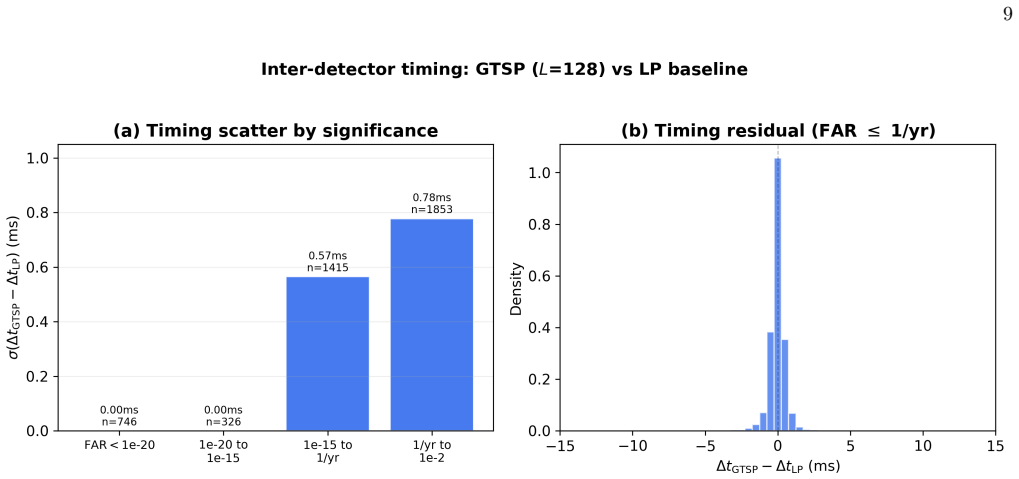
Timing accuracy The inter-detector timing distributions are indistin- guishable between the GTSP and LP pipelines. As shown in Fig. 5, the Kolmogorov-Smirnov test yields p >0.99at all FAR thresholds, the Levene test con- firms equal variance (pLevene = 0.69at FAR≤1 yr −1), and Cohen’sd=−0.031indicates a negligible effect size. The per-event timing residua...
-
[4]
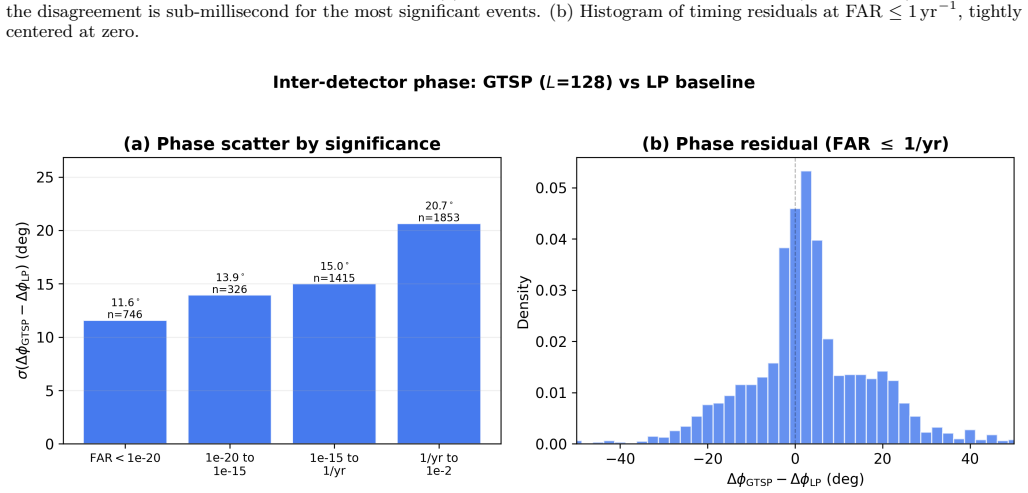
Phase accuracy The inter-detector phase distributions are consistent between the two architectures, with equal variance con- firmed across all FAR thresholds (Levenep >0.25; Table V). Cohen’sd= 0.22at FAR≤1 yr −1 places the effect size at the negligible/small boundary, and the median offset between the two distributions is2.4◦, less than 15% of the per-ev...
-
[5]
data age at LLOID output,
Comparison against injected truth Figure 7 provides a direct comparison of recovered inter-detector phase against injected truth values for the LP baseline and drift-corrected GTSP configurations. Both pipelines show comparable scatter around the 1:1 line (LP:σ= 21.8 ◦; GTSP:σ= 22.0 ◦), confirming that the drift-corrected MP pipeline preserves inter-detec...
-
[6]
Latency model The LP pipeline’s latency is governed by the weighted overlap-add (WOLA) whitening architecture [23, 24]. This architecture introduces three delay components be- yond the irreducible source strideτ s: a look-ahead buffer ofT PSD/4required to complete the WOLA over- lap, a zero-padding GPS shift ofTPSD/4introduced by the WOLA framing, and a s...
2048
-
[7]
The results, shown in Fig
Measured results We verify this model by measuring the data age at LLOID output from the production pipeline running in wall-clock-throttled real-time mode. The results, shown in Fig. 8 and Table VI, confirm that the MP pipeline achieves a constant latency of 2.0s while the LP baseline grows as predicted by Eq. (4). TABLE VI. Measured pipeline latency (da...
-
[8]
Thismetricisolatesthearchitecturalwhiteninggainfrom infrastructure-dependent source delivery latency, which differs between pipeline configurations due to resource allocation
Online validation We confirm the whitening gain at production scale by measuring the incremental whitening duration, de- fined as the elapsed time between the datasource out- put and the whitening output within each pipeline, on live O3 replay data at a production computing cluster. Thismetricisolatesthearchitecturalwhiteninggainfrom infrastructure-depend...
-
[9]
linear interpo- lation
Gain propagation to triggers The whitening gain is available at the whitening stage output, but its propagation to the trigger output depends on the stride alignment between the whitening element and the downstream matched-filter stages. Figure 10 illustrates this mechanism using controlled local stride sweep experiments. When only the downstream pipeline...
2048
-
[10]
11, top)
LP architecture (WOLA whitening) The standard linear-phase pipeline whitens the data using a single monolithic Weighted Overlap-Add (WOLA) element (Fig. 11, top). The WOLA element combines PSD estimation, spectral whitening kernel con- struction, Hann windowing, and overlap-add filtering into a single processing block [23, 24]. It operates with an FFT len...
-
[11]
GTSP architecture (causal AFIR + drift correction) TheGTSParchitecturereplacesthemonolithicWOLA element with four independent, composable stages (Fig. 11, bottom): Spectrum.The PSD estimator produces live spec- tral density estimates from the incoming data stream at a configurable cadence (default: one estimate per τs stride), using the standard median-of...
-
[12]
The GTSP pipeline has more elements, but each is functionally simpler
Architectural comparison Table IX summarizes the element-level differences be- tween the two architectures. The GTSP pipeline has more elements, but each is functionally simpler. The WOLA whitener is a monolithic block that combines PSD estimation, kernel construction, windowing, and fil- tering; the GTSP decomposes these into independent concerns, enabli...
2048
-
[13]
Itemized latency budget for the LP (WOLA) pipeline as a function of PSD estimation window lengthT
LP latency budget (WOLA whitening) The LP pipeline’s latency comprises four components, all scaling with the PSD FFT lengthT: TABLE X. Itemized latency budget for the LP (WOLA) pipeline as a function of PSD estimation window lengthT. Component FormulaT=4sT=8sT=16s Source stride 1.0s 1.0 1.0 1.0 Look-aheadT /41.0 2.0 4.0 Zero-paddingT /41.0 2.0 4.0 Stride ...
2048
-
[14]
Itemized latency budget for the GTSP (causal AFIR) pipeline
GTSP latency budget (causal AFIR + drift correction) The GTSP pipeline’s latency has only two components and is independent ofT: TABLE XI. Itemized latency budget for the GTSP (causal AFIR) pipeline. The total is constant at 2.0s for all PSD lengths, providedL≤2048taps. Component Formula Value Source stride 1.0s 1.0 Drift AFIR stride 1.0s 1.0 Anti-causal ...
-
[15]
Measured latency at the drift AFIR output and the LLOID output as a function of kernel truncation length L
Stride absorption: mechanism and limits The anti-causal delay(L−1)/fs from the adjoint cor- rection kernel appears in the drift AFIR’s measured data age but is absorbed by the downstream LLOID element’s stride alignment forL≤2048taps: TABLE XII. Measured latency at the drift AFIR output and the LLOID output as a function of kernel truncation length L. For...
2048
-
[16]
LetN=TPSD ×f s denote the PSD FFT length in samples
Computational cost The GTSP pipeline’s main computational costs are the cepstral projectionP + used in both kernel computations and the per-stride AFIR correlations. LetN=TPSD ×f s denote the PSD FFT length in samples. The cepstral projection involves five operations: ele- mentwise log-spectrum (O(N)), inverse FFT to the cep- straldomain(O(NlogN)), cepstr...
-
[17]
The GTSP architecture achieves notably better timing preci- sion relative to injected truth, consistent with the causal filter’s preservation of the signal’s intrinsic group delay
Residual distributions from the O3 injection campaign Figure 13 shows the residual distributions of inter- detector timing and phase relative to injected truth from the O3 pipeline campaign described in Section IIIC. The GTSP architecture achieves notably better timing preci- sion relative to injected truth, consistent with the causal filter’s preservatio...
-
[18]
The LIGO Scientific Collaboration, Advanced LIGO, Classical and Quantum Gravity32, 074001 (2015)
2015
-
[19]
Acernese and others, Advanced virgo: a second- generation interferometric gravitational wave detector, Classical and Quantum Gravity32, 024001 (2015)
F. Acernese and others, Advanced virgo: a second- generation interferometric gravitational wave detector, Classical and Quantum Gravity32, 024001 (2015)
2015
-
[20]
Akutsu and others, Overview of KAGRA: Detector design and construction history, Progress of Theoretical and Experimental Physics2021, 05A101 (2021)
T. Akutsu and others, Overview of KAGRA: Detector design and construction history, Progress of Theoretical and Experimental Physics2021, 05A101 (2021)
2021
-
[21]
The LIGO Scientific Collaboration and The Virgo Col- laboration, GW170817 observation of gravitational waves from a binary neutron star inspiral, Physical Review Let- ters119, 161101 (2017), 1710.05832 [gr-qc]
work page internal anchor Pith review arXiv 2017
- [22]
-
[23]
First demonstration of early warning gravitational wave alerts,
R. Magee, D. Chatterjee, L. P. Singer, S. Sachdev, M. Kovalam, G. Mo, S. Anderson, P. Brady, P. Brockill, K. Cannon, T. D. Canton, Q. Chu, P. Clearwa- ter, A. Codoreanu, M. Drago, P. Godwin, S. Ghosh, G. Greco, C. Hanna, S. J. Kapadia, E. Katsavounidis, V. Oloworaran, A. E. Pace, F. Panther, A. Patwary, R. D. Pietri, B. Piotrzkowski, T. Prestegard, L. Rei...
-
[24]
M. Kovalam, M. A. K. Patwary, A. K. Sreekumar, L. Wen, F. H. Panther, and Q. Chu, Early warnings of binary neutron star coalescence using the SPIIR search, The Astrophysical Journal Letters927, L9 (2022), 2112.03597 [gr-qc]
-
[25]
Analysis Framework for the Prompt Discovery of Compact Binary Mergers in Gravitational-wave Data
C. Messick, etal., Analysisframeworkfor thepromptdis- covery of compact binary mergers in gravitational-wave data, Physical Review D95, 042001 (2017), 1604.04324 [astro-ph]
work page Pith review arXiv 2017
-
[26]
A. H. Nitz, T. Dal Canton, D. Davis, and S. Reyes, Rapid detection of gravitational waves from compact bi- nary mergers with PyCBC live, Physical Review D98, 024050 (2018)
2018
-
[27]
Q. Chu, M. Kovalam, L. Wen, T. Slaven-Blair, J.Bosveld, Y.Chen, P.Clearwater, A.Codoreanu, Z.Du, X. Guo, X. Guo, K. Kim, T. G. F. Li, V. Oloworaran, F. Panther, J. Powell, A. S. Sengupta, K. Wette, and X. Zhu, The SPIIR online coherent pipeline to search for gravitational waves from compact binary coalescences (2021), 2011.06787 [gr-qc]. 18 FIG. 12. Unit-...
-
[28]
T. Adams, D. Buskulic, V. Germain, G. M. Guidi, F. Marion, M. Montani, B. Mours, F. Piergiovanni, and G. Wang, Low-latency analysis pipeline for compact bi- nary coalescences in the advanced gravitational wave de- tector era, Classical and Quantum Gravity33, 175012 (2016), 1512.02864 [gr-qc]
-
[29]
K.Cannon, R.Cariou, A.Chapman, M.Crispin-Ortuzar, N. Fotopoulos, M. Frei, C. Hanna, E. Kara, D. Keppel, L. Liao, S. Privitera, A. Searle, L. Singer, and A. We- instein, Toward early-warning detection of gravitational waves from compact binary coalescence, The Astrophys- ical Journal748, 136 (2012), 1107.2665 [astro-ph]
-
[30]
L. A. Wainstein and V. D. Zubakov,Extraction of sig- nals from noise, republ ed., Dover books on physics and mathematical physics (Dover Publ, 1970)
1970
-
[31]
C. W. Helstrom,Statistical theory of signal detection, 2nd ed., International series of monographs in electronics and instrumentation No. v. 9 (Pergamon Press, 1968)
1968
- [32]
-
[33]
B. P. Abbott and others, A guide to LIGO–virgo de- tector noise and extraction of transient gravitational- wave signals, Classical and Quantum Gravity37, 055002 (2020), tex.collaboration: LIGO Scientific Collaboration and Virgo Collaboration
2020
-
[34]
Davis and others, LIGO detector characterization in the second and third observing runs, Classical and Quan- tum Gravity38, 135014 (2021)
D. Davis and others, LIGO detector characterization in the second and third observing runs, Classical and Quan- tum Gravity38, 135014 (2021)
2021
-
[35]
P. R. Saulson, Thermal noise in mechanical experiments, Physical Review D42, 2437 (1990)
1990
-
[36]
Matichard, B
F. Matichard, B. Lantz, R. Mittleman, K. Mason, J.Kissel,andothers,SeismicisolationofadvancedLIGO: Review of strategy, instrumentation and performance, Classical and Quantum Gravity32, 185003 (2015)
2015
-
[37]
The LIGO Scientific Collaboration, Characterization of transient noise in advanced LIGO relevant to gravita- tional wave signal GW150914, Classical and Quantum Gravity33, 134001 (2016)
2016
- [38]
-
[39]
Discrete-time signal processing (2010)
2010
-
[40]
S. Sachdev, S. Caudill, H. Fong, R. K. L. Lo, C. Mes- sick, D. Mukherjee, R. Magee, L. Tsukada, K. Black- burn, P. Brady, P. Brockill, K. Cannon, S. J. Cham- berlin, D. Chatterjee, J. D. E. Creighton, P. Godwin, A. Gupta, C. Hanna, S. Kapadia, R. N. Lang, T. G. F. Li, D. Meacher, A. Pace, S. Privitera, L. Sadeghian, L. Wade, M. Wade, A. Weinstein, and S. ...
work page Pith review arXiv 2019
-
[41]
Ewing et al., Performance of the low-latency Gst- LAL inspiral search towards LIGO, virgo, and KAGRA’s fourth observing run, Physical Review D109, 042008 (2024)
B. Ewing et al., Performance of the low-latency Gst- LAL inspiral search towards LIGO, virgo, and KAGRA’s fourth observing run, Physical Review D109, 042008 (2024)
2024
-
[42]
L. Tsukada, K. Cannon, C. Hanna, D. Keppel, D. Meacher, and C. Messick, Application of a zero- latency whitening filter to compact binary coalescence gravitational-wave searches, Physical Review D97, 103009 (2018), 1708.04125 [astro-ph]
work page Pith review arXiv 2018
-
[43]
J. Kennington and J. Black, Gauge theoretic signal pro- cessing i: The commutative formalism for single-detector adaptive whitening (2026), arXiv:2604.06432 [gr-qc]
work page internal anchor Pith review Pith/arXiv arXiv 2026
-
[44]
H. M. Nussenzveig,Causality and dispersion relations, Mathematics in science and engineering, Vol. 95 (Aca- demic Press, 1972)
1972
-
[45]
H. W. Bode,Network analysis and feedback amplifier de- sign(Van Nostrand, 1945)
1945
-
[46]
J. S. Toll, Causality and the dispersion relation: Logical foundations, Physical Review104, 1760 (1956)
1956
-
[47]
B. C. Hall,Lie groups, lie algebras, and representations: An elementary introduction, 2nd ed., Graduate texts in mathematics, Vol. 222 (Springer, 2015)
2015
-
[48]
F. W. Warner,Foundations of differentiable manifolds and lie groups, Graduate texts in mathematics, Vol. 94 (Springer, 1983)
1983
-
[49]
Gilmore,Lie groups, physics, and geometry: An in- troduction for physicists, engineers and chemists(Cam- bridge University Press, 2008)
R. Gilmore,Lie groups, physics, and geometry: An in- troduction for physicists, engineers and chemists(Cam- bridge University Press, 2008)
2008
-
[50]
J. M. Lee,Riemannian manifolds: An introduction to curvature, Graduate texts in mathematics (Springer, 19 FIG. 13. Residual distributions of inter-detector timing (top) and phase (bottom) relative to injected truth values on O3 data, for LP (left) and drift-corrected GTSPL=128(right) at FAR≤1 yr−1. 1997)
1997
-
[51]
Göckeler and T
M. Göckeler and T. Schücker,Differential geometry, gauge theories, and gravity(Cambridge University Press, 1987)
1987
- [52]
-
[53]
Spivak,A comprehensive introduction to differential geometry, vol
M. Spivak,A comprehensive introduction to differential geometry, vol. 2, 3rd ed. (Publish or Perish, 1999)
1999
-
[54]
Ambrose and I
W. Ambrose and I. M. Singer, A theorem on holonomy, Transactions of the American Mathematical Society75, 428 (1953)
1953
-
[55]
Huang, C
Y.-J. Huang, C. Hanna, B. Ewing, P. Godwin, J. Gon- salves, R. Magee, C. Messick, L. Tsukada, Z. Yarbrough, P. Joshi, J. Kennington, W. Niu, J. Rollins, and U. Shah, Scalable matched-filtering pipeline for gravitational-wave searches of compact binary mergers, Physical Review D 112, 082002 (2025)
2025
-
[56]
Triangulation of gravitational wave sources with a network of detectors,
S. Fairhurst, Triangulation of gravitational wave sources with a network of detectors, New Journal of Physics11, 123006 (2009), 0908.2356 [gr-qc]
- [57]
-
[58]
A. H. Sayed,Fundamentals of adaptive filtering(Wiley, 2003)
2003
-
[59]
Buikema et al., Sensitivity and performance of the ad- vanced LIGO detectors in the third observing run, Phys- ical Review D102, 062003 (2020)
A. Buikema et al., Sensitivity and performance of the ad- vanced LIGO detectors in the third observing run, Phys- ical Review D102, 062003 (2020)
2020
-
[60]
Makhoul, Linear prediction: a tutorial review, Pro- ceedings of the IEEE63, 561 (1975)
J. Makhoul, Linear prediction: a tutorial review, Pro- ceedings of the IEEE63, 561 (1975)
1975
- [61]
-
[62]
Amari and H
S.-i. Amari and H. Nagaoka,Methods of information ge- ometry, Translations of mathematical monographs, Vol. 191 (American Mathematical Society, 2000)
2000
-
[63]
N. J. Higham,Accuracy and Stability of Numerical Algo- rithms, 2nd ed. (SIAM, 2002). 20
2002
- [64]
-
[65]
LIGO Scientific Collaboration, LALSuite: LIGO al- gorithm library suite,https://git.ligo.org/lscsoft/ lalsuite(2018), software
2018
discussion (0)
Sign in with ORCID, Apple, or X to comment. Anyone can read and Pith papers without signing in.