Recognition: unknown
Constraining the nature of active galactic nuclei through circumgalactic Lya emission at z=2-3
Pith reviewed 2026-05-07 16:05 UTC · model grok-4.3
The pith
Lyα nebulae around unobscured quasars at z=2-3 are less symmetric, more extended, and show stronger outflows than those around obscured quasars, favoring an evolutionary sequence over pure orientation effects.
A machine-rendered reading of the paper's core claim, the machinery that carries it, and where it could break.
Core claim
We find that Lyα nebulae around unobscured quasars are significantly less symmetric having a symmetry parameter of a_w=0.2-0.6 and more spatially extended having a scale length of r_h=10.7±0.5 kpc than those around obscured quasars (a_w=0.6-0.8; r_h=6.6-7.7 kpc). Unobscured quasars also exhibit steeply declining velocity dispersion profiles with the slope of -4.3±0.4 km s^{-1} kpc^{-1}, indicative of large-scale outflows, whereas obscured quasars display flat profiles (-0.2±0.7 and -0.6±0.4 km s^{-1} kpc^{-1}). The degree of quasar obscuration appears to be intrinsically linked to nebular asymmetry and extent, a relationship that could be in tension with the standard orientation-based AGN un
What carries the argument
Circumgalactic Lyα nebulae whose symmetry parameter a_w, scale length r_h, and velocity dispersion slope are measured to compare obscured and unobscured quasars and test whether obscuration reflects evolutionary stage or viewing angle.
If this is right
- AGN feedback progressively redistributes gas to larger radii and introduces anisotropy as quasars transition from obscured to unobscured phases.
- Nebular properties can be used as tracers of AGN evolutionary state at cosmic noon.
- The standard orientation-based unified model requires modification for quasars at z=2-3 because it predicts the opposite trend in symmetry and extent.
- Obscuration is tied to the ongoing process of gas redistribution driven by feedback rather than solely to line-of-sight effects.
Where Pith is reading between the lines
- Simulations of galaxy formation could be checked for whether their feedback prescriptions reproduce the observed shift from compact symmetric nebulae to extended asymmetric ones with outflows.
- The evolutionary picture implies a finite duration for the obscured phase whose length could be constrained by measuring how the fraction of obscured quasars changes with redshift and environment.
- If the trend holds, multi-wavelength surveys might use Lyα morphology as an independent indicator of AGN feedback strength in distant galaxies.
Load-bearing premise
That the measured differences in symmetry, scale length, and velocity dispersion slopes directly trace evolutionary stage rather than selection biases, projection effects, or other unaccounted variables in the sample of 85 quasars.
What would settle it
A larger sample of quasars at z=2-3 in which symmetry parameters, scale lengths, and velocity slopes show no correlation with obscuration level after controlling for luminosity and environment would undermine the claimed link.
Figures

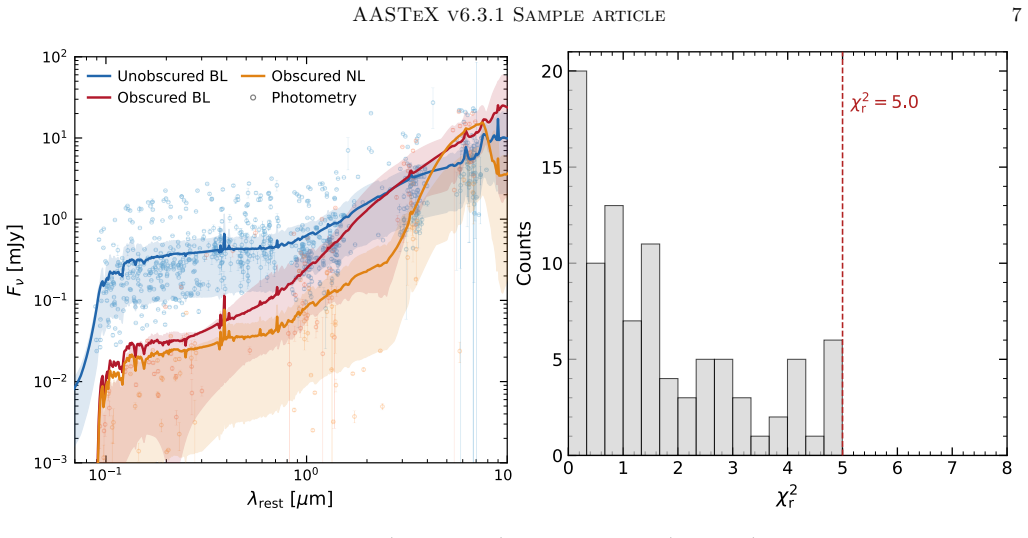
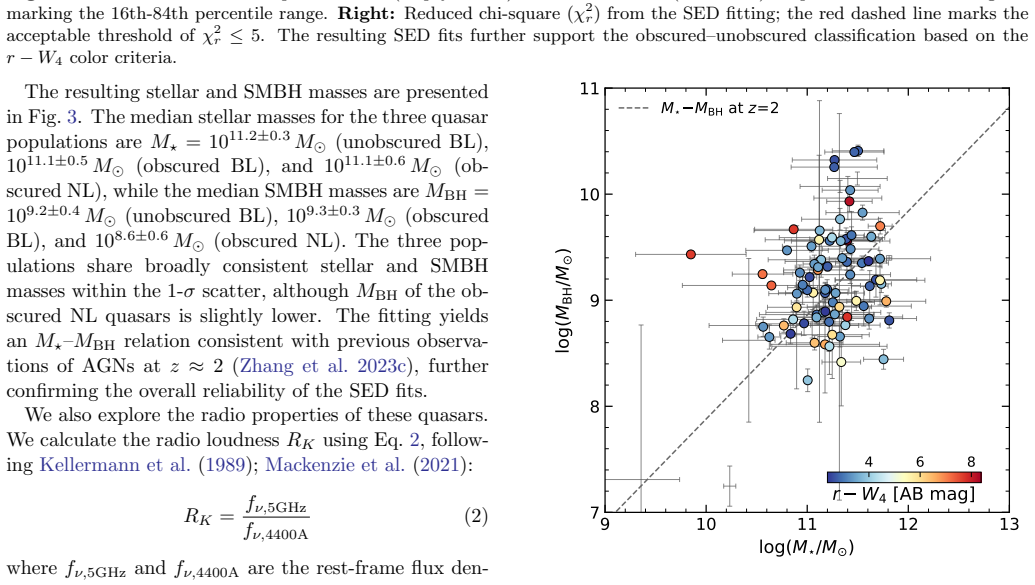
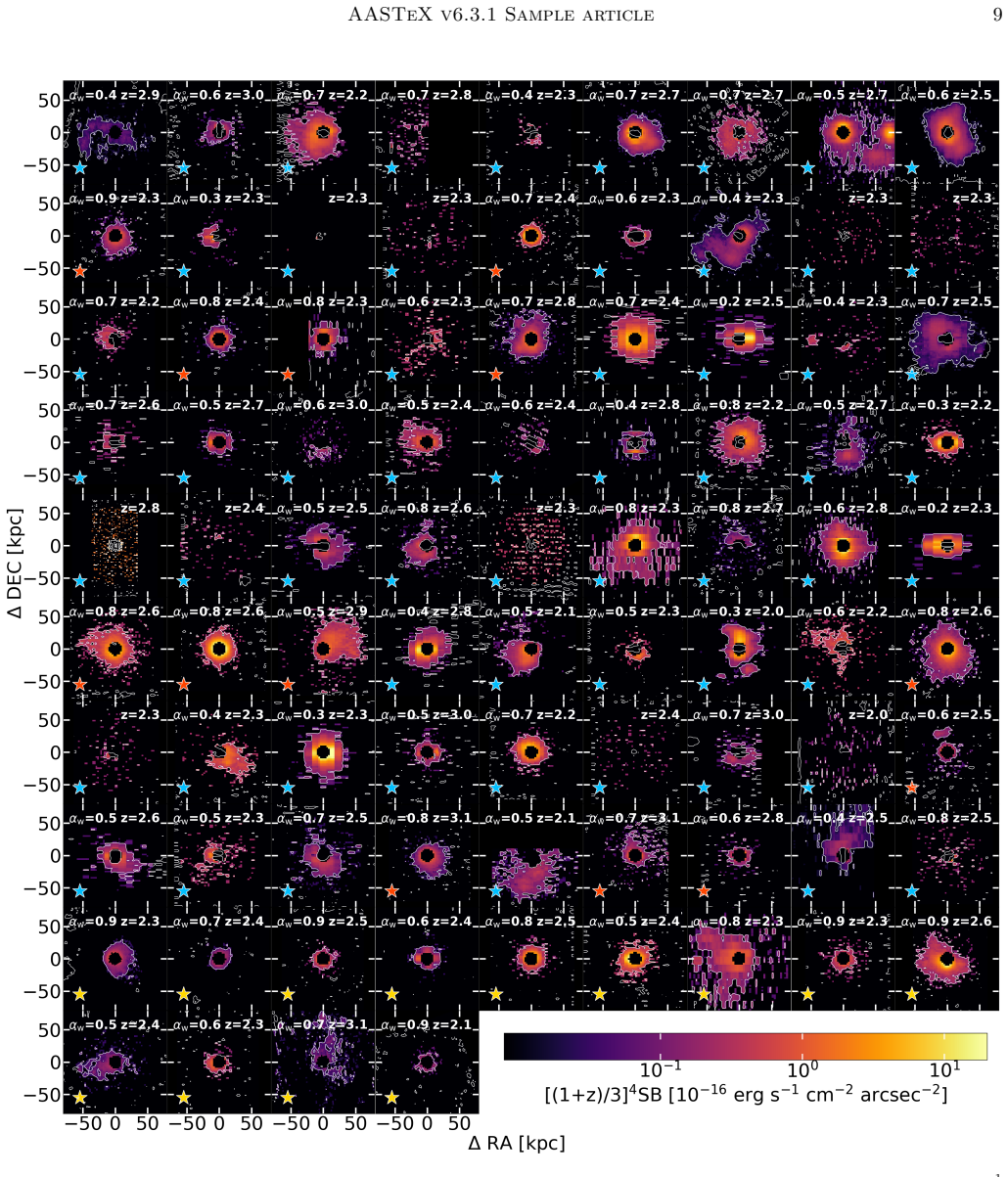


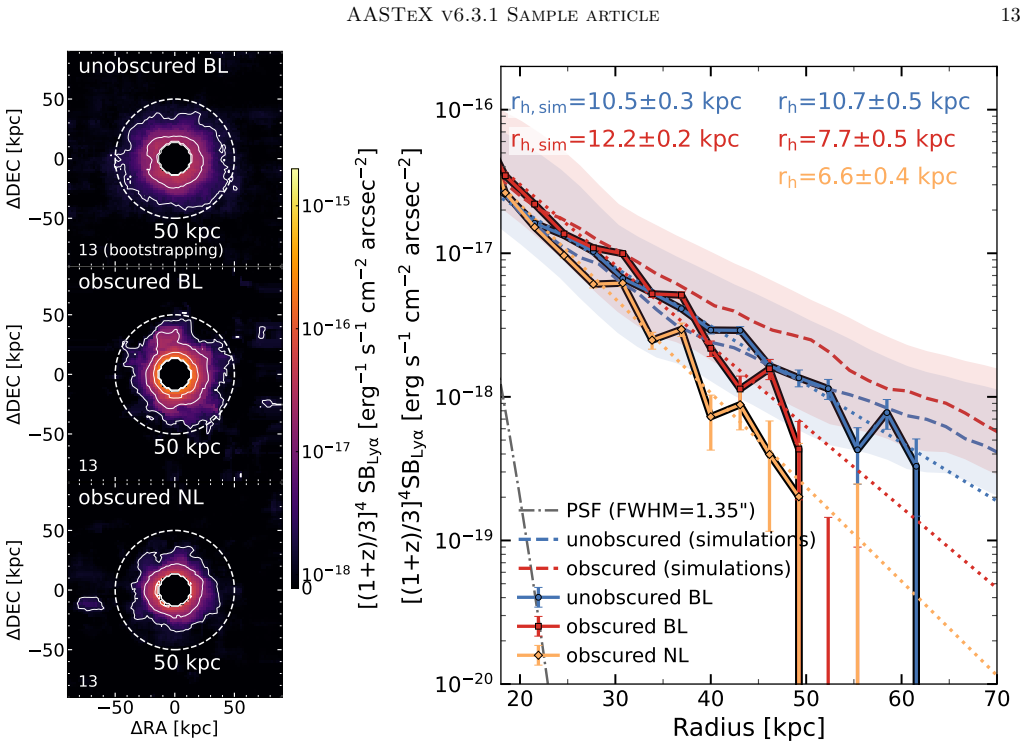


read the original abstract
We present a comprehensive analysis of circumgalactic Lya nebulae around 59 unobscured and 26 obscured quasars at z=2-3, observed with the Keck Cosmic Web Imager (KCWI), to constrain the nature of active galactic nuclei (AGN) at cosmic noon. We find that Lya nebulae around unobscured quasars are significantly less symmetric having a symmetry parameter of a_w=0.2-0.6 and more spatially extended having a scale length of r_h=10.7+/-0.5 kpc than those around obscured quasars (a_w=0.6-0.8; r_h=6.6-7.7 kpc).Unobscured quasars also exhibit steeply declining velocity dispersion profiles with the slope of -4.3+/-0.4 km s^-1 kpc^-1, indicative of large-scale outflows, whereas obscured quasars display flat profiles (-0.2+/-0.7 and -0.6+/-0.4 km s^-1 kpc^-1). The degree of quasar obscuration appears to be intrinsically linked to nebular asymmetry and extent, a relationship that could be in tension with the standard orientation-based AGN unified model, as it expects unobscured-quasar nebulae to be more symmetric and compact. These results naturally fit the evolutionary scenario, where AGN feedback drives a transition from an obscured to an unobscured phase-progressively redistributing gas to larger radii, introducing anisotropy, and driving turbulence. Taken together, our findings favor the evolutionary scenario over the purely orientation-based unified model for quasars at cosmic noon.
Editorial analysis
A structured set of objections, weighed in public.
Referee Report
Summary. The paper reports KCWI observations of circumgalactic Lyα nebulae around 59 unobscured and 26 obscured quasars at z=2-3. It measures statistically distinct values of the symmetry parameter a_w (0.2-0.6 vs 0.6-0.8), scale length r_h (10.7 kpc vs 6.6-7.7 kpc), and velocity dispersion slopes (-4.3 km s^{-1} kpc^{-1} vs ~0 km s^{-1} kpc^{-1}), interpreting the less symmetric, more extended nebulae with outflow signatures around unobscured quasars as evidence favoring an evolutionary AGN feedback scenario over the orientation-based unified model.
Significance. If the differences are shown to be intrinsic after controlling for selection and projection effects, the work would provide a valuable empirical test of AGN evolutionary models at cosmic noon, with the large sample size and quantitative metrics offering falsifiable predictions for simulations of feedback-driven gas redistribution.
major comments (3)
- [§2] §2 (Sample Selection): The central claim that nebular differences favor the evolutionary over orientation model assumes the unobscured and obscured samples are comparable in quasar luminosity, redshift, and host properties. The manuscript provides no explicit matching or Kolmogorov-Smirnov tests on these quantities, leaving open the possibility that the reported differences in a_w, r_h, and velocity slopes arise from unmatched populations rather than evolutionary stage.
- [§4] §4 (Interpretation): The assertion that the orientation model 'expects unobscured-quasar nebulae to be more symmetric and compact' is stated without quantitative support such as mock KCWI observations or radiative-transfer predictions under different viewing angles. Without this, the tension with the unified model remains qualitative and the mapping from observed parameters to intrinsic gas redistribution is under-constrained.
- [§3.3] §3.3 (Velocity Dispersion Profiles): The steeply negative slope of -4.3 km s^{-1} kpc^{-1} is interpreted as large-scale outflows, yet the paper does not test whether line-of-sight projection effects (face-on vs edge-on) could produce similar gradients when the same intrinsic velocity field is viewed at different angles, which is required to rule out the orientation scenario.
minor comments (3)
- [Abstract] Abstract: The sentence structure is awkward ('having a symmetry parameter of a_w=0.2-0.6 and more spatially extended having a scale length') and a space is missing after the period before 'Unobscured quasars also exhibit'.
- [Methods] Methods: Expand the definitions and extraction procedures for the symmetry parameter a_w and scale length r_h, including any assumptions in the KCWI data reduction and fitting that might correlate with obscuration classification.
- [Tables/Figures] Tables/Figures: Report the exact statistical significance (p-values) for all claimed differences in a_w, r_h, and slopes, and clarify the origin of the two values quoted for obscured r_h (6.6-7.7 kpc).
Simulated Author's Rebuttal
We thank the referee for their thoughtful and constructive report. The comments highlight important areas for strengthening the robustness of our conclusions regarding sample comparability and the distinction between evolutionary and orientation-based AGN models. We address each major comment in detail below and indicate the revisions we will make.
read point-by-point responses
-
Referee: §2 (Sample Selection): The central claim that nebular differences favor the evolutionary over orientation model assumes the unobscured and obscured samples are comparable in quasar luminosity, redshift, and host properties. The manuscript provides no explicit matching or Kolmogorov-Smirnov tests on these quantities, leaving open the possibility that the reported differences in a_w, r_h, and velocity slopes arise from unmatched populations rather than evolutionary stage.
Authors: We agree that explicit demonstration of sample comparability is essential to support our interpretation. Although the unobscured and obscured quasars were selected from parent catalogs with overlapping redshift and luminosity ranges, we did not include formal statistical comparisons in the submitted manuscript. In the revised version, we will add a dedicated paragraph and accompanying table (or figure) showing the distributions of quasar bolometric luminosity, redshift, and available host properties (e.g., stellar mass where measured). We will report the results of two-sample Kolmogorov-Smirnov tests for each quantity, including p-values, to quantify the degree of similarity. This addition will directly address the referee's concern and confirm that the observed differences in nebular properties are unlikely to arise from unmatched populations. revision: yes
-
Referee: §4 (Interpretation): The assertion that the orientation model 'expects unobscured-quasar nebulae to be more symmetric and compact' is stated without quantitative support such as mock KCWI observations or radiative-transfer predictions under different viewing angles. Without this, the tension with the unified model remains qualitative and the mapping from observed parameters to intrinsic gas redistribution is under-constrained.
Authors: We acknowledge that our discussion of expectations from the orientation-based unified model is qualitative. The standard unified model posits that obscuration is due to viewing angle through a toroidal structure, which would not inherently predict large differences in the extended circumgalactic Lyα emission; if anything, face-on (unobscured) views might appear more symmetric if the CGM is isotropic. To strengthen this section, we will expand the interpretation to reference existing literature on simulations of Lyα emission and AGN feedback that explore orientation effects. We will also explicitly state that a full quantitative test via new mock KCWI observations and radiative-transfer modeling lies beyond the scope of the current observational study. The revised text will frame our results as providing observational tension with simple orientation expectations while noting the value of future simulation comparisons for a more definitive mapping. revision: partial
-
Referee: §3.3 (Velocity Dispersion Profiles): The steeply negative slope of -4.3 km s^{-1} kpc^{-1} is interpreted as large-scale outflows, yet the paper does not test whether line-of-sight projection effects (face-on vs edge-on) could produce similar gradients when the same intrinsic velocity field is viewed at different angles, which is required to rule out the orientation scenario.
Authors: This is a valid point that must be considered when distinguishing evolutionary from purely geometric effects. The negative velocity dispersion gradient is seen exclusively in the unobscured sample and is accompanied by the differences in symmetry parameter and scale length. In the revision, we will add a paragraph discussing possible projection effects, noting that an orientation-only scenario would require the two samples to share the same intrinsic velocity field but appear different solely due to inclination. However, a rigorous quantitative test would necessitate assuming a specific 3D kinematic model and generating projected profiles for different viewing angles, which cannot be performed with the existing data alone. We will therefore include this as an explicit caveat, while arguing that the joint behavior across multiple independent observables (asymmetry, spatial extent, and kinematics) makes a pure projection explanation less parsimonious. Future work combining these observations with tailored simulations could provide a more complete test. revision: partial
- Performing new radiative-transfer simulations and mock KCWI observations to quantitatively predict nebular properties under different viewing angles for the orientation model, as this requires substantial additional modeling resources beyond the scope of the current analysis.
Circularity Check
No significant circularity; central claim rests on direct observational sample comparison.
full rationale
The paper reports empirical measurements of Lyα nebula properties (symmetry parameter a_w, scale length r_h, velocity dispersion slopes) from KCWI observations of two distinct quasar samples (59 unobscured, 26 obscured). These differences are presented as direct data products, and the inference favoring an evolutionary scenario is a qualitative interpretation of the observed distinctions rather than any mathematical derivation, fitted parameter, or self-referential definition. No equations, ansatzes, or load-bearing self-citations appear in the derivation chain; the analysis is self-contained against external benchmarks as it relies on independent observational inputs without reducing to its own outputs by construction.
Axiom & Free-Parameter Ledger
free parameters (3)
- symmetry parameter a_w
- scale length r_h
- velocity dispersion slope
axioms (2)
- domain assumption Lya emission traces circumgalactic gas kinematics and morphology in a manner that distinguishes evolutionary state from orientation effects.
- standard math Standard flat Lambda-CDM cosmology for converting angular sizes and velocities to physical units at z=2-3.
Reference graph
Works this paper leans on
-
[1]
Akins, H. B., Casey, C. M., Lambrides, E., et al. 2025, ApJ, 991, 37, doi: 10.3847/1538-4357/ade984
-
[2]
Alexander, D. M., & Hickox, R. C. 2012, NewAR, 56, 93, doi: 10.1016/j.newar.2011.11.003
-
[3]
Alexandroff, R., Strauss, M. A., Greene, J. E., et al. 2013, MNRAS, 435, 3306, doi: 10.1093/mnras/stt1500
-
[4]
Andonie, C., Alexander, D. M., Greenwell, C., et al. 2024, MNRAS, 527, L144, doi: 10.1093/mnrasl/slad144 Angl´ es-Alc´ azar, D., Faucher-Gigu` ere, C.-A., Kereˇ s, D., et al. 2017, MNRAS, 470, 4698, doi: 10.1093/mnras/stx1517
-
[5]
Antonucci, R. 1993, ARA&A, 31, 473, doi: 10.1146/annurev.aa.31.090193.002353 Arrigoni Battaia, F., Hennawi, J. F., Prochaska, J. X., et al. 2019, MNRAS, 482, 3162, doi: 10.1093/mnras/sty2827
-
[6]
Assef, R. J., Stern, D., Kochanek, C. S., et al. 2013, ApJ, 772, 26, doi: 10.1088/0004-637X/772/1/26
-
[7]
J., Kannan, R., Vogelsberger, M., & Marinacci, F
Barnes, D. J., Kannan, R., Vogelsberger, M., & Marinacci, F. 2020, MNRAS, 494, 1143, doi: 10.1093/mnras/staa591
-
[8]
2019, A&A, 622, A103, doi: 10.1051/0004-6361/201834156
Boquien, M., Burgarella, D., Roehlly, Y., et al. 2019, A&A, 622, A103, doi: 10.1051/0004-6361/201834156
-
[9]
The demographics, physics, and ecology of growing supermassive black holes
Brandt, W. N., & Alexander, D. M. 2015, A&A Rv, 23, 1, doi: 10.1007/s00159-014-0081-z
-
[10]
2021, MNRAS, 506, 5129, doi: 10.1093/mnras/stab1958
Byrohl, C., Nelson, D., Behrens, C., et al. 2021, MNRAS, 506, 5129, doi: 10.1093/mnras/stab1958
-
[11]
Cai, Z., Fan, X., Yang, Y., et al. 2017, ApJ, 837, 71, doi: 10.3847/1538-4357/aa5d14
-
[12]
Cai, Z., Cantalupo, S., Prochaska, J. X., et al. 2019, ApJS, 245, 23, doi: 10.3847/1538-4365/ab4796
-
[13]
doi:10.1038/nature12898 , number =
Hennawi, J. F., & Madau, P. 2014, Nature, 506, 63, doi: 10.1038/nature12898
-
[14]
Cantalupo, S., Pezzulli, G., Lilly, S. J., et al. 2019, MNRAS, 483, 5188, doi: 10.1093/mnras/sty3481
-
[15]
Carilli, C. L., Perley, R. A., Dhawan, V., & Perley, D. A. 2019, ApJL, 874, L32, doi: 10.3847/2041-8213/ab1019
-
[16]
Cielo, S., Bieri, R., Volonteri, M., Wagner, A. Y., & Dubois, Y. 2018, MNRAS, 477, 1336, doi: 10.1093/mnras/sty708
-
[17]
2019, A&A, 623, A172, doi: 10.1051/0004-6361/201834426
Circosta, C., Vignali, C., Gilli, R., et al. 2019, A&A, 623, A172, doi: 10.1051/0004-6361/201834426
-
[18]
Costa, T., Arrigoni Battaia, F., Farina, E. P., et al. 2022, MNRAS, 517, 1767, doi: 10.1093/mnras/stac2432
-
[19]
Costa, T., Rosdahl, J., Sijacki, D., & Haehnelt, M. G. 2018, MNRAS, 473, 4197, doi: 10.1093/mnras/stx2598
-
[20]
Cresci, G., Tozzi, G., Perna, M., et al. 2023, A&A, 672, A128, doi: 10.1051/0004-6361/202346001
-
[21]
Daddi, E., Valentino, F., Rich, R. M., et al. 2021, A&A, 649, A78, doi: 10.1051/0004-6361/202038700
-
[22]
2024, A&A, 685, A8, doi: 10.1051/0004-6361/202346972 den Brok, J
Madau, P. 2024, A&A, 685, A8, doi: 10.1051/0004-6361/202346972 den Brok, J. S., Cantalupo, S., Mackenzie, R., et al. 2020, MNRAS, 495, 1874, doi: 10.1093/mnras/staa1269
-
[23]
2012, A&A, 548, A45, doi: 10.1051/0004-6361/201220059
Drouart, G., De Breuck, C., Vernet, J., et al. 2012, A&A, 548, A45, doi: 10.1051/0004-6361/201220059
-
[24]
Fabian, A. C. 2012, ARA&A, 50, 455, doi: 10.1146/annurev-astro-081811-125521
work page Pith review doi:10.1146/annurev-astro-081811-125521 2012
-
[25]
P., Arrigoni-Battaia, F., Costa, T., et al
Farina, E. P., Arrigoni-Battaia, F., Costa, T., et al. 2019, ApJ, 887, 196, doi: 10.3847/1538-4357/ab5847
-
[26]
F., Quataert, E., Faucher-Gigu` ere, C.-A., & Kereˇ s, D
Feldmann, R., Hopkins, P. F., Quataert, E., Faucher-Gigu` ere, C.-A., & Kereˇ s, D. 2016, MNRAS, 458, L14, doi: 10.1093/mnrasl/slw014
-
[27]
F., Faucher-Gigu` ere, C.-A., & Kereˇ s, D
Feldmann, R., Quataert, E., Hopkins, P. F., Faucher-Gigu` ere, C.-A., & Kereˇ s, D. 2017, MNRAS, 470, 1050, doi: 10.1093/mnras/stx1120 22 Zhang et al
-
[28]
Ferland, G. J., Chatzikos, M., Guzm´ an, F., et al. 2017, RMXAA, 53, 385, doi: 10.48550/arXiv.1705.10877
-
[29]
and Tonnesen, Stephanie and DeFelippis, Daniel and Li, Miao and Su, Kung-Yi and Bryan, Greg L
Fielding, D. B., Tonnesen, S., DeFelippis, D., et al. 2020, ApJ, 903, 32, doi: 10.3847/1538-4357/abbc6d
-
[30]
Fritz, J., Franceschini, A., & Hatziminaoglou, E. 2006, MNRAS, 366, 767, doi: 10.1111/j.1365-2966.2006.09866.x Garc´ ıa-Burillo, S., Alonso-Herrero, A., Ramos Almeida, C., et al. 2021, A&A, 652, A98, doi: 10.1051/0004-6361/202141075
-
[31]
Geach, J. E., Alexander, D. M., Lehmer, B. D., et al. 2009, ApJ, 700, 1, doi: 10.1088/0004-637X/700/1/1
-
[32]
Gillette, J., Lau, M. W., Hamann, F., et al. 2023, MNRAS, 526, 2578, doi: 10.1093/mnras/stad2923
-
[33]
2022, A&A, 666, A17, doi: 10.1051/0004-6361/202243708
Gilli, R., Norman, C., Calura, F., et al. 2022, A&A, 666, A17, doi: 10.1051/0004-6361/202243708 Gonz´ alez Lobos, J., Arrigoni Battaia, F., Obreja, A., et al. 2026, A&A, 707, A380, doi: 10.1051/0004-6361/202554054 GRAVITY+ Collaboration, Abd El Dayem, K., Aimar, N., et al. 2026, A&A, 706, A99, doi: 10.1051/0004-6361/202557285
-
[34]
2020, ApJ, 898, 26, doi: 10.3847/1538-4357/ab9b7f
Guo, Y., Maiolino, R., Jiang, L., et al. 2020, ApJ, 898, 26, doi: 10.3847/1538-4357/ab9b7f
-
[35]
Hamann, F., Zakamska, N. L., Ross, N., et al. 2017, MNRAS, 464, 3431, doi: 10.1093/mnras/stw2387
-
[36]
2023, ApJ, 959, 39, doi:10.3847/1538-4357/ad029e
Harikane, Y., Zhang, Y., Nakajima, K., et al. 2023, ApJ, 959, 39, doi: 10.3847/1538-4357/ad029e
-
[37]
Harrison, C. M., & Ramos Almeida, C. 2024, Galaxies, 12, 17, doi: 10.3390/galaxies12020017
-
[38]
Herwig, E., Arrigoni Battaia, F., Gonz´ alez Lobos, J., et al. 2024, A&A, 691, A210, doi: 10.1051/0004-6361/202450959
-
[39]
Hopkins, P. F., Hernquist, L., Cox, T. J., & Kereˇ s, D. 2008, ApJS, 175, 356, doi: 10.1086/524362
work page internal anchor Pith review doi:10.1086/524362 2008
-
[40]
Hopkins, P. F., Kereˇ s, D., O˜ norbe, J., et al. 2014, MNRAS, 445, 581, doi: 10.1093/mnras/stu1738
-
[41]
Hviding, R. E., de Graaff, A., Miller, T. B., et al. 2025, A&A, 702, A57, doi: 10.1051/0004-6361/202555816
-
[42]
2025, ApJL, 988, L22, doi: 10.3847/2041-8213/adea66
Inayoshi, K. 2025, ApJL, 988, L22, doi: 10.3847/2041-8213/adea66
-
[43]
Kellermann, K. I., Sramek, R., Schmidt, M., Shaffer, D. B., & Green, R. 1989, AJ, 98, 1195, doi: 10.1086/115207 Kereˇ s, D., Katz, N., Weinberg, D. H., & Dav´ e, R. 2005, MNRAS, 363, 2, doi: 10.1111/j.1365-2966.2005.09451.x
-
[44]
D., Onoue, M., Inayoshi, K., et al
Kocevski, D. D., Onoue, M., Inayoshi, K., et al. 2023, ApJL, 954, L4, doi: 10.3847/2041-8213/ace5a0
-
[45]
Kocevski, D. D., Finkelstein, S. L., Barro, G., et al. 2025, ApJ, 986, 126, doi: 10.3847/1538-4357/adbc7d
-
[46]
Langen, V., Cantalupo, S., Steidel, C. C., et al. 2023, MNRAS, 519, 5099, doi: 10.1093/mnras/stac3205
-
[47]
W., Perrotta, S., Hamann, F., et al
Lau, M. W., Perrotta, S., Hamann, F., et al. 2024, MNRAS, 532, 2044, doi: 10.1093/mnras/stae1621
-
[48]
Law, D. R., Steidel, C. C., Chen, Y., et al. 2018, ApJ, 866, 119, doi: 10.3847/1538-4357/aae156
-
[49]
Li, J., Emonts, B. H. C., Cai, Z., et al. 2021, ApJL, 922, L29, doi: 10.3847/2041-8213/ac390d
-
[50]
2024, ApJS, 275, 27, doi: 10.3847/1538-4365/ad812c
Li, M., Zhang, H., Cai, Z., et al. 2024, ApJS, 275, 27, doi: 10.3847/1538-4365/ad812c
-
[51]
2026, ApJ, 997, 364, doi: 10.3847/1538-4357/ae2bdf
Lin, X., Fan, X., Cai, Z., et al. 2026, ApJ, 997, 364, doi: 10.3847/1538-4357/ae2bdf
-
[52]
Ma, Y., Greene, J. E., Setton, D. J., et al. 2026, ApJ, 1000, 59, doi: 10.3847/1538-4357/ae4596
-
[53]
2021, MNRAS, 502, 494, doi: 10.1093/mnras/staa3277
Mackenzie, R., Pezzulli, G., Cantalupo, S., et al. 2021, MNRAS, 502, 494, doi: 10.1093/mnras/staa3277
-
[54]
Madau, P., & Dickinson, M. 2014, ARAA, 52, 415, doi: 10.1146/annurev-astro-081811-125615
work page Pith review doi:10.1146/annurev-astro-081811-125615 2014
-
[55]
Maiolino, R., Scholtz, J., Curtis-Lake, E., et al. 2024, A&A, 691, A145, doi: 10.1051/0004-6361/202347640
-
[56]
C., Matuszewski, M., Morrissey, P., et al
Martin, D. C., Matuszewski, M., Morrissey, P., et al. 2015, Nature, 524, 192, doi: 10.1038/nature14616
-
[57]
Matthee, J., Naidu, R. P., Brammer, G., et al. 2024, ApJ, 963, 129, doi: 10.3847/1538-4357/ad2345
-
[58]
Meenakshi, M., Mukherjee, D., Wagner, A. Y., et al. 2022, MNRAS, 511, 1622, doi: 10.1093/mnras/stac167
-
[59]
2020, Astronomy and Astrophysics, 635, A154, doi: 10.1051/0004-6361/201834961
Michel-Dansac, L., Blaizot, J., Garel, T., et al. 2020, A&A, 635, A154, doi: 10.1051/0004-6361/201834961
-
[60]
Morrissey, P., Matuszewski, M., Martin, D. C., et al. 2018, ApJ, 864, 93, doi: 10.3847/1538-4357/aad597
-
[61]
Nesvadba, N. P. H., De Breuck, C., Lehnert, M. D., Best, P. N., & Collet, C. 2017, A&A, 599, A123, doi: 10.1051/0004-6361/201528040
-
[62]
Netzer, H. 2015, ARAA, 53, 365, doi: 10.1146/annurev-astro-082214-122302
-
[63]
Nielsen, N. M., Kacprzak, G. G., Pointon, S. K., et al. 2020, ApJ, 904, 164, doi: 10.3847/1538-4357/abc561
-
[64]
2022, MNRAS, 515, 4838, doi: 10.1093/mnras/stac2061
Chaikin, E. 2022, MNRAS, 515, 4838, doi: 10.1093/mnras/stac2061
-
[65]
Obreja, A., Arrigoni Battaia, F., Macci` o, A. V., & Buck, T. 2024, MNRAS, 527, 8078, doi: 10.1093/mnras/stad3410 O’Meara, J. M., Prochaska, J. X., Worseck, G., Chen, H.-W., & Madau, P. 2013, ApJ, 765, 137, doi: 10.1088/0004-637X/765/2/137 O’Sullivan, D., & Chen, Y. 2020, arXiv e-prints, arXiv:2011.05444, doi: 10.48550/arXiv.2011.05444 O’Sullivan, D. B., ...
-
[66]
Perrotta, S., Hamann, F., Zakamska, N. L., et al. 2019, MNRAS, 488, 4126, doi: 10.1093/mnras/stz1993 AASTeX v6.3.1 Sample article 23
-
[67]
Prasad, D., Voit, G. M., & O’Shea, B. W. 2022, APJ, 932, 18, doi: 10.3847/1538-4357/ac69ee
-
[68]
Richards, G. T., Strauss, M. A., Fan, X., et al. 2006, AJ, 131, 2766, doi: 10.1086/503559
-
[69]
Ross, N. P., McGreer, I. D., White, M., et al. 2013, ApJ, 773, 14, doi: 10.1088/0004-637X/773/1/14
-
[70]
Ruffa, I., Laing, R. A., Prandoni, I., et al. 2020, MNRAS, 499, 5719, doi: 10.1093/mnras/staa3166
-
[71]
Chandra Rules Out Super-Eddington Accretion Models for Little Red Dots
Sacchi, A., & Bogd´ an,´A. 2025, ApJL, 989, L30, doi: 10.3847/2041-8213/adf5c8
-
[72]
Sanders, D. B., Soifer, B. T., Elias, J. H., et al. 1988, ApJ, 325, 74, doi: 10.1086/165983
-
[73]
2021, ApJ, 923, 252, doi: 10.3847/1538-4357/ac3077
Fynbo, J., & Møller, P. 2021, ApJ, 923, 252, doi: 10.3847/1538-4357/ac3077
-
[74]
Schmitt, H. R., Pringle, J. E., Clarke, C. J., & Kinney, A. L. 2002, ApJ, 575, 150, doi: 10.1086/341211
-
[75]
Setton, D. J., Greene, J. E., de Graaff, A., et al. 2025, ApJ, 995, 118, doi: 10.3847/1538-4357/ae1500
-
[76]
Steidel, C. C., Rudie, G. C., Strom, A. L., et al. 2014, ApJ, 795, 165, doi: 10.1088/0004-637X/795/2/165
-
[77]
2015, MNRAS, 448, 895, doi: 10.1093/mnras/stu2762
Suresh, J., Bird, S., Vogelsberger, M., et al. 2015, MNRAS, 448, 895, doi: 10.1093/mnras/stu2762
-
[78]
Terrazas, B. A., Bell, E. F., Pillepich, A., et al. 2020, MNRAS, 493, 1888, doi: 10.1093/mnras/staa374
-
[79]
2025, ApJL, 980, L43, doi: 10.3847/2041-8213/adb0ba
Tornotti, D., Fumagalli, M., Fossati, M., et al. 2025, ApJL, 980, L43, doi: 10.3847/2041-8213/adb0ba
-
[80]
2024, A&A, 690, A141, doi: 10.1051/0004-6361/202450162
Tozzi, G., Cresci, G., Perna, M., et al. 2024, A&A, 690, A141, doi: 10.1051/0004-6361/202450162
discussion (0)
Sign in with ORCID, Apple, or X to comment. Anyone can read and Pith papers without signing in.