Recognition: unknown
Prior-Aligned Data Cleaning for Tabular Foundation Models
Pith reviewed 2026-05-07 16:42 UTC · model grok-4.3
The pith
Reinforcement learning sequences cleaning operators on tabular data to align it with the synthetic priors of foundation models, improving accuracy and enabling cross-dataset policy transfer.
A machine-rendered reading of the paper's core claim, the machinery that carries it, and where it could break.
Core claim
L2C2 is a deep RL framework that trains a policy to sequence tabular cleaning operators so as to minimize the distributional gap between a dirty real-world input and the synthetic prior of a Tabular Foundation Model such as TabPFN. On ten OpenML datasets the framework identifies that certain reward designs collapse to degenerate behavior while a novel TFMAwareReward selects distinct pipelines and raises accuracy on those cases; parameterized actions improve reward on nine of ten datasets; and a policy pre-trained on one source dataset exceeds scratch training at the 2,000-step checkpoint on three held-out datasets, with gains up to 28.8 percent after full fine-tuning.
What carries the argument
L2C2, the deep reinforcement learning agent whose policy learns to sequence and parameterize cleaning operators in order to minimize the distributional gap between observed tabular data and the TFM synthetic prior.
If this is right
- Careful reward engineering is required because three of seven tested rewards collapse to trivial cleaning strategies.
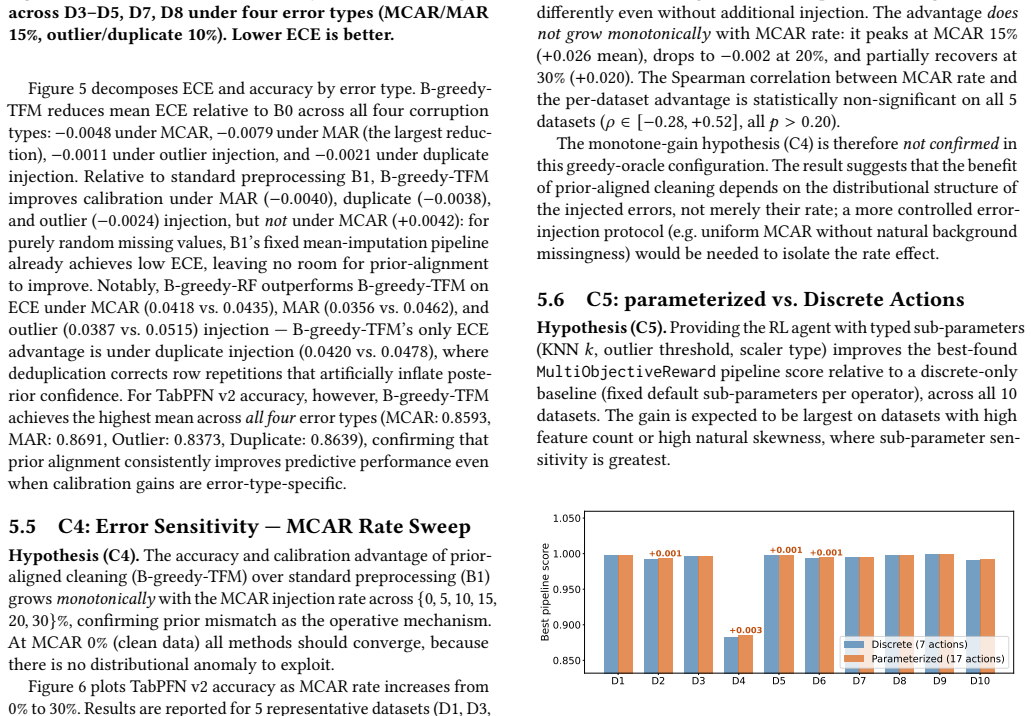
- Parameterized cleaning actions raise best-found pipeline reward on nine of ten datasets compared with discrete actions.
- A single pre-trained policy transfers prior-alignment knowledge and improves fine-tuning speed and final accuracy on new datasets.
- Model-aware rewards can select structurally different cleaning pipelines that deliver higher downstream accuracy than generic rewards.
Where Pith is reading between the lines
- The same prior-alignment idea could be tested on other foundation models that rely on synthetic pre-training, such as those for time series or graph data.
- If transfer holds across more domains, organizations might maintain a small library of reusable cleaning policies rather than retraining for every new tabular task.
- The framework implicitly suggests that data preparation for foundation models is itself a meta-learning problem that can be solved with the same RL machinery used for the model itself.
Load-bearing premise
That reinforcement learning can discover sequences of cleaning operators that reliably shrink the gap to the TFM prior without creating new biases or overfitting to the reward signal.
What would settle it
A controlled experiment in which a policy pre-trained on one dataset fails to exceed scratch-trained performance on held-out datasets at the 2,000-step fine-tuning checkpoint, or in which any cleaning pipeline produced by the RL agent lowers TabPFN accuracy relative to the raw dirty input.
Figures



read the original abstract
Tabular Foundation Models (TFMs) achieve state-of-the-art zero-shot accuracy on small tabular datasets by meta-learning over synthetic data-generating processes -- making them highly attractive for practitioners who cannot afford large annotated corpora. However, their in-context learning mechanism assumes approximately clean inputs: missing values, outliers, and duplicates in the real-world data create a prior mismatch that degrades both accuracy and confidence calibration simultaneously. Correcting this mismatch requires sequential decisions over cleaning operators whose interactions no static preprocessing rule can anticipate -a natural fit for reinforcement learning~(RL). We introduce L2C2, the first deep RL framework framing tabular data cleaning as prior alignment: a learned policy sequences operators to minimize the distributional gap between dirty input and the TFM's synthetic prior. Six experiments on ten OpenML benchmark datasets establish: 1) three of seven reward designs collapse to degenerate trivial cleaning strategies -- principled reward engineering is scientifically non-trivial; 2) the novel TFMAwareReward reward we propose selects structurally distinct pipelines on 4/10 datasets and achieves higher TabPFN accuracy on those diverging cases (mean 0.851 vs. 0.843; Wilcoxon p=0.063, n=4) while never underperforming; 3) parameterized cleaning actions improve best-found pipeline reward on 9/10 datasets (Wilcoxon p=0.004); and 4) a policy pre-trained on one single source dataset exceeds scratch training at the 2,000-step fine-tuning checkpoint on all three held-out datasets (up to +28.8% after full fine-tuning) demonstrating cross-dataset transfer of prior-alignment knowledge. These findings establish that prior alignment is a principled data preparation strategy for TFM deployment on real-world tabular data.
Editorial analysis
A structured set of objections, weighed in public.
Referee Report
Summary. The manuscript introduces L2C2, a deep RL framework that frames tabular data cleaning as sequential prior alignment to the synthetic data-generating process of Tabular Foundation Models (e.g., TabPFN). Experiments on ten OpenML datasets show that three of seven reward formulations collapse to degenerate policies, that the proposed TFMAwareReward yields higher accuracy on structurally distinct pipelines (mean 0.851 vs. 0.843), that parameterized actions improve rewards on 9/10 datasets, and that a policy pre-trained on one source dataset outperforms scratch training at the 2,000-step fine-tuning checkpoint on three held-out datasets (gains up to +28.8% after full fine-tuning), which the authors interpret as cross-dataset transfer of prior-alignment knowledge.
Significance. If the transfer and alignment results hold under more direct distributional metrics, the work would offer a principled, learned alternative to static preprocessing for TFMs on real-world dirty data, potentially improving both accuracy and calibration in low-data regimes. The explicit demonstration that reward design is non-trivial and the cross-dataset transfer finding would be valuable contributions to RL-for-data-preparation literature.
major comments (4)
- Abstract: the central transfer claim (pre-trained policy exceeds scratch training at the 2,000-step checkpoint on all three held-out datasets) rests on the assumption that the policy learns to reduce distributional mismatch to the TFM synthetic prior; however, TFMAwareReward is defined as a downstream accuracy proxy rather than a direct distributional divergence metric, and the experiments do not report any held-out gap measurements, leaving open the possibility that gains arise from source-specific heuristics or initialization rather than transferable alignment knowledge.
- Abstract: the accuracy comparison for TFMAwareReward on the 4/10 diverging datasets reports mean 0.851 vs. 0.843 with Wilcoxon p=0.063 (n=4); this marginal p-value and small sample size do not support the unqualified statement that the reward 'achieves higher TabPFN accuracy' and weakens the load-bearing claim that the novel reward is superior.
- Abstract: three of seven reward designs are reported to collapse to degenerate trivial cleaning strategies, yet the manuscript provides no derivation, state-action specification, or ablation isolating why these failures occur or how TFMAwareReward avoids them; this sensitivity is load-bearing for the claim that 'prior alignment is a principled data preparation strategy' because it shows the framework is not robust without careful (and apparently non-obvious) reward engineering.
- Abstract: the benchmark experiments cite Wilcoxon tests and note degenerate rewards but supply no error-bar analysis, full policy architecture, or reproducibility details for the RL training; without these, the reported improvements (including the +28.8% fine-tuning gain) cannot be assessed for statistical reliability or sensitivity to random seeds.
minor comments (2)
- Abstract contains minor LaTeX artifacts (e.g., 'learning~(RL)') and awkward phrasing that should be cleaned for readability.
- The abstract does not mention confidence intervals or variance estimates alongside the reported means, which would aid interpretation of the small accuracy differences.
Simulated Author's Rebuttal
We thank the referee for their detailed and constructive feedback on our manuscript. We address each of the major comments point by point below, providing clarifications and proposing revisions to strengthen the paper where needed.
read point-by-point responses
-
Referee: Abstract: the central transfer claim (pre-trained policy exceeds scratch training at the 2,000-step checkpoint on all three held-out datasets) rests on the assumption that the policy learns to reduce distributional mismatch to the TFM synthetic prior; however, TFMAwareReward is defined as a downstream accuracy proxy rather than a direct distributional divergence metric, and the experiments do not report any held-out gap measurements, leaving open the possibility that gains arise from source-specific heuristics or initialization rather than transferable alignment knowledge.
Authors: While we agree that TFMAwareReward uses downstream accuracy as a proxy, this is intentional because TabPFN accuracy is highly sensitive to deviations from its synthetic prior, making it a valid surrogate for alignment quality. Nevertheless, to directly address the concern and bolster the transfer claim, we will revise the manuscript to include direct distributional metrics (e.g., maximum mean discrepancy or Wasserstein distance) between the cleaned data and samples from the TFM's prior on held-out datasets. This will provide evidence that the policy learns transferable alignment rather than dataset-specific heuristics. revision: yes
-
Referee: Abstract: the accuracy comparison for TFMAwareReward on the 4/10 diverging datasets reports mean 0.851 vs. 0.843 with Wilcoxon p=0.063 (n=4); this marginal p-value and small sample size do not support the unqualified statement that the reward 'achieves higher TabPFN accuracy' and weakens the load-bearing claim that the novel reward is superior.
Authors: We acknowledge that the p-value is marginal and the sample size limited. We will revise the abstract and main text to temper the language, for example stating that TFMAwareReward 'achieves higher or equal TabPFN accuracy' on the diverging datasets and 'never underperforms' the alternatives. We will also add more context on the statistical analysis and consider reporting additional metrics or expanding the experiment if possible in the revision. revision: yes
-
Referee: Abstract: three of seven reward designs are reported to collapse to degenerate trivial cleaning strategies, yet the manuscript provides no derivation, state-action specification, or ablation isolating why these failures occur or how TFMAwareReward avoids them; this sensitivity is load-bearing for the claim that 'prior alignment is a principled data preparation strategy' because it shows the framework is not robust without careful (and apparently non-obvious) reward engineering.
Authors: We agree that a deeper analysis of the reward failures would strengthen the paper. The current manuscript describes the seven reward formulations and observes the collapses in the results section, but we will expand this with explicit state-action specifications for the degenerate cases, a derivation of why they lead to trivial policies (e.g., due to reward sparsity or lack of alignment signal), and an ablation study showing how TFMAwareReward's design mitigates these issues. This will better illustrate the non-triviality of reward engineering for this task. revision: yes
-
Referee: Abstract: the benchmark experiments cite Wilcoxon tests and note degenerate rewards but supply no error-bar analysis, full policy architecture, or reproducibility details for the RL training; without these, the reported improvements (including the +28.8% fine-tuning gain) cannot be assessed for statistical reliability or sensitivity to random seeds.
Authors: We thank the referee for pointing this out. The full manuscript does include the policy architecture details (a deep Q-network with specific layer sizes and hyperparameters), but we will enhance the experimental section with error bars (mean and standard deviation over multiple random seeds, e.g., 5 runs), a full reproducibility checklist including all hyperparameters, training curves, and a link to the code repository. This will allow readers to better evaluate the reliability of the results, including the cross-dataset transfer gains. revision: yes
Circularity Check
No significant circularity; empirical results rest on external benchmarks
full rationale
The paper's central claims are empirical evaluations of an RL policy for tabular data cleaning on ten OpenML datasets, with pre-training on one source and fine-tuning on held-out targets. No equations, derivations, or first-principles results are presented that reduce to fitted inputs by construction. The TFMAwareReward and other formulations are tested for downstream accuracy and pipeline selection, but the transfer advantage at 2,000 steps is measured on separate held-out data rather than being forced by the reward definition itself. Self-citations, if present, are not load-bearing for the core transfer result, which relies on standard RL training and benchmark comparisons.
Axiom & Free-Parameter Ledger
Reference graph
Works this paper leans on
-
[1]
Abdelaal, A.B
M. Abdelaal, A.B. Yayak, K. Klede, and H. Schöning. 2024. ReClean: Reinforcement Learning for Automated Data Cleaning in ML Pipelines. InDBML Workshop at the IEEE 40th International Conference on Data Engineering (ICDE). IEEE. https: //www.wis.ewi.tudelft.nl/assets/files/dbml2024/DBML24_paper_11.pdf
2024
-
[2]
S. Alnegheimish, D. Liu, C. Sala, L. Berti-Équille, and K. Veeramachaneni. 2022. Sintel: An Overarching Ecosystem for End-to-End Time Series Anomaly De- tection. InProceedings of the 2022 ACM SIGMOD International Conference on Management of Data. ACM. doi:10.1145/3514221.3517910
-
[3]
L. Berti-Équille. 2007. Data Quality Awareness: A Case Study for Cost Optimal Association Rule Mining.Knowledge and Information Systems (KAIS)11 (2007), 191–215. doi:10.1007/s10115-006-0006-x
-
[4]
L. Berti-Équille. 2019. Learn2Clean: Optimizing the Sequence of Tasks for Web Data Preparation. InProceedings of The Web Conference (WWW). ACM, 2580–2586. doi:10.1145/3308558.3313602
-
[5]
L. Berti-Équille, A. Bonifati, and T. Milo. 2018. Machine Learning to Data Manage- ment: A Round Trip. InIEEE 34th International Conference on Data Engineering (ICDE). IEEE, 1735–1738. doi:10.1109/ICDE.2018.00226
-
[6]
arXiv preprint arXiv:1708.03731 , year=
B. Bischl, G. Casalicchio, M. Feurer, P. Gijsbers, F. Hutter, M. Lang, R.G. Manto- vani, J.N. van Rijn, and J. Vanschoren. 2021. OpenML Benchmarking Suites. In Thirty-Fifth Conference on Neural Information Processing Systems Datasets and Benchmarks Track (NeurIPS). https://arxiv.org/abs/1708.03731
- [7]
-
[8]
arXiv preprint arXiv:2003.06505 (2020)
N. Erickson, J. Mueller, A. Shirkov, H. Zhang, P. Larroy, M. Li, and A. Smola. 2020. AutoGluon-Tabular: Robust and Accurate AutoML for Structured Data.arXiv preprint arXiv:2003.06505(2020). https://arxiv.org/abs/2003.06505
-
[9]
Feurer, A
M. Feurer, A. Klein, K. Eggensperger, J.T. Springenberg, M. Blum, and F. Hutter
-
[10]
InAdvances in Neural Information Processing Systems (NeurIPS), Vol
Efficient and Robust Automated Machine Learning. InAdvances in Neural Information Processing Systems (NeurIPS), Vol. 28. 2962–2970. https://proceedings. neurips.cc/paper/2015/file/11d0e6287202fced83f79975ec59a3a6-Paper.pdf
2015
-
[11]
Datacomp: In search of the next generation of multimodal datasets
S.Y. Gadre, G. Ilharco, A. Fang, J. Hayase, M. Yatskar, T. Acosta, et al . 2023. DataComp: In Search of the Next Generation of Multimodal Datasets. InAdvances in Neural Information Processing Systems (NeurIPS), Vol. 36. https://arxiv.org/abs/ 2304.14108
-
[12]
Y. Gorishniy, I. Rubachev, V. Khrulkov, and A. Babenko. 2021. Revisiting Deep Learning Models for Tabular Data. InAdvances in Neural Information Processing Systems (NeurIPS), Vol. 34. 18932–18943. https://arxiv.org/abs/2106.11959
-
[13]
L. Grinsztajn, E. Oyallon, and G. Varoquaux. 2022. Why Tree-Based Models Still Outperform Deep Learning on Tabular Data. InAdvances in Neural Information Processing Systems (NeurIPS), Vol. 35. 507–520. https://arxiv.org/abs/2207.08815
-
[14]
C. Guo, G. Pleiss, Y. Sun, and K.Q. Weinberger. 2017. On Calibration of Modern Neural Networks. InProceedings of the 34th International Conference on Machine Learning (ICML) (Proceedings of Machine Learning Research, Vol. 70). 1321–1330. https://proceedings.mlr.press/v70/guo17a.html
2017
-
[15]
N. Hollmann, S. Müller, L. Purucker, A. Krishnakumar, M. Hoo, R.T. Schirrmeister, and F. Hutter. 2025. Accurate Predictions on Small Data with a Tabular Foundation Model.Nature637 (2025), 319–326. doi:10.1038/s41586-024-08328-6
- [16]
-
[17]
S. Krishnan, J. Wang, E. Wu, M.J. Franklin, and K. Goldberg. 2016. ActiveClean: Interactive Data Cleaning For Statistical Modeling. InProceedings of the VLDB Endowment, Vol. 9. 948–959. doi:10.14778/2994509.2994514
- [18]
-
[19]
Longpre, L
S. Longpre, L. Hou, T. Vu, A. Webson, H.W. Chung, Y. Tay, D. Zhou, Q.V. Le, B. Zoph, J. Wei, and A. Roberts. 2023. The Flan Collection: Designing Data and Methods for Effective Instruction Tuning. InProceedings of the 40th International Conference on Machine Learning (ICML) (Proceedings of Machine Learning Research, Vol. 202). 22631–22648. https://proceed...
2023
-
[20]
M. Mahdavi, Z. Abedjan, R. Castro Fernandez, S. Madden, M. Ouzzani, M. Stone- braker, and N. Tang. 2019. Raha: A Configuration-Free Error Detection System. In Proceedings of the 2019 International Conference on Management of Data (SIGMOD). ACM, 865–882. doi:10.1145/3299869.3324956
-
[21]
M. Minderer, J. Djolonga, R. Romijnders, F. Hubis, X. Zhai, N. Houlsby, D. Tran, and M. Lucic. 2021. Revisiting the Calibration of Modern Neural Networks. In Advances in Neural Information Processing Systems (NeurIPS), Vol. 34. 15682–15694. https://arxiv.org/abs/2106.07998
-
[22]
R.S. Olson, R.J. Urbanowicz, P.C. Andrews, N.A. Lavender, L.C. Kidd, and J.H. Moore. 2016. Automating Biomedical Data Science Through Tree-Based Pipeline Optimization. InProceedings of the 19th European Conference on Applications of Evolutionary Computation (EvoApplications) (Lecture Notes in Computer Science, Conference’17, July 2017, Washington, DC, USA...
-
[23]
Y. Ovadia, E. Fertig, J. Ren, Z. Nado, D. Sculley, S. Nowozin, J.V. Dillon, B. Lak- shminarayanan, and J. Snoek. 2019. Can You Trust Your Model’s Uncertainty? Evaluating Predictive Uncertainty Under Dataset Shift. InAdvances in Neural In- formation Processing Systems (NeurIPS), Vol. 32. https://arxiv.org/abs/1906.02530
-
[24]
Patel, S
M. Patel, S. Guttula, P. Mittal, N. Manwani, L. Berti-Équille, and A. Manatkar
-
[25]
InProceedings of the 28th ACM SIGKDD Conference on Knowledge Discovery and Data Mining
Advances in Exploratory Data Analysis, Visualisation and Quality for Data Centric AI Systems. InProceedings of the 28th ACM SIGKDD Conference on Knowledge Discovery and Data Mining. ACM. doi:10.1145/3534678.3542604
-
[26]
J. Peng, D. Shen, T. Nie, and Y. Kou. 2024. RLclean: An Unsupervised Integrated Data Cleaning Framework Based on Deep Reinforcement Learning.Information Sciences(2024). doi:10.1016/j.ins.2024.121281
- [27]
-
[28]
Raffin, A
A. Raffin, A. Hill, A. Gleave, A. Kanervisto, M. Ernestus, and N. Dormann. 2021. Stable-Baselines3: Reliable Reinforcement Learning Implementations.Journal of Machine Learning Research22, 268 (2021), 1–8. http://jmlr.org/papers/v22/20- 1364.html
2021
-
[29]
T. Rekatsinas, X. Chu, I.F. Ilyas, and C. Ré. 2017. HoloClean: Holistic Data Repairs with Probabilistic Inference.Proceedings of the VLDB Endowment10, 11 (2017), 1190–1201. doi:10.14778/3137628.3137631
-
[30]
Aad W. van der Vaart. 1998.Asymptotic Statistics. Cambridge University Press. doi:10.1017/CBO9780511802256
-
[31]
S.M. Xie, A. Raghunathan, P. Liang, and T. Ma. 2022. An Explanation of In-Context Learning as Implicit Bayesian Inference. InProceedings of the International Con- ference on Learning Representations (ICLR). https://openreview.net/forum?id= RdJVFCHjUMI
2022
- [32]
- [33]
discussion (0)
Sign in with ORCID, Apple, or X to comment. Anyone can read and Pith papers without signing in.