Recognition: unknown
IAM: Identity-Aware Human Motion and Shape Joint Generation
Pith reviewed 2026-05-07 16:53 UTC · model grok-4.3
The pith
Body shape and identity cues must be modeled together to generate realistic human motions.
A machine-rendered reading of the paper's core claim, the machinery that carries it, and where it could break.
Core claim
The proposed identity-aware framework represents identity via multimodal signals and uses a joint generation process for motion sequences and body shape parameters, enabling identity to modulate motion dynamics directly.
What carries the argument
The joint motion-shape generation paradigm that synthesizes both outputs simultaneously so identity cues influence the motion.
If this is right
- Motions become consistent with the performer's body proportions and mass distribution.
- Natural language and image cues suffice to control shape-specific dynamics.
- Generated sequences maintain high quality while improving identity match.
- Performance holds on both lab motion capture data and in-the-wild videos.
Where Pith is reading between the lines
- Applications in animation could personalize characters without manual retargeting.
- Future systems might use this to correct motion capture for different actor builds.
- Testing across age groups and body types could expose dataset biases.
- Integration with real-time video input may enable live identity transfer in AR.
Load-bearing premise
Multimodal identity signals from language and visuals are enough to capture body morphology effects on motion without explicit measurements.
What would settle it
Compare generated motions for the same text prompt but different body shapes against real recordings of people with those shapes performing the action; the identity-aware outputs should align better in joint angles and timing.
Figures





read the original abstract
Recent advances in text-driven human motion generation enable models to synthesize realistic motion sequences from natural language descriptions. However, most existing approaches assume identity-neutral motion and generate movements using a canonical body representation, ignoring the strong influence of body morphology on motion dynamics. In practice, attributes such as body proportions, mass distribution, and age significantly affect how actions are performed, and neglecting this coupling often leads to physically inconsistent motions. We propose an identity-aware motion generation framework that explicitly models the relationship between body morphology and motion dynamics. Instead of relying on explicit geometric measurements, identity is represented using multimodal signals, including natural language descriptions and visual cues. We further introduce a joint motion-shape generation paradigm that simultaneously synthesizes motion sequences and body shape parameters, allowing identity cues to directly modulate motion dynamics. Extensive experiments on motion capture datasets and large-scale in-the-wild videos demonstrate improved motion realism and motion-identity consistency while maintaining high motion quality. Project page: https://vjwq.github.io/IAM
Editorial analysis
A structured set of objections, weighed in public.
Referee Report
Summary. The paper proposes IAM, an identity-aware framework for joint generation of human motion sequences and body shape parameters. It represents identity via multimodal signals (natural language descriptions and visual cues) rather than explicit geometric measurements, with the goal of modeling how body morphology influences motion dynamics. A joint synthesis paradigm is introduced so that identity cues directly modulate the generated motions. Experiments on motion capture datasets and large-scale in-the-wild videos are reported to show gains in motion realism and motion-identity consistency while preserving quality.
Significance. If the central claims hold, the work would address a clear limitation in current text-driven motion generation models that rely on canonical body representations. The joint motion-shape paradigm and use of multimodal identity signals represent a potentially useful direction for producing more personalized and physically plausible animations. Strengths include the explicit focus on morphology-motion coupling and the empirical evaluation across both controlled and in-the-wild data; however, the significance depends on whether the learned mappings respect biomechanical relationships rather than spurious correlations.
major comments (3)
- Abstract and §3 (joint generation paradigm): the claim that multimodal signals (text + visual cues) suffice to capture and modulate precise morphology effects on dynamics (e.g., stride length, mass distribution) is load-bearing for the central contribution, yet the abstract provides no quantitative evidence that the model respects biomechanical constraints; without such checks the improvement in 'motion-identity consistency' could reflect dataset biases rather than causal modeling.
- §4 (experiments): the reported gains in realism and consistency are asserted but the abstract gives no numerical tables, baselines, or ablation results; this prevents verification of whether the joint paradigm actually improves over separate motion-then-shape pipelines or merely trades off quality, undermining the empirical support for the framework.
- §3.2 (identity embedding): the free parameters for embedding dimension and conditioning strength are acknowledged in the axiom ledger; if these are tuned post-hoc on the same evaluation sets, the 'explicit modeling' claim risks circularity and requires a clear statement of how hyper-parameters were selected without leakage.
minor comments (2)
- The project page URL is provided but the manuscript should include a direct link to code, pre-trained models, or evaluation scripts to support reproducibility claims.
- Notation for the joint loss (motion + shape terms) should be introduced earlier and kept consistent across equations to aid readability.
Simulated Author's Rebuttal
We thank the referee for the constructive and detailed comments. We address each major point below and describe the revisions we will make to improve clarity and empirical support.
read point-by-point responses
-
Referee: Abstract and §3 (joint generation paradigm): the claim that multimodal signals (text + visual cues) suffice to capture and modulate precise morphology effects on dynamics (e.g., stride length, mass distribution) is load-bearing for the central contribution, yet the abstract provides no quantitative evidence that the model respects biomechanical constraints; without such checks the improvement in 'motion-identity consistency' could reflect dataset biases rather than causal modeling.
Authors: We agree that the abstract, as a concise summary, omits specific quantitative metrics on biomechanical aspects. Section 4 of the manuscript reports quantitative evaluations on motion-capture and in-the-wild data, including metrics for motion realism and identity consistency, with ablations and cross-dataset checks intended to reduce the risk of spurious correlations. We will revise the abstract to include key numerical results (e.g., consistency score improvements and proxies for morphology-motion coupling such as stride and mass-distribution alignment) and add a short discussion in §3 clarifying how the joint paradigm encourages respect for biomechanical relationships rather than dataset artifacts. revision: yes
-
Referee: §4 (experiments): the reported gains in realism and consistency are asserted but the abstract gives no numerical tables, baselines, or ablation results; this prevents verification of whether the joint paradigm actually improves over separate motion-then-shape pipelines or merely trades off quality, undermining the empirical support for the framework.
Authors: The abstract is not the appropriate location for tables or full ablation details; those appear in §4, which contains baseline comparisons, joint-versus-separate pipeline ablations, and numerical tables demonstrating gains in realism and consistency without quality degradation. To improve accessibility, we will revise the abstract to summarize the primary quantitative outcomes and explicitly note the comparison against separate motion-then-shape pipelines. revision: yes
-
Referee: §3.2 (identity embedding): the free parameters for embedding dimension and conditioning strength are acknowledged in the axiom ledger; if these are tuned post-hoc on the same evaluation sets, the 'explicit modeling' claim risks circularity and requires a clear statement of how hyper-parameters were selected without leakage.
Authors: We acknowledge the need for explicit documentation. The embedding dimension and conditioning strength were chosen via grid search on a held-out validation split that is disjoint from both the training data and the final test sets, following standard practice. The 'axiom ledger' simply records these design choices. We will expand §3.2 with a dedicated paragraph describing the validation protocol and confirming the absence of leakage to evaluation sets. revision: yes
Circularity Check
No circularity: framework claims rest on empirical validation
full rationale
The paper introduces a new identity-aware motion generation framework using multimodal signals (language and visual cues) for joint motion-shape synthesis. No derivations, equations, or predictions are presented that reduce by construction to fitted inputs, self-definitions, or self-citation chains. Central claims of improved realism and consistency are supported by experiments on motion capture datasets and in-the-wild videos, making the approach self-contained without load-bearing reductions to its own assumptions.
Axiom & Free-Parameter Ledger
free parameters (1)
- identity embedding dimension and conditioning strength
axioms (2)
- domain assumption Multimodal signals (text + vision) are sufficient proxies for body morphology effects on dynamics
- ad hoc to paper Joint optimization of motion and shape parameters improves consistency without degrading quality
Reference graph
Works this paper leans on
-
[1]
arXiv preprint arXiv:2510.12537 (2025) 4
Björkstrand, D., Wang, T., Bretzner, L., Sullivan, J.: Unconditional human mo- tion and shape generation via balanced score-based diffusion. arXiv preprint arXiv:2510.12537 (2025) 4
-
[2]
Chen,C.,Zhang,J.,Lakshmikanth,S.K.,Fang,Y.,Shao,R.,Wetzstein,G.,Fei-Fei, L., Adeli, E.: The language of motion: Unifying verbal and non-verbal language of 3dhumanmotion.In:ProceedingsoftheComputerVisionandPatternRecognition Conference. pp. 6200–6211 (2025) 3
2025
-
[3]
In: Proceedings of the IEEE/CVF conference on computer vision and pattern recognition
Chen, X., Jiang, B., Liu, W., Huang, Z., Fu, B., Chen, T., Yu, G.: Executing your commands via motion diffusion in latent space. In: Proceedings of the IEEE/CVF conference on computer vision and pattern recognition. pp. 18000–18010 (2023) 3
2023
-
[4]
Choutas, V., Müller, L., Huang, C.H.P., Tang, S., Tzionas, D., Black, M.J.: Accu- rate3dbodyshaperegressionusingmetricandsemanticattributes.In:Proceedings of the IEEE/CVF Conference on Computer Vision and Pattern Recognition. pp. 2718–2728 (2022) 9, 11
2022
-
[5]
Comanici, G., Bieber, E., Schaekermann, M., Pasupat, I., Sachdeva, N., Dhillon, I., Blistein, M., Ram, O., Zhang, D., Rosen, E., et al.: Gemini 2.5: Pushing the frontier with advanced reasoning, multimodality, long context, and next generation agentic capabilities. arXiv preprint arXiv:2507.06261 (2025) 5
work page internal anchor Pith review arXiv 2025
-
[6]
In: Proceedings of the IEEE/CVF International Conference on Computer Vision
Fan,K., Lu,S., Dai,M.,Yu,R.,Xiao, L.,Dou, Z.,Dong,J., Ma,L.,Wang,J.:Go to zero: Towards zero-shot motion generation with million-scale data. In: Proceedings of the IEEE/CVF International Conference on Computer Vision. pp. 13336–13348 (2025) 2, 3
2025
- [7]
-
[8]
Grattafiori, A., Dubey, A., Jauhri, A., Pandey, A., Kadian, A., Al-Dahle, A., Let- man, A., Mathur, A., Schelten, A., Vaughan, A., et al.: The llama 3 herd of models. arXiv preprint arXiv:2407.21783 (2024) 5
work page internal anchor Pith review arXiv 2024
-
[9]
In: Proceedings of the IEEE/CVF Conference on Computer Vision and Pattern Recognition
Guo, C., Mu, Y., Javed, M.G., Wang, S., Cheng, L.: Momask: Generative masked modeling of 3d human motions. In: Proceedings of the IEEE/CVF Conference on Computer Vision and Pattern Recognition. pp. 1900–1910 (2024) 2, 3, 9
1900
-
[10]
In: Proceedings of the IEEE/CVF Conference on Computer Vision and Pattern Recognition (CVPR)
Guo, C., Zou, S., Zuo, X., Wang, S., Ji, W., Li, X., Cheng, L.: Generating di- verse and natural 3d human motions from text. In: Proceedings of the IEEE/CVF Conference on Computer Vision and Pattern Recognition (CVPR). pp. 5152–5161 (June 2022) 2, 3, 9
2022
-
[11]
Classifier-Free Diffusion Guidance
Ho, J., Salimans, T.: Classifier-free diffusion guidance. arXiv preprint arXiv:2207.12598 (2022) 6 16 Jia et al
work page internal anchor Pith review arXiv 2022
-
[12]
Advances in Neural Information Processing Systems36, 20067–20079 (2023) 3
Jiang, B., Chen, X., Liu, W., Yu, J., Yu, G., Chen, T.: Motiongpt: Human motion as a foreign language. Advances in Neural Information Processing Systems36, 20067–20079 (2023) 3
2023
-
[13]
Advances in Neural Information Processing Systems36 (2024) 2, 3
Jiang, B., Chen, X., Liu, W., Yu, J., Yu, G., Chen, T.: Motiongpt: Human motion as a foreign language. Advances in Neural Information Processing Systems36 (2024) 2, 3
2024
-
[14]
In: Proceedings of the Computer Vision and Pattern Recognition Conference
Jiang, J., Xiao, W., Lin, Z., Zhang, H., Ren, T., Gao, Y., Lin, Z., Cai, Z., Yang, L., Liu, Z.: Solami: Social vision-language-action modeling for immersive interac- tion with 3d autonomous characters. In: Proceedings of the Computer Vision and Pattern Recognition Conference. pp. 26887–26898 (2025) 2
2025
-
[15]
ACM Transactions On Graphics (TOG)38(4), 1–12 (2019) 2
Jiang, Y., Van Wouwe, T., De Groote, F., Liu, C.K.: Synthesis of biologically real- istic human motion using joint torque actuation. ACM Transactions On Graphics (TOG)38(4), 1–12 (2019) 2
2019
-
[16]
In: Proceedings of the IEEE/CVF Conference on Computer Vision and Pattern Recognition
Kim, B., Jeong, H.I., Sung, J., Cheng, Y., Lee, J., Chang, J.Y., Choi, S.I., Choi, Y., Shin, S., Kim, J., et al.: Personabooth: Personalized text-to-motion generation. In: Proceedings of the IEEE/CVF Conference on Computer Vision and Pattern Recognition. pp. 22756–22765 (2025) 4
2025
-
[17]
ACM Trans
Lee, S., Lee, S., Lee, Y., Lee, J.: Learning a family of motor skills from a single motion clip. ACM Trans. Graph.40(4) (2021) 2
2021
-
[18]
Li, Z., An, S., Tang, C., Guo, C., Shugurov, I., Zhang, L., Zhao, A., Sridhar, S., Tao, L., Mittal, A.: Llamo: Scaling pretrained language models for unified mo- tion understanding and generation with continuous autoregressive tokens. arXiv preprint arXiv:2602.12370 (2026) 2, 3
work page internal anchor Pith review Pith/arXiv arXiv 2026
-
[19]
Liao, T.H., Zhou, Y., Shen, Y., Huang, C.H.P., Mitra, S., Huang, J.B., Bhat- tacharya, U.: Shape my moves: Text-driven shape-aware synthesis of human mo- tions.In:ProceedingsoftheComputerVisionandPatternRecognitionConference. pp. 1917–1928 (2025) 2, 4, 9
1917
-
[20]
ACM Transactions on Graphics, (Proc
Loper, M., Mahmood, N., Romero, J., Pons-Moll, G., Black, M.J.: SMPL: A skinned multi-person linear model. ACM Transactions on Graphics, (Proc. SIG- GRAPH Asia)34(6), 248:1–248:16 (Oct 2015) 2
2015
-
[21]
In: Proceedings of the Computer Vision and Pattern Recognition Conference
Lu, S., Wang, J., Lu, Z., Chen, L.H., Dai, W., Dong, J., Dou, Z., Dai, B., Zhang, R.: Scamo: Exploring the scaling law in autoregressive motion generation model. In: Proceedings of the Computer Vision and Pattern Recognition Conference. pp. 27872–27882 (2025) 3
2025
-
[22]
In: International Conference on Com- puter Vision
Mahmood, N., Ghorbani, N., Troje, N.F., Pons-Moll, G., Black, M.J.: AMASS: Archive of motion capture as surface shapes. In: International Conference on Com- puter Vision. pp. 5442–5451 (Oct 2019) 5, 8
2019
-
[23]
In: Proceedings IEEE Conf
Pavlakos, G., Choutas, V., Ghorbani, N., Bolkart, T., Osman, A.A.A., Tzionas, D., Black, M.J.: Expressive body capture: 3d hands, face, and body from a single image. In: Proceedings IEEE Conf. on Computer Vision and Pattern Recognition (CVPR) (2019) 2
2019
-
[24]
In: International conference on machine learning
Radford, A., Kim, J.W., Hallacy, C., Ramesh, A., Goh, G., Agarwal, S., Sastry, G., Askell, A., Mishkin, P., Clark, J., et al.: Learning transferable visual models from natural language supervision. In: International conference on machine learning. pp. 8748–8763. PmLR (2021) 9
2021
-
[25]
DistilBERT, a distilled version of BERT: smaller, faster, cheaper and lighter
Sanh, V., Debut, L., Chaumond, J., Wolf, T.: Distilbert, a distilled version of bert: smaller, faster, cheaper and lighter. arXiv preprint arXiv:1910.01108 (2019) 9
work page internal anchor Pith review arXiv 1910
-
[26]
arXiv preprint arXiv:2503.19557 (2025) 4 IAM 17
Sawdayee, H., Guo, C., Tevet, G., Zhou, B., Wang, J., Bermano, A.H.: Dance like a chicken: Low-rank stylization for human motion diffusion. arXiv preprint arXiv:2503.19557 (2025) 4 IAM 17
-
[27]
In: SIGGRAPH Asia Conference Proceedings (2024) 5
Shen,Z.,Pi,H.,Xia,Y.,Cen,Z.,Peng,S.,Hu,Z.,Bao,H.,Hu,R.,Zhou,X.:World- grounded human motion recovery via gravity-view coordinates. In: SIGGRAPH Asia Conference Proceedings (2024) 5
2024
-
[28]
arXiv preprint arXiv:2506.00173 (2025) 2
Shi, M., Liu, W., Mei, J., Tse, W., Chen, R., Chen, X., Komura, T.: Motionpersona: Characteristics-aware locomotion control. arXiv preprint arXiv:2506.00173 (2025) 2
-
[29]
ACM Transactions on Graphics (TOG)35(4), 1–14 (2016) 5
Streuber, S., Quiros-Ramirez, M.A., Hill, M.Q., Hahn, C.A., Zuffi, S., O’Toole, A., Black, M.J.: Body talk: Crowdshaping realistic 3d avatars with words. ACM Transactions on Graphics (TOG)35(4), 1–14 (2016) 5
2016
-
[30]
Tevet, G., Raab, S., Cohan, S., Reda, D., Luo, Z., Peng, X.B., Bermano, A.H., van de Panne, M.: Closd: Closing the loop between simulation and diffusion for multi-task character control. arXiv preprint arXiv:2410.03441 (2024) 7, 9
-
[31]
Tevet, G., Raab, S., Gordon, B., Shafir, Y., Cohen-Or, D., Bermano, A.H.: Human motion diffusion model. arXiv preprint arXiv:2209.14916 (2022) 2, 3
work page internal anchor Pith review arXiv 2022
-
[32]
In: European Conference on Computer Vision
Tripathi, S., Taheri, O., Lassner, C., Black, M.J., Holden, D., Stoll, C.: HUMOS: Human motion model conditioned on body shape. In: European Conference on Computer Vision. pp. 133–152. Springer (2025) 2, 4
2025
-
[33]
arXiv preprint arXiv:2506.21912 (2025) 4
Wang, X., Xu, K., Li, F., Sheng, C., Yu, J., Mu, Y.: Generating attribute-aware human motions from textual prompt. arXiv preprint arXiv:2506.21912 (2025) 4
-
[34]
Wen, Y., Shuai, Q., Kang, D., Li, J., Wen, C., Qian, Y., Jiao, N., Chen, C., Chen, W., Wang, Y., et al.: Hy-motion 1.0: Scaling flow matching models for text-to- motion generation. arXiv preprint arXiv:2512.23464 (2025) 3
-
[35]
In: Proceedings of the IEEE/CVF International Conference on Computer Vision
Wu, Y., Karunratanakul, K., Luo, Z., Tang, S.: Uniphys: Unified planner and con- troller with diffusion for flexible physics-based character control. In: Proceedings of the IEEE/CVF International Conference on Computer Vision. pp. 13214–13224 (2025) 2
2025
-
[36]
In: Proceedings of the IEEE/CVF International Conference on Computer Vision
Xiao, L., Lu, S., Pi, H., Fan, K., Pan, L., Zhou, Y., Feng, Z., Zhou, X., Peng, S., Wang, J.: Motionstreamer: Streaming motion generation via diffusion-based autoregressive model in causal latent space. In: Proceedings of the IEEE/CVF International Conference on Computer Vision. pp. 10086–10096 (2025) 2, 3, 4
2025
-
[37]
Xie, W., Zheng, J., Han, J., Shi, J., Zhang, W., Bai, C., Li, X.: Textop: Real- time interactive text-driven humanoid robot motion generation and control. arXiv preprint arXiv:2602.07439 (2026) 2
-
[38]
ACM Transactions on Graphics (TOG)42(6), 1–17 (2023) 2
Xu, P., Xie, K., Andrews, S., Kry, P.G., Neff, M., McGuire, M., Karamouzas, I., Zordan, V.: Adaptnet: Policy adaptation for physics-based character control. ACM Transactions on Graphics (TOG)42(6), 1–17 (2023) 2
2023
-
[39]
In: Proceedings of the IEEE/CVF Conference on Computer Vision and Pattern Recognition (CVPR) (2023) 2, 3
Zhang, J., Zhang, Y., Cun, X., Huang, S., Zhang, Y., Zhao, H., Lu, H., Shen, X.: T2m-gpt: Generating human motion from textual descriptions with discrete representations. In: Proceedings of the IEEE/CVF Conference on Computer Vision and Pattern Recognition (CVPR) (2023) 2, 3
2023
-
[40]
In: Proceedings of the 32nd ACM Inter- national Conference on Multimedia
Zhang,J.,Chen,X.,Yu,G.,Tu,Z.:Generativemotionstylizationofcross-structure characters within canonical motion space. In: Proceedings of the 32nd ACM Inter- national Conference on Multimedia. pp. 7018–7026 (2024) 2
2024
-
[41]
arXiv preprint arXiv:2310.12678 (2023) 2
Zhang, J., Huang, S., Tu, Z., Chen, X., Zhan, X., Yu, G., Shan, Y.: Tapmo: Shape-aware motion generation of skeleton-free characters. arXiv preprint arXiv:2310.12678 (2023) 2
-
[42]
In: Proceedings of the IEEE/CVF Conference on Computer Vision and Pattern Recognition
Zhang, J., Weng, J., Kang, D., Zhao, F., Huang, S., Zhe, X., Bao, L., Shan, Y., Wang, J., Tu, Z.: Skinned motion retargeting with residual perception of motion semantics & geometry. In: Proceedings of the IEEE/CVF Conference on Computer Vision and Pattern Recognition. pp. 13864–13872 (2023) 2 18 Jia et al
2023
-
[43]
ViBES: A Conversational Agent with Behaviorally-Intelligent 3D Virtual Body
Zhang, J., Chen, C., Chen, X., Yu, H., Xiang, T., Khan, A.S., Lakshmikanth, S.K., Adeli, E.: Vibes: A conversational agent with behaviorally-intelligent 3d virtual body. arXiv preprint arXiv:2512.14234 (2025) 2
work page internal anchor Pith review Pith/arXiv arXiv 2025
-
[44]
Motiondiffuse: Text-driven human motion generation with diffusion model
Zhang, M., Cai, Z., Pan, L., Hong, F., Guo, X., Yang, L., Liu, Z.: Motiondif- fuse: Text-driven human motion generation with diffusion model. arXiv preprint arXiv:2208.15001 (2022) 3
-
[45]
In: Proceedings of the IEEE/CVF international conference on computer vision
Zhong, C., Hu, L., Zhang, Z., Xia, S.: Attt2m: Text-driven human motion generation with multi-perspective attention mechanism. In: Proceedings of the IEEE/CVF international conference on computer vision. pp. 509–519 (2023) 3
2023
-
[46]
Cannot judge
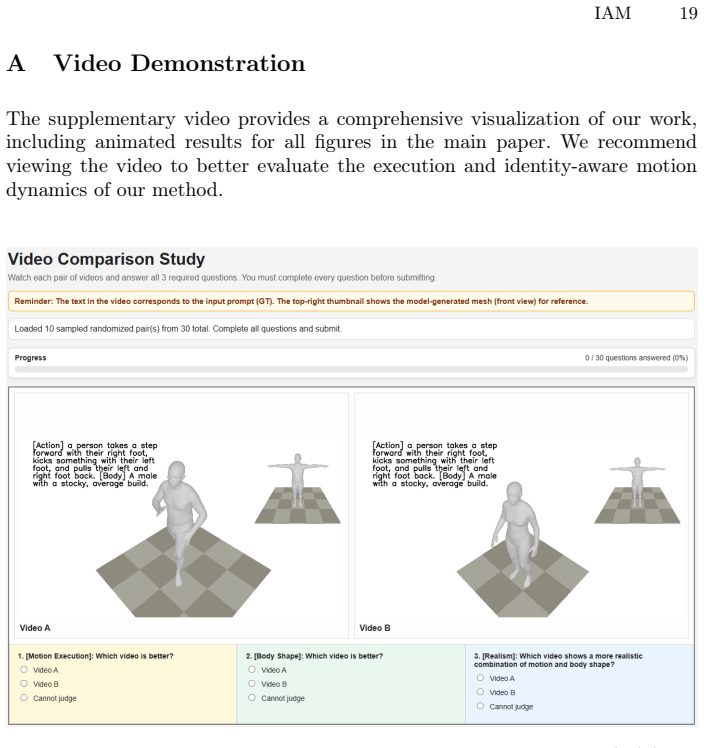
Zhong, L., Xie, Y., Jampani, V., Sun, D., Jiang, H.: Smoodi: Stylized motion diffu- sion model. In: European Conference on Computer Vision. pp. 405–421. Springer (2024) 4 IAM 19 A Video Demonstration The supplementary video provides a comprehensive visualization of our work, including animated results for all figures in the main paper. We recommend viewin...
2024
discussion (0)
Sign in with ORCID, Apple, or X to comment. Anyone can read and Pith papers without signing in.