Recognition: unknown
Conditional Flow Matching for Probabilistic Downscaling of Maximum 3-day Snowfall in Alaska
Pith reviewed 2026-05-07 14:03 UTC · model grok-4.3
The pith
A conditional flow matching model maps coarse climate outputs and topography to calibrated fine-scale snowfall ensembles orders of magnitude faster than dynamical downscaling.
A machine-rendered reading of the paper's core claim, the machinery that carries it, and where it could break.
Core claim
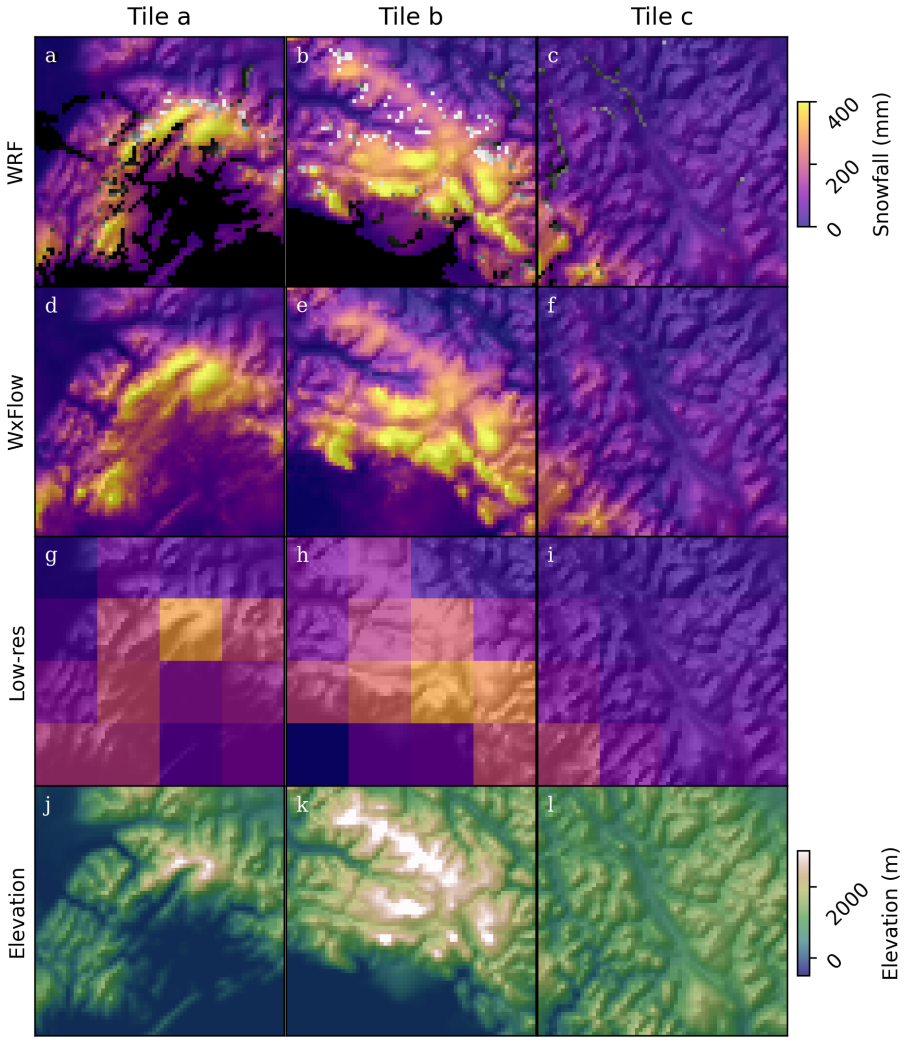
WxFlow learns a conditional generative model via flow matching that produces 50-member ensembles of 4 km resolution maximum 3-day snowfall from coarse inputs and topography; these ensembles exhibit 87.8 percent higher spectral fidelity, substantially lower Continuous Ranked Probability Scores, and physically plausible topographic control on uncertainty compared with conventional lapse-rate-corrected bicubic downscaling.
What carries the argument
Conditional flow matching model that transports samples from a base distribution to the target fine-scale precipitation distribution conditioned on coarse climate variables and high-resolution topography.
If this is right
- Large probabilistic ensembles of high-resolution snowfall become feasible on ordinary hardware rather than requiring months of supercomputer time.
- Uncertainty estimates respect topographic controls and remain spatially coherent across the domain.
- The same trained model can be queried repeatedly to explore different coarse-scale inputs without retraining.
- Downscaling cost drops from months per scenario to seconds per ensemble member.
Where Pith is reading between the lines
- The same architecture could be retrained on other orographic variables such as extreme rainfall or wind, provided suitable high-resolution training data exist.
- If the learned conditional distribution generalizes across climates, the model could serve as an emulator for testing many future scenarios that would otherwise be computationally prohibitive.
- A direct test would be to compare the model's ensemble spread against actual observed variability in dense station networks or additional high-resolution simulations not used in training.
Load-bearing premise
The statistical relationship between coarse conditions, topography, and fine-scale snowfall observed in the training simulations is the same relationship that will hold for any new climate scenario or region.
What would settle it
On an independent set of WRF simulations for a different time period, different emission scenario, or different mountainous region, the flow-matching ensembles show no improvement in spectral fidelity or CRPS over lapse-rate-corrected bicubic interpolation, or produce spatially incoherent uncertainty fields.
Figures




read the original abstract
Precipitation in complex terrain is governed by orographic processes operating at scales of a few kilometers, yet climate models typically run at resolutions of 50--100~km where this topographic detail is absent. Dynamical downscaling with high-resolution regional models such as WRF can resolve these processes, but the computational cost -- months of wall-clock time per scenario -- precludes the large ensembles needed for uncertainty quantification. We present WxFlow, a conditional generative model based on flow matching that learns to map coarse-resolution climate model output and high-resolution topography to calibrated probabilistic ensembles of fine-scale precipitation fields. Applied to 4~km WRF simulations of maximum 3-day snowfall over southeast Alaska, WxFlow achieves 87.8\% improvement in spectral fidelity and dramatically lower Continuous Ranked Probability Scores relative to conventional lapse-rate-corrected bicubic downscaling, while generating 50-member ensembles in seconds on a laptop. Ensemble spread is spatially coherent and governed by topography, reflecting physically plausible uncertainty structure. All code is available at https://github.com/glide-ism/wrf-flow.
Editorial analysis
A structured set of objections, weighed in public.
Referee Report
Summary. The manuscript introduces WxFlow, a conditional generative model based on flow matching that learns to map coarse-resolution climate model output and high-resolution topography to probabilistic ensembles of fine-scale maximum 3-day snowfall fields. Applied to 4 km WRF simulations over southeast Alaska, it reports an 87.8% improvement in spectral fidelity and substantially lower CRPS relative to lapse-rate-corrected bicubic downscaling, while enabling rapid generation of 50-member ensembles; all code is released publicly.
Significance. If the learned conditional distributions prove robust, the method could substantially reduce the computational barrier to producing large probabilistic ensembles for orographic precipitation in complex terrain, supporting uncertainty quantification in climate applications. The explicit release of reproducible code is a clear strength that facilitates verification and extension.
major comments (2)
- [Abstract and §4 (Results)] Abstract and §4 (Results): The abstract states that WxFlow maps 'coarse-resolution climate model output' to fine-scale fields, yet all reported metrics (87.8% spectral fidelity gain, CRPS comparisons) are obtained exclusively on held-out WRF-derived coarse inputs from the same dynamical model. No evaluation on actual GCM fields (~50-100 km resolution) or explicit tests for distribution shift is provided, which directly bears on the claimed applicability to climate scenarios.
- [§3 (Methods)] §3 (Methods): The manuscript does not report the training/validation split ratios, hyperparameter selection procedure, or any diagnostics for overfitting and generalization error. These details are required to assess whether the quantitative improvements on the test set reflect genuine learning of the conditional distribution rather than memorization of WRF-specific features.
minor comments (2)
- [Figure 2] Figure 2: The spectral fidelity plots would benefit from explicit annotation of the wavenumber ranges used for the integrated error metric and inclusion of a reference spectrum from the original 4 km WRF fields.
- [§2.2] Notation in §2.2: The conditioning variables (coarse fields and topography) are introduced but their precise concatenation or embedding into the flow-matching network could be clarified with a diagram or explicit equation.
Simulated Author's Rebuttal
We thank the referee for their thoughtful and constructive comments, which have identified key areas where the manuscript's scope and methodological transparency can be improved. We address each major comment point by point below, indicating the revisions we will incorporate.
read point-by-point responses
-
Referee: [Abstract and §4 (Results)] Abstract and §4 (Results): The abstract states that WxFlow maps 'coarse-resolution climate model output' to fine-scale fields, yet all reported metrics (87.8% spectral fidelity gain, CRPS comparisons) are obtained exclusively on held-out WRF-derived coarse inputs from the same dynamical model. No evaluation on actual GCM fields (~50-100 km resolution) or explicit tests for distribution shift is provided, which directly bears on the claimed applicability to climate scenarios.
Authors: We acknowledge that the quantitative evaluation relies on coarsened WRF fields as a proxy for coarse inputs, which enables direct validation against high-resolution WRF targets in a controlled setting. This proxy approach is standard in downscaling studies to isolate model performance. However, we agree that the abstract and results sections overstate direct applicability to GCM outputs without qualification. In revision, we will update the abstract to specify that reported metrics are obtained from WRF-derived coarse inputs and add a clarifying statement in §4 noting that application to actual GCM fields (e.g., CMIP6) would require separate validation for distribution shift. The public code release supports such future tests. revision: yes
-
Referee: [§3 (Methods)] §3 (Methods): The manuscript does not report the training/validation split ratios, hyperparameter selection procedure, or any diagnostics for overfitting and generalization error. These details are required to assess whether the quantitative improvements on the test set reflect genuine learning of the conditional distribution rather than memorization of WRF-specific features.
Authors: We thank the referee for highlighting this omission. The current manuscript does not include these details. In the revised version, we will expand §3 with a new subsection reporting the exact training/validation/test split ratios, the hyperparameter selection procedure (including any validation-based tuning or search strategy), and diagnostic plots such as training versus validation loss curves to demonstrate generalization and lack of overfitting. These additions will strengthen the evidence that the model has learned the underlying conditional distribution. revision: yes
Circularity Check
No circularity; data-driven model evaluated on independent held-out metrics
full rationale
The paper trains a conditional flow matching generative model on WRF simulations to learn a mapping from coarse fields and topography to fine-scale snowfall ensembles. Performance is quantified via external, independent metrics (spectral fidelity improvement of 87.8%, lower CRPS) computed on held-out WRF cases rather than any quantity defined by the fitted parameters themselves. No self-definitional equations, fitted inputs renamed as predictions, or load-bearing self-citations appear in the derivation. The central claims rest on standard ML training and evaluation procedures that remain falsifiable against the held-out simulation data.
Axiom & Free-Parameter Ledger
free parameters (1)
- neural network weights and flow matching schedule parameters
axioms (1)
- domain assumption High-resolution precipitation fields can be treated as samples from a learnable conditional distribution given coarse climate state and topography.
Reference graph
Works this paper leans on
-
[1]
Chen, R. T. Q., Rubanova, Y., Bettencourt, J., and Duvenaud, D. K. (2018). Neural ordinary differ- ential equations.Advances in Neural Information Processing Systems,
2018
-
[2]
Dormand, J. R. and Prince, P . J. (1980). A family of embedded Runge-Kutta formulae.Journal of Computational and Applied Mathematics, 6(1):19–26. Gneiting, T. and Raftery, A. E. (2007). Strictly proper scoring rules, prediction, and estimation. Journal of the American Statistical Association, 102(477):359–378. Ho, J., Jain, A., and Abbeel, P . (2020). Den...
work page internal anchor Pith review arXiv 1980
discussion (0)
Sign in with ORCID, Apple, or X to comment. Anyone can read and Pith papers without signing in.