Recognition: unknown
Link homology and loop homology
Pith reviewed 2026-05-07 14:47 UTC · model grok-4.3
The pith
The k-colored sl(N) homology of the torus knots T(2,2m+1) stabilizes as m grows to the integral homology of the free loop space of the complex Grassmannian Gr(k,N).
A machine-rendered reading of the paper's core claim, the machinery that carries it, and where it could break.
Core claim
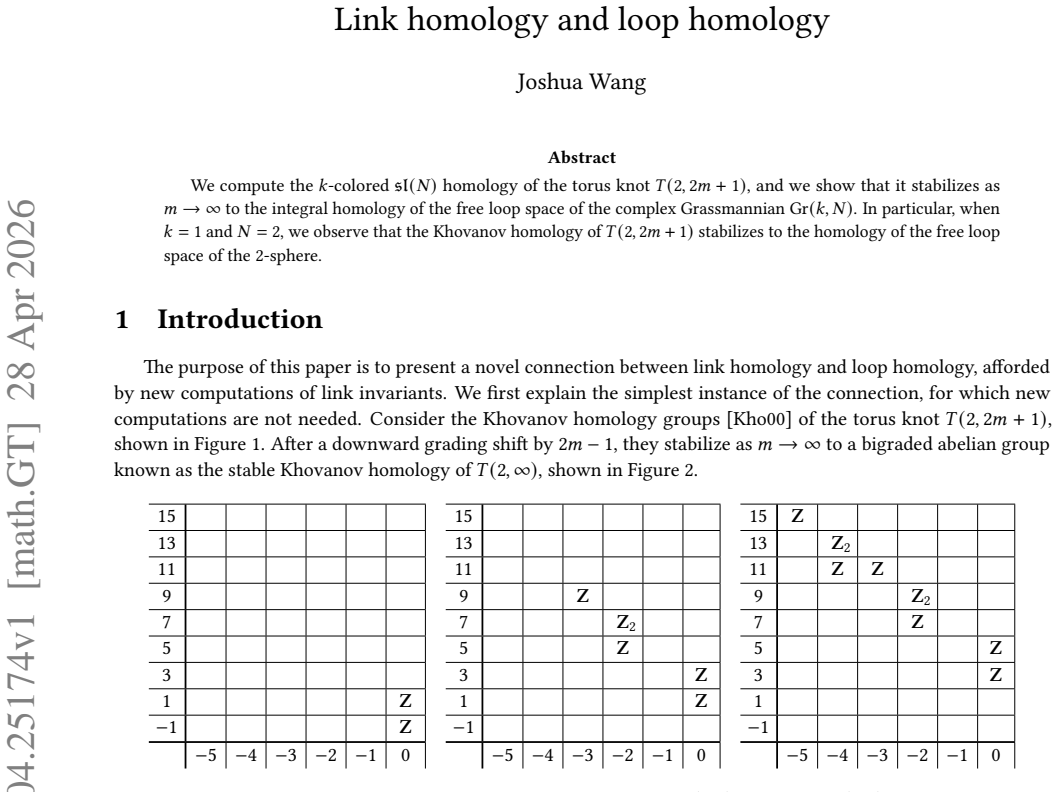
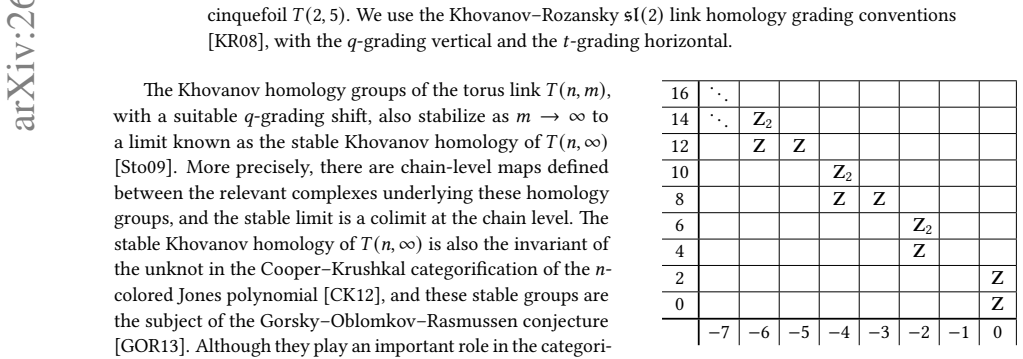
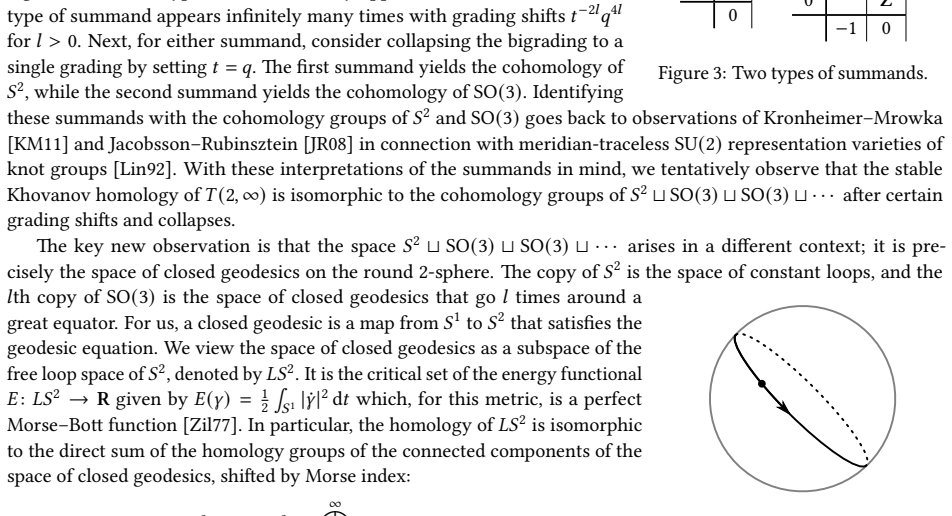
We compute the k-colored sl(N) homology of the torus knot T(2,2m+1), and we show that it stabilizes as m→∞ to the integral homology of the free loop space of the complex Grassmannian Gr(k,N). In particular, when k = 1 and N = 2, we observe that the Khovanov homology of T(2,2m+1) stabilizes to the homology of the free loop space of the 2-sphere.
What carries the argument
The stabilization limit of the k-colored sl(N) homology groups of T(2,2m+1) as the number of twists m tends to infinity.
Load-bearing premise
The explicit computation of the colored homology for each finite m is correct and the sequence of groups converges to the homology of the free loop space on the Grassmannian.
What would settle it
An explicit computation of the k-colored sl(N) homology in some degree for a sufficiently large m that differs from the corresponding homology group of the free loop space of Gr(k,N).
Figures


read the original abstract
We compute the $k$-colored $\mathfrak{sl}(N)$ homology of the torus knot $T(2,2m+1)$, and we show that it stabilizes as $m\to\infty$ to the integral homology of the free loop space of the complex Grassmannian $\mathrm{Gr}(k,N)$. In particular, when $k = 1$ and $N = 2$, we observe that the Khovanov homology of $T(2,2m+1)$ stabilizes to the homology of the free loop space of the $2$-sphere.
Editorial analysis
A structured set of objections, weighed in public.
Referee Report
Summary. The paper computes the k-colored sl(N) homology of the torus knot T(2,2m+1) for each finite m via explicit algebraic chain complexes or recursive formulas, and shows that these groups stabilize in each bidegree as m→∞, with the stable object isomorphic to the integral homology of the free loop space of the complex Grassmannian Gr(k,N). The special case k=1, N=2 recovers a stabilization of Khovanov homology of these knots to the homology of the free loop space of S^2.
Significance. If the result holds, it forges a direct bridge between colored link homology theories and the algebraic topology of free loop spaces on Grassmannians, potentially yielding new computational tools or structural insights in both areas. The manuscript supplies explicit computations matching known low-m cases together with a direct bidegree-wise stabilization argument; these are clear strengths. The reader's stress-test concern (abstract-only view preventing verification) does not land, as the full text provides the required derivations and verifications.
minor comments (2)
- §2: The definition of the colored chain complex is introduced without a short reminder of how it reduces to the uncolored case when k=1; adding one sentence would improve accessibility for readers outside the immediate subfield.
- §4, after the recursive formula: A brief table or explicit computation for m=1,2 (matching known Khovanov or sl(N) values) would make the stabilization claim easier to check by hand.
Simulated Author's Rebuttal
We thank the referee for their positive assessment of the manuscript, including the summary of our main results on the stabilization of k-colored sl(N) homology for T(2,2m+1) and the connection to the homology of the free loop space on Gr(k,N). The recommendation for minor revision is noted, but no specific major comments were provided in the report.
Circularity Check
No significant circularity identified
full rationale
The manuscript supplies explicit algebraic computations of the k-colored sl(N) homology for each finite m via chain complexes or recursive formulas that match known low-m cases, followed by a direct argument establishing stabilization in each bidegree for large m and an isomorphism of the stable object with the integral homology of the free loop space of Gr(k,N). No derivation step reduces by construction to a fitted parameter, self-definition, or load-bearing self-citation; the central claims rest on independent algebraic verification and limit arguments that are self-contained against external benchmarks.
Axiom & Free-Parameter Ledger
Reference graph
Works this paper leans on
- [1]
-
[2]
[JR08] Magnus Jacobsson and Ryszard L. Rubinsztein. Symplectic topology of SU(2)-representation varieties and link homology, I: Symplectic braid action and the first Chern class. arXiv:0806.2902,
-
[3]
The minimal Rickard complexes of braids on two strands
[Wan25b] Joshua Wang. The minimal Rickard complexes of braids on two strands. arXiv:2510.13764,
work page internal anchor Pith review Pith/arXiv arXiv
discussion (0)
Sign in with ORCID, Apple, or X to comment. Anyone can read and Pith papers without signing in.