Recognition: unknown
AgentDID: Trustless Identity Authentication for AI Agents
Pith reviewed 2026-05-07 16:05 UTC · model grok-4.3
The pith
AI agents can self-manage identities and verify execution states trustlessly using decentralized identifiers, verifiable credentials, and challenge-response protocols.
A machine-rendered reading of the paper's core claim, the machinery that carries it, and where it could break.
Core claim
AgentDID is a decentralized framework that lets AI agents manage their own decentralized identifiers (DIDs) and verifiable credentials (VCs) to authenticate across systems without centralized control. To overcome the limits of static credentials, it adds a challenge-response mechanism allowing verifiers to confirm an agent's execution conditions, such as valid context and capabilities, at the exact time of interaction. The framework is implemented to W3C standards and evaluated for throughput with multiple concurrent agents, showing it supports scalable identity authentication and state verification for large agent populations.
What carries the argument
The challenge-response mechanism layered on DIDs and VCs that lets verifiers validate an agent's current execution conditions during authentication.
If this is right
- Agents can create and control identities autonomously without needing centralized enrollment.
- Authentication scales to large numbers of concurrent agent interactions.
- Verifiers gain the ability to confirm that claimed context and capabilities remain valid at interaction time.
- The design supports short-lived, state-coupled agent identities across migrating platforms.
- W3C-compliant implementation allows integration with existing decentralized identity tools.
Where Pith is reading between the lines
- This could reduce dependence on central identity providers that act as single points of failure in multi-agent deployments.
- It opens the possibility of real-time capability checks during agent handoffs between different execution environments.
- Adoption might enable more fluid trust relationships in open ecosystems where agents from unrelated creators interact.
- A direct test would measure whether the mechanism prevents spoofing during simulated agent migration or state tampering.
Load-bearing premise
AI agents can securely create, store, and present DIDs and VCs on their own, and the challenge-response step reliably detects mismatches in dynamic execution states without adding new vulnerabilities.
What would settle it
An experiment in which an agent with altered or invalid execution state successfully passes authentication while a verifier cannot distinguish it from a valid agent.
Figures



read the original abstract
AI agents are autonomous entities that can be instantiated on demand, migrate across platforms, and interact with other agents or services without continuous human supervision. In such environments, identity is critical for establishing reliable interaction semantics among agents that may lack prior trust relationships. However, existing identity and access management mechanisms are designed for human users or static machines, assuming centralized enrollment, persistent identifiers, and stable execution contexts. These assumptions do not hold for AI agents, whose identities are self-managed, short-lived, and tightly coupled with their execution state and capabilities. We study the problem of identity authentication and state verification for AI agents and identify three challenges: (1) supporting self-managed identities for autonomously created agents, (2) enabling authentication under large-scale, concurrent interactions, and (3) verifying agents' dynamic execution state, such as whether their context and capabilities remain valid at interaction time. To address these challenges, we present AgentDID, a decentralized framework for identity authentication and state verification. AgentDID leverages decentralized identifiers (DIDs) and verifiable credentials (VCs), enabling agents to manage their own identities and authenticate across systems without centralized control. To address the limitations of static credential-based approaches, AgentDID introduces a challenge-response mechanism that allows verifiers to validate an agent's execution conditions at interaction time. We implement AgentDID in compliance with W3C standards and evaluate it through throughput experiments with multiple concurrent agents. Results show that the system achieves scalable identity authentication and state verification, demonstrating its potential to support large populations of AI agents.
Editorial analysis
A structured set of objections, weighed in public.
Referee Report
Summary. The paper proposes AgentDID, a decentralized framework for AI agent identity authentication that uses W3C-compliant DIDs and VCs to support self-managed, short-lived identities. It identifies three challenges (self-managed identities, large-scale concurrent interactions, and dynamic execution-state verification) and introduces a challenge-response mechanism to let verifiers check an agent's current context and capabilities at interaction time without centralized control or prior trust. The work includes an implementation and reports throughput results under concurrent agent loads, claiming the design enables scalable, trustless authentication.
Significance. If the challenge-response protocol can be shown to securely bind to live execution state and resist fabrication without external attestation, AgentDID would address a genuine gap in identity systems for autonomous, migrating AI agents. The W3C compliance and throughput evaluation are concrete strengths that could make the framework immediately usable as a reference design, though the absence of security analysis limits its current impact.
major comments (3)
- [Abstract and design section] Abstract and §3 (design description): the challenge-response mechanism is presented only at the level of 'allows verifiers to validate an agent's execution conditions at interaction time.' No protocol steps, binding method (e.g., signed execution proofs, remote attestation, or ledger anchoring), or resistance argument against a malicious host reporting stale or fabricated state are supplied. This is load-bearing for the central claim of trustless dynamic verification.
- [Evaluation] Evaluation section: only throughput under concurrent agents is reported; no experiments, attack scenarios, or correctness metrics address whether the challenge-response actually verifies dynamic state or resists the threats implied by the 'no prior trust' setting. The scalability claim therefore rests on an untested security assumption.
- [Missing threat model] No threat model or security analysis section is present. Without an explicit adversary model (e.g., compromised agent host, replay of old VCs, or collusion with verifiers), it is impossible to assess whether the proposed mechanism meets the 'trustless' requirement stated in the title and abstract.
minor comments (2)
- [Introduction] The three challenges listed in the abstract are clear, but the mapping from each challenge to the corresponding component of AgentDID could be made more explicit with a short table or numbered list.
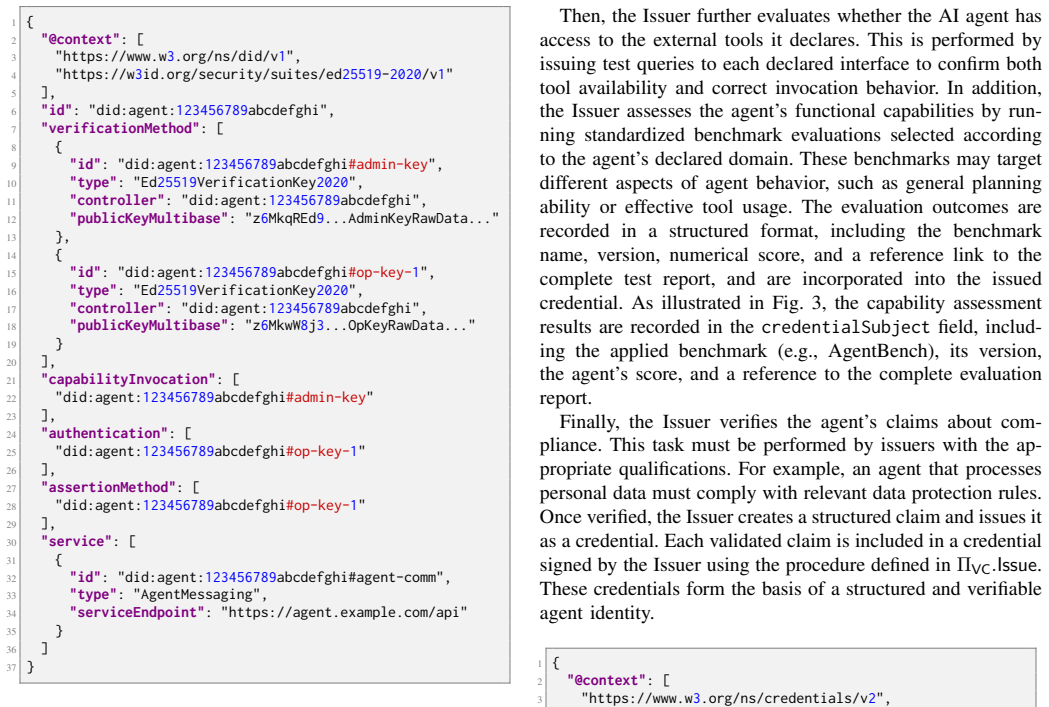
- [Implementation] Implementation details (e.g., exact DID method, VC schema extensions, and how the challenge is generated and signed) are referenced only at a high level; adding pseudocode or a sequence diagram would improve reproducibility.
Simulated Author's Rebuttal
We thank the referee for the constructive and detailed feedback. We agree that the security properties of the challenge-response mechanism require more explicit treatment to support the trustless claims. We address each major comment below and will revise the manuscript to incorporate the suggested clarifications and additions.
read point-by-point responses
-
Referee: [Abstract and design section] Abstract and §3 (design description): the challenge-response mechanism is presented only at the level of 'allows verifiers to validate an agent's execution conditions at interaction time.' No protocol steps, binding method (e.g., signed execution proofs, remote attestation, or ledger anchoring), or resistance argument against a malicious host reporting stale or fabricated state are supplied. This is load-bearing for the central claim of trustless dynamic verification.
Authors: We agree that the current presentation of the challenge-response mechanism remains at a high level. In the revised manuscript we will expand §3 with a precise protocol description, including message flows, the binding of responses to live execution state via signed proofs anchored to the agent's runtime context, and an argument that a malicious host cannot produce a valid response for fabricated or stale state without violating the W3C VC signature and freshness checks. revision: yes
-
Referee: [Evaluation] Evaluation section: only throughput under concurrent agents is reported; no experiments, attack scenarios, or correctness metrics address whether the challenge-response actually verifies dynamic state or resists the threats implied by the 'no prior trust' setting. The scalability claim therefore rests on an untested security assumption.
Authors: The evaluation section currently reports only throughput. We will add a security analysis subsection that enumerates attack scenarios (stale VC replay, state fabrication by a compromised host) and explains, using the protocol details added in §3, why each is prevented. Where implementation logs permit, we will also include basic correctness metrics; full adversarial simulations would require additional experiments that we can perform for the revision. revision: partial
-
Referee: [Missing threat model] No threat model or security analysis section is present. Without an explicit adversary model (e.g., compromised agent host, replay of old VCs, or collusion with verifiers), it is impossible to assess whether the proposed mechanism meets the 'trustless' requirement stated in the title and abstract.
Authors: We acknowledge the absence of an explicit threat model. We will insert a new subsection that defines the adversary (compromised host, replay capability, verifier collusion) and maps each threat to the countermeasures provided by the DID/VC infrastructure and the challenge-response protocol, thereby grounding the trustless claim. revision: yes
Circularity Check
No circularity: architectural proposal based on external standards
full rationale
The paper is a systems/architectural proposal that defines AgentDID by composing existing W3C DID and VC standards with a new challenge-response design choice. No equations, fitted parameters, predictions, or derivation chains are present in the abstract or described structure. The central claims rest on compliance with external standards and an empirical throughput evaluation, none of which reduce to self-definition or self-citation by construction. This is the common case of a non-circular design paper.
Axiom & Free-Parameter Ledger
axioms (1)
- domain assumption W3C DID and VC standards are secure and suitable for self-managed AI agent identities
Reference graph
Works this paper leans on
-
[1]
A survey on large language model (llm) security and privacy: The good, the bad, and the ugly,
Y . Yao, J. Duan, K. Xu, Y . Cai, Z. Sun, and Y . Zhang, “A survey on large language model (llm) security and privacy: The good, the bad, and the ugly,”High-Confidence Computing, vol. 4, no. 2, p. 100211, 2024
2024
-
[2]
AI agents under threat: A survey of key security challenges and future pathways,
Z. Deng, Y . Guo, C. Han, W. Ma, J. Xiong, S. Wen, and Y . Xiang, “AI agents under threat: A survey of key security challenges and future pathways,”ACM Computing Surveys, vol. 57, no. 7, pp. 1–36, 2025
2025
-
[3]
On protecting the data privacy of large language models (llms) and llm agents: A literature review,
B. Yan, K. Li, M. Xu, Y . Dong, Y . Zhang, Z. Ren, and X. Cheng, “On protecting the data privacy of large language models (llms) and llm agents: A literature review,”High-Confidence Computing, vol. 5, no. 2, p. 100300, 2025
2025
-
[4]
Unlock the power of multi-agent AI with CrewAI,
CrewAI, “Unlock the power of multi-agent AI with CrewAI,” https: //www.crewai.com/open-source, 2025, accessed: 2025-12-01
2025
-
[5]
The rise of enterprise AI agents,
Tray.io, Inc., “The rise of enterprise AI agents,” https://tray.ai/press/su rvey-86-percent-of-enterprises-require-tech-stack-upgrades-to-deplo y-ai-agents/, 2024, accessed: 2025-11-20
2024
-
[6]
Model-based security testing: An empirical study on OAuth 2.0 implementations,
R. Yang, G. Li, W. C. Lau, K. Zhang, and P. Hu, “Model-based security testing: An empirical study on OAuth 2.0 implementations,” inProceedings of the 11th ACM on Asia Conference on Computer and Communications Security, 2016, pp. 651–662
2016
-
[7]
A survey on adaptive authentication,
P. Arias-Cabarcos, C. Krupitzer, and C. Becker, “A survey on adaptive authentication,”ACM Computing Surveys (CSUR), vol. 52, no. 4, pp. 1–30, 2019
2019
-
[8]
The rise and potential of large language model based agents: A survey,
Z. Xi, W. Chen, X. Guo, W. He, Y . Ding, B. Hong, M. Zhang, J. Wang, S. Jin, E. Zhouet al., “The rise and potential of large language model based agents: A survey,”Science China Information Sciences, vol. 68, no. 2, p. 121101, 2025
2025
-
[9]
From LLM Reasoning to Autonomous AI Agents: A Comprehensive Review
M. A. Ferrag, N. Tihanyi, and M. Debbah, “From LLM reasoning to autonomous AI agents: A comprehensive review,”arXiv preprint arXiv:2504.19678, 2025
work page internal anchor Pith review arXiv 2025
-
[10]
Wooldridge,An introduction to multiagent systems
M. Wooldridge,An introduction to multiagent systems. John wiley & sons, 2009
2009
-
[11]
Generative agents: Interactive simulacra of human behavior,
J. S. Park, J. O’Brien, C. J. Cai, M. R. Morris, P. Liang, and M. S. Bernstein, “Generative agents: Interactive simulacra of human behavior,” inProceedings of the 36th Annual ACM Symposium on User Interface Software and Technology, 2023, pp. 1–22
2023
-
[12]
Jailbreak Attacks and Defenses Against Large Language Models: A Survey
S. Yi, Y . Liu, Z. Sun, T. Cong, X. He, J. Song, K. Xu, and Q. Li, “Jail- break attacks and defenses against large language models: A survey,” arXiv preprint arXiv:2407.04295, 2024
work page internal anchor Pith review arXiv 2024
-
[13]
Abusing agent cards in the agent-2-agent (A2A) protocol,
T. Neaves, “Abusing agent cards in the agent-2-agent (A2A) protocol,” https://www.trustwave.com/en-us/resources/blogs/spiderlabs-blog/agen t-in-the-middle-abusing-agent-cards-in-the-agent-2-agent-protocol-t o-win-all-the-tasks/, 2026, accessed: 2026-01-05
2026
-
[14]
Exploring blockchain technology through a modular lens: A survey,
M. Xu, Y . Guo, C. Liu, Q. Hu, D. Yu, Z. Xiong, D. T. Niyato, and X. Cheng, “Exploring blockchain technology through a modular lens: A survey,”ACM Computing Surveys, vol. 56, no. 9, 2024
2024
-
[15]
xRW A: A cross- chain framework for interoperability of real-world assets,
Y . Guo, H. Zhu, M. Xu, X. Cheng, and B. Xiao, “xRW A: A cross- chain framework for interoperability of real-world assets,”arXiv preprint arXiv:2509.12957, 2025
-
[16]
Cross- channel: Scalable off-chain channels supporting fair and atomic cross- chain operations,
Y . Guo, M. Xu, D. Yu, Y . Yu, R. Ranjan, and X. Cheng, “Cross- channel: Scalable off-chain channels supporting fair and atomic cross- chain operations,”IEEE Transactions on Computers, 2023
2023
-
[17]
zkCross: A novel architecture for cross-chain privacy-preserving audit- ing,
Y . Guo, M. Xu, X. Cheng, D. Yu, W. Qiu, G. Qu, W. Wang, and M. Song, “zkCross: A novel architecture for cross-chain privacy-preserving audit- ing,” in33rd USENIX Security Symposium (USENIX Security 24), 2024
2024
-
[18]
T. South, S. Nagabhushanaradhya, A. Dissanayaka, S. Cecchetti, G. Fletcher, V . Lu, A. Pietropaolo, D. H. Saxe, J. Lombardo, A. M. Shivalingaiahet al., “Identity management for agentic AI: The new frontier of authorization, authentication, and security for an AI agent world,”arXiv preprint arXiv:2510.25819, 2025
-
[19]
Blocka2a: Towards secure and verifiable agent-to-agent interoperability,
Z. Zou, Z. Liu, L. Zhao, and Q. Zhan, “BlockA2A: Towards se- cure and verifiable agent-to-agent interoperability,”arXiv preprint arXiv:2508.01332, 2025
-
[20]
The Kerberos network authentication service (V5),
J. Kohl and C. Neuman, “The Kerberos network authentication service (V5),” Tech. Rep., 1993
1993
-
[21]
Lightweight directory access protocol (LDAP): Technical specification road map,
K. Zeilenga, “Lightweight directory access protocol (LDAP): Technical specification road map,” Tech. Rep., 2006
2006
-
[22]
Assertions and protocols for the OASIS security assertion markup language (SAML) V2.0,
OASIS Open, “Assertions and protocols for the OASIS security assertion markup language (SAML) V2.0,” https://docs.oasis-open.org/security/s aml/v2.0/saml-core-2.0-os.pdf, 2025, accessed: 2025-12-22
2025
-
[23]
The OAuth 2.0 authorization framework,
D. Hardt, “The OAuth 2.0 authorization framework,” Tech. Rep., 2012
2012
-
[24]
OpenID Connect Core 1.0 incorporating errata set 1,
N. Sakimura, J. Bradley, M. Jones, B. De Medeiros, and C. Mortimore, “OpenID Connect Core 1.0 incorporating errata set 1,”The OpenID Foundation, specification, vol. 335, 2014
2014
-
[25]
Web authentication: An API for accessing public key credentials level 3,
W3C, “Web authentication: An API for accessing public key credentials level 3,” https://www.w3.org/TR/webauthn-3/, 2025, accessed: 2025- 12-22
2025
-
[26]
A survey on decentralized identifiers and verifiable creden- tials,
C. Mazzocca, A. Acar, S. Uluagac, R. Montanari, P. Bellavista, and M. Conti, “A survey on decentralized identifiers and verifiable creden- tials,”IEEE Communications Surveys & Tutorials, 2025
2025
-
[27]
B. A. Hu, Y . Liu, and H. Rong, “Trustless autonomy: Understanding motivations, benefits and governance dilemma in self-sovereign decen- tralized AI agents,”arXiv preprint arXiv:2505.09757, 2025
-
[28]
K. Huang, V . S. Narajala, J. Yeoh, J. Ross, R. Raskar, Y . Harkati, J. Huang, I. Habler, and C. Hughes, “A novel zero-trust identity framework for agentic AI: Decentralized authentication and fine-grained access control,”arXiv preprint arXiv:2505.19301, 2025
-
[29]
AI agents with decentralized identifiers and verifiable credentials,
S. R. Garzon, A. Vaziry, E. M. Kuzu, D. E. Gehrmann, B. Varkan, A. Gaballa, and A. Küpper, “AI agents with decentralized identifiers and verifiable credentials,”arXiv preprint arXiv:2511.02841, 2025
discussion (0)
Sign in with ORCID, Apple, or X to comment. Anyone can read and Pith papers without signing in.