Recognition: unknown
Spectral Evolution and Transient Broad-Line Features in the Isolated AGN UNAM-KIAS 613
Pith reviewed 2026-05-07 15:54 UTC · model grok-4.3
The pith
The double-peaked broad Hα profile in the low-luminosity AGN UNAM-KIAS 613 is a transient feature from a one-time bipolar outflow.
A machine-rendered reading of the paper's core claim, the machinery that carries it, and where it could break.
Core claim
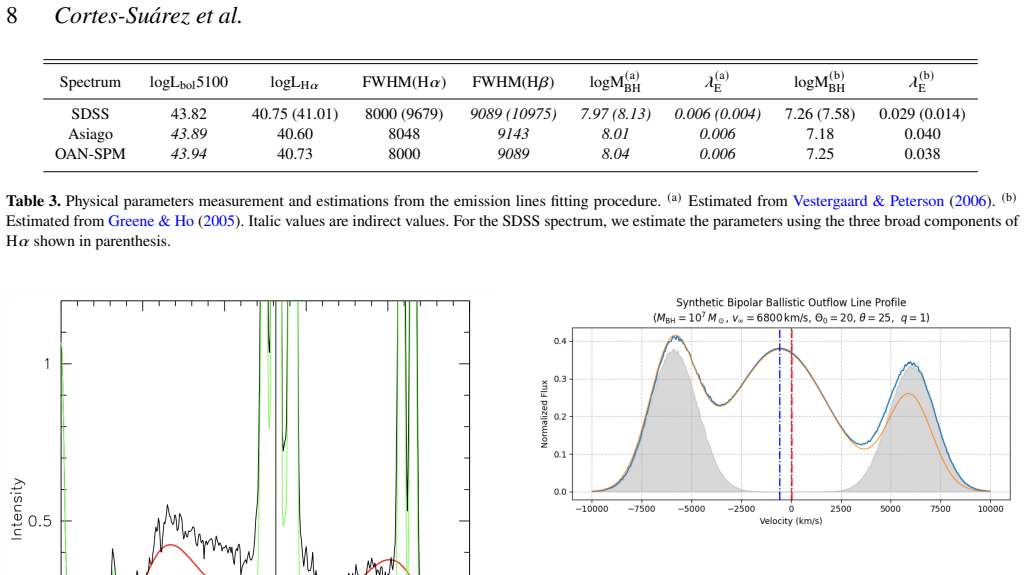
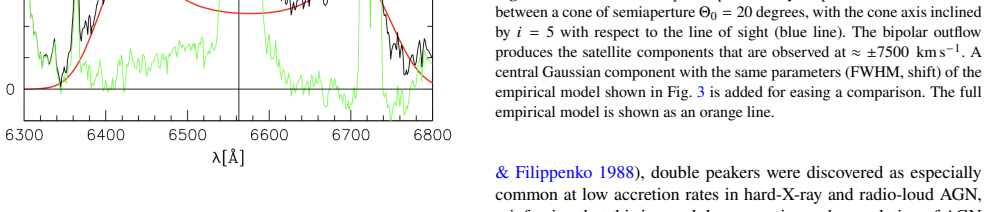
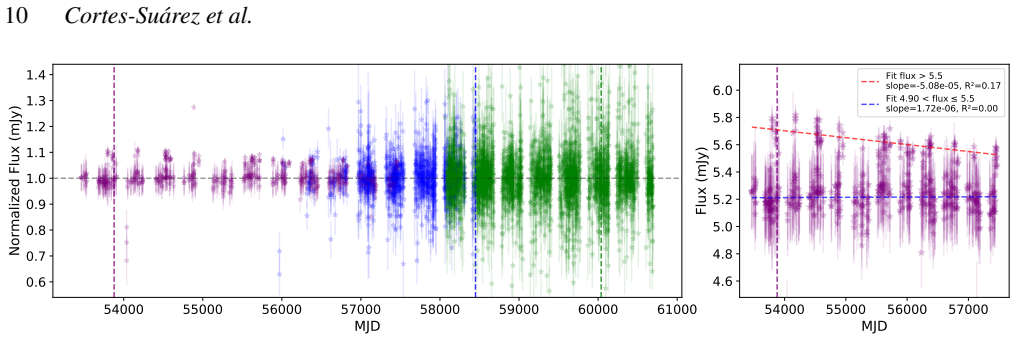
The paper reports that the distinctive double-peaked structure in the broad Hα emission line, seen in 2006 SDSS data and initially modeled as a relativistic accretion disk, was no longer present in 2018 and 2023 observations, which showed only a single-peaked central broad component. With no significant continuum variability detected in light curves from 2012 to 2025 and supporting multi-wavelength data indicating a radio-quiet, sub-Eddington AGN, the authors propose the double-peak structure arose from a transient bipolar outflow event. They suggest the system may be experiencing a turn-off of the accretion disk emitting region or a transition between accretion modes, highlighting the role
What carries the argument
The transient double-peaked broad-line profile interpreted as emission from a one-time bipolar outflow rather than a persistent disk.
Load-bearing premise
The interpretation assumes that the lack of detected continuum variability over the 2012-2025 period rules out a tidal disruption event and indicates the outflow was a single past event without needing quantitative modeling of the kinematics.
What would settle it
Detection of kinematic evidence for an outflow, such as blueshifted absorption lines or velocity-resolved maps, in new high-resolution spectra would support the bipolar outflow model; reappearance of the double peaks would challenge the transient one-time event idea.
Figures



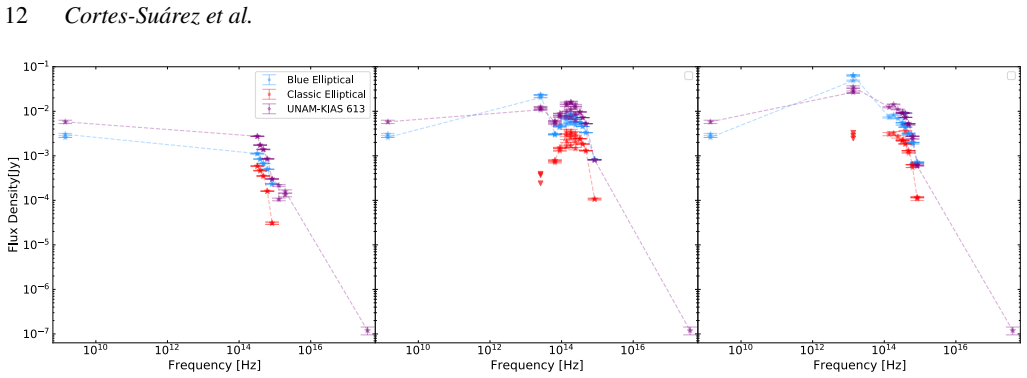


read the original abstract
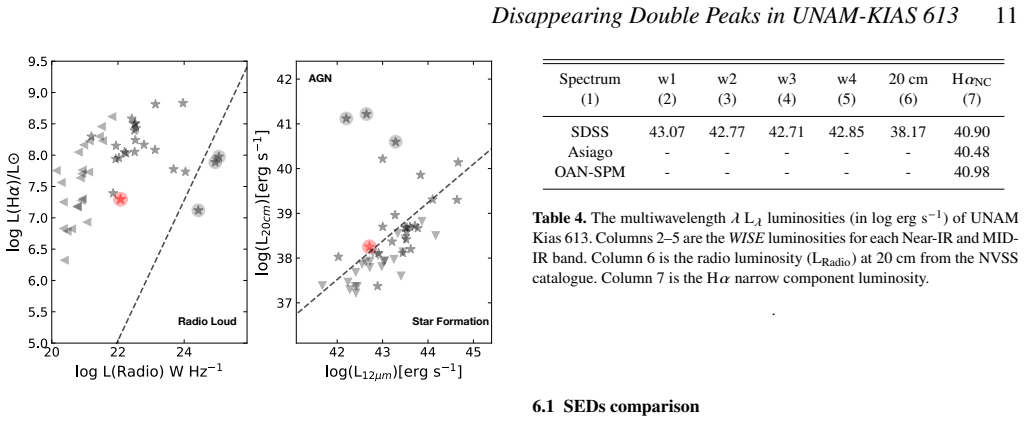
We present multi-epoch optical spectroscopy of the isolated elliptical galaxy UNAM-KIAS 613, hosting a low-luminosity Type 1 AGN. Analysis of archival Sloan Digital Sky Survey (SDSS) data from 2006 reveals a distinctive double-peaked broad H$\alpha$ profile, tentatively modeled by a relativistic accretion disk. Follow-up observations in 2018 and 2023 show the disappearance of the red and blue wings, leaving only a single-peaked, central broad component. No significant continuum variability is detected in ASAS-SN and Catalina light curves over 2012-2025, and multi-wavelength data (radio, mid-IR, X-ray) confirm a sub-Eddington, radio-quiet AGN (Eddington ratio $\approx$0.03-0.04, black hole mass $\approx$10$^{7.2}$ M$\odot$). We propose that the double-peak structure is in reality transient, and arose from a one-time bipolar outflow event rather than a stable disk or from a Tidal Disruption Event. The mid-IR SED and radio luminosity place UK 613 on the boundary between AGN and star formation dominance, suggesting residual star formation, while we have found that the isolated environment seems to be prone to the rejuvenation of ellipticals by recent ($\lesssim$ 1 Gyr) cold gas. We also examined its location within the cosmic web with the aim of identifying possible distinctive effects imprinted on its spectroscopic properties. Ultimately, our results are consistent that UNAM-KIAS 613 might have under gone a ''turn-off'' of the accretion disk emitting region or a transition between a radiatively-inefficient and radiatively-efficient accretion mode, and highlight the complex interplay of disk, outflow, host processes and environment in low-accretion, low-black hole mass AGNs, an AGN population still largely unexplored to-date.
Editorial analysis
A structured set of objections, weighed in public.
Referee Report
Summary. The manuscript reports multi-epoch optical spectroscopy of the isolated elliptical galaxy UNAM-KIAS 613 hosting a low-luminosity Type 1 AGN. Archival 2006 SDSS spectra show a double-peaked broad Hα profile tentatively fit as a relativistic accretion disk; 2018 and 2023 follow-up spectra show the red and blue wings have disappeared, leaving a single-peaked central component. Public ASAS-SN and Catalina light curves exhibit no significant continuum variability from 2012–2025, and multi-wavelength data indicate sub-Eddington accretion (Eddington ratio ≈0.03–0.04, M_BH ≈10^{7.2} M_⊙). The authors interpret the transient double-peaked feature as arising from a one-time bipolar outflow rather than a stable disk or tidal disruption event, and discuss possible accretion-mode transitions, residual star formation, and the galaxy’s isolated environment.
Significance. The multi-epoch spectroscopic documentation of the broad-line profile change, combined with the absence of detectable continuum variability over more than a decade, provides a valuable observational constraint on spectral evolution in low-luminosity AGNs. If the outflow interpretation can be placed on a quantitative footing, the work would help illuminate the interplay between disk, outflow, and host-galaxy processes in the still-underexplored regime of sub-Eddington, low-mass black holes. The use of public photometric archives and the environmental context add useful context, though the interpretive step remains qualitative.
major comments (2)
- [Abstract and Discussion] Abstract and Discussion: The central claim that the 2006 double-peaked Hα profile is better explained by a one-time bipolar outflow than by a stable relativistic disk or a TDE rests entirely on the negative observation of no continuum variability and the later disappearance of the wings. No kinematic decomposition (e.g., two-component velocity offsets, P-Cygni profile fits, or wing-velocity modeling), no χ² or residual comparison to the tentative relativistic-disk model, and no light-curve or timing simulations to test whether a TDE could have faded before 2012 monitoring are presented. This absence of positive dynamical or temporal evidence is load-bearing for the preferred interpretation.
- [Results (multi-wavelength properties)] Results section (multi-wavelength properties): The Eddington ratio (≈0.03–0.04) and black-hole mass (≈10^{7.2} M_⊙) are invoked to argue for a sub-Eddington state inconsistent with ongoing TDE activity, yet no derivation details, uncertainty estimates, or sensitivity tests on these parameters are supplied. Without quantified errors or alternative accretion-rate histories, the exclusion of a TDE scenario remains qualitative.
minor comments (3)
- [Abstract] The phrasing “our results are consistent that UNAM-KIAS 613 might have under gone a ‘turn-off’” contains a grammatical error (“under gone” → “undergone”) and an awkward construction; rephrase for clarity.
- [Discussion] The statement that “the isolated environment seems to be prone to the rejuvenation of ellipticals by recent (≲ 1 Gyr) cold gas” is vague; specify what observational or simulation evidence supports this claim for UK 613 or the sample.
- [Discussion] The sentence “We also examined its location within the cosmic web with the aim of identifying possible distinctive effects imprinted on its spectroscopic properties” does not report what, if any, distinctive effects were actually found; either quantify the result or remove the clause.
Simulated Author's Rebuttal
We thank the referee for their careful and constructive review of our manuscript on the spectral evolution of UNAM-KIAS 613. We have considered each major comment in detail and outline below how we will revise the paper to address the concerns while preserving the observational focus of the work.
read point-by-point responses
-
Referee: [Abstract and Discussion] Abstract and Discussion: The central claim that the 2006 double-peaked Hα profile is better explained by a one-time bipolar outflow than by a stable relativistic disk or a TDE rests entirely on the negative observation of no continuum variability and the later disappearance of the wings. No kinematic decomposition (e.g., two-component velocity offsets, P-Cygni profile fits, or wing-velocity modeling), no χ² or residual comparison to the tentative relativistic-disk model, and no light-curve or timing simulations to test whether a TDE could have faded before 2012 monitoring are presented. This absence of positive dynamical or temporal evidence is load-bearing for the preferred interpretation.
Authors: We acknowledge that the preferred outflow interpretation would be strengthened by additional quantitative tests. In the revised manuscript we will add, in the Results section, a direct χ² comparison of the 2006 Hα profile against the relativistic disk model, a single broad Gaussian, and a two-Gaussian decomposition, together with residual plots. We will also report the velocity offsets obtained from the two-Gaussian fit and discuss their implications for a bipolar outflow while noting the moderate S/N of the archival spectrum as a limitation. For the TDE scenario we will expand the Discussion to include a comparison with published TDE light-curve decay timescales and argue that the absence of detectable variability from 2012 onward, combined with the 12-year gap before monitoring began, makes a TDE origin less likely; we will not add new hydrodynamic simulations, as these lie outside the scope of this observational study. These additions will provide a more balanced presentation without altering the core observational results. revision: yes
-
Referee: [Results (multi-wavelength properties)] Results section (multi-wavelength properties): The Eddington ratio (≈0.03–0.04) and black-hole mass (≈10^{7.2} M_⊙) are invoked to argue for a sub-Eddington state inconsistent with ongoing TDE activity, yet no derivation details, uncertainty estimates, or sensitivity tests on these parameters are supplied. Without quantified errors or alternative accretion-rate histories, the exclusion of a TDE scenario remains qualitative.
Authors: We agree that greater transparency is needed. The black-hole mass was obtained via the single-epoch virial estimator using the broad Hα FWHM and luminosity, and the bolometric luminosity was derived from the 5100 Å continuum with a standard correction factor, cross-checked against X-ray and WISE mid-IR luminosities. In the revised Results section we will insert an explicit subsection presenting the adopted formulas, the measured line parameters with their fitting uncertainties, and the propagated statistical plus systematic errors (including the typical 0.3–0.5 dex uncertainty on virial masses). We will also report sensitivity tests varying the bolometric correction by ±20 % and the assumed Eddington ratio range. While a complete time-dependent accretion-rate reconstruction is not possible with the existing sparse data, we will note that the decade-long low-luminosity state is inconsistent with the rapid decline expected for a TDE, thereby making the sub-Eddington argument more quantitative. revision: yes
Circularity Check
No significant circularity; observational claims rest on direct data comparison without self-referential reductions.
full rationale
The manuscript reports multi-epoch spectra (SDSS 2006 showing double-peaked Hα, later epochs showing single peak), public light curves (ASAS-SN/Catalina 2012-2025 with no variability), and multi-wavelength properties (sub-Eddington ratio ~0.03-0.04). The central proposal—that the 2006 profile arose from a one-time bipolar outflow rather than stable disk or TDE—is an interpretive inference from the negative observation of wing disappearance plus absent continuum variability. No equations, fitted parameters renamed as predictions, or self-citation chains appear in the provided text or abstract. The argument does not reduce by construction to its inputs; it is an external comparison against archival and survey data. This is the most common honest finding for purely observational papers.
Axiom & Free-Parameter Ledger
free parameters (2)
- Black hole mass =
10^{7.2} M_sun
- Eddington ratio =
0.03-0.04
axioms (2)
- domain assumption Double-peaked broad Hα can be tentatively modeled as emission from a relativistic accretion disk
- domain assumption Absence of significant continuum variability rules out a tidal disruption event
invented entities (1)
-
One-time bipolar outflow event
no independent evidence
Reference graph
Works this paper leans on
-
[1]
write newline
" write newline "" before.all 'output.state := FUNCTION fin.entry write newline FUNCTION new.block output.state before.all = 'skip after.block 'output.state := if FUNCTION new.sentence output.state after.block = 'skip output.state before.all = 'skip after.sentence 'output.state := if if FUNCTION not #0 #1 if FUNCTION and 'skip pop #0 if FUNCTION or pop #1...
-
[2]
Antonucci R., Hurt T., Agol E., 1996, @doi [ ] 10.1086/309858 , https://ui.adsabs.harvard.edu/abs/1996ApJ...456L..25A 456, L25
-
[3]
Aragon-Calvo M. A., 2021, @doi [ ] 10.1093/mnras/stab403 , https://ui.adsabs.harvard.edu/abs/2021MNRAS.503..557A 503, 557
-
[4]
Aragon-Calvo M. A., 2024, @doi [ ] 10.1093/mnras/stae468 , https://ui.adsabs.harvard.edu/abs/2024MNRAS.529...74A 529, 74
-
[5]
Aragon-Calvo M. A., Szalay A. S., 2013, @doi [ ] 10.1093/mnras/sts281 , https://ui.adsabs.harvard.edu/abs/2013MNRAS.428.3409A 428, 3409
-
[6]
Arag \'o n-Calvo M. A., Jones B. J. T., van de Weygaert R., van der Hulst J. M., 2007, @doi [ ] 10.1051/0004-6361:20077880 , https://ui.adsabs.harvard.edu/abs/2007A&A...474..315A 474, 315
-
[7]
Astrophysical Journal723(1), 364–382 (2010) https://doi
Arag \'o n-Calvo M. A., Platen E., van de Weygaert R., Szalay A. S., 2010, @doi [ ] 10.1088/0004-637X/723/1/364 , https://ui.adsabs.harvard.edu/abs/2010ApJ...723..364A 723, 364
-
[8]
Aragon Calvo M. A., Neyrinck M. C., Silk J., 2019, @doi [The Open Journal of Astrophysics] 10.21105/astro.1697.07881 , https://ui.adsabs.harvard.edu/abs/2019OJAp....2E...7A 2, 7
-
[9]
Assef R. J., et al., 2013, @doi [ ] 10.1088/0004-637X/772/1/26 , https://ui.adsabs.harvard.edu/abs/2013ApJ...772...26A 772, 26
-
[10]
Baldwin J. A., Phillips M. M., Terlevich R., 1981, @doi [ ] 10.1086/130766 , http://adsabs.harvard.edu/abs/1981PASP...93....5B 93, 5
-
[11]
Ballo L., Heras F. J. H., Barcons X., Carrera F. J., 2012, @doi [ ] 10.1051/0004-6361/201117464 , https://ui.adsabs.harvard.edu/abs/2012A&A...545A..66B 545, A66
-
[12]
R., 2012, Active Galactic Nuclei
Beckmann V., Shrader C. R., 2012, Active Galactic Nuclei
2012
-
[13]
The Astrophysical Journal , volume =
Ben \' tez-Llambay A., Navarro J. F., Abadi M. G., Gottl \"o ber S., Yepes G., Hoffman Y., Steinmetz M., 2013, @doi [ ] 10.1088/2041-8205/763/2/L41 , https://ui.adsabs.harvard.edu/abs/2013ApJ...763L..41B 763, L41
-
[14]
The Low-Luminosity End of the Radius-Luminosity Relationship for Active Galactic Nuclei
Bentz M. C., et al., 2013, @doi [ ] 10.1088/0004-637X/767/2/149 , http://adsabs.harvard.edu/abs/2013 ...767..149B 767, 149
-
[15]
2012, MNRAS, 423, 600, doi: 10.1111/j.1365-2966.2012.20901.x
Best P. N., Heckman T. M., 2012, @doi [ ] 10.1111/j.1365-2966.2012.20414.x , https://ui.adsabs.harvard.edu/abs/2012MNRAS.421.1569B 421, 1569
-
[16]
Bianchi L., Shiao B., Thilker D., 2017, @doi [ ] 10.3847/1538-4365/aa7053 , https://ui.adsabs.harvard.edu/abs/2017ApJS..230...24B 230, 24
-
[17]
2025, arXiv e-prints, arXiv:2507.01355, doi: 10.48550/arXiv.2507.01355
Birmingham S., Ward C., Nyland K., Dobie D., Graham M. J., Kaplan D. L., Murphy T., 2025, @doi [arXiv e-prints] 10.48550/arXiv.2507.01355 , https://ui.adsabs.harvard.edu/abs/2025arXiv250701355B p. arXiv:2507.01355
-
[18]
Blanton M. R., et al., 2005, @doi [ ] 10.1086/429803 , https://ui.adsabs.harvard.edu/abs/2005AJ....129.2562B 129, 2562
-
[19]
Blanton M. R., et al., 2017, @doi [ ] 10.3847/1538-3881/aa7567 , https://ui.adsabs.harvard.edu/abs/2017AJ....154...28B 154, 28
-
[20]
Bon E., Jovanovi \'c P., Marziani P., Bon N., Ota s evi \'c A., 2018, @doi [Frontiers in Astronomy and Space Sciences] 10.3389/fspas.2018.00019 , https://ui.adsabs.harvard.edu/abs/2018FrASS...5...19B 5, 19
-
[21]
Boroson T. A., Green R. F., 1992, @doi [ ] 10.1086/191661 , https://ui.adsabs.harvard.edu/abs/1992 ...80..109B 80, 109
-
[22]
Bruzual G., Charlot S., 2003, @doi [ ] 10.1046/j.1365-8711.2003.06897.x , https://ui.adsabs.harvard.edu/abs/2003MNRAS.344.1000B 344, 1000
-
[23]
Bundy K., et al., 2015, @doi [ ] 10.1088/0004-637X/798/1/7 , https://ui.adsabs.harvard.edu/abs/2015ApJ...798....7B 798, 7
-
[24]
Cardelli J. A., Clayton G. C., Mathis J. S., 1989, @doi [ ] 10.1086/167900 , https://ui.adsabs.harvard.edu/abs/1989ApJ...345..245C 345, 245
-
[25]
Ceccarelli L., Duplancic F., Garcia Lambas D., 2022, @doi [ ] 10.1093/mnras/stab2902 , https://ui.adsabs.harvard.edu/abs/2022MNRAS.509.1805C 509, 1805
-
[26]
Charalampopoulos P., et al., 2022, @doi [ ] 10.1051/0004-6361/202142122 , https://ui.adsabs.harvard.edu/abs/2022A&A...659A..34C 659, A34
-
[27]
P., 1989, @doi [ ] 10.1086/167782 , https://ui.adsabs.harvard.edu/abs/1989ApJ...344..115C 344, 115
Chen K., Halpern J. P., 1989, @doi [ ] 10.1086/167782 , https://ui.adsabs.harvard.edu/abs/1989ApJ...344..115C 344, 115
-
[28]
Chen K., Halpern J. P., Filippenko A. V., 1989, @doi [ ] 10.1086/167332 , https://ui.adsabs.harvard.edu/abs/1989ApJ...339..742C 339, 742
-
[29]
Choi Y.-Y., Woo J.-H., Park C., 2009, @doi [ ] 10.1088/0004-637X/699/2/1679 , https://ui.adsabs.harvard.edu/abs/2009ApJ...699.1679C 699, 1679
-
[30]
Cid Fernandes R., Mateus A., Sodr \'e L., Stasi \'n ska G., Gomes J. M., 2005, @doi [ ] 10.1111/j.1365-2966.2005.08752.x , https://ui.adsabs.harvard.edu/abs/2005MNRAS.358..363C 358, 363
-
[31]
V., Gurovich S., D \' az Tello J., S \"o chting I
Coldwell G. V., Gurovich S., D \' az Tello J., S \"o chting I. K., Lambas D. G., 2014, @doi [ ] 10.1093/mnras/stt1920 , https://ui.adsabs.harvard.edu/abs/2014MNRAS.437.1199C 437, 1199
-
[32]
Coldwell G. V., Pereyra L., Alonso S., Donoso E., Duplancic F., 2017, @doi [ ] 10.1093/mnras/stx294 , https://ui.adsabs.harvard.edu/abs/2017MNRAS.467.3338C 467, 3338
-
[33]
Condon J. J., Cotton W. D., Greisen E. W., Yin Q. F., Perley R. A., Taylor G. B., Broderick J. J., 1998, @doi [ ] 10.1086/300337 , http://adsabs.harvard.edu/abs/1998AJ....115.1693C 115, 1693
-
[34]
S., 2008, @doi [ ] 10.1086/524310 , https://ui.adsabs.harvard.edu/abs/2008ApJ...673..715C 673, 715
Constantin A., Hoyle F., Vogeley M. S., 2008, @doi [ ] 10.1086/524310 , https://ui.adsabs.harvard.edu/abs/2008ApJ...673..715C 673, 715
-
[35]
Cortes-Su \'a rez E., Negrete C. A., Hern \'a ndez-Toledo H. M., Ibarra-Medel H., Lacerna I., 2022, @doi [ ] 10.1093/mnras/stac1505 , https://ui.adsabs.harvard.edu/abs/2022MNRAS.514.3626C 514, 3626
-
[36]
2012, MNRAS, 420, 1825, doi: 10.1111/j.1365-2966.2011.19805.x
Croom S. M., et al., 2012, @doi [ ] 10.1111/j.1365-2966.2011.20365.x , https://ui.adsabs.harvard.edu/abs/2012MNRAS.421..872C 421, 872
-
[37]
Davenport J., 2021, PyKOSMOS: A Python-Based Spectral Reduction Suite for KOSMOS at APO, @doi 10.5281/zenodo.5120786 , https://doi.org/10.5281/zenodo.5120786
-
[38]
Decarli R., Dotti M., Treves A., 2011, @doi [ ] 10.1111/j.1365-2966.2010.18102.x , http://adsabs.harvard.edu/abs/2011MNRAS.413...39D 413, 39
-
[39]
Dey A., et al., 2019, @doi [ ] 10.3847/1538-3881/ab089d , https://ui.adsabs.harvard.edu/abs/2019AJ....157..168D 157, 168
-
[40]
C., Liu J., Mathes G., Flohic H
Doan A., Eracleous M., Runnoe J. C., Liu J., Mathes G., Flohic H. M. L. G., 2020, @doi [ ] 10.1093/mnras/stz2705 , https://ui.adsabs.harvard.edu/abs/2020MNRAS.491.1104D 491, 1104
-
[41]
2012, MNRAS, 420, 1825, doi: 10.1111/j.1365-2966.2011.19805.x
Done C., Davis S. W., Jin C., Blaes O., Ward M., 2012, @doi [ ] 10.1111/j.1365-2966.2011.19779.x , https://ui.adsabs.harvard.edu/abs/2012MNRAS.420.1848D 420, 1848
-
[42]
Drake A. J., et al., 2014, @doi [ ] 10.1088/0067-0049/213/1/9 , https://ui.adsabs.harvard.edu/abs/2014ApJS..213....9D 213, 9
-
[43]
M., Collin-Souffrin S., 1990, A&Ap, http://adsabs.harvard.edu/abs/1990A\
Dumont A. M., Collin-Souffrin S., 1990, A&Ap, http://adsabs.harvard.edu/abs/1990A\
1990
-
[44]
Elitzur M., Ho L. C., 2009, @doi [ ] 10.1088/0004-637X/701/2/L91 , https://ui.adsabs.harvard.edu/abs/2009ApJ...701L..91E 701, L91
-
[45]
Elitzur M., Ho L. C., Trump J. R., 2014, @doi [ ] 10.1093/mnras/stt2445 , https://ui.adsabs.harvard.edu/abs/2014MNRAS.438.3340E 438, 3340
-
[46]
Elvis M., 2000, @doi [ ] 10.1086/317778 , https://ui.adsabs.harvard.edu/abs/2000ApJ...545...63E 545, 63
-
[47]
Eracleous M., Halpern J. P., 1994, @doi [ ] 10.1086/191856 , https://ui.adsabs.harvard.edu/abs/1994ApJS...90....1E 90, 1
-
[48]
Eracleous M., Halpern J. P., 2003, @doi [ ] 10.1086/379540 , https://ui.adsabs.harvard.edu/abs/2003ApJ...599..886E 599, 886
-
[49]
Eracleous M., Livio M., Halpern J. P., Storchi-Bergmann T., 1995, @doi [ ] 10.1086/175104 , https://ui.adsabs.harvard.edu/abs/1995ApJ...438..610E 438, 610
-
[50]
Flohic H. M. L. G., Eracleous M., 2008, @doi [ ] 10.1086/590547 , https://ui.adsabs.harvard.edu/abs/2008ApJ...686..138F 686, 138
-
[51]
Flohic H. M. L. G., Eracleous M., Bogdanovi \'c T., 2012, @doi [ ] 10.1088/0004-637X/753/2/133 , https://ui.adsabs.harvard.edu/abs/2012ApJ...753..133F 753, 133
-
[52]
Gaskell C. M., 1988, in Miller H. R., Wiita P. J., eds, , Vol. 307, Active Galactic Nuclei. Springer-Verlag, p. 61, @doi 10.1007/3-540-19492-4_168
-
[53]
Gaskell C. M., Harrington P. Z., 2018, @doi [ ] 10.1093/mnras/sty848 , https://ui.adsabs.harvard.edu/abs/2018MNRAS.478.1660G 478, 1660
-
[54]
George K., 2023, @doi [ ] 10.1051/0004-6361/202345837 , https://ui.adsabs.harvard.edu/abs/2023A&A...671A.166G 671, A166
-
[55]
George K., Zingade K., 2015, @doi [ ] 10.1051/0004-6361/201424826 , https://ui.adsabs.harvard.edu/abs/2015A&A...583A.103G 583, A103
-
[56]
Gezari S., Halpern J. P., Eracleous M., 2007, @doi [ ] 10.1086/511032 , https://ui.adsabs.harvard.edu/abs/2007ApJS..169..167G 169, 167
-
[57]
Gioia I. M., Maccacaro T., Schild R. E., Wolter A., Stocke J. T., Morris S. L., Henry J. P., 1990, @doi [ ] 10.1086/191426 , https://ui.adsabs.harvard.edu/abs/1990ApJS...72..567G 72, 567
-
[58]
Estimating Black Hole Masses in Active Galaxies Using the Halpha Emission Line
Greene J. E., Ho L. C., 2005, @doi [ ] 10.1086/431897 , https://ui.adsabs.harvard.edu/abs/2005ApJ...630..122G 630, 122
-
[59]
Halpern J. P., Eracleous M., 1994, @doi [ ] 10.1086/187537 , https://ui.adsabs.harvard.edu/abs/1994ApJ...433L..17H 433, L17
-
[60]
Halpern J. P., Filippenko A. V., 1988, @doi [ ] 10.1038/331046a0 , https://ui.adsabs.harvard.edu/abs/1988Natur.331...46H 331, 46
-
[61]
Hao L., et al., 2005, @doi [ ] 10.1086/428485 , https://ui.adsabs.harvard.edu/abs/2005AJ....129.1783H 129, 1783
-
[62]
Harris D. E., Krawczynski H., 2006, @doi [ ] 10.1146/annurev.astro.44.051905.092446 , https://ui.adsabs.harvard.edu/abs/2006ARA&A..44..463H 44, 463
-
[63]
Hayasaki K., Stone N., Loeb A., 2016, @doi [ ] 10.1093/mnras/stw1387 , https://ui.adsabs.harvard.edu/abs/2016MNRAS.461.3760H 461, 3760
-
[64]
Hern \'a ndez-Toledo H. M., V \'a zquez-Mata J. A., Mart \' nez-V \'a zquez L. A., Choi Y.-Y., Park C., 2010, @doi [ ] 10.1088/0004-6256/139/6/2525 , https://ui.adsabs.harvard.edu/abs/2010AJ....139.2525H 139, 2525
-
[65]
Hopkins P. F., Bundy K., Murray N., Quataert E., Lauer T. R., Ma C.-P., 2009, @doi [ ] 10.1111/j.1365-2966.2009.15062.x , https://ui.adsabs.harvard.edu/abs/2009MNRAS.398..898H 398, 898
-
[66]
Huang S., Ho L. C., Peng C. Y., Li Z.-Y., Barth A. J., 2013, @doi [ ] 10.1088/2041-8205/768/2/L28 , https://ui.adsabs.harvard.edu/abs/2013ApJ...768L..28H 768, L28
-
[67]
Hung T., et al., 2020, @doi [ ] 10.3847/1538-4357/abb606 , https://ui.adsabs.harvard.edu/abs/2020ApJ...903...31H 903, 31
-
[68]
Jaber M., Peper M., Hellwing W. A., Arag \'o n-Calvo M. A., Valenzuela O., 2024, @doi [ ] 10.1093/mnras/stad3347 , https://ui.adsabs.harvard.edu/abs/2024MNRAS.527.4087J 527, 4087
-
[69]
Jarrett T. H., et al., 2011, @doi [ ] 10.1088/0004-637X/735/2/112 , https://ui.adsabs.harvard.edu/abs/2011ApJ...735..112J 735, 112
-
[70]
Jarvis M. J., McLure R. J., 2006, @doi [ ] 10.1111/j.1365-2966.2006.10295.x , http://adsabs.harvard.edu/abs/2006MNRAS.369..182J 369, 182
-
[71]
Johansson P. H., Naab T., Ostriker J. P., 2012, @doi [ ] 10.1088/0004-637X/754/2/115 , https://ui.adsabs.harvard.edu/abs/2012ApJ...754..115J 754, 115
-
[72]
C ., Stalevski M., Shapovalova A
Jovanovi \'c P., Popovi \'c L. C ., Stalevski M., Shapovalova A. I., 2010, @doi [ ] 10.1088/0004-637X/718/1/168 , https://ui.adsabs.harvard.edu/abs/2010ApJ...718..168J 718, 168
-
[73]
Kaastra J. S., et al., 2014, @doi [Science] 10.1126/science.1253787 , https://ui.adsabs.harvard.edu/abs/2014Sci...345...64K 345, 64
-
[74]
Kauffmann G., et al., 2003, @doi [ ] 10.1111/j.1365-2966.2003.07154.x , https://ui.adsabs.harvard.edu/abs/2003MNRAS.346.1055K 346, 1055
-
[75]
Kauffmann G., White S. D. M., Heckman T. M., M \'e nard B., Brinchmann J., Charlot S., Tremonti C., Brinkmann J., 2004, @doi [ ] 10.1111/j.1365-2966.2004.08117.x , https://ui.adsabs.harvard.edu/abs/2004MNRAS.353..713K 353, 713
-
[76]
Theoretical Modeling of Starburst Galaxies
Kewley L. J., Dopita M. A., Sutherland R. S., Heisler C. A., Trevena J., 2001, @doi [ ] 10.1086/321545 , https://ui.adsabs.harvard.edu/abs/2001ApJ...556..121K 556, 121
-
[77]
Kewley L. J., Groves B., Kauffmann G., Heckman T., 2006, @doi [ ] 10.1111/j.1365-2966.2006.10859.x , https://ui.adsabs.harvard.edu/abs/2006MNRAS.372..961K 372, 961
-
[78]
Kochanek C. S., et al., 2017, @doi [ ] 10.1088/1538-3873/aa80d9 , https://ui.adsabs.harvard.edu/abs/2017PASP..129j4502K 129, 104502
-
[79]
SDSS-V: Pioneering Panoptic Spectroscopy
Kollmeier J. A., et al., 2017, @doi [arXiv e-prints] 10.48550/arXiv.1711.03234 , https://ui.adsabs.harvard.edu/abs/2017arXiv171103234K p. arXiv:1711.03234
-
[80]
Komossa S., 2015, @doi [Journal of High Energy Astrophysics] 10.1016/j.jheap.2015.04.006 , https://ui.adsabs.harvard.edu/abs/2015JHEAp...7..148K 7, 148
discussion (0)
Sign in with ORCID, Apple, or X to comment. Anyone can read and Pith papers without signing in.