Recognition: unknown
B'-orbits on flag varieties and symmetry breaking
Pith reviewed 2026-05-07 14:27 UTC · model grok-4.3
The pith
Certain pairs of Levi factors and parabolics in GL(n,R) have B'-orbits on flag varieties determined by Bruhat-inspired invariant functions.
A machine-rendered reading of the paper's core claim, the machinery that carries it, and where it could break.
Core claim
We classify all such pairs (G',P) for which B'-orbits on the generalized flag variety G/P are determined by invariant functions inspired from the Bruhat decomposition. We also describe explicitly the double coset space B' backslash G/P as well as the closed B'-orbits on G/P whenever B'-orbits are computed by these invariant functions.
What carries the argument
The classification of pairs (G', P) for which invariant functions from the Bruhat decomposition determine the B'-orbits on G/P, along with the explicit parametrization of the double coset space B' backslash G/P.
If this is right
- B'-orbits on G/P are determined by these invariants for the classified pairs.
- The double coset space B' backslash G/P admits an explicit description.
- Closed B'-orbits on G/P can be identified explicitly.
- This setup supports the study of symmetry breaking in principal series representations of GL(n,R).
Where Pith is reading between the lines
- Similar classifications might apply to other real Lie groups beyond GL(n,R) where branching problems arise.
- The explicit orbit descriptions could simplify computations in representation theory applications like restriction of representations.
- Testing the invariants on small values of n could verify the classification for low-dimensional cases.
Load-bearing premise
The assumption that the invariant functions inspired from the Bruhat decomposition determine the B'-orbits precisely for the pairs included in the classification.
What would settle it
A counterexample pair (G',P) not in the classified list where the invariants still determine all B'-orbits, or a classified pair where the invariants fail to separate some orbits.
Figures

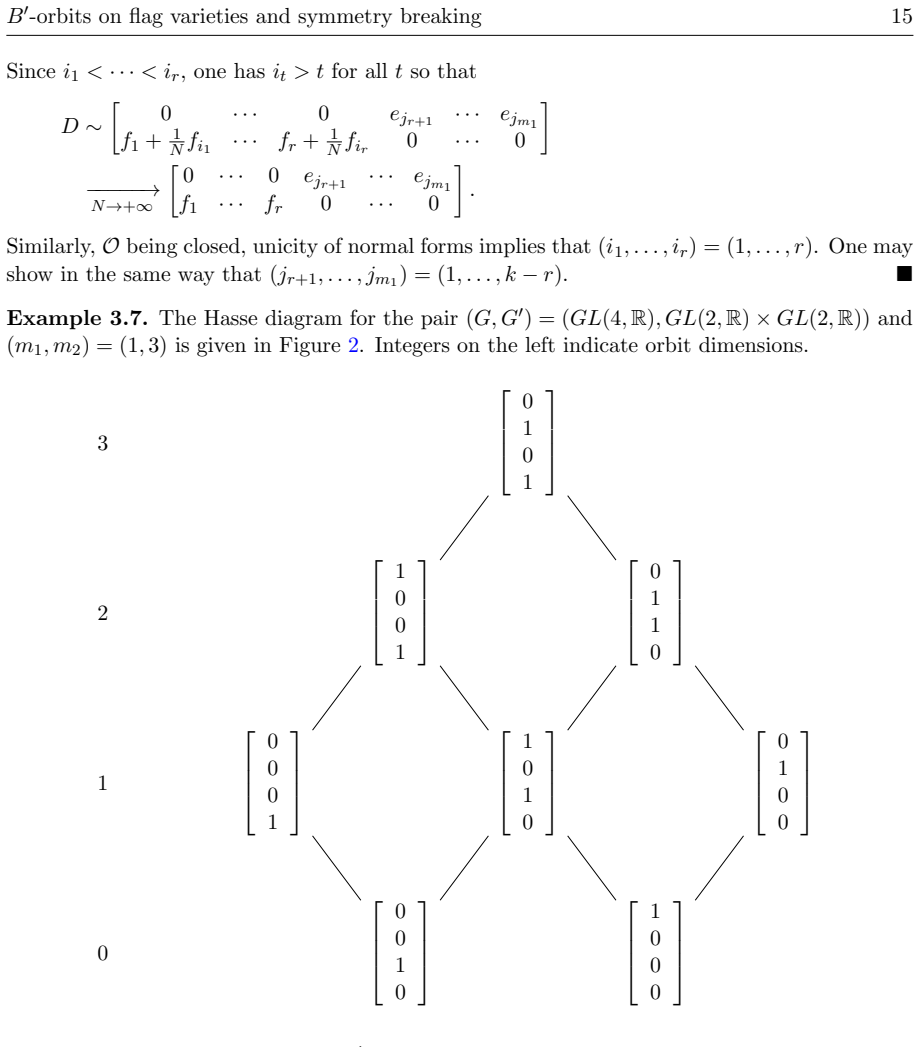
read the original abstract
Motivated by branching problems for principal series representations of the Lie group $G = GL(n,\mathbb R)$, we consider all pairs $(G', P)$ with $G'$ being the Levy factor of a parabolic subgroup of $G$ and $P$ a parabolic subgroup of $G$ for which a Borel subgroup $B'$ of $G'$ has finitely many orbits on $G/P$. We classify all such pairs $(G',P)$ for which $B'$-orbits on the generalized flag variety $G/P$ are determined by invariant functions inspired from the Bruhat decomposition. We also describe explicitly the double coset space $B'\backslash G/P$ as well as the closed $B'$-orbits on $G/P$ whenever $B'$-orbits are computed by these invariant functions.
Editorial analysis
A structured set of objections, weighed in public.
Referee Report
Summary. Motivated by branching problems for principal series representations of the Lie group G = GL(n, ℝ), the manuscript classifies all pairs (G', P) with G' the Levi factor of a parabolic subgroup of G and P a parabolic subgroup of G such that a Borel subgroup B' of G' has finitely many orbits on the generalized flag variety G/P and these orbits are determined by invariant functions inspired from the Bruhat decomposition. It also explicitly describes the double coset space B'∖G/P as well as the closed B'-orbits on G/P for the classified pairs.
Significance. If the classification and descriptions hold, the result supplies concrete, explicit information on B'-orbit structures and invariants on flag varieties in the setting of GL(n, ℝ). This is relevant to symmetry breaking and branching laws for principal series. The paper provides explicit descriptions of the double coset space and closed orbits, which are strengths that can serve as tools for further representation-theoretic applications.
Simulated Author's Rebuttal
We thank the referee for their positive report, accurate summary of the manuscript's contributions, and recommendation to accept. We are pleased that the explicit classification of pairs (G', P), the description of the double coset space B'∖G/P, and the closed orbits are viewed as useful for symmetry breaking and branching problems.
Circularity Check
No significant circularity; classification is self-contained
full rationale
The paper defines the object of study as the set of pairs (G', P) for which B' has finitely many orbits on G/P and those orbits are separated by Bruhat-inspired invariant functions. The classification, explicit double-coset description, and closed-orbit list are all stated to hold precisely for the pairs satisfying that separation condition. No load-bearing equation, parameter fit, or self-citation is shown that would make the classified set equivalent to its own input by construction. The derivation therefore remains independent of its outputs and is self-contained against external benchmarks.
Axiom & Free-Parameter Ledger
axioms (2)
- standard math Levi factors and parabolic subgroups of GL(n,R) admit the usual structure theory of algebraic groups
- standard math The Bruhat decomposition provides a cell decomposition of G/P that can be used to construct invariant functions
Reference graph
Works this paper leans on
-
[1]
Brion M., Lectures on the geometry of flag varieties, in Topics in cohomological studies of algebraic varieties, Trends Math., Birkh¨ auser, Basel, 2005, 33–85
2005
-
[2]
Bruhat F., Sur les repr´ esentations induites des groupes de Lie,Bull. Soc. Math. France84(1956), 97–205
1956
-
[3]
Pure Appl
Colarusso M., Evens S., Orbits on a product of two flags and a line and the Bruhat order, I,J. Pure Appl. Algebra229(2025), Paper No. 108100, 21
2025
- [4]
-
[5]
Ditlevsen J., Labriet Q., Differential symmetry breaking operators for the pair (GL n+1(R),GL n(R)),J. Funct. Anal.290(2026), Paper No. 111335, 39
2026
-
[6]
Frahm J., Symmetry breaking operators for strongly spherical reductive pairs,Publ. Res. Inst. Math. Sci. 59(2023), 259–337
2023
-
[7]
35, Cambridge University Press, Cambridge, 1997, with applications to representation theory and geometry
Fulton W., Young tableaux,London Mathematical Society Student Texts, Vol. 35, Cambridge University Press, Cambridge, 1997, with applications to representation theory and geometry
1997
-
[8]
Dedicata105(2004), 13–27
Hashimoto T.,B n−1-orbits on the flag variety GL n/Bn,Geom. Dedicata105(2004), 13–27
2004
-
[9]
Knapp A.W., Representation theory of semisimple groups, Princeton Landmarks in Mathematics, Princeton University Press, Princeton, NJ, 2001, an overview based on examples, Reprint of the 1986 original
2001
-
[10]
Kobayashi T., A generalized Cartan decomposition for the double coset space (U(n 1)×U(n 2)× U(n3))\U(n)/(U(p)×U(q)),J. Math. Soc. Japan59(2007), 669–691
2007
-
[11]
Groups17(2012), 523–546
Kobayashi T., Restrictions of generalized Verma modules to symmetric pairs,Transform. Groups17(2012), 523–546
2012
-
[12]
Kobayashi T., Generating operators of symmetry breaking—from discrete to continuous,Indag. Math. (N.S.) 36(2025), 631–643
2025
-
[13]
Japan Acad
Kobayashi T., Leontiev A., Symmetry breaking operators for the restriction of representations of indefinite orthogonal groupsO(p, q),Proc. Japan Acad. Ser. A Math. Sci.93(2017), 86–91
2017
-
[14]
Math.248(2013), 921–944
Kobayashi T., Oshima T., Finite multiplicity theorems for induction and restriction,Adv. Math.248(2013), 921–944
2013
-
[15]
General theory and F-method, Selecta Math
Kobayashi T., Pevzner M., Differential symmetry breaking operators: I. General theory and F-method, Selecta Math. (N.S.)22(2016), 801–845
2016
-
[16]
Kobayashi T., Pevzner M., Generating operators and normal derivatives, in Expansion in Representation Theory and Harmonic Analysis, Vol. 2297, Y. Tanaka, Kyoto, Japan, 2024, 1–15
2024
-
[17]
Kobayashi T., Pevzner M., A generating operator for Rankin-Cohen brackets,J. Funct. Anal.289(2025), Paper No. 110944, 22
2025
-
[18]
Kobayashi T., Speh B., Symmetry breaking for representations of rank one orthogonal groups,Mem. Amer. Math. Soc.238(2015), v+110
2015
-
[19]
2234, Springer, Singapore, 2018
Kobayashi T., Speh B., Symmetry breaking for representations of rank one orthogonal groups II,Lecture Notes in Mathematics, Vol. 2234, Springer, Singapore, 2018
2018
-
[20]
Algebraic Combin.21(2005), 71–101
Magyar P., Bruhat order for two flags and a line,J. Algebraic Combin.21(2005), 71–101. 30 V. Massicot
2005
-
[21]
Mautner F.I., Unitary representations of locally compact groups. I,Ann. of Math. (2)51(1950), 1–25
1950
-
[22]
Schwartz L., Th´ eorie des distributions ` a valeurs vectorielles. I,Ann. Inst. Fourier (Grenoble)7(1957), 1–141
1957
-
[23]
Sun B., Zhu C.B., Multiplicity one theorems: the Archimedean case,Ann. of Math. (2)175(2012), 23–44
2012
discussion (0)
Sign in with ORCID, Apple, or X to comment. Anyone can read and Pith papers without signing in.