Recognition: unknown
Oxygen Isotopic Compositions of Chondrules as Probes of Solar Protoplanetary Disk Formation
Pith reviewed 2026-05-07 14:41 UTC · model grok-4.3
The pith
Simulations of solar disk formation show that moderate radial mass infall reproduces oxygen isotopic compositions of carbonaceous chondrules.
A machine-rendered reading of the paper's core claim, the machinery that carries it, and where it could break.
Core claim
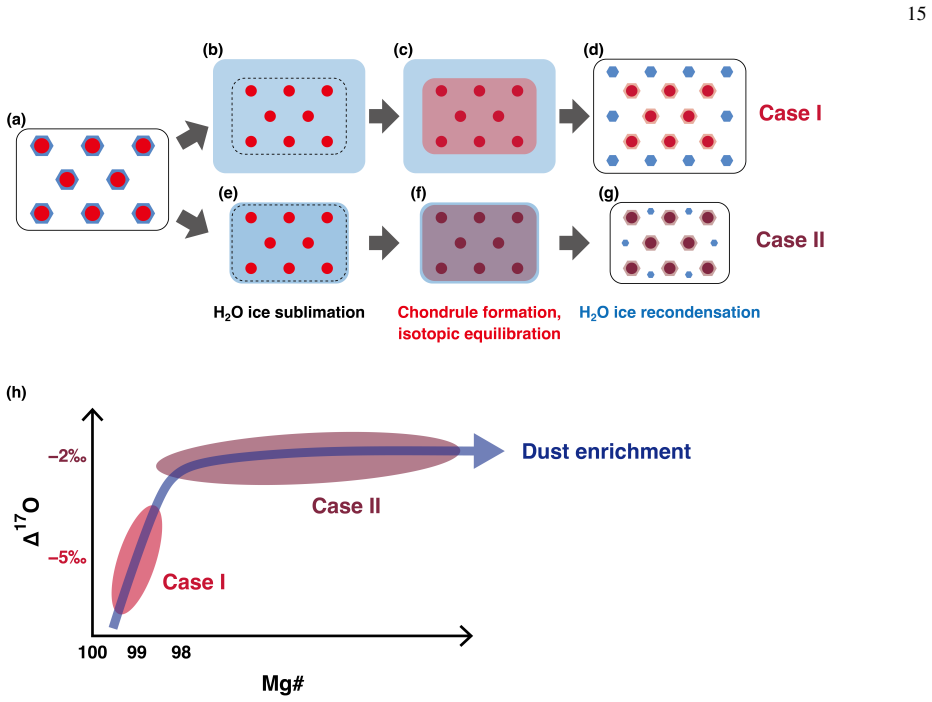
The central claim is that the oxygen isotopic compositions of carbonaceous-chondrite chondrules can be reproduced in the disk evolution model if the radial extent of mass infall is moderate at about 10 au, or if it is larger than 10 au but the parental cloud core was ice-depleted or had weaker CO self-shielding. The model further suggests that the bimodal trends in isotopic composition and redox state arise from partial escape of H2O vapor from chondrule-forming regions. However, ordinary-chondrite chondrules formed inside the snow line at temperatures below 500 K would be difficult to explain because isotopic exchange occurs efficiently only in hotter inner regions above 500-600 K.
What carries the argument
One-dimensional simulations solving the diffusion-advection equation for disk surface density evolution with added mass infall from the parental cloud core, coupled to an experimentally derived model for oxygen isotope exchange between silicates and vapor species.
If this is right
- The observed oxygen isotopes in carbonaceous chondrules are consistent with either limited radial spread of infalling gas and dust or altered initial cloud conditions.
- Bimodal distributions in isotopes and oxidation can result from water vapor loss during flash heating of chondrules.
- Ordinary chondrules require formation conditions where temperatures allow efficient isotope exchange, likely closer to the star.
- The model constrains the possible radial profiles of material addition during disk formation.
Where Pith is reading between the lines
- Different chondrite groups may sample material from distinct radial zones or epochs in the disk's history.
- Future observations of protoplanetary disks around other stars could test whether infall radii are typically around 10 au.
- The assumption of efficient exchange only at high temperatures suggests that ordinary chondrules might have formed earlier or in a different dynamical setting than currently modeled.
- Linking to redox states implies that volatile loss processes during chondrule formation influenced the final compositions of planetesimals.
Load-bearing premise
The laboratory-derived rates and conditions for oxygen isotope exchange between silicates and gas species hold under the actual temperature, density, and timescale conditions inside the solar protoplanetary disk.
What would settle it
Laboratory experiments demonstrating that significant oxygen isotope exchange between chondrule silicates and surrounding vapor does not occur at temperatures below 500 K in realistic disk gas compositions, or astronomical observations showing that the radial extent of mass infall in the early solar disk greatly exceeded 10 au with standard cloud ice content and shielding.
Figures


read the original abstract
Chondrules are thought to have formed during transient flash-heating events in dust-enriched regions of the solar protoplanetary disk. Although laboratory studies have characterized the oxygen isotopic compositions of chondritic materials, quantitative interpretations based on simulations of disk formation and evolution remain limited. Here, we perform one-dimensional simulations of disk formation and evolution by solving a diffusion--advection equation with mass infall from the parental cloud core. We compute the temporal evolution of oxygen isotopic compositions using an experimentally derived isotope-exchange model. We examine how the oxygen isotopic signatures of the disk depend on the radial distribution of infalling material and the composition of the parental cloud core. We find that the oxygen isotopic compositions of carbonaceous-chondrite chondrules can be reproduced if either (i) the radial extent of mass infall onto the disk is moderate ($\sim 10~{\rm au}$), or (ii) it is large ($> 10~{\rm au}$) and the parental cloud core was ice-depleted and/or experienced weaker CO self-shielding than is commonly assumed. We further suggest the scenario that the observed bimodal trends in oxygen isotopic composition and redox state reflect the partial escape of H$_{2}$O vapor from chondrule-forming regions during heating. In contrast, if ordinary-chondrite chondrules formed inside the snow line under background temperatures of $\lesssim 500~{\rm K}$, their oxygen isotopic compositions may be difficult to explain within the present disk-evolution model, because oxygen isotopic exchange between silicates and vapor species proceeds efficiently only in the inner disk at $T \gtrsim 500$--$600~{\rm K}$.
Editorial analysis
A structured set of objections, weighed in public.
Referee Report
Summary. The manuscript presents one-dimensional diffusion-advection simulations of protoplanetary disk formation that include mass infall from the parental cloud core. Oxygen isotopic evolution is computed using an experimentally derived isotope-exchange model. The central claim is that carbonaceous-chondrite chondrule compositions are reproduced either when the radial extent of infall is moderate (~10 au) or when it is larger (>10 au) but the parental cloud is ice-depleted and/or has weaker CO self-shielding than standard assumptions; bimodal isotopic and redox trends are attributed to partial H2O vapor escape during heating. Ordinary-chondrite chondrules are argued to be difficult to explain if formed inside the snow line at background temperatures ≲500 K, because efficient exchange occurs only at T ≳500–600 K in the inner disk.
Significance. If the numerical results hold under independent validation, the work supplies a quantitative dynamical framework linking observed chondrule oxygen isotopes to disk formation parameters such as infall radial extent and cloud-core composition. The use of laboratory-derived exchange rates within a time-dependent infall model is a constructive step toward falsifiable predictions for solar-nebula evolution and the origin of isotopic bimodality.
major comments (3)
- [Abstract and results section describing infall scenarios] Abstract and results on parameter exploration: the reproduction of CC chondrule compositions is achieved by varying the free parameters 'radial extent of mass infall' and 'parental cloud ice content and CO self-shielding strength'; no a-priori constraints or grid of untuned runs are shown to demonstrate that the match is not the result of post-hoc selection.
- [Methods section on isotope-exchange model] Model implementation of isotope exchange: the manuscript assumes the experimentally derived exchange rates and temperature thresholds (efficient only at T ≳500–600 K) apply directly to disk pressures, densities, and transient heating timescales, but provides no explicit mapping, validation against disk conditions, or sensitivity tests to these assumptions.
- [Discussion of ordinary chondrules] Ordinary-chondrule discussion: the claim that OC chondrules are difficult to reproduce rests on the additional assumption of formation inside the snow line at background T ≲500 K; no alternative formation locations, temperature histories, or parameter variations are explored to test the robustness of this difficulty.
minor comments (2)
- [Abstract] The abstract states that the model 'further suggest[s] the scenario' of partial H2O escape but does not quantify the vapor-loss fraction or show the corresponding simulation output that supports the bimodal trend.
- [Abstract and methods] Notation for radial distances (au) and temperature thresholds is used without an initial definition or reference to standard values.
Simulated Author's Rebuttal
We thank the referee for their thorough and constructive review of our manuscript. We address each of the major comments below and have revised the manuscript accordingly to improve clarity and robustness.
read point-by-point responses
-
Referee: Abstract and results on parameter exploration: the reproduction of CC chondrule compositions is achieved by varying the free parameters 'radial extent of mass infall' and 'parental cloud ice content and CO self-shielding strength'; no a-priori constraints or grid of untuned runs are shown to demonstrate that the match is not the result of post-hoc selection.
Authors: We agree that a more systematic presentation of the parameter space would strengthen the manuscript. In the revised version, we have added a new figure (Figure X) that displays the oxygen isotopic compositions for a grid of simulations varying the radial extent of infall from 5 to 30 au and the ice content from 0 to 100% of standard, along with a table summarizing the key outcomes. This demonstrates that the reproduction of CC compositions occurs systematically for moderate infall radii or reduced ice contents, rather than isolated tuned cases. We have also updated the abstract to reflect this broader exploration. revision: yes
-
Referee: Model implementation of isotope exchange: the manuscript assumes the experimentally derived exchange rates and temperature thresholds (efficient only at T ≳500–600 K) apply directly to disk pressures, densities, and transient heating timescales, but provides no explicit mapping, validation against disk conditions, or sensitivity tests to these assumptions.
Authors: The exchange model is based on laboratory experiments that were conducted under conditions relevant to the solar nebula, as detailed in the cited references. To address the concern, we have performed additional sensitivity tests in the revised manuscript, varying the temperature threshold for efficient exchange between 400-700 K and the exchange rate by factors of 0.5 and 2. The results show that while the exact timing shifts, the overall conclusions regarding the need for inner disk conditions or specific infall scenarios remain unchanged. We have added a new subsection in the methods discussing the mapping to disk conditions, including estimates of how pressure and density affect the rates based on kinetic theory. revision: yes
-
Referee: Ordinary-chondrule discussion: the claim that OC chondrules are difficult to reproduce rests on the additional assumption of formation inside the snow line at background T ≲500 K; no alternative formation locations, temperature histories, or parameter variations are explored to test the robustness of this difficulty.
Authors: The paper's primary focus is on the implications of disk formation for chondrule isotopes under commonly assumed formation conditions for OC chondrules. We recognize that alternative scenarios exist, such as formation in warmer regions or with different thermal histories. In the revised discussion section, we have expanded the text to include a brief exploration of how higher background temperatures (e.g., >500 K) or additional heating events could facilitate isotopic exchange for OC chondrules. However, a comprehensive parameter study of all possible OC formation locations is outside the scope of this work, which centers on the infall and disk evolution phase. We believe the conditional statement in the original manuscript is appropriate given the current understanding. revision: partial
Circularity Check
No significant circularity; parameter exploration matches observations without reduction to inputs by construction
full rationale
The paper solves a standard 1D diffusion-advection equation for disk evolution with mass infall, inserts an experimentally derived isotope-exchange model, and varies two external parameters (radial extent of infall, parental cloud ice/CO-shielding) to determine the conditions under which observed CC chondrule compositions are reproduced. This is an explicit conditional parameter study, not a closed derivation in which the output isotopic ratios are forced by the inputs via self-definition, fitted parameters renamed as predictions, or load-bearing self-citations. No equations or sections in the provided text exhibit a reduction of the central claim to its own fitted values by construction; the exchange kinetics remain independent laboratory inputs. The result is therefore self-contained against the external observational benchmark.
Axiom & Free-Parameter Ledger
free parameters (2)
- radial extent of mass infall
- parental cloud ice content and CO self-shielding strength
axioms (3)
- standard math One-dimensional diffusion-advection equation governs disk mass and isotope transport
- domain assumption Experimentally derived isotope-exchange model applies to protoplanetary disk conditions
- domain assumption Ordinary chondrules formed inside snow line at background temperatures ≲500 K
Reference graph
Works this paper leans on
-
[1]
Alexander, C. M. O., Nittler, L. R., Davidson, J., & Ciesla, F. J. 2017, M&PS, 52, 1797, doi: 10.1111/maps.12891
-
[2]
Alexander, C. M. O. D. 2004, GeoCoA, 68, 3943, doi: 10.1016/j.gca.2004.03.030
-
[3]
Alexander, C. M. O. D., Grossman, J. N., Ebel, D. S., & Ciesla, F. J. 2008, Science, 320, 1617, doi: 10.1126/science.1156561
-
[4]
Altwegg, K., Balsiger, H., & Fuselier, S. A. 2019, ARA&A, 57, 113, doi: 10.1146/annurev-astro-091918-104409
-
[5]
Amelin, Y ., Kaltenbach, A., Iizuka, T., et al. 2010, Earth and Planetary Science Letters, 300, 343, doi: 10.1016/j.epsl.2010.10.015 André, P., Di Francesco, J., Ward-Thompson, D., et al. 2014, in Protostars and Planets VI, ed. H. Beuther, R. S. Klessen, C. P. Dullemond, & T. Henning, 27–51, doi: 10.2458/azu_uapress_9780816531240-ch002
-
[6]
Ansdell, M., Williams, J. P., van der Marel, N., et al. 2016, ApJ, 828, 46, doi: 10.3847/0004-637X/828/1/46
-
[7]
2021, ApJ, 920, 27, doi: 10.3847/1538-4357/ac157e
Arakawa, S., Matsumoto, Y ., & Honda, M. 2021, ApJ, 920, 27, doi: 10.3847/1538-4357/ac157e
-
[8]
2024, ApJ, 974, 199, doi: 10.3847/1538-4357/ad7795
Kawasaki, N. 2024, ApJ, 974, 199, doi: 10.3847/1538-4357/ad7795
-
[9]
Arakawa, S., Yamamoto, D., Ushikubo, T., et al. 2023, Icarus, 405, 115690, doi: 10.1016/j.icarus.2023.115690 20 Figure D1.Radial distribution of each oxygen reservoir and their oxygen isotopic composition att= 0.1 Myr, instead oft= 1 Myr(Figure 5). The left, middle, and right columns correspond toωcd = 3×10 −15 s−1 (i.e.,r c,fin ≈1 au),ω cd = 1×10 −14 s−1...
-
[10]
Armitage, P. J., Livio, M., & Pringle, J. E. 2001, MNRAS, 324, 705, doi: 10.1046/j.1365-8711.2001.04356.x
-
[11]
Arzoumanian, D., Arakawa, S., Kobayashi, M. I. N., et al. 2023, ApJL, 947, L29, doi: 10.3847/2041-8213/acc849
-
[12]
Asplund, M., Amarsi, A. M., & Grevesse, N. 2021, A&A, 653, A141, doi: 10.1051/0004-6361/202140445
-
[13]
1976, Earth and Planetary Science Letters, 31, 341, doi: 10.1016/0012-821X(76)90115-1
Baertschi, P. 1976, Earth and Planetary Science Letters, 31, 341, doi: 10.1016/0012-821X(76)90115-1
-
[14]
2017, ApJ, 845, 75, doi: 10.3847/1538-4357/aa7dda
Bai, X.-N. 2017, ApJ, 845, 75, doi: 10.3847/1538-4357/aa7dda
-
[15]
2024, A&A, 687, A158, doi: 10.1051/0004-6361/202449594
Bhandare, A., Commerçon, B., Laibe, G., et al. 2024, A&A, 687, A158, doi: 10.1051/0004-6361/202449594
-
[16]
2018, SSRv, 214, 52, doi: 10.1007/s11214-018-0486-5 Bodénan, J.-D., Starkey, N
Blum, J. 2018, SSRv, 214, 52, doi: 10.1007/s11214-018-0486-5 Bodénan, J.-D., Starkey, N. A., Russell, S. S., Wright, I. P., &
-
[17]
Franchi, I. A. 2014, Earth and Planetary Science Letters, 401, 327, doi: 10.1016/j.epsl.2014.05.035
-
[18]
Bonnor, W. B. 1956, MNRAS, 116, 351, doi: 10.1093/mnras/116.3.351
-
[19]
Boogert, A. C. A., Gerakines, P. A., & Whittet, D. C. B. 2015, ARA&A, 53, 541, doi: 10.1146/annurev-astro-082214-122348
work page Pith review doi:10.1146/annurev-astro-082214-122348 2015
-
[20]
1981, Icarus, 48, 353, doi: 10.1016/0019-1035(81)90051-8
Cassen, P., & Moosman, A. 1981, Icarus, 48, 353, doi: 10.1016/0019-1035(81)90051-8
-
[21]
Chaumard, N., Defouilloy, C., Hertwig, A. T., & Kita, N. T. 2021, GeoCoA, 299, 199, doi: 10.1016/j.gca.2021.02.012
-
[22]
Chiang, E. I., & Goldreich, P. 1997, ApJ, 490, 368, doi: 10.1086/304869
-
[23]
doi:10.1016/j.icarus.2005.11.009 , eprint =
Ciesla, F. J., & Cuzzi, J. N. 2006, Icarus, 181, 178, doi: 10.1016/j.icarus.2005.11.009
-
[24]
Clayton, R. N. 2002, Nature, 415, 860, doi: 10.1038/415860b
-
[25]
N., Onuma, N., Grossman, L., & Mayeda, T
Clayton, R. N., Onuma, N., Grossman, L., & Mayeda, T. K. 1977, Earth and Planetary Science Letters, 34, 209, doi: 10.1016/0012-821X(77)90005-X
-
[26]
Connelly, J. N., Bizzarro, M., Krot, A. N., et al. 2012, Science, 338, 651, doi: 10.1126/science.1226919
-
[27]
Cuzzi, J. N., & Zahnle, K. J. 2004, ApJ, 614, 490, doi: 10.1086/423611 21 Figure D2.Radial distribution of each oxygen reservoir and their oxygen isotopic composition att= 0.1 Myr, instead oft= 1 Myr(Figure 6). The left, middle, and right columns correspond to case (i) (a agg,in = 10 mmanda agg,out = 0.1 mm), case (ii) (a agg,in = 0.1 mmand aagg,out = 10 ...
-
[28]
2023, Icarus, 402, 115607, doi: 10.1016/j.icarus.2023.115607
Mane, P. 2023, Icarus, 402, 115607, doi: 10.1016/j.icarus.2023.115607
-
[29]
2023, ApJ, 957, 11, doi: 10.3847/1538-4357/acf5df
Doi, K., & Kataoka, A. 2023, ApJ, 957, 11, doi: 10.3847/1538-4357/acf5df
-
[30]
Dominik, C., & Dullemond, C. P. 2024, A&A, 682, A144, doi: 10.1051/0004-6361/202347716
-
[31]
Dullemond, C. P., Apai, D., & Walch, S. 2006, ApJL, 640, L67, doi: 10.1086/503100
-
[32]
Dullemond, C. P., & Monnier, J. D. 2010, ARA&A, 48, 205, doi: 10.1146/annurev-astro-081309-130932
-
[33]
S., Alexander, C
Ebel, D. S., Alexander, C. M. O., & Libourel, G. 2018, in Chondrules: Records of Protoplanetary Disk Processes, ed. S. S
2018
-
[34]
Russell, H. C. Connolly, Jr., & A. N. Krot, 151–174, doi: 10.1017/9781108284073.006
-
[35]
2017, Royal Society Open Science, 4, 170114, doi: 10.1098/rsos.170114
Ercolano, B., & Pascucci, I. 2017, Royal Society Open Science, 4, 170114, doi: 10.1098/rsos.170114
-
[36]
2018, Earth and Planetary Science Letters, 481, 264, doi: 10.1016/j.epsl.2017.10.046
Fujiya, W. 2018, Earth and Planetary Science Letters, 481, 264, doi: 10.1016/j.epsl.2017.10.046
-
[37]
2019, Nature Astronomy, 3, 910, doi: 10.1038/s41550-019-0801-4
Fujiya, W., Hoppe, P., Ushikubo, T., et al. 2019, Nature Astronomy, 3, 910, doi: 10.1038/s41550-019-0801-4
-
[38]
Fukuda, K., Brownlee, D. E., Joswiak, D. J., et al. 2021, GeoCoA, 293, 544, doi: 10.1016/j.gca.2020.09.036
-
[39]
Fukuda, K., Tenner, T. J., Kimura, M., et al. 2022, GeoCoA, 322, 194, doi: 10.1016/j.gca.2021.12.027
-
[40]
2022, ApJ, 938, 29, doi: 10.3847/1538-4357/ac9233
Furuya, K., Lee, S., & Nomura, H. 2022, ApJ, 938, 29, doi: 10.3847/1538-4357/ac9233
-
[41]
Greenberg, J. M. 1998, A&A, 330, 375
1998
-
[42]
Guidi, G., Isella, A., Testi, L., et al. 2022, A&A, 664, A137, doi: 10.1051/0004-6361/202142303
-
[43]
Hallenbeck, S. L., Nuth, III, J. A., & Nelson, R. N. 2000, ApJ, 535, 247, doi: 10.1086/308810 22
-
[44]
Harker, D. E., Wooden, D. H., Kelley, M. S. P., & Woodward, C. E. 2023, PSJ, 4, 242, doi: 10.3847/PSJ/ad0382
-
[45]
Progress of Theoretical Physics Supplement , year = 1981, month = jan, volume =
Hayashi, C. 1981, Progress of Theoretical Physics Supplement, 70, 35, doi: 10.1143/PTPS.70.35
-
[46]
2008, A&A, 477, 9, doi: 10.1051/0004-6361:20078309
Hennebelle, P., & Fromang, S. 2008, A&A, 477, 9, doi: 10.1051/0004-6361:20078309
-
[47]
2010, ARA&A, 48, 21, doi: 10.1146/annurev-astro-081309-130815 47
Henning, T. 2010, ARA&A, 48, 21, doi: 10.1146/annurev-astro-081309-130815
-
[48]
Hertwig, A. T., Defouilloy, C., & Kita, N. T. 2018, GeoCoA, 224, 116, doi: 10.1016/j.gca.2017.12.013
-
[49]
T., Kimura, M., Ushikubo, T., Defouilloy, C., & Kita, N
Hertwig, A. T., Kimura, M., Ushikubo, T., Defouilloy, C., & Kita, N. T. 2019, GeoCoA, 253, 111, doi: 10.1016/j.gca.2019.02.020
-
[50]
Hirano, S., Tsukamoto, Y ., Basu, S., & Machida, M. N. 2020, ApJ, 898, 118, doi: 10.3847/1538-4357/ab9f9d
-
[51]
2018, ApJ, 868, 118, doi: 10.3847/1538-4357/aae0fb
Homma, K., & Nakamoto, T. 2018, ApJ, 868, 118, doi: 10.3847/1538-4357/aae0fb
-
[52]
A., Okuzumi, S., Arakawa, S., & Fukai, R
Homma, K. A., Okuzumi, S., Arakawa, S., & Fukai, R. 2024, PASJ, 76, 881, doi: 10.1093/pasj/psae052
-
[53]
Honda, M., Kataza, H., Okamoto, Y . K., et al. 2003, ApJL, 585, L59, doi: 10.1086/374034
-
[54]
2023, SSRv, 219, 32, doi: 10.1007/s11214-023-00977-9
Hoppe, P., Rubin, M., & Altwegg, K. 2023, SSRv, 219, 32, doi: 10.1007/s11214-023-00977-9
-
[55]
2021, MNRAS, 503, 162, doi: 10.1093/mnras/stab542
Hu, Z., & Bai, X.-N. 2021, MNRAS, 503, 162, doi: 10.1093/mnras/stab542
-
[56]
Hueso, R., & Guillot, T. 2005, A&A, 442, 703, doi: 10.1051/0004-6361:20041905
-
[57]
2025, ApJL, 979, L29, doi: 10.3847/2041-8213/ada554
Iizuka, T., Hibiya, Y ., Yoshihara, S., & Hayakawa, T. 2025, ApJL, 979, L29, doi: 10.3847/2041-8213/ada554
-
[58]
2023, ApJ, 957, 47, doi: 10.3847/1538-4357/acf310
Ishizaki, L., Tachibana, S., Okamoto, T., Yamamoto, D., & Ida, S. 2023, ApJ, 957, 47, doi: 10.3847/1538-4357/acf310
-
[59]
Iwasaki, K., Tomida, K., Takasao, S., Okuzumi, S., & Suzuki, T. K. 2024, PASJ, 76, 616, doi: 10.1093/pasj/psae036
-
[60]
C., Chaussidon, M., & Charnoz, S
Jacquet, E., Pignatale, F. C., Chaussidon, M., & Charnoz, S. 2019, ApJ, 884, 32, doi: 10.3847/1538-4357/ab38c1
-
[61]
Jaoul, O., Froidevaux, C., Durham, W. B., & Michaut, M. 1980, Earth and Planetary Science Letters, 47, 391, doi: 10.1016/0012-821X(80)90026-6
-
[62]
2014, in Protostars and Planets VI, ed
Johansen, A., Blum, J., Tanaka, H., et al. 2014, in Protostars and Planets VI, ed. H. Beuther, R. S. Klessen, C. P. Dullemond, & T. Henning, 547–570, doi: 10.2458/azu_uapress_9780816531240-ch024
-
[63]
H., Villeneuve, J., & Libourel, G
Jones, R. H., Villeneuve, J., & Libourel, G. 2018, in Chondrules: Records of Protoplanetary Disk Processes, ed. S. S. Russell, H. C. Connolly, Jr., & A. N. Krot, 57–90, doi: 10.1017/9781108284073.003
-
[64]
2025, Communications Earth and Environment, 6, 537, doi: 10.1038/s43247-025-02511-x
Kawasaki, N., Arakawa, S., Miyamoto, Y ., et al. 2025, Communications Earth and Environment, 6, 537, doi: 10.1038/s43247-025-02511-x
-
[65]
2017, GeoCoA, 201, 83, doi: 10.1016/j.gca.2015.12.031
Kawasaki, N., Itoh, S., Sakamoto, N., & Yurimoto, H. 2017, GeoCoA, 201, 83, doi: 10.1016/j.gca.2015.12.031
-
[66]
2020, GeoCoA, 279, 1, doi: 10.1016/j.gca.2020.03.045
Kawasaki, N., Wada, S., Park, C., Sakamoto, N., & Yurimoto, H. 2020, GeoCoA, 279, 1, doi: 10.1016/j.gca.2020.03.045
-
[67]
Kawasaki, Y ., & Machida, M. N. 2025, ApJ, 985, 106, doi: 10.3847/1538-4357/adc67b
-
[68]
Kemper, F., Vriend, W. J., & Tielens, A. G. G. M. 2004, ApJ, 609, 826, doi: 10.1086/421339
-
[69]
T., Nagahara, H., Tachibana, S., et al
Kita, N. T., Nagahara, H., Tachibana, S., et al. 2010, GeoCoA, 74, 6610, doi: 10.1016/j.gca.2010.08.011
-
[70]
Kita, N. T., & Ushikubo, T. 2012, M&PS, 47, 1108, doi: 10.1111/j.1945-5100.2011.01264.x
-
[71]
2020, SSRv, 216, 55, doi: 10.1007/s11214-020-00675-w
Kleine, T., Budde, G., Burkhardt, C., et al. 2020, SSRv, 216, 55, doi: 10.1007/s11214-020-00675-w
-
[72]
2023, ApJ, 949, 119, doi: 10.3847/1538-4357/acc840
Kondo, K., Okuzumi, S., & Mori, S. 2023, ApJ, 949, 119, doi: 10.3847/1538-4357/acc840
-
[73]
Krijt, S., Bosman, A. D., Zhang, K., et al. 2020, ApJ, 899, 134, doi: 10.3847/1538-4357/aba75d
-
[74]
Krot, A. N. 2019, M&PS, 54, 1647, doi: 10.1111/maps.13350
-
[75]
Krot, A. N., Nagashima, K., Lyons, J. R., Lee, J.-E., & Bizzarro, M. 2020, Science Advances, 6, eaay2724, doi: 10.1126/sciadv.aay2724
-
[76]
S., Burkhardt, C., Budde, G., & Kleine, T
Kruijer, T. S., Burkhardt, C., Budde, G., & Kleine, T. 2017, Proceedings of the National Academy of Science, 114, 6712, doi: 10.1073/pnas.1704461114
-
[77]
Kruijer, T. S., Kleine, T., & Borg, L. E. 2020, Nature Astronomy, 4, 32, doi: 10.1038/s41550-019-0959-9
-
[78]
Kunitomo, M., Suzuki, T. K., & Inutsuka, S.-i. 2020, MNRAS, 492, 3849, doi: 10.1093/mnras/staa087
-
[79]
Lauretta, D. S., Connolly, H. C., Aebersold, J. E., et al. 2024, M&PS, 59, 2453, doi: 10.1111/maps.14227
-
[80]
arXiv , author =:2102.07963 , journal =
Lee, Y .-N., Charnoz, S., & Hennebelle, P. 2021, A&A, 648, A101, doi: 10.1051/0004-6361/202038105
discussion (0)
Sign in with ORCID, Apple, or X to comment. Anyone can read and Pith papers without signing in.