Recognition: unknown
Edge-Cloud Collaborative Reconstruction via Structure-Aware Latent Diffusion for Downstream Remote Sensing Perception
Pith reviewed 2026-05-07 17:07 UTC · model grok-4.3
The pith
A structure-aware latent diffusion system lets edge devices send minimal compressed remote sensing data while the cloud reconstructs details that support accurate detection.
A machine-rendered reading of the paper's core claim, the machinery that carries it, and where it could break.
Core claim
SALD decouples remote sensing imagery into a highly compressed low-frequency payload and a lightweight soft structural prior at the resource-limited edge, then transmits this minimal representation; the cloud applies a Structure-Gated Large Kernel module and Semantic-Guidance Engine inside the diffusion backbone to use the prior for long-range dependency modeling while suppressing hallucinations.
What carries the argument
Structure-Gated Large Kernel (SGLK) module together with Semantic-Guidance Engine (SGE) that gate large-kernel convolutions and steer the latent diffusion process using the transmitted structural prior.
If this is right
- Perceptual quality measured by LPIPS improves even at extreme compression ratios.
- Scene classification accuracy rises compared with regression-based or unguided diffusion baselines.
- Small-target detection recall and precision increase because structural hallucinations are reduced.
- Downlink bandwidth usage stays low while downstream task performance remains usable.
Where Pith is reading between the lines
- The same decoupling of payload and structural prior could be tested on other bandwidth-limited imaging streams such as drone video.
- Task-specific fine-tuning of the structural prior extraction might further raise detection scores without extra transmission cost.
- If the prior proves robust across sensors, the approach could reduce the need for on-board high-resolution storage on satellites.
Load-bearing premise
The lightweight soft structural prior extracted and sent from the edge supplies enough accurate guidance to steer cloud diffusion and suppress hallucinations without injecting new errors that lower downstream perception performance.
What would settle it
A controlled test that replaces the transmitted structural prior with random noise or an empty signal and measures whether small-target detection accuracy on the UCMerced dataset drops below the level achieved by standard regression super-resolution under the same bandwidth budget.
Figures


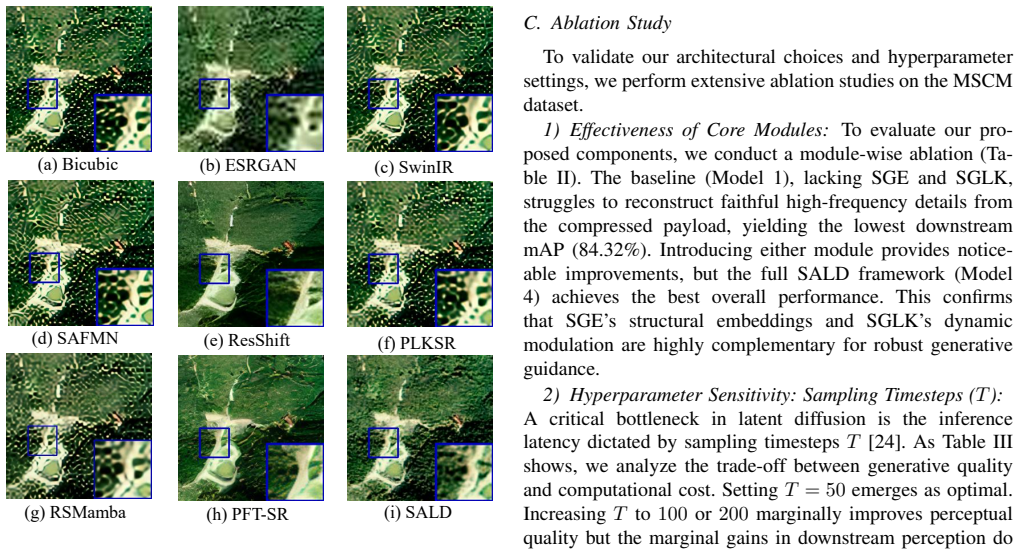
read the original abstract
The exponential surge in high-resolution remote sensing data faces a severe bottleneck in satellite-to-ground transmission. Limited downlink bandwidth forces the use of extreme high-ratio compression, which irreversibly destroys high-frequency structural details essential for downstream machine perception tasks like object detection. While current super-resolution techniques attempt to recover these details, regression-based methods often yield over-smoothed textures, and generative diffusion models frequently introduce structural hallucinations that mislead detection systems. To address this trade-off, we propose the Structure-Aware Latent Diffusion (SALD) framework, an asymmetric edge-cloud collaborative SR system. At the resource-constrained edge, the system decouples imagery into a highly compressed low-frequency payload and a lightweight soft structural prior. Transmitting this decoupled representation minimizes bandwidth consumption. On the powerful cloud side, we introduce a Structure-Gated Large Kernel (SGLK) module and a Semantic-Guidance Engine (SGE) within the diffusion backbone. These modules leverage the transmitted structural priors to gate large-kernel convolutions, effectively capturing long-range dependencies inherent in aerial scenes while actively suppressing generative hallucinations. Extensive experiments on both the MSCM and UCMerced datasets demonstrate that, even under extreme bandwidth constraints, SALD achieves superior perceptual quality (LPIPS) and significantly enhances downstream performance in both scene classification and small-target detection.
Editorial analysis
A structured set of objections, weighed in public.
Referee Report
Summary. The paper proposes the Structure-Aware Latent Diffusion (SALD) framework, an asymmetric edge-cloud collaborative super-resolution system for remote sensing imagery. At the edge, imagery is decoupled into a highly compressed low-frequency payload and a lightweight soft structural prior for minimal bandwidth transmission. On the cloud, a diffusion backbone incorporates the Structure-Gated Large Kernel (SGLK) module and Semantic-Guidance Engine (SGE) to leverage the prior for capturing long-range dependencies while suppressing generative hallucinations. The abstract claims that under extreme bandwidth constraints, SALD yields superior LPIPS perceptual quality and significantly improves downstream scene classification and small-target detection on the MSCM and UCMerced datasets.
Significance. If the empirical claims hold with proper validation, the work addresses a practical bottleneck in satellite-to-ground data transmission by enabling high-quality reconstruction tailored to machine perception tasks rather than human viewing. The asymmetric design and use of soft structural priors to constrain diffusion represent a targeted contribution to bandwidth-efficient remote sensing pipelines, with potential applicability to other high-resolution imaging domains facing similar compression-perception trade-offs.
major comments (3)
- [Abstract] Abstract: The central empirical claims of superior LPIPS and enhanced downstream performance (scene classification and small-target detection) are stated without any quantitative numbers, baselines, error bars, ablation results, or dataset-specific metrics. This absence makes it impossible to assess whether the gains are statistically meaningful or practically significant, directly undermining the headline assertion that SALD works 'even under extreme bandwidth constraints.'
- [Abstract and §4] Abstract and §4 (Method): The claim that the transmitted soft structural prior enables SGLK and SGE to suppress hallucinations without introducing new structural errors that degrade small-object AP rests on an untested assumption. No ablation isolating the prior's contribution (e.g., null prior vs. real prior, or hallucination-specific metrics tied to detection failures) is referenced, leaving open the possibility that any LPIPS improvement comes at the cost of misleading high-frequency content harmful to detection.
- [Abstract] Abstract: The bandwidth-efficiency claim depends on the prior being both lightweight and sufficiently accurate for long-range guidance, yet no transmission overhead figures, compression ratios, or edge-side extraction details are supplied to quantify the 'extreme' constraints under which the system operates.
minor comments (1)
- [Abstract] The newly introduced modules (SGLK, SGE) are described at a high level in the abstract; their precise integration into the diffusion backbone (e.g., where gating occurs in the U-Net or latent space) would benefit from a diagram or pseudocode for reproducibility.
Simulated Author's Rebuttal
We thank the referee for the constructive feedback, which highlights opportunities to strengthen the empirical presentation and clarify key design assumptions. We address each major comment below and will revise the manuscript accordingly.
read point-by-point responses
-
Referee: [Abstract] Abstract: The central empirical claims of superior LPIPS and enhanced downstream performance (scene classification and small-target detection) are stated without any quantitative numbers, baselines, error bars, ablation results, or dataset-specific metrics. This absence makes it impossible to assess whether the gains are statistically meaningful or practically significant, directly undermining the headline assertion that SALD works 'even under extreme bandwidth constraints.'
Authors: We agree that the abstract should contain key quantitative results to allow immediate evaluation of the claims. The detailed metrics, including LPIPS values, scene classification accuracies, small-target AP improvements, baseline comparisons, and standard deviations across runs on MSCM and UCMerced, are reported in Section 4 and the supplementary material. In the revised manuscript we will update the abstract to include representative numerical results (e.g., LPIPS reduction and AP gains under the stated bandwidth limits) together with the relevant baselines. revision: yes
-
Referee: [Abstract and §4] Abstract and §4 (Method): The claim that the transmitted soft structural prior enables SGLK and SGE to suppress hallucinations without introducing new structural errors that degrade small-object AP rests on an untested assumption. No ablation isolating the prior's contribution (e.g., null prior vs. real prior, or hallucination-specific metrics tied to detection failures) is referenced, leaving open the possibility that any LPIPS improvement comes at the cost of misleading high-frequency content harmful to detection.
Authors: We acknowledge that an explicit isolation of the structural prior's effect on hallucination suppression and small-object detection would strengthen the argument. Section 4 already presents ablation variants with and without the prior, demonstrating that its inclusion improves LPIPS while preserving or enhancing detection AP. To directly address the concern, we will add a focused ablation table in the revised version that includes hallucination-specific metrics (structural consistency scores) correlated with detection error rates on small targets. revision: yes
-
Referee: [Abstract] Abstract: The bandwidth-efficiency claim depends on the prior being both lightweight and sufficiently accurate for long-range guidance, yet no transmission overhead figures, compression ratios, or edge-side extraction details are supplied to quantify the 'extreme' constraints under which the system operates.
Authors: We agree that explicit bandwidth figures are required to substantiate the operating regime. Section 3.2 and the associated tables already specify the edge-side extraction process, the payload compression ratios (exceeding 100:1), and the additional transmission overhead of the soft structural prior (typically 5-10% of the compressed payload). In the revised manuscript we will incorporate these concrete numbers and a short summary of the bandwidth constraints into the abstract. revision: yes
Circularity Check
No circularity: empirical system proposal with no derivations or fitted predictions
full rationale
The manuscript describes an asymmetric edge-cloud SR framework (SALD) that decouples imagery into compressed payload plus lightweight structural prior at the edge, then applies SGLK and SGE modules on the cloud to condition a latent diffusion process. All performance claims (LPIPS, scene classification accuracy, small-target AP) are presented as outcomes of experiments on MSCM and UCMerced under stated bandwidth constraints. No equations, parameter-fitting steps, uniqueness theorems, or self-citations appear in the provided text that would reduce any result to its own inputs by construction. The central assumption—that the transmitted prior sufficiently constrains diffusion—is treated as an empirical hypothesis tested via overall metrics rather than derived or fitted by definition. This is a standard engineering proposal whose validity rests on external validation, not internal circularity.
Axiom & Free-Parameter Ledger
invented entities (2)
-
Structure-Gated Large Kernel (SGLK) module
no independent evidence
-
Semantic-Guidance Engine (SGE)
no independent evidence
Reference graph
Works this paper leans on
-
[1]
Bag-of-visual-words and spatial extensions for land-use classification,
Y . Yang and S. Newsam, “Bag-of-visual-words and spatial extensions for land-use classification,” inProceedings of the 18th SIGSPATIAL international conference on advances in geographic information sys- tems, 2010, pp. 270–279
2010
-
[2]
Searching for mo- bilenetv3,
A. Howard, M. Sandler, G. Chu, L.-C. Chen, B. Chen, M. Tan, W. Wang, Y . Zhu, R. Pang, V . Vasudevan,et al., “Searching for mo- bilenetv3,” inProceedings of the IEEE/CVF international conference on computer vision, 2019, pp. 1314–1324
2019
-
[3]
U-net: Convolutional networks for biomedical image segmentation,
O. Ronneberger, P. Fischer, and T. Brox, “U-net: Convolutional networks for biomedical image segmentation,” inInternational Confer- ence on Medical image computing and computer-assisted intervention. Springer, 2015, pp. 234–241
2015
-
[4]
Esrgan: Enhanced super-resolution generative ad- versarial networks,
X. Wang, K. Yu, S. Wu, J. Gu, Y . Liu, C. Dong, Y . Qiao, and C. Change Loy, “Esrgan: Enhanced super-resolution generative ad- versarial networks,” inProceedings of the European conference on computer vision (ECCV) workshops, 2018, pp. 0–0
2018
-
[5]
Swinir: Image restoration using swin transformer,
J. Liang, J. Cao, G. Sun, K. Zhang, L. Van Gool, and R. Timofte, “Swinir: Image restoration using swin transformer,” inProceedings of the IEEE/CVF international conference on computer vision, 2021, pp. 1833–1844
2021
-
[6]
Spatially-adaptive feature modulation for efficient image super-resolution,
L. Sun, J. Dong, J. Tang, and J. Pan, “Spatially-adaptive feature modulation for efficient image super-resolution,” inProceedings of the IEEE/CVF international conference on computer vision, 2023, pp. 13 190–13 199
2023
-
[7]
Efficient and explicit modelling of image hierarchies for image restoration,
Y . Li, Y . Fan, X. Xiang, D. Demandolx, R. Ranjan, R. Timofte, and L. Van Gool, “Efficient and explicit modelling of image hierarchies for image restoration,” inProceedings of the IEEE/CVF conference on computer vision and pattern recognition, 2023, pp. 18 278–18 289
2023
-
[8]
Resshift: Efficient diffusion model for image super-resolution by residual shifting,
Z. Yue, J. Wang, and C. C. Loy, “Resshift: Efficient diffusion model for image super-resolution by residual shifting,”Advances in neural information processing systems, vol. 36, pp. 13 294–13 307, 2023
2023
-
[9]
Partial large kernel cnns for efficient super-resolution,
D. Lee, S. Yun, and Y . Ro, “Partial large kernel cnns for efficient super-resolution,”arXiv preprint arXiv:2404.11848, 2024
-
[10]
Rsmamba: Remote sensing image classification with state space model,
K. Chen, B. Chen, C. Liu, W. Li, Z. Zou, and Z. Shi, “Rsmamba: Remote sensing image classification with state space model,”IEEE Geoscience and Remote Sensing Letters, vol. 21, pp. 1–5, 2024
2024
-
[11]
Progressive focused transformer for single image super-resolution,
W. Long, X. Zhou, L. Zhang, and S. Gu, “Progressive focused transformer for single image super-resolution,” inProceedings of the IEEE/CVF Conference on Computer Vision and Pattern Recognition, 2025, pp. 2279–2288
2025
-
[12]
Arbitrary-steps image super- resolution via diffusion inversion,
Z. Yue, K. Liao, and C. C. Loy, “Arbitrary-steps image super- resolution via diffusion inversion,” inProceedings of the Computer Vision and Pattern Recognition Conference, 2025, pp. 23 153–23 163
2025
-
[13]
Auto-Encoding Variational Bayes
D. P. Kingma and M. Welling, “Auto-encoding variational bayes,” arXiv preprint arXiv:1312.6114, 2013
work page internal anchor Pith review arXiv 2013
-
[14]
Cbam: Convolutional block attention module,
S. Woo, J. Park, J.-Y . Lee, and I. S. Kweon, “Cbam: Convolutional block attention module,” inProceedings of the European conference on computer vision (ECCV), 2018, pp. 3–19
2018
-
[15]
High-resolution image synthesis with latent diffusion models,
R. Rombach, A. Blattmann, D. Lorenz, P. Esser, and B. Ommer, “High-resolution image synthesis with latent diffusion models,” in Proceedings of the IEEE/CVF conference on computer vision and pattern recognition, 2022, pp. 10 684–10 695
2022
-
[16]
Ediffsr: An efficient diffusion probabilistic model for remote sensing image super- resolution,
Y . Xiao, Q. Yuan, K. Jiang, J. He, X. Jin, and L. Zhang, “Ediffsr: An efficient diffusion probabilistic model for remote sensing image super- resolution,”IEEE Transactions on Geoscience and Remote Sensing, vol. 62, pp. 1–14, 2024
2024
-
[17]
Feature pyramid networks for object detection,
T.-Y . Lin, P. Doll´ar, R. Girshick, K. He, B. Hariharan, and S. Belongie, “Feature pyramid networks for object detection,” inProceedings of the IEEE conference on computer vision and pattern recognition, 2017, pp. 2117–2125
2017
-
[18]
Understanding the effective receptive field in deep convolutional neural networks,
W. Luo, Y . Li, R. Urtasun, and R. Zemel, “Understanding the effective receptive field in deep convolutional neural networks,”Advances in neural information processing systems, vol. 29, 2016
2016
-
[19]
Perceptual losses for real- time style transfer and super-resolution,
J. Johnson, A. Alahi, and L. Fei-Fei, “Perceptual losses for real- time style transfer and super-resolution,” inEuropean conference on computer vision. Springer, 2016, pp. 694–711
2016
-
[20]
Edg- net: Edge-enhanced dynamic graph convolutional network for remote sensing scene classification of mining-disturbed land,
X. Li, P. Kong, W. Chen, W. He, J. Feng, and J. Wang, “Edg- net: Edge-enhanced dynamic graph convolutional network for remote sensing scene classification of mining-disturbed land,”IEEE Journal of Selected Topics in Applied Earth Observations and Remote Sensing, vol. 18, pp. 17 622–17 637, 2025
2025
-
[21]
Image quality assessment: from error visibility to structural similarity,
Z. Wang, A. C. Bovik, H. R. Sheikh, and E. P. Simoncelli, “Image quality assessment: from error visibility to structural similarity,”IEEE transactions on image processing, vol. 13, no. 4, pp. 600–612, 2004
2004
-
[22]
The unreasonable effectiveness of deep features as a perceptual metric,
R. Zhang, P. Isola, A. A. Efros, E. Shechtman, and O. Wang, “The unreasonable effectiveness of deep features as a perceptual metric,” in Proceedings of the IEEE conference on computer vision and pattern recognition, 2018, pp. 586–595
2018
-
[23]
YOLOv11: An Overview of the Key Architectural Enhancements
R. Khanam and M. Hussain, “Yolov11: An overview of the key architectural enhancements,”arXiv preprint arXiv:2410.17725, 2024
work page internal anchor Pith review arXiv 2024
-
[24]
Denoising diffusion probabilistic models,
J. Ho, A. Jain, and P. Abbeel, “Denoising diffusion probabilistic models,”Advances in neural information processing systems, vol. 33, pp. 6840–6851, 2020
2020
discussion (0)
Sign in with ORCID, Apple, or X to comment. Anyone can read and Pith papers without signing in.