Recognition: unknown
VAE-Inf: A statistically interpretable generative paradigm for imbalanced classification
Pith reviewed 2026-05-07 16:42 UTC · model grok-4.3
The pith
VAE-Inf combines a majority-class VAE with projection statistics to achieve exact finite-sample control of false positive rates in imbalanced classification.
A machine-rendered reading of the paper's core claim, the machinery that carries it, and where it could break.
Core claim
In VAE-Inf, a variational autoencoder is trained on majority-class data to learn latent posteriors, which are aggregated via Wasserstein barycenter into a global Gaussian reference. The encoder is then fine-tuned with minority samples using a distribution-aware loss enforcing separation through variance-normalized projections. Inference employs a projection-based score that admits a hypothesis testing interpretation, enabling a distribution-free calibration procedure that yields exact finite-sample control of the Type-I error without restrictive parametric assumptions.
What carries the argument
The variance-normalized projection statistic computed against the Wasserstein barycenter-derived Gaussian reference, which supplies both the discriminative separation signal and the basis for distribution-free hypothesis testing and calibration.
If this is right
- Exact finite-sample Type-I error control holds at any pre-specified level using only majority-class data.
- No strong parametric assumptions on the underlying data distribution are needed for valid calibration.
- The framework maintains competitive accuracy on standard real-world imbalanced benchmarks.
- The two-stage design separates representation learning from statistical calibration, allowing each component to be validated independently.
Where Pith is reading between the lines
- The reference-model construction could be reused for one-class anomaly detection by treating anomalies directly as out-of-reference points.
- The explicit separation between generative pre-training and projection-based fine-tuning may simplify model auditing in regulated domains.
- If the barycenter step remains stable across varying latent dimensions, the guarantees could extend to higher-dimensional feature spaces without additional assumptions.
Load-bearing premise
The Wasserstein barycenter of the VAE latent posteriors supplies a geometrically principled global Gaussian reference for the majority class, and the variance-normalized projection statistic admits a distribution-free calibration procedure.
What would settle it
On a held-out set of majority-class samples, the empirical false positive rate after applying the calibrated threshold exceeds the target significance level alpha by more than sampling error, or the empirical distribution of the projection scores under the majority class deviates from the theoretical null distribution required for the calibration.
Figures


read the original abstract
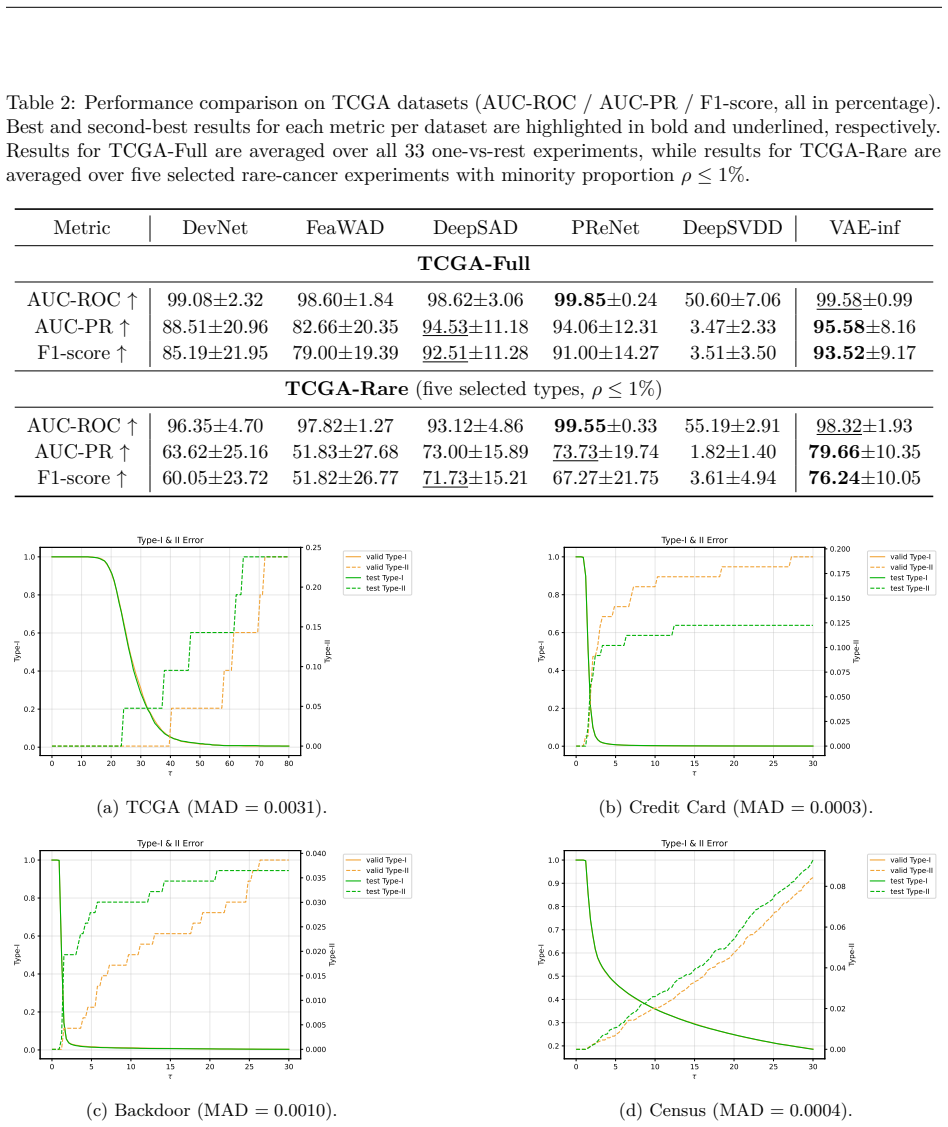
Imbalanced classification remains a pervasive challenge in machine learning, particularly when minority samples are too scarce to provide a robust discriminative boundary. In such extreme scenarios, conventional models often suffer from unstable decision boundaries and a lack of reliable error control. To bridge the gap between generative modeling and discriminative classification, we propose a two-stage framework \textbf{VAE-Inf} that integrates deep representation learning with statistically interpretable hypothesis testing. In the first stage, we adopt a one-class modeling perspective by training a variational autoencoder (VAE) exclusively on majority-class data to capture the underlying reference distribution. The resulting latent posteriors are aggregated via a Wasserstein barycenter to construct a global Gaussian reference model, providing a geometrically principled baseline for the majority class. In the second stage, we transform this generative foundation into a discriminative classifier by fine-tuning the encoder with limited minority samples. This is achieved through a novel distribution-aware loss that enforces probabilistic separation between classes based on variance-normalized projection statistics. For inference, we introduce a projection-based score that admits a natural hypothesis testing interpretation, allowing for a distribution-free calibration procedure. This approach yields exact finite-sample control of the Type-I error (false positive rate) without relying on restrictive parametric assumptions. Extensive experiments on diverse real-world benchmarks demonstrate that our framework achieves competitive performance against other approaches. The codes are available upon request.
Editorial analysis
A structured set of objections, weighed in public.
Referee Report
Summary. The paper proposes VAE-Inf, a two-stage framework for imbalanced classification. Stage 1 trains a VAE solely on majority-class data and aggregates the latent posteriors via Wasserstein barycenter to obtain a global Gaussian reference model. Stage 2 fine-tunes the encoder on scarce minority samples using a distribution-aware loss based on variance-normalized projection statistics. At inference, a projection-based score is calibrated in a distribution-free manner, yielding the central claim of exact finite-sample Type-I error control without parametric assumptions. Competitive empirical performance on real-world benchmarks is reported.
Significance. If the exact finite-sample Type-I control can be rigorously established, the work would meaningfully bridge deep generative modeling with hypothesis testing, offering interpretable, calibrated decisions in extreme imbalance settings where standard classifiers fail. The geometric use of Wasserstein barycenters and the emphasis on distribution-free calibration are conceptually attractive strengths.
major comments (3)
- [Abstract and inference section] Abstract and the section describing the projection-based score and calibration: the claim of 'exact finite-sample control of the Type-I error' and 'distribution-free calibration procedure' is load-bearing for the entire contribution, yet no derivation, theorem, or explicit mechanism (e.g., sample splitting, permutation, or conformalization) is supplied to show that the null distribution of the variance-normalized projection statistic remains independent of the data-dependent VAE parameters and Wasserstein barycenter estimated from the majority training set.
- [Methods / loss definition] The paragraph introducing the distribution-aware loss and variance-normalized projections: without the explicit loss equations or the definition of the projection statistic, it is impossible to verify whether the statistic is truly parameter-free after the reference Gaussian is constructed from finite-sample VAE posteriors, or whether it reduces to a quantity whose distribution depends on the fitted parameters.
- [Experiments] Experimental section: no details are provided on how Type-I control is validated (e.g., p-value uniformity under the null, simulation studies with known majority distribution, or hold-out calibration checks), which is required to substantiate the finite-sample guarantee beyond the abstract claim.
minor comments (2)
- The abstract states 'codes are available upon request'; for reproducibility a public repository link or supplementary material with the exact implementation would strengthen the submission.
- Notation for the Wasserstein barycenter and the global Gaussian reference should be introduced with an equation number to allow precise reference in the calibration argument.
Simulated Author's Rebuttal
We thank the referee for the thoughtful and constructive report. The comments correctly identify that the central claim of exact finite-sample Type-I error control requires a more explicit theoretical foundation and supporting experimental validation than currently provided. We address each major comment below and will incorporate the necessary additions and clarifications in the revised manuscript.
read point-by-point responses
-
Referee: [Abstract and inference section] Abstract and the section describing the projection-based score and calibration: the claim of 'exact finite-sample control of the Type-I error' and 'distribution-free calibration procedure' is load-bearing for the entire contribution, yet no derivation, theorem, or explicit mechanism (e.g., sample splitting, permutation, or conformalization) is supplied to show that the null distribution of the variance-normalized projection statistic remains independent of the data-dependent VAE parameters and Wasserstein barycenter estimated from the majority training set.
Authors: We agree that the current manuscript does not supply a formal derivation or theorem establishing the independence of the null distribution from the estimated VAE parameters and Wasserstein barycenter. The abstract and inference section state the claim but rely on an implicit argument that the variance-normalized projection, once the reference Gaussian is fixed, yields a distribution-free statistic. To correct this, we will add a dedicated theorem in the revised inference section that rigorously proves the finite-sample Type-I control, using a sample-splitting argument: the majority data is partitioned into training and calibration sets, the VAE and barycenter are estimated on the training portion only, and the projection statistic on the calibration portion is shown to be pivotal under the null. We will also include a brief discussion of why conformalization is not required here. revision: yes
-
Referee: [Methods / loss definition] The paragraph introducing the distribution-aware loss and variance-normalized projections: without the explicit loss equations or the definition of the projection statistic, it is impossible to verify whether the statistic is truly parameter-free after the reference Gaussian is constructed from finite-sample VAE posteriors, or whether it reduces to a quantity whose distribution depends on the fitted parameters.
Authors: We acknowledge the omission of the explicit mathematical definitions. The distribution-aware loss and the variance-normalized projection statistic are defined in the full methods section, but the equations were not reproduced in the paragraph referenced by the referee. In the revision we will insert the complete loss function (a weighted combination of reconstruction, KL, and projection-separation terms) together with the precise definition of the projection statistic as the normalized inner product between the encoded minority point and the principal direction of the reference Gaussian. We will add a short lemma showing that, conditional on the fixed reference parameters, the statistic follows a standard normal under the null, thereby clarifying its parameter-free character after the reference model is constructed. revision: yes
-
Referee: [Experiments] Experimental section: no details are provided on how Type-I control is validated (e.g., p-value uniformity under the null, simulation studies with known majority distribution, or hold-out calibration checks), which is required to substantiate the finite-sample guarantee beyond the abstract claim.
Authors: The referee is correct that the experimental section currently reports only classification metrics and does not include explicit checks of Type-I error control. We will add a new subsection (and corresponding figures) that validates the finite-sample guarantee. This will contain: (i) synthetic experiments with known Gaussian majority distributions where p-value uniformity is assessed via QQ-plots and Kolmogorov-Smirnov tests; (ii) hold-out calibration checks on the real-world benchmarks using the calibration set to verify that the empirical false-positive rate matches the nominal level across a range of thresholds; and (iii) a table summarizing the observed Type-I error rates under the null. revision: yes
Circularity Check
No circularity detected; statistical claims rest on proposed procedures without reduction to inputs by construction
full rationale
The paper proposes a two-stage framework: VAE trained solely on majority-class data, latent posteriors aggregated by Wasserstein barycenter into a global Gaussian reference, followed by encoder fine-tuning via a distribution-aware loss on variance-normalized projections, and a projection-based score with claimed distribution-free calibration yielding exact finite-sample Type-I control. No equations or self-citations appear in the provided text that reduce the calibration procedure, the projection statistic, or the Type-I guarantee to quantities defined by the fitted VAE parameters or barycenter estimate. The central claims introduce new components (barycenter aggregation, distribution-aware loss, projection score) presented as independent of the training data in their statistical properties, with no evidence of self-definitional loops, fitted inputs renamed as predictions, or load-bearing self-citations. The derivation chain is therefore self-contained as a novel methodological proposal.
Axiom & Free-Parameter Ledger
Reference graph
Works this paper leans on
-
[1]
Chawla, Aleksandar Lazarevic, Lawrence O
Nitesh V. Chawla, Aleksandar Lazarevic, Lawrence O. Hall, and Kevin W. Bowyer. Smoteboost: Improving prediction of the minority class in boosting. InKnowledge Discovery in Databases: PKDD 2003, pp. 107–119,
2003
-
[2]
Auto-Encoding Variational Bayes
Diederik P Kingma and Max Welling. Auto-encoding variational bayes.arXiv preprint arXiv:1312.6114,
work page internal anchor Pith review arXiv
-
[3]
Bagan: Data augmentation with balancing gan.arXiv preprint arXiv:1803.09655,
Giovanni Mariani, Florian Scheidegger, Roxana Istrate, Costas Bekas, and Cristiano Malossi. Bagan: Data augmentation with balancing gan.arXiv preprint arXiv:1803.09655,
-
[4]
Cost-sensitive learning methods for imbal- anced data
Nguyen Thai-Nghe, Zeno Gantner, and Lars Schmidt-Thieme. Cost-sensitive learning methods for imbal- anced data. InThe 2010 International Joint Conference on Neural Networks (IJCNN), pp. 1–8,
2010
-
[5]
Over-sampling algorithm based on vae in imbalanced classification
Chunkai Zhang, Ying Zhou, Yingyang Chen, Yepeng Deng, Xuan Wang, Lifeng Dong, and Haoyu Wei. Over-sampling algorithm based on vae in imbalanced classification. InCloud Computing – CLOUD 2018, pp. 334–344,
2018
-
[6]
In practice, some labeled data is often available and should be fully exploited
A Appendix A.1 Related Work Deep anomaly detection (AD) under limited supervision has received increasing attention in recent years. In practice, some labeled data is often available and should be fully exploited. Leveraging such labels effectively to learn expressive representations of normality and abnormality is therefore essential for accurate anomaly...
2021
-
[7]
Unlabeled and normal samples are encouraged to concentrate around a latent center, while labeled anomalies are pushed away, yielding low- entropy representations for normal data
to the semi-supervised setting by incorpo- rating labeled normal and anomalous samples into a unified objective. Unlabeled and normal samples are encouraged to concentrate around a latent center, while labeled anomalies are pushed away, yielding low- entropy representations for normal data. This framework effectively leverages limited supervision to impro...
2019
-
[8]
The minority-class proportion is defined asρ=N2/(N1 +N 2)
Table 4: Overview of the tabular datasets. The minority-class proportion is defined asρ=N2/(N1 +N 2). Dataset #Samples F eatures #Minority Samples Minority Prop. Category Credit Card 284,807 30 492 0.17% Finance Backdoor 95,329 196 2,329 2.44% Network Census 299,285 500 18,568 6.20% Sociology All tabular features are standardized to zero mean and unit var...
2020
-
[9]
17 Table 5: Distribution of phenotype classes in the TCGA pan-cancer dataset. Class Occurrences Proportion Breast invasive carcinoma 1218 11.65% Kidney clear cell carcinoma 606 5.79% Lung adenocarcinoma 576 5.51% Thyroid carcinoma 572 5.47% Head & neck squamous cell carcinoma 566 5.41% Lung squamous cell carcinoma 553 5.29% Prostate adenocarcinoma 550 5.2...
2023
-
[10]
Our approach employs a vanilla VAE backbone in Stage 1, with the architecture adapted to the structure of each data domain
and ADBench (Han et al., 2022), which provide standardized training pipelines and widely validated configurations for deep anomaly detection. Our approach employs a vanilla VAE backbone in Stage 1, with the architecture adapted to the structure of each data domain. For tabular datasets, we use a lightweight fully connected encoder–decoder, where both thee...
2022
-
[11]
All models are optimized using Adam with default momentum parameters, and early stopping is applied based on the validation loss to prevent overfitting
For projection-based scoring, we sample32random projection vectors to estimate the anomaly score. All models are optimized using Adam with default momentum parameters, and early stopping is applied based on the validation loss to prevent overfitting. A.3.3 Evaluation Metrics We evaluate model performance using three widely adopted metrics: the Area Under ...
2015
discussion (0)
Sign in with ORCID, Apple, or X to comment. Anyone can read and Pith papers without signing in.