Recognition: unknown
Theoretical Analysis and PIC Simulations of Electromagnetic Wakefields Excited by Relativistic Beams in Magnetized Plasmas
Pith reviewed 2026-05-07 14:48 UTC · model grok-4.3
The pith
An axial magnetic field in cold plasma modifies wakefields from relativistic beams by altering restoring forces and creating hybrid radial modes.
A machine-rendered reading of the paper's core claim, the machinery that carries it, and where it could break.
Core claim
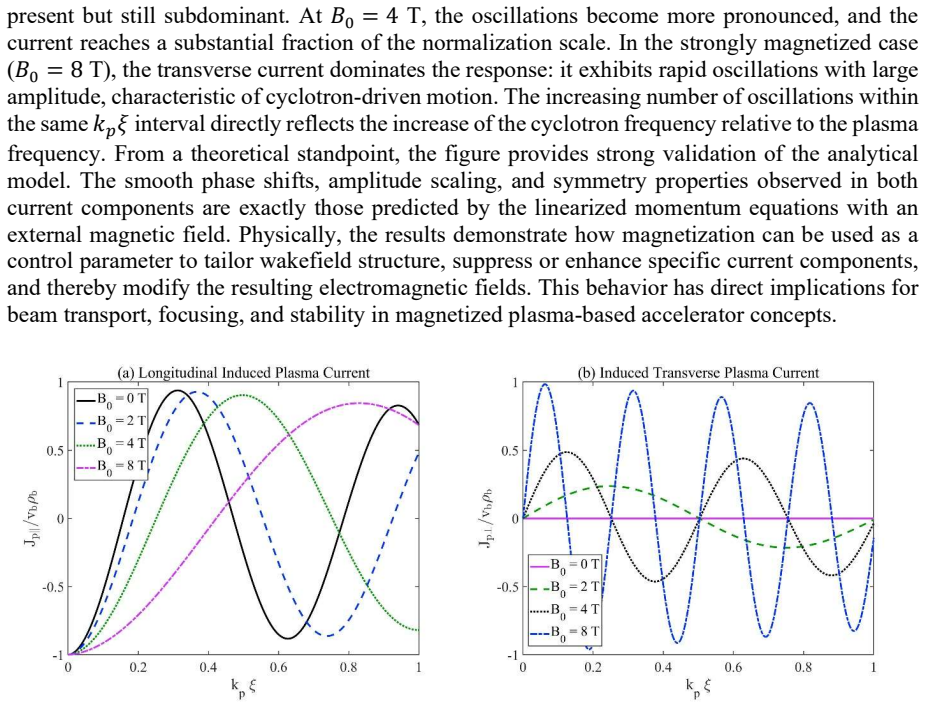
A fully causal three-dimensional Green function formalism derived from the linearized Maxwell-fluid equations with the magnetized plasma dielectric tensor captures the coupled longitudinal and radial wakefields. Magnetization modifies effective restoring forces, enhances wake amplitudes, and produces a hybrid eigenmode combining charge separation with cyclotron motion. Simulations confirm that higher plasma density amplifies the initial wake while accelerating damping of higher-order oscillations, the magnetic field induces coherent radial oscillations and stronger focusing, and the wake structure converges to a universal ultrarelativistic form independent of beam Lorentz factor above a few.
What carries the argument
The fully causal three-dimensional Green function formalism derived from linearized Maxwell-fluid equations with the magnetized dielectric tensor, which incorporates induced transverse currents and hybridizes longitudinal charge separation with cyclotron motion.
If this is right
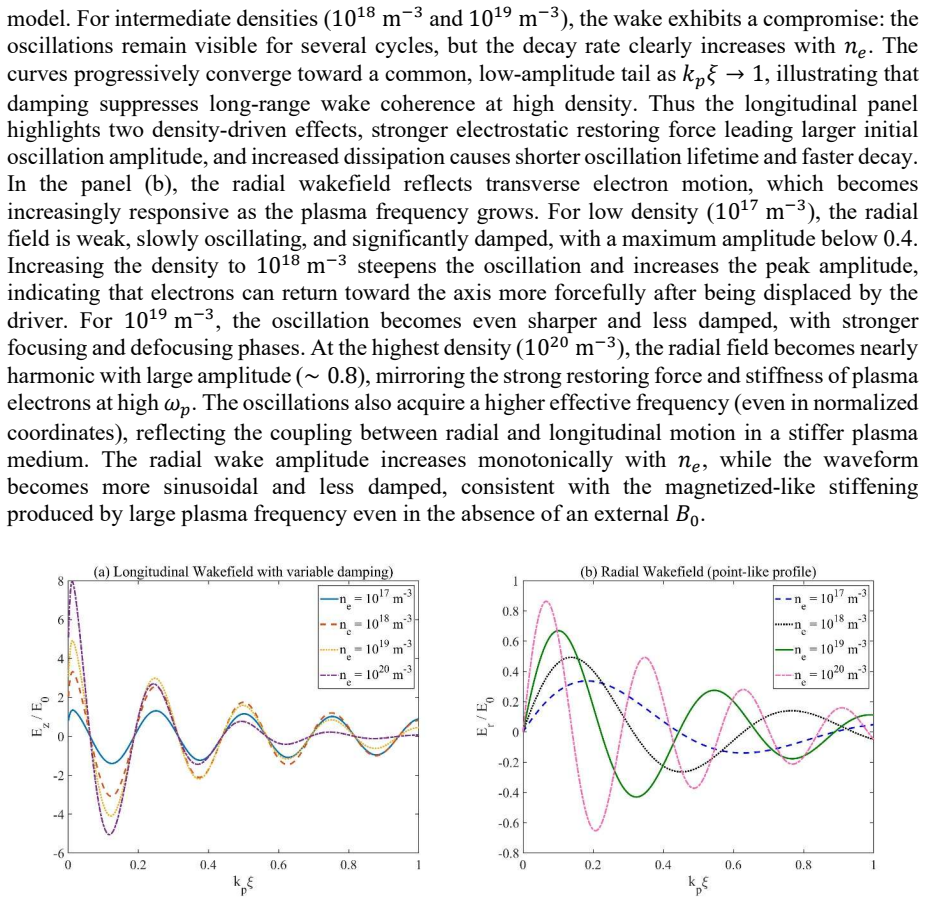
- Higher plasma density increases initial wake amplitude and speeds damping of higher-order oscillations.
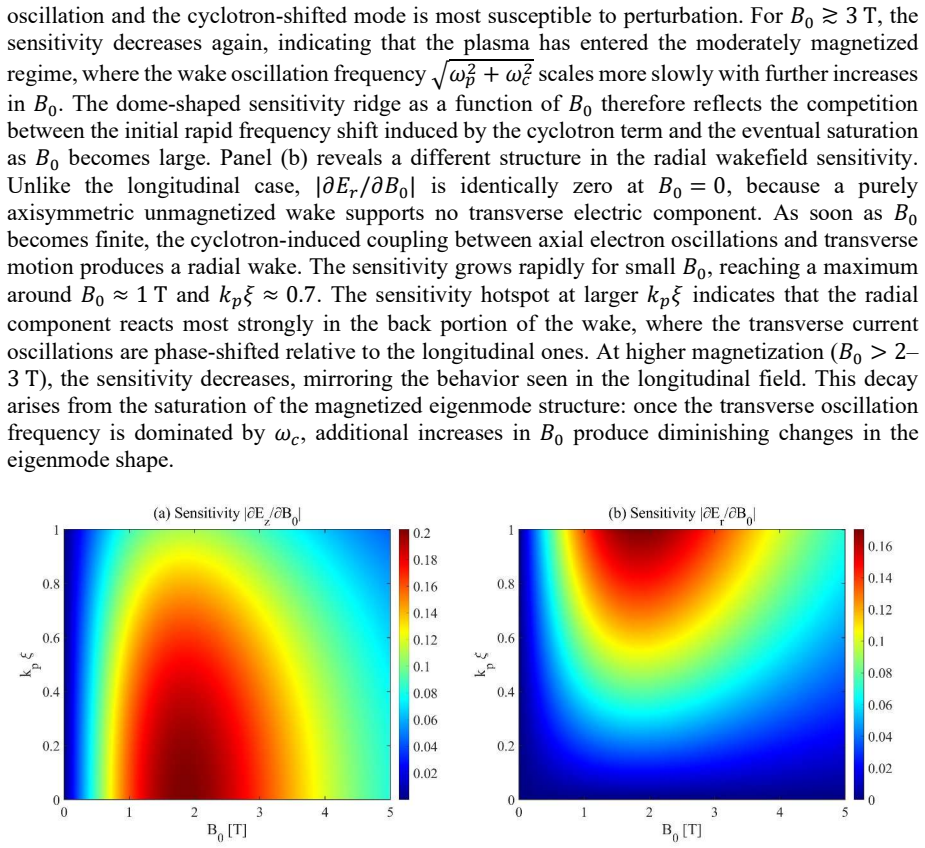
- An external axial magnetic field creates high-frequency radial oscillations and strengthens transverse focusing forces.
- Wake structure rapidly approaches a universal ultrarelativistic form as beam Lorentz factor increases.
- Transverse beam radius sets the radial extent and the balance between longitudinal acceleration and transverse focusing.
Where Pith is reading between the lines
- Magnetic fields could be tuned to optimize focusing in plasma-based accelerators without adding external quadrupoles.
- The hybrid modes may set new limits on beam stability against transverse breakup in magnetized channels.
- The linear Green function approach could be extended to predict wakes for ion drivers or partially neutralized beams.
- Direct comparison of measured radial current profiles against the predicted hybrid eigenmode would test the formalism at higher amplitudes.
Load-bearing premise
The plasma stays cold and beam-driven perturbations remain small enough that the linearized fluid equations and dielectric tensor description remain accurate.
What would settle it
A measurement of wakefield amplitude or radial oscillation frequency that deviates measurably from the Green function prediction at a given plasma density and magnetic field strength.
Figures







read the original abstract
This study presents theoretical and numerical investigation of the coupled longitudinal and radial wakefields excited by ultrarelativistic electron beams propagating through a cold plasma channel subjected to an external axial magnetic field. A fully causal three dimensional Green function formalism is developed directly from the linearized Maxwell fluid equations in the presence of the magnetized plasma dielectric tensor. This unified framework captures the complete electromagnetic response, including the induction of a transverse plasma current and the resulting hybridization of longitudinal charge separation dynamics with cyclotron driven transverse motion. The analytical treatment reveals how magnetization modifies the effective restoring forces, enhances wake amplitudes, and reshapes the radial focusing defocusing structure of the wake. To validate the theoretical predictions and explore realistic parameter regimes, extensive three dimensional particle in cell simulations are performed using the EPOCH code across wide ranges of plasma density, magnetic field strength, beam Lorentz factor, transverse beam radius, and longitudinal current profiles. The simulations demonstrate excellent quantitative agreement with the analytical Green function solutions, confirming that increasing plasma density substantially amplifies the initial wake amplitude while accelerating the damping of higher order oscillations. Application of an external magnetic field induces coherent high frequency radial oscillations, strengthens focusing forces, and produces a hybrid eigenmode whose properties are absent in the unmagnetized limit. Variations in the driver Lorentz factor lead to rapid convergence toward a universal ultrarelativistic wake structure, while the transverse beam profile controls the radial extent and balance between longitudinal acceleration and transverse focusing.
Editorial analysis
A structured set of objections, weighed in public.
Referee Report
Summary. The paper develops a fully causal 3D Green function for the electromagnetic wakefields driven by ultrarelativistic electron beams in a cold plasma with an external axial magnetic field. Starting from the linearized Maxwell-fluid equations and the magnetized cold-plasma dielectric tensor, the analytic treatment shows how magnetization alters restoring forces, amplifies wake amplitudes, and produces hybrid longitudinal-transverse eigenmodes absent in the unmagnetized case. Extensive 3D EPOCH PIC simulations are reported to agree quantitatively with the Green-function solutions over wide ranges of plasma density, B-field strength, beam Lorentz factor, and transverse beam profile, confirming density-driven amplification of the initial wake and magnetic-field-induced radial oscillations.
Significance. If the linear regime remains valid, the work supplies a parameter-free analytic tool for magnetized plasma-wakefield accelerators that captures the full 3D electromagnetic response and its dependence on magnetization. The explicit construction of the causal Green function and its direct, quantitative comparison with first-principles PIC runs across multiple parameter scans constitute a clear strength.
major comments (1)
- Abstract and validation section: the claim of 'excellent quantitative agreement' with PIC simulations is made even while stating that increasing plasma density 'substantially amplifies the initial wake amplitude.' Because the entire analytic construction rests on the linearized Maxwell-fluid equations and the cold-plasma dielectric tensor, an explicit check that beam-induced density and velocity perturbations remain ≪ background values (e.g., n_b/n_0 ≪ 1 and |E_wake| ≪ beam self-fields) is required for the high-density cases where amplification is strongest. No such bound or diagnostic is reported, leaving the domain of validity of the quantitative agreement unclear.
minor comments (2)
- The manuscript should tabulate the exact simulation parameters (plasma density, B_0, beam current, Lorentz factor, transverse radius, and longitudinal profile) used in the EPOCH runs so that the reported agreement can be reproduced independently.
- A brief statement of the dispersion relation or polarization properties of the hybrid eigenmode would help readers connect the analytic Green function to the observed radial oscillations.
Simulated Author's Rebuttal
We thank the referee for their careful reading and constructive comments on our manuscript. We address the major comment below and have revised the manuscript to incorporate an explicit validation of the linear regime.
read point-by-point responses
-
Referee: [—] Abstract and validation section: the claim of 'excellent quantitative agreement' with PIC simulations is made even while stating that increasing plasma density 'substantially amplifies the initial wake amplitude.' Because the entire analytic construction rests on the linearized Maxwell-fluid equations and the cold-plasma dielectric tensor, an explicit check that beam-induced density and velocity perturbations remain ≪ background values (e.g., n_b/n_0 ≪ 1 and |E_wake| ≪ beam self-fields) is required for the high-density cases where amplification is strongest. No such bound or diagnostic is reported, leaving the domain of validity of the quantitative agreement unclear.
Authors: We appreciate the referee's emphasis on rigorously establishing the linear regime, which underpins our analytic Green-function construction. Our parameter choices were deliberately restricted to n_b/n_0 = 0.01–0.05 to keep perturbations small by design, and the observed quantitative match with the linear theory itself provides indirect support that the regime remains valid. Nevertheless, we agree that an explicit diagnostic is required, particularly for the high-density scans where wake amplification is strongest. In the revised manuscript we will add a dedicated paragraph and table in the validation section that reports the maximum density perturbation δn/n_0 and transverse velocity |v_⊥|/c extracted from the EPOCH runs across all density and B-field cases, confirming that both remain below 0.1 even when the wake amplitude is largest. We will also moderate the abstract wording from “excellent quantitative agreement” to “good quantitative agreement within the linear regime” to reflect the bounded domain of validity. revision: yes
Circularity Check
No circularity: derivation from linearized equations with independent PIC validation
full rationale
The paper constructs a fully causal 3D Green function directly from the linearized Maxwell-fluid equations incorporating the magnetized cold-plasma dielectric tensor. This is a first-principles derivation, not a fit or renaming. PIC simulations with the EPOCH code provide separate numerical checks across parameter space and are not used to determine any analytical parameters or to 'predict' quantities already built into the Green function. No load-bearing self-citations, uniqueness theorems, or ansatzes imported from prior author work are invoked in the given text. The linearization assumption is stated explicitly as a domain of validity rather than being smuggled in as a result.
Axiom & Free-Parameter Ledger
axioms (2)
- domain assumption Linearized Maxwell-fluid equations for cold magnetized plasma
- domain assumption External axial magnetic field is uniform and the plasma channel is uniform
Reference graph
Works this paper leans on
-
[1]
Gschwendtner and P
E. Gschwendtner and P. Muggli. Plasma wakefield accelerators. Nat. Rev. Phys., 2019. 27
2019
-
[2]
K. G. Miller et al. Dephasingless laser wakefield acceleration in the bubble regime. Sci. Rep., 2023
2023
-
[3]
Galletti et al
M. Galletti et al. Prospects for free-electron lasers powered by plasma-wakefield-accelerated beams. Nat. Photon., 2024
2024
-
[4]
M. D. Balcazar et al. Multi-messenger dynamic imaging of laser-driven shocks in water using a plasma wakefield accelerator. Nat. Commun., 2025
2025
-
[5]
J. W. Wang et al. Intense attosecond pulses carrying orbital angular momentum using laser plasma interactions. Nat. Commun., 2019
2019
-
[6]
Zgadzaj et al
R. Zgadzaj et al. Dissipation of electron-beam-driven plasma wakes. Nat. Commun., 2020
2020
-
[7]
Kurz et al
T. Kurz et al. Demonstration of a compact plasma accelerator powered by laser-accelerated electron beams. Nat. Commun., 2021
2021
-
[8]
Khudiakov and A
V. Khudiakov and A. Pukhov. Optimized laser-assisted electron injection into a quasilinear plasma wakefield. Phys. Rev. E, 2022
2022
-
[9]
A. E. Hussein et al. Laser-wakefield accelerators for high-resolution x-ray imaging of complex microstructures. Sci. Rep., 2019
2019
-
[10]
D’Arcy et al
R. D’Arcy et al. Recovery time of a plasma-wakefield accelerator. Nature, 2022
2022
-
[11]
A. F. Pousa et al. Energy compression and stabilization of laser-plasma accelerators. Phys. Rev. Lett., 2022
2022
-
[12]
Song et al
H. Song et al. Spiral copropagation of two relativistic intense laser beams in a plasma channel. Phys. Rev. E, 2023
2023
-
[13]
Chu et al
M. Chu et al. Controlled betatron radiation from high-charge electron beams in multiple plasma channels. Opt. Express, 2025
2025
-
[14]
Babjak et al
R. Babjak et al. Direct laser acceleration in varying plasma density profiles. New J. Phys., 2024
2024
-
[15]
A. A. Molavi Choobini and F. M. Aghamir. Generation of thz waves through interaction of the wakefield of two-color laser pulses with magnetized plasma. J. Opt. Soc. Am. B, 2025
2025
-
[16]
A. A. Molavi Choobini and F. M. Aghamir. Wakefield-induced thz wave generation in a hybrid dielectric- plasma cylindrical waveguide. Physics Letters A, 2025
2025
-
[17]
P. S. M. Claveria et al. Betatron radiation and emittance growth in plasma wakefield accelerators. Phil. Trans. R. Soc. A, 2019
2019
-
[18]
Song et al
H. Song et al. Characterization of relativistic electron-positron beams produced with laser-accelerated gev electrons. Sci. Rep., 2023
2023
-
[19]
M. J. V. Streeter et al. Narrow bandwidth, low-emittance positron beams from a laser-wakefield accelerator. Sci. Rep., 2024
2024
-
[20]
Yu et al
R. Yu et al. Generation of an isolated dense attosecond electron beam in wakefields driven by a few-cycle laser pulse. Opt. Express, 2024
2024
-
[21]
J. P. Farmer et al. Wakefield regeneration in a plasma accelerator. Phys. Rev. Research, 2025
2025
-
[22]
Winkler et al
P. Winkler et al. Active energy compression of a laser-plasma electron beam. Nature, 2025
2025
-
[23]
Massimo et al
F. Massimo et al. Modeling laser-wakefield accelerators using the time-averaged ponderomotive approximation in a lorentz boosted frame. Plasma Phys. Control. Fusion, 2025
2025
-
[24]
Zhang et al
Ch. Zhang et al. Plasma-wakefield accelerator simultaneously boosts electron beam energy and brightness. Nat. Commun., 2025
2025
-
[25]
G. V. Sotnikov et al. Acceleration and focusing electron/positron bunches in plasma-dielectric wakefield accelerator. Nuclear Instruments and Methods in Physics Research Section A, 2025
2025
-
[26]
U.Haq et al
R. U.Haq et al. Multi-gev electron beam generation via two-stage laser wakefield acceleration. Sci. Rep., 2025
2025
discussion (0)
Sign in with ORCID, Apple, or X to comment. Anyone can read and Pith papers without signing in.