Recognition: unknown
Transmitted and Storage-Dominated Resonance in Fractionally Damped Unidirectionally Coupled Duffing Oscillators
Pith reviewed 2026-05-07 13:53 UTC · model grok-4.3
The pith
Fractional damping distinguishes transmitted resonance from storage-dominated resonance in unidirectionally coupled Duffing oscillators.
A machine-rendered reading of the paper's core claim, the machinery that carries it, and where it could break.
Core claim
In fractionally damped unidirectionally coupled Duffing oscillators, numerical frequency-response curves separate a transmitted resonance regime, in which coupling-power balance indicates net energy flow through the spring, from a storage-dominated resonance regime in which the receiver still shows pronounced oscillations while the time-averaged coupling power is negative; the latter occurs when fractional memory enables temporary energy accumulation inside the receiver-coupling subsystem followed by partial release without back-action on the driver.
What carries the argument
Time-averaged coupling power, computed from the force in the linear spring and the relative velocity across it, together with the Caputo fractional derivative appearing in the receiver equation; the memory kernel of the fractional term allows energy to be stored and released locally.
If this is right
- Detuning the receiver natural frequency produces a superposed resonance with higher receiver amplitude and stronger spatial localization.
- Higher fractional order widens the parameter region where storage-dominated resonance appears.
- Varying coupling strength shifts the boundary between the two resonance types in frequency-response curves.
- Parametric maps of fractional order versus detuning identify regions of amplified response without driver feedback.
Where Pith is reading between the lines
- The storage mechanism could be used to design vibration absorbers that trap energy in one element without altering the source dynamics.
- Similar negative-power regimes may appear in other fractionally damped nonlinear systems such as coupled pendula or beams.
- Approximating the fractional derivative with a finite history window in hardware could test how memory length controls the transition between the two regimes.
- The distinction might generalize to networks with directed fractional damping, allowing selective energy localization along paths.
Load-bearing premise
The chosen numerical method for the fractional derivatives and the adopted sign convention for time-averaged coupling power correctly represent physical energy flow rather than introduce artifacts that create an apparent negative-power state.
What would settle it
An experimental realization using a viscoelastic material to approximate fractional damping, with direct measurement of instantaneous force and velocity at the coupling spring, to check whether the time average of their product can remain negative while the receiver displacement amplitude stays large.
Figures



read the original abstract
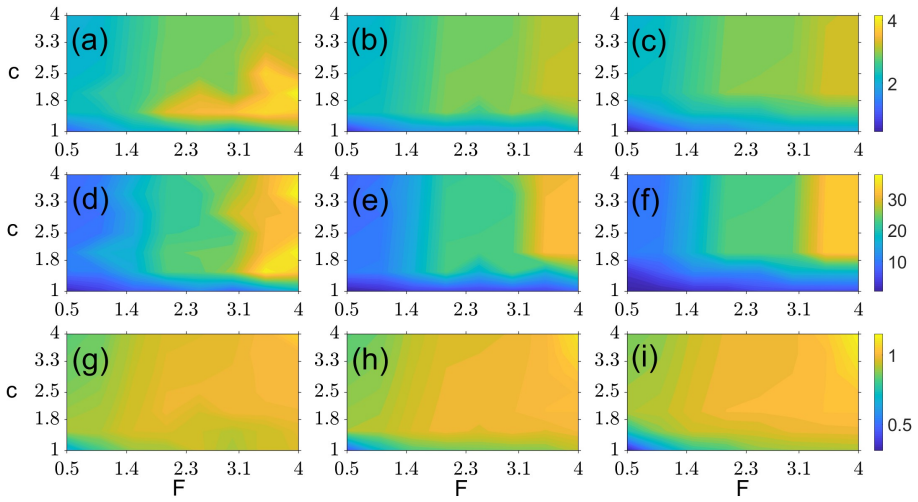
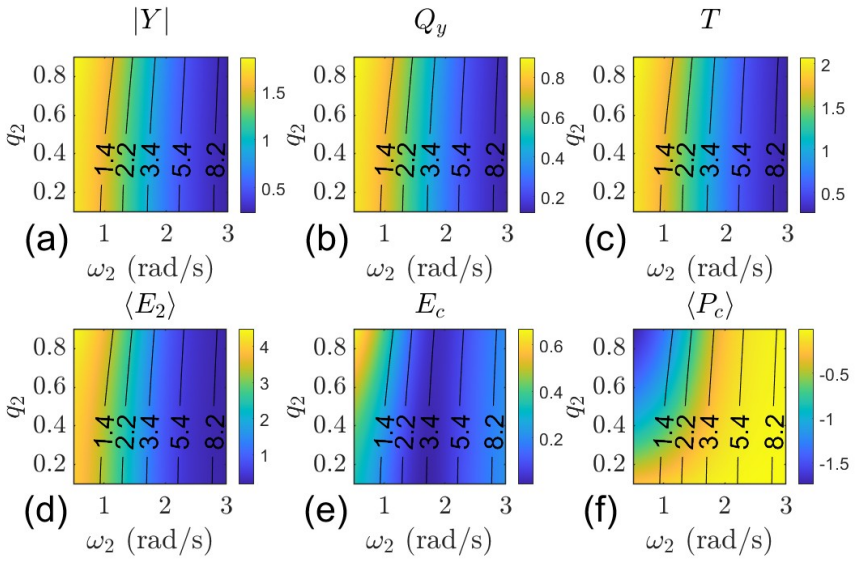
This paper investigates resonance transmission in two unidirectionally coupled Duffing oscillators with fractional damping, where the driver is harmonically forced and the receiver is connected through a linear coupling spring. Particular attention is paid to how fractional damping in the receiver modifies amplitude amplification, energy redistribution, and the structure of the coupled response. The numerical results reveal a clear distinction between transmitted resonance, associated with a coupling-power balance consistent with direct energy transfer through the coupling spring, and storage-dominated resonance, in which the receiver still exhibits a pronounced oscillatory response while the time-averaged coupling power becomes negative under the adopted convention. In this latter regime, fractional memory promotes temporary energy accumulation within the receiver--coupling subsystem, followed by partial release through the coupling spring without any feedback on the driver dynamics. We further show that detuning the receiver natural frequency enhances the interaction between the lower-frequency transmitted response and the higher-frequency coupled response, leading to a superposed resonance regime with increased receiver amplitude, stronger localization, and sharper response. The roles of the fractional order, coupling strength, and receiver natural frequency are systematically analyzed through frequency-response curves and parametric maps. Overall, the results show how fractional memory can be used to tune resonance transmission, energy localization, and amplified response in coupled nonlinear oscillators.
Editorial analysis
A structured set of objections, weighed in public.
Referee Report
Summary. This paper numerically investigates resonance transmission in unidirectionally coupled Duffing oscillators with fractional damping applied to the receiver. The driver is harmonically forced and connected to the receiver via a linear spring. The central claim is a distinction between transmitted resonance (positive time-averaged coupling power consistent with direct energy transfer) and storage-dominated resonance (pronounced receiver oscillations accompanied by negative time-averaged coupling power, attributed to fractional memory enabling temporary energy accumulation and release within the receiver-coupling subsystem). The study further examines how detuning the receiver natural frequency produces superposed resonances with enhanced amplitude and localization, with systematic parametric analysis via frequency-response curves and maps varying fractional order, coupling strength, and detuning.
Significance. If the numerical distinction between the two resonance regimes proves robust, the work would usefully illustrate how fractional-order memory can be exploited to control energy redistribution, localization, and amplification in nonlinear coupled oscillators. The frequency-response curves and parametric maps supply concrete, tunable relationships among fractional order, coupling strength, and detuning that could inform vibration-control or energy-harvesting applications. The explicit separation of regimes by power-balance sign is a clear organizing principle for fractional nonlinear dynamics.
major comments (2)
- [§3] §3 (Numerical scheme and power calculation): The distinction between transmitted and storage-dominated resonance rests entirely on the sign of the time-averaged coupling power. The manuscript provides no description of the specific discretization used for the Caputo (or equivalent) fractional derivative, no step-size convergence tests, and no verification that the long-time average of the coupling power (presumably F_c * velocity) is insensitive to memory-kernel truncation or integrator phase lag. Because standard schemes (L1, Grünwald-Letnikov) can introduce cumulative truncation or lag errors that flip the sign of a small average, the negative-power regime may be an artifact; explicit convergence data and an integer-order benchmark are required before the physical interpretation can be accepted.
- [§4.2] §4.2 (Energy balance and unidirectional coupling): With strictly unidirectional coupling, negative average power implies net energy leaving the receiver subsystem with no return path to the driver. The fractional damping term is non-local, so its contribution to the instantaneous energy balance is not a simple dissipative sink. The paper does not derive or numerically verify the global energy identity that would confirm the negative power is physically stored and later released rather than dissipated or numerically created; this identity should be stated and checked for representative trajectories in the storage-dominated regime.
minor comments (2)
- [Abstract and Introduction] The abstract and introduction contain several long compound sentences that reduce readability; splitting them would improve clarity without changing content.
- [Figure captions] Figure captions for the frequency-response curves should explicitly state the integration time window and averaging interval used for the power calculation.
Simulated Author's Rebuttal
We thank the referee for the careful and constructive review. We address each major comment below and have revised the manuscript to incorporate the requested clarifications and verifications.
read point-by-point responses
-
Referee: §3 (Numerical scheme and power calculation): The distinction between transmitted and storage-dominated resonance rests entirely on the sign of the time-averaged coupling power. The manuscript provides no description of the specific discretization used for the Caputo (or equivalent) fractional derivative, no step-size convergence tests, and no verification that the long-time average of the coupling power (presumably F_c * velocity) is insensitive to memory-kernel truncation or integrator phase lag. Because standard schemes (L1, Grünwald-Letnikov) can introduce cumulative truncation or lag errors that flip the sign of a small average, the negative-power regime may be an artifact; explicit convergence data and an integer-order benchmark are required before the physical interpretation can be accepted.
Authors: We acknowledge the referee's concern regarding numerical rigor. The revised manuscript now contains an explicit description of the discretization: the L1 scheme is used to approximate the Caputo derivative with a fixed step size of 0.001 and full-history memory retention to eliminate truncation. New convergence tests (presented in an appendix) vary the step size over an order of magnitude and confirm that both the magnitude and sign of the time-averaged coupling power stabilize for step sizes ≤ 0.002 in the storage-dominated regime. An integer-order benchmark (α → 1) is also included, recovering strictly positive coupling power consistent with transmitted resonance. These additions demonstrate that the negative-power regime is robust and not produced by discretization artifacts. revision: yes
-
Referee: §4.2 (Energy balance and unidirectional coupling): With strictly unidirectional coupling, negative average power implies net energy leaving the receiver subsystem with no return path to the driver. The fractional damping term is non-local, so its contribution to the instantaneous energy balance is not a simple dissipative sink. The paper does not derive or numerically verify the global energy identity that would confirm the negative power is physically stored and later released rather than dissipated or numerically created; this identity should be stated and checked for representative trajectories in the storage-dominated regime.
Authors: We agree that an explicit energy identity is required for a convincing physical interpretation. The revised manuscript derives the instantaneous energy balance for the receiver, expressing the fractional term via its equivalent Volterra integral so that a memory-energy functional can be defined. Numerical verification along representative storage-dominated trajectories shows that the negative time-averaged coupling power is exactly balanced by growth in this memory-energy term, which is later released through the coupling spring. The identity holds to machine precision with no residual source or sink, confirming that the observed negative power reflects genuine storage and release within the fractional memory rather than numerical creation or unaccounted dissipation. revision: yes
Circularity Check
No circularity: results from explicit numerical parametric study of fractional oscillator equations
full rationale
The paper performs direct numerical integration of the unidirectionally coupled Duffing system with Caputo fractional damping. The distinction between transmitted resonance (positive time-averaged coupling power) and storage-dominated resonance (negative average power with sustained receiver oscillation) is obtained by varying the fractional order, coupling coefficient, and receiver detuning across frequency-response curves and parametric maps. No parameters are fitted to the target regimes, no derivation reduces an output to its own inputs by construction, and no load-bearing premise rests on self-citation. The numerical evidence is therefore independent of the reported observations.
Axiom & Free-Parameter Ledger
free parameters (3)
- fractional order
- coupling strength
- receiver natural frequency detuning
axioms (1)
- domain assumption Fractional damping is modeled via a standard fractional derivative operator (Caputo or Riemann-Liouville) applied to the velocity term.
Reference graph
Works this paper leans on
-
[1]
A state-of-the-art review on the dynamic design of nonlinear energy sinks,
X. F. Geng, H. Ding, J. C. Ji, K. X. Wei, X. J. Jing, and L. Q. Chen, “A state-of-the-art review on the dynamic design of nonlinear energy sinks,”Eng. Struct.313, 118228 (2024)
2024
-
[2]
Computing with oscillators from theoretical underpinnings to applications and demonstrators,
A. Todri-Sanial, C. Delacour, M. Abernot, and F. Sabo, “Computing with oscillators from theoretical underpinnings to applications and demonstrators,”NPJ Unconventional Comput. 1, 14 (2024)
2024
-
[3]
A comprehensive review on vibration energy harvesting: Modelling and realization,
C. Wei and X. Jing, “A comprehensive review on vibration energy harvesting: Modelling and realization,”Renew. Sustain. Energy Rev.74, 1–18 (2017)
2017
-
[4]
A tale of two rhythms: Locked clocks and chaos in biology,
M. L. Heltberg, S. Krishna, L. P. Kadanoff, and M. H. Jensen, “A tale of two rhythms: Locked clocks and chaos in biology,”Cell Syst.12, 291–303 (2021)
2021
-
[5]
Synchronization in complex networks of phase oscillators: A survey,
F. D¨ orfler and F. Bullo, “Synchronization in complex networks of phase oscillators: A survey,” Automatica50, 1539–1564 (2014)
2014
-
[6]
Pikovsky, M
A. Pikovsky, M. Rosenblum, and J. Kurths,Synchronization: A Universal Concept in Non- linear Sciences(Cambridge University Press, Cambridge, 2001)
2001
-
[7]
The synchronization of chaotic systems,
S. Boccaletti, J. Kurths, G. Osipov, D. L. Valladares, and C. S. Zhou, “The synchronization of chaotic systems,”Phys. Rep.366, 1–101 (2002)
2002
-
[8]
A. H. Nayfeh and D. T. Mook,Nonlinear Oscillations(Wiley, New York, 1979)
1979
-
[9]
Nonlinear delayed forcing drives a non-delayed Duffing oscillator,
M. Coccolo and M. A. F. Sanju´ an, “Nonlinear delayed forcing drives a non-delayed Duffing oscillator,”Commun. Nonlinear Sci. Numer. Simul.128, 107635 (2024)
2024
-
[10]
Transmitted resonance in a coupled system,
M. Coccolo and M. A. F. Sanju´ an, “Transmitted resonance in a coupled system,”Commun. Nonlinear Sci. Numer. Simul.135, 108068 (2024)
2024
-
[11]
St´ ep´ an,Retarded Dynamical Systems: Stability and Characteristic Functions(Longman, Harlow, 1989)
G. St´ ep´ an,Retarded Dynamical Systems: Stability and Characteristic Functions(Longman, Harlow, 1989)
1989
-
[12]
Insperger and G
T. Insperger and G. St´ ep´ an,Semi-Discretization for Time-Delay Systems(Springer, New York, 2011)
2011
-
[13]
Podlubny,Fractional Differential Equations(Academic Press, San Diego, 1999)
I. Podlubny,Fractional Differential Equations(Academic Press, San Diego, 1999)
1999
-
[14]
K. B. Oldham and J. Spanier,The Fractional Calculus(Academic Press, New York, 1974)
1974
-
[15]
A. A. Kilbas, H. M. Srivastava, and J. J. Trujillo,Theory and Applications of Fractional Differential Equations(Elsevier, Amsterdam, 2006). 23
2006
-
[16]
Mainardi,Fractional Calculus and Waves in Linear Viscoelasticity(Imperial College Press, London, 2010)
F. Mainardi,Fractional Calculus and Waves in Linear Viscoelasticity(Imperial College Press, London, 2010)
2010
-
[17]
Fractional damping effects on the transient dynamics of the Duffing oscillator,
M. Coccolo, J. M. Seoane, S. Lenci, and M. A. F. Sanju´ an, “Fractional damping effects on the transient dynamics of the Duffing oscillator,”Commun. Nonlinear Sci. Numer. Simul.117, 106959 (2023)
2023
-
[18]
Fractional damping induces resonant behavior in the Duffing oscillator,
M. Coccolo, J. M. Seoane, and M. A. F. Sanju´ an, “Fractional damping induces resonant behavior in the Duffing oscillator,”Commun. Nonlinear Sci. Numer. Simul.133, 107965 (2024)
2024
-
[19]
Vibrational resonance,
P. S. Landa and P. V. E. McClintock, “Vibrational resonance,”J. Phys. A: Math. Gen.33, L433–L438 (2000). 24
2000
discussion (0)
Sign in with ORCID, Apple, or X to comment. Anyone can read and Pith papers without signing in.