Recognition: unknown
A graph-aware bounded distance decoder for all stabilizer codes
Pith reviewed 2026-05-07 16:37 UTC · model grok-4.3
The pith
Any stabilizer code admits a bounded distance decoder by mapping it to an equivalent graph state.
A machine-rendered reading of the paper's core claim, the machinery that carries it, and where it could break.
Core claim
The central claim is that the local Clifford equivalence between stabilizer states and graph states supplies a graphical representation of the stabilizers and syndromes from which a bounded-distance decoder can be built for any stabilizer code. The decoder is realized as an adaptable generalization of maximum-likelihood decoding that is guaranteed to return a correction for every error of weight at most t; strategic pruning along the feed-forward structure of the graph reduces the search space while preserving this guarantee. The resulting procedure is shown to perform satisfactorily on optimal non-CSS codes up to distance 11 under depolarizing noise and to achieve near-optimal performance 0
What carries the argument
The local Clifford equivalence between arbitrary stabilizer states and graph states, which converts the stabilizer generators and the syndrome into a graph whose edges and vertices encode the parity checks needed for bounded-distance correction.
If this is right
- Bounded-distance decoding becomes available for non-CSS stabilizer codes that previously lacked a uniform algorithmic treatment.
- The runtime of the decoder can be lowered by graph pruning without sacrificing the ability to correct every error inside the target weight bound.
- The same procedure yields satisfactory results for optimal non-CSS codes of distance up to 11 under depolarizing noise.
- Near-optimal performance is obtained for the color code and the surface code under bit-flip noise.
- An open-source implementation is supplied so the method can be applied directly to any stabilizer code the user supplies.
Where Pith is reading between the lines
- Any future refinement of graph-state decoding algorithms would immediately apply to the entire class of stabilizer codes through the same equivalence.
- The pruning strategy could be combined with classical graph algorithms such as shortest-path methods to further reduce complexity on large codes.
- Because the representation is graphical, the decoder may be adaptable to hybrid classical-quantum error models that treat some qubits differently from others.
Load-bearing premise
That the local Clifford mapping to graph states retains every piece of information required to locate and correct low-weight errors and that the pruning rules never discard a path that would have produced a valid correction.
What would settle it
A concrete low-weight error on any small stabilizer code for which the pruned graph search returns the wrong correction or returns no correction at all, while an exhaustive search over the unpruned graph would have succeeded.
Figures



read the original abstract
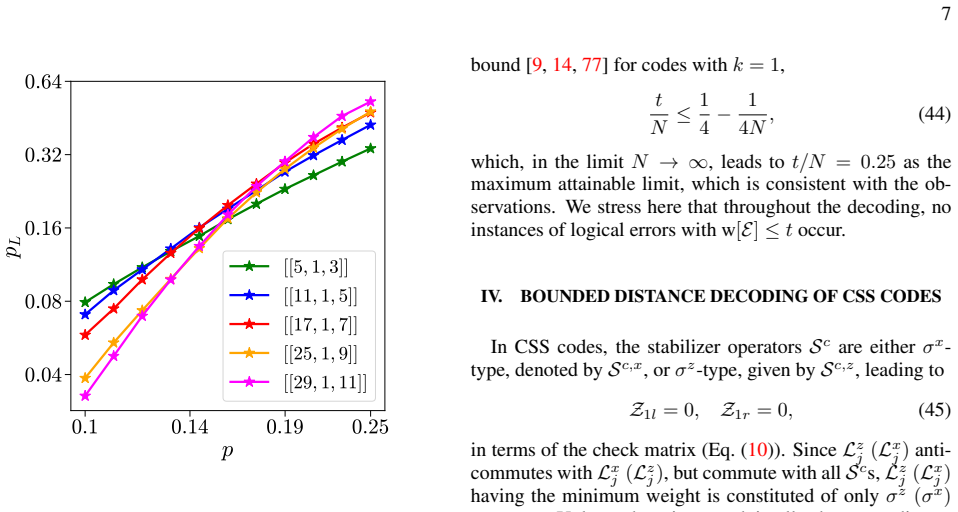
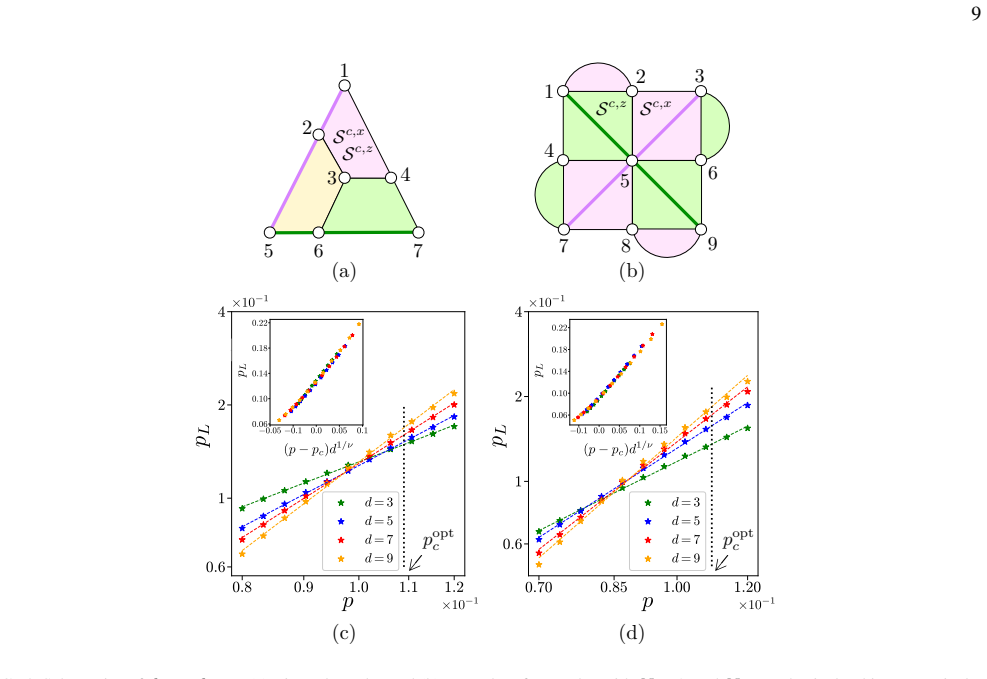
We formulate a bounded distance decoding strategy applicable to all stabilizer codes including both CSS and non-CSS code-families. The framework emerges out of the local Clifford equivalence between arbitrary stabilizer states and graph states. Using the graphical representation of the stabilizers and the syndromes, we constitute the bounded distance decoding as an adaptable generalization of maximum likelihood decoding, ensuring correction of all errors with weights upper bounded by a target weight. We show that strategic pruning associated with a feed-forward network structure of the graph can reduce the search space and subsequently the runtime of the designed decoder. We demonstrate satisfactory performance of the bounded distance decoder in the case of the optimal non-CSS codes up to distance $d=11$ subjected to the depolarizing error on all qubits, and near-optimal decoding for the color and the surface codes, both belonging to the CSS family, under the bit-flip errors on the qubits. We also develop an open-source library, QGDecoder, enabling the graph-aware bounded distance decoding of arbitrary stabilizer codes.
Editorial analysis
A structured set of objections, weighed in public.
Referee Report
Summary. The paper proposes a bounded-distance decoder applicable to all stabilizer codes (CSS and non-CSS) by exploiting the local Clifford equivalence of stabilizer states to graph states. Decoding is cast as an adaptable generalization of maximum-likelihood search on the graphical representation of stabilizers and syndromes, augmented by strategic pruning within a feed-forward network structure to reduce the search space. The authors claim this guarantees correction of all errors of weight at most t = floor((d-1)/2), report satisfactory empirical performance on optimal non-CSS codes up to distance 11 under depolarizing noise and near-optimal results on surface and color codes under bit-flip noise, and release an open-source library QGDecoder.
Significance. A general, graph-based bounded-distance decoder for arbitrary stabilizer codes would be a meaningful contribution, as most existing decoders are specialized to particular code families. The open-source library strengthens reproducibility and utility. However, the significance is limited by the absence of a general correctness argument for the pruning step, which is central to the 'all stabilizer codes' claim; the reported results are empirical only.
major comments (2)
- [Decoder algorithm and pruning rule] The section describing the strategic pruning and feed-forward network structure: the central claim that this pruning 'never discards a valid low-weight error' and thereby guarantees bounded-distance correction for arbitrary stabilizer codes lacks a general proof or formal invariant. The manuscript supplies only empirical performance on the tested non-CSS instances up to d=11; if the pruning rule is code- or noise-dependent, the universality guarantee does not hold.
- [Numerical results] Performance evaluation (results section): the abstract and text assert 'satisfactory performance' and 'near-optimal decoding' without error bars, explicit numerical tables comparing logical error rates or runtime against standard decoders (e.g., MWPM for surface codes), or a derivation of the pruning threshold. This weakens the ability to verify the claimed near-optimality.
minor comments (2)
- The abstract states that the framework 'ensures correction of all errors with weights upper bounded by a target weight' but does not specify how the target weight is chosen or enforced inside the algorithm; a short clarifying paragraph or pseudocode would improve clarity.
- No link, installation instructions, or repository reference is provided for the claimed open-source library QGDecoder; this should be added to enable immediate use and verification.
Simulated Author's Rebuttal
We thank the referee for the thoughtful review and constructive suggestions. We address each major comment below and will revise the manuscript to incorporate clarifications and additional material where needed.
read point-by-point responses
-
Referee: [Decoder algorithm and pruning rule] The section describing the strategic pruning and feed-forward network structure: the central claim that this pruning 'never discards a valid low-weight error' and thereby guarantees bounded-distance correction for arbitrary stabilizer codes lacks a general proof or formal invariant. The manuscript supplies only empirical performance on the tested non-CSS instances up to d=11; if the pruning rule is code- or noise-dependent, the universality guarantee does not hold.
Authors: The pruning rule is constructed directly from the feed-forward layering of the stabilizer graph, which arises from the local Clifford equivalence of any stabilizer state to a graph state. At each layer, branches are pruned only when the partial syndrome cannot be completed to a valid error of weight at most t by any assignment of the remaining qubits; this elimination criterion depends solely on the graph adjacency and the target weight t = floor((d-1)/2), not on the specific code or noise model. We acknowledge that the manuscript did not include an explicit inductive invariant or proof of this property. In the revised version we will add a dedicated subsection that states the invariant (no valid weight-≤t error is ever pruned) and proves it by induction over the layers of the feed-forward graph, using only the stabilizer commutation relations and the definition of the syndrome graph. revision: yes
-
Referee: [Numerical results] Performance evaluation (results section): the abstract and text assert 'satisfactory performance' and 'near-optimal decoding' without error bars, explicit numerical tables comparing logical error rates or runtime against standard decoders (e.g., MWPM for surface codes), or a derivation of the pruning threshold. This weakens the ability to verify the claimed near-optimality.
Authors: We agree that the presentation of the numerical results can be strengthened. The revised manuscript will include (i) error bars computed from at least 10^5 Monte-Carlo trials per data point, (ii) explicit tables reporting logical error rates and average runtimes for the surface and color codes under bit-flip noise, with direct comparison to the minimum-weight perfect matching decoder, and (iii) a short derivation of the pruning threshold showing that it is set to t = floor((d-1)/2) and is independent of the particular noise realization. revision: yes
Circularity Check
No significant circularity; algorithmic construction from established equivalence
full rationale
The paper derives a bounded-distance decoder algorithmically from the known local Clifford equivalence between stabilizer states and graph states. This equivalence is external and not self-cited as a load-bearing uniqueness theorem. The decoder is presented as a constructive generalization of maximum-likelihood decoding on the graph representation, with pruning as an optimization heuristic. No equations reduce a claimed prediction or correction guarantee to a fitted parameter or to the input data by construction. The central claim is an algorithmic method rather than a fitted result or renamed empirical pattern, making the derivation self-contained against external benchmarks.
Axiom & Free-Parameter Ledger
axioms (1)
- domain assumption Local Clifford equivalence maps any stabilizer state to a graph state while preserving the stabilizer group structure
Reference graph
Works this paper leans on
-
[1]
Acharya, D
R. Acharya, D. A. Abanin, L. Aghababaie-Beni,et al., Nature 638, 920 (2025)
2025
-
[2]
D. A. Abanin, R. Acharya, L. Aghababaie-Beni,et al., Nature 646, 825 (2025)
2025
-
[3]
Y . Kim, A. Eddins, S. Anand, K. X. Wei, E. van den Berg, S. Rosenblatt, H. Nayfeh, Y . Wu, M. Zaletel, K. Temme, and A. Kandala, Nature618, 500 (2023)
2023
-
[4]
Preskill, Quantum2, 79 (2018)
J. Preskill, Quantum2, 79 (2018)
2018
-
[5]
Cheng, X.-H
B. Cheng, X.-H. Deng, X. Gu,et al., Frontiers of Physics18, 21308 (2023)
2023
-
[6]
Y . Yan, Z. Du, J. Chen, and X. Ma, npj Quantum Information 11, 188 (2025)
2025
-
[7]
Mind the gaps: The fraught road to quantum advantage
J. Eisert and J. Preskill, Mind the gaps: The fraught road to quantum advantage (2025), arXiv:2510.19928 [quant-ph]
-
[8]
P. W. Shor, Phys. Rev. A52, R2493 (1995)
1995
-
[9]
An Introduction to Quantum Error Correction and Fault-Tolerant Quantum Computation
D. Gottesman, arXiv:0904.2557v1 (2009)
work page Pith review arXiv 2009
-
[10]
M. A. Nielsen and I. L. Chuang,Quantum Computation and Quantum Information(Cambridge University Press, 2010)
2010
-
[11]
B. M. Terhal, Rev. Mod. Phys.87, 307 (2015)
2015
-
[12]
Roffe, Contemporary Physics60, 226 (2019)
J. Roffe, Contemporary Physics60, 226 (2019)
2019
-
[13]
S. M. Girvin, SciPost Phys. Lect. Notes , 70 (2023)
2023
-
[14]
Knill and R
E. Knill and R. Laflamme, Phys. Rev. A55, 900 (1997)
1997
-
[15]
Knill, R
E. Knill, R. Laflamme, and W. H. Zurek, Proceedings of the Royal Society A: Mathematical, Physical and Engineering Sciences454, 365 (1998)
1998
-
[16]
Eastin and E
B. Eastin and E. Knill, Phys. Rev. Lett.102, 110502 (2009)
2009
-
[17]
Stabilizer Codes and Quantum Error Correction
D. Gottesman, Stabilizer codes and quantum error correction (1997), arXiv:quant-ph/9705052 [quant-ph]
work page internal anchor Pith review arXiv 1997
-
[18]
Laflamme, C
R. Laflamme, C. Miquel, J. P. Paz, and W. H. Zurek, Phys. Rev. Lett.77, 198 (1996)
1996
-
[19]
A. R. Calderbank and P. W. Shor, Phys. Rev. A54, 1098 (1996)
1996
-
[20]
A. M. Steane, Phys. Rev. Lett.77, 793 (1996)
1996
-
[21]
Kitaev, Annals of Physics303, 2 (2003)
A. Kitaev, Annals of Physics303, 2 (2003)
2003
-
[22]
Bombin and M
H. Bombin and M. A. Martin-Delgado, Phys. Rev. Lett.97, 180501 (2006)
2006
-
[23]
Tillich and G
J.-P. Tillich and G. Zemor, in2009 IEEE International Sym- posium on Information Theory(2009) pp. 799–803
2009
-
[24]
The error correction zoo (2026)
2026
-
[25]
Grassl, Bounds on the minimum distance of linear codes and quantum codes, Online available athttp://www
M. Grassl, Bounds on the minimum distance of linear codes and quantum codes, Online available athttp://www. codetables.de(2007)
2007
-
[26]
A. G. Fowler, M. Mariantoni, J. M. Martinis, and A. N. Cle- land, Phys. Rev. A86, 032324 (2012)
2012
- [27]
-
[28]
N. P. Breuckmann and J. N. Eberhardt, PRX Quantum2, 040101 (2021)
2021
-
[29]
J. P. Bonilla Ataides, D. K. Tuckett, S. D. Bartlett, S. T. Flammia, and B. J. Brown, Nature Communications12, 2172 (2021)
2021
-
[30]
Battistel, C
F. Battistel, C. Chamberland, K. Johar, R. W. J. Overwater, F. Sebastiano, L. Skoric, Y . Ueno, and M. Usman, Nano Fu- tures7, 032003 (2023)
2023
-
[31]
deMarti iOlius, P
A. deMarti iOlius, P. Fuentes, R. Or ´us, P. M. Crespo, and J. Etxezarreta Martinez, Quantum8, 1498 (2024)
2024
-
[32]
Iyer and D
P. Iyer and D. Poulin, IEEE Transactions on Information The- ory61, 5209 (2015)
2015
-
[33]
Hsieh and F
M.-H. Hsieh and F. m. c. Le Gall, Phys. Rev. A83, 052331 (2011)
2011
-
[34]
MacWilliams and N
F. MacWilliams and N. Sloane, inThe Theory of Error- Correcting Codes, North-Holland Mathematical Library, V ol. 16 (Elsevier, 1977) pp. 1–37
1977
-
[35]
Bravyi, M
S. Bravyi, M. Suchara, and A. Vargo, Phys. Rev. A90, 032326 (2014)
2014
- [36]
-
[37]
O. Higgott, ACM Transactions on Quantum Computing3, 10.1145/3505637 (2022)
-
[38]
Delfosse, V
N. Delfosse, V . Londe, and M. E. Beverland, IEEE Transac- tions on Information Theory68, 3187 (2022)
2022
-
[39]
Wu and L
Y . Wu and L. Zhong, in2023 IEEE International Conference on Quantum Computing and Engineering (QCE)(IEEE Com- puter Society, Los Alamitos, CA, USA, 2023) pp. 928–938
2023
-
[40]
E. Sabo, A. B. Aloshious, and K. R. Brown, IEEE Transac- tions on Quantum Engineering5, 1 (2024)
2024
-
[41]
Higgott and C
O. Higgott and C. Gidney, Quantum9, 1600 (2025)
2025
-
[42]
Delfosse and N
N. Delfosse and N. H. Nickerson, Quantum5, 595 (2021)
2021
-
[43]
S.-H. Lee, A. Li, and S. D. Bartlett, Quantum9, 1609 (2025)
2025
-
[44]
Berent, L
L. Berent, L. Burgholzer, P.-J. H. Derks, J. Eisert, and R. Wille, Quantum8, 1506 (2024)
2024
-
[45]
Pearl, inProbabilistic Reasoning in Intelligent Systems (Morgan Kaufmann, San Francisco (CA), 1988) pp
J. Pearl, inProbabilistic Reasoning in Intelligent Systems (Morgan Kaufmann, San Francisco (CA), 1988) pp. 467–520
1988
-
[46]
Kschischang, B
F. Kschischang, B. Frey, and H.-A. Loeliger, IEEE Transac- tions on Information Theory47, 498 (2001)
2001
-
[47]
Chung, G
S.-Y . Chung, G. Forney, T. Richardson, and R. Urbanke, IEEE Communications Letters5, 58 (2001)
2001
-
[48]
Poulin and Y
D. Poulin and Y . Chung, Quantum Inf. Comput.8, 987 (2008)
2008
-
[49]
Panteleev and G
P. Panteleev and G. Kalachev, Quantum5, 585 (2021)
2021
-
[50]
Hillmann, L
T. Hillmann, L. Berent, A. O. Quintavalle, J. Eisert, R. Wille, and J. Roffe, Nature Communications16, 8214 (2025)
2025
-
[51]
Roffe, D
J. Roffe, D. R. White, S. Burton, and E. Campbell, Phys. Rev. Res.2, 043423 (2020)
2020
-
[52]
Tanner, IEEE Transactions on Information Theory27, 533 (1981)
R. Tanner, IEEE Transactions on Information Theory27, 533 (1981)
1981
-
[53]
M. Hein, W. D ¨ur, J. Eisert, R. Raussendorf, M. Van den Nest, and H. J. Briegel, arXiv:quant-ph/0602096 (2006)
work page Pith review arXiv 2006
-
[54]
M. Hein, J. Eisert, and H. J. Briegel, Phys. Rev. A69, 062311 (2004)
2004
-
[55]
R. Raussendorf and H. J. Briegel, Quantum computing via measurements only (2000), arXiv:quant-ph/0010033 [quant- ph]
-
[56]
Raussendorf and H
R. Raussendorf and H. J. Briegel, Phys. Rev. Lett.86, 5188 (2001)
2001
-
[57]
H. J. Briegel, D. E. Browne, W. D ¨ur, R. Raussendorf, and M. Van den Nest, Nature Physics5, 19 (2009)
2009
-
[58]
Płodzie´n, M
M. Płodzie´n, M. Lewenstein, and J. Chwede´nczuk, Reports on Progress in Physics88, 077601 (2025)
2025
-
[59]
Schlingemann and R
D. Schlingemann and R. F. Werner, Phys. Rev. A65, 012308 (2001)
2001
-
[60]
Schlingemann, arXiv:quant-ph/0111080 (2001)
D. Schlingemann, arXiv:quant-ph/0111080 (2001)
-
[61]
D. Schlingemann, Logical network implementation for clus- ter states and graph codes (2002), arXiv:quant-ph/0202007 [quant-ph]
-
[62]
Cross, G
A. Cross, G. Smith, J. A. Smolin, and B. Zeng, IEEE Transac- tions on Information Theory55, 433–438 (2009)
2009
-
[63]
Chuang, A
I. Chuang, A. Cross, G. Smith, J. Smolin, and B. Zeng, Journal of Mathematical Physics50, 042109 (2009)
2009
-
[64]
Sudevan, S
S. Sudevan, S. Das, T. Aswanth, and N. Kashyap, in2024 IEEE International Symposium on Information Theory Work- shops (ISIT-W)(2024) pp. 1–6
2024
-
[65]
A. B. Khesin, J. Z. Lu, and P. W. Shor, PRX Quantum6, 040325 (2025)
2025
-
[66]
Y . Li, I. Dumer, and L. P. Pryadko, Phys. Rev. Lett.104, 190501 (2010)
2010
-
[67]
Y . Li, I. Dumer, M. Grassl, and L. P. Pryadko, Phys. Rev. A 81, 052337 (2010)
2010
-
[68]
Y . Li, I. Dumer, M. Grassl, and L. P. Pryadko, in2010 IEEE International Symposium on Information Theory(2010) pp. 2662–2666
2010
-
[69]
N. Basak and G. Paul, Faster optimal decoder for graph codes with a single logical qubit (2026), arXiv:2602.14730 [quant- ph]
-
[70]
Amaro, M
D. Amaro, M. M ¨uller, and A. K. Pal, New Journal of Physics 22, 053038 (2020)
2020
-
[71]
Van den Nest, J
M. Van den Nest, J. Dehaene, and B. De Moor, Phys. Rev. A 69, 022316 (2004)
2004
-
[72]
S. Liu, C. Ling, and D. Stehle, IEEE Transactions on Informa- tion Theory57, 5933 (2011)
2011
-
[73]
Kasai, M
K. Kasai, M. Hagiwara, H. Imai, and K. Sakaniwa, IEEE Transactions on Information Theory58, 1223 (2012)
2012
-
[74]
Aggarwal, Y
D. Aggarwal, Y . Chen, R. Kumar, and Y . Shen, SIAM Journal on Computing54, 233 (2025)
2025
-
[75]
Diestel,Graph Theory(Springer, Heidelberg, 2000)
R. Diestel,Graph Theory(Springer, Heidelberg, 2000)
2000
-
[76]
Harikrishnan K J, QGDecoder (2026), an open-source GitHub repository written in C++ that performs graph-aware bounded distance decoding of arbitrary stabilizer codes
2026
-
[77]
Calderbank, E
A. Calderbank, E. Rains, P. Shor, and N. Sloane, inProceed- ings of IEEE International Symposium on Information Theory (1997) pp. 292–
1997
-
[78]
H. G. Katzgraber, H. Bombin, and M. A. Martin-Delgado, Phys. Rev. Lett.103, 090501 (2009)
2009
-
[79]
Dennis, A
E. Dennis, A. Kitaev, A. Landahl, and J. Preskill, Journal of Mathematical Physics43, 4452 (2002)
2002
-
[80]
Thomsen, M
F. Thomsen, M. S. Kesselring, S. D. Bartlett, and B. J. Brown, Phys. Rev. Res.6, 043125 (2024)
2024
discussion (0)
Sign in with ORCID, Apple, or X to comment. Anyone can read and Pith papers without signing in.