Recognition: unknown
Ember: An Extensible Benchmark Suite for Quantum Annealing Embedding Algorithms
Pith reviewed 2026-05-08 03:18 UTC · model grok-4.3
The pith
No single embedding algorithm for quantum annealing performs best across all graph families
A machine-rendered reading of the paper's core claim, the machinery that carries it, and where it could break.
Core claim
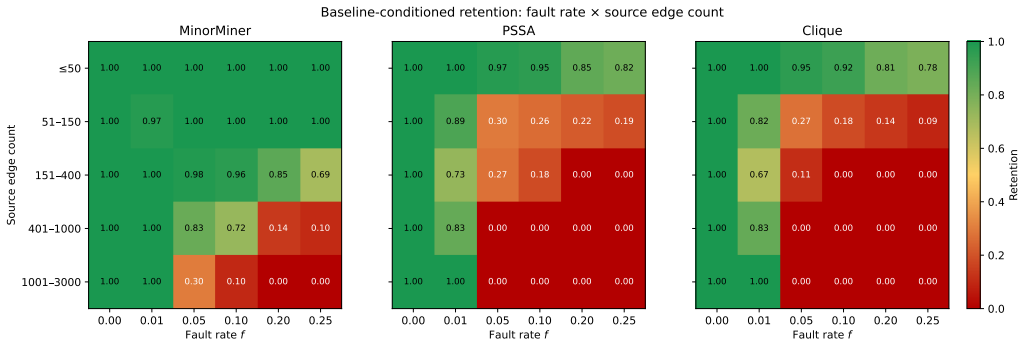
The paper introduces Ember as an extensible benchmark suite for minor embedding algorithms and uses it to evaluate five algorithms over its full library on the Chimera topology. It establishes that no algorithm dominates universally: performance rankings vary systematically according to the structure of the embedded graph, and the optimal choice depends on the problem family.
What carries the argument
Ember's standardized algorithm interface together with its library of 24,016 diverse graphs and unified analysis pipeline that supports Chimera, Pegasus, and Zephyr topologies.
If this is right
- Algorithm choice for embedding must be matched to the specific graph family rather than selected once for all problems.
- Future comparisons of embedding methods require diverse graph libraries to avoid conclusions that hold only for narrow problem classes.
- Hardware topology and qubit error rates must be included in benchmarks because they alter relative algorithm performance.
- Reinforcement-learning embedding methods can be fairly compared against classical algorithms inside the same reproducible framework.
Where Pith is reading between the lines
- Users could build simple graph-feature detectors that route each new problem to the currently best-performing embedding algorithm for its family.
- The systematic variation suggests that graph-theoretic invariants may predict which algorithm will succeed, opening a path to parameter-free selection rules.
- The same benchmark structure could be reused for other sparse-hardware compilation tasks once analogous graph libraries are assembled.
Load-bearing premise
The 24,016 graphs and chosen metrics capture the embedding challenges and solution-quality factors that arise in practical quantum annealing applications.
What would settle it
Finding one algorithm that ranks first on every graph family in the library, or showing that a different but still practical set of metrics reverses the observed ranking pattern.
Figures


read the original abstract
Minor embedding is a required compilation step for quantum annealing, mapping logical problem graphs onto sparse hardware topologies. Despite its central role in determining solution quality, no standardized benchmark exists for comparing embedding algorithms: prior studies use incompatible graph libraries, inconsistent metrics, and non-reproducible experimental setups, making cross-algorithm comparisons unreliable. We present Ember (Embedding Minor Benchmark for Evaluative Reproducibility), an open-source benchmarking framework addressing this gap. Ember provides a standardized algorithm interface with seeded, reproducible execution infrastructure; a diverse graph library of 24,016 instances spanning structured, random, and physics-motivated problem types not previously used in embedding benchmarks; and a unified analysis pipeline supporting all three current D-Wave hardware topologies (Chimera, Pegasus, Zephyr). We evaluate five algorithms across the full library on Chimera and find that no algorithm dominates universally: rankings vary systematically with graph structure, and the best algorithm depends on the family being embedded. We also examine the effects of hardware topology (including Pegasus and Zephyr), qubit error rates, and evaluate a reinforcement-learning approach (CHARME) within a narrower test set. Ember is available at https://github.com/zachmacsmith/ember and is installable via pip install ember-qc.
Editorial analysis
A structured set of objections, weighed in public.
Referee Report
Summary. The manuscript introduces Ember, an open-source benchmark suite for minor embedding algorithms in quantum annealing. It supplies a standardized algorithm interface with seeded reproducibility, a library of 24,016 graph instances spanning structured, random, and physics-motivated types, and a unified analysis pipeline for D-Wave Chimera, Pegasus, and Zephyr topologies. Evaluation of five algorithms on Chimera shows no universal dominator, with rankings varying systematically by graph family. Additional results examine topology effects, qubit error rates, and a reinforcement-learning approach (CHARME) on a narrower subset.
Significance. If the central empirical result holds, the work supplies valuable infrastructure for reproducible comparisons of embedding algorithms, a longstanding gap in quantum annealing research. The open-source code, pip-installable package, and emphasis on seeded execution are concrete strengths that enable community use. The finding that algorithm performance depends on graph family has direct implications for practitioners selecting embeddings for structured versus random problems. Significance is tempered by the need to confirm the library captures practical embedding difficulties.
major comments (1)
- The claim that no embedding algorithm dominates universally (abstract) rests on the 24,016-instance library capturing the distribution of minor-embedding difficulties encountered in practice. The library is described as spanning structured, random, and physics-motivated types not previously benchmarked, yet no external validation or comparison is provided against QUBO graphs derived from published application instances (e.g., TSP, scheduling, or ML models). If the synthetic generators produce systematically different chain-length or success-rate statistics than real applications, the observed family-dependent rankings could be an artifact of benchmark construction rather than a robust property of the algorithms.
minor comments (1)
- Abstract: the statement that Ember supports all three D-Wave topologies is clear, but only Chimera results are detailed; a concise summary table or key quantitative differences for Pegasus and Zephyr would aid readers.
Simulated Author's Rebuttal
We thank the referee for the constructive review and the recommendation for major revision. The primary concern regarding external validation of the benchmark library against real application-derived QUBOs is addressed point-by-point below. We have made targeted revisions to strengthen the discussion of the library's representativeness while preserving the core contribution of a standardized, reproducible framework.
read point-by-point responses
-
Referee: The claim that no embedding algorithm dominates universally (abstract) rests on the 24,016-instance library capturing the distribution of minor-embedding difficulties encountered in practice. The library is described as spanning structured, random, and physics-motivated types not previously benchmarked, yet no external validation or comparison is provided against QUBO graphs derived from published application instances (e.g., TSP, scheduling, or ML models). If the synthetic generators produce systematically different chain-length or success-rate statistics than real applications, the observed family-dependent rankings could be an artifact of benchmark construction rather than a robust property of the algorithms.
Authors: We acknowledge the value of direct validation against QUBO instances extracted from published applications such as TSP, scheduling, or machine-learning models. Our library was constructed to span graph families that correspond to the structural characteristics of such problems (e.g., grid-like and lattice graphs for many combinatorial optimization tasks, and physics-motivated graphs drawn from Ising models). The central empirical result—that algorithm rankings vary systematically by family—remains robust within this controlled, reproducible setting and provides practitioners with guidance on selecting embeddings according to problem structure. To address the referee's concern, we have added a new paragraph in the revised Discussion section that explicitly maps common application QUBOs onto the families in Ember, citing representative literature, and notes the benchmark's extensibility for users to incorporate their own application-derived instances. This revision clarifies the scope without overstating generalizability. revision: partial
Circularity Check
No significant circularity in Ember benchmark evaluation
full rationale
The paper introduces new infrastructure (Ember framework, standardized interface, 24,016-instance graph library spanning structured/random/physics-motivated types, unified analysis pipeline) and reports direct empirical results from running five embedding algorithms on Chimera (plus narrower tests on Pegasus/Zephyr and CHARME). The central claim—no algorithm dominates universally, with rankings varying by graph family—is an observation from these runs rather than a derivation, fitted parameter, or self-referential definition. No equations reduce outputs to inputs by construction, no load-bearing self-citations justify uniqueness theorems, and the work is self-contained against external benchmarks (the tested algorithms). This matches the expected honest non-finding for a benchmark suite paper.
Axiom & Free-Parameter Ledger
Reference graph
Works this paper leans on
-
[1]
Embedding of complete graphs in broken Chimera graphs,
E. Lobe and A. Lutz, “Embedding of complete graphs in broken Chimera graphs,”Quantum Information Processing, vol. 20, no. 8, p. 291, 2021
2021
-
[2]
What is the computational value of finite-range tunneling?
V . S. Denchev et al., “What is the computational value of finite-range tunneling?”Physical Review X, vol. 6, no. 3, p. 031015, 2016
2016
-
[3]
Stochastic blockmodels: First steps,
P. W. Holland, K. B. Laskey, and S. Leinhardt, “Stochastic blockmodels: First steps,”Social Networks, vol. 5, no. 2, pp. 109–137, 1983
1983
-
[4]
The D-Wave Advantage system: An overview,
D-Wave Systems Inc., “The D-Wave Advantage system: An overview,” Technical Report 14-1049A-A, 2020. [Online]. Avail- able: https://www.dwavequantum.com/media/s3qbjp3s/14-1049a-a the d-wave advantage system an overview.pdf
2020
-
[5]
Quantum annealing in the transverse Ising model,
T. Kadowaki and H. Nishimori, “Quantum annealing in the transverse Ising model,”Physical Review E, vol. 58, no. 5, pp. 5355–5363, 1998
1998
-
[6]
Minor-embedding in adiabatic quantum computation: I. The parameter setting problem,
V . Choi, “Minor-embedding in adiabatic quantum computation: I. The parameter setting problem,”Quantum Information Processing, vol. 7, pp. 193–209, 2008
2008
-
[7]
A. G ´omez-Tejedor and E. Osaba, “Addressing the minor-embedding problem in quantum annealing and evaluating state-of-the-art algorithm performance,” arXiv:2504.13376, 2025
-
[8]
J. Cai, W. Macready, and A. Roy, “A practical heuristic for finding graph minors,” arXiv:1406.2741, 2014
-
[9]
Efficiently embedding QUBO problems on adiabatic quantum computers,
P. Date, D. Arthur, and L. Pusey-Nazzaro, “Efficiently embedding QUBO problems on adiabatic quantum computers,”Quantum Informa- tion Processing, vol. 18, no. 4, p. 117, 2019
2019
-
[10]
ATOM: An efficient topology adaptive algorithm for minor embedding in quantum computing,
H. Ngo et al., “ATOM: An efficient topology adaptive algorithm for minor embedding in quantum computing,” arXiv:2307.01843, 2023
-
[11]
CHARME: A chain-based reinforcement learning ap- proach for the minor embedding problem,
H. Ngo et al., “CHARME: A chain-based reinforcement learning ap- proach for the minor embedding problem,” arXiv:2406.07124, 2024
-
[12]
Embedding algorithms for quantum annealers with Chimera and Pegasus connection topologies,
S. Zbinden, A. B ¨artschi, H. Djidjev, and S. Eidenbenz, “Embedding algorithms for quantum annealers with Chimera and Pegasus connection topologies,” inProc. ISC High Performance, pp. 187–206, 2020
2020
-
[13]
T. Boothby, P. Bunyk, J. Raymond, and A. Roy, “Next-generation topology of D-Wave quantum processors,” arXiv:2003.00133, 2020
-
[14]
Pegasus graph (Ocean documentation),
D-Wave Systems Inc., “Pegasus graph (Ocean documentation),” https: //docs.ocean.dwavesys.com/
-
[15]
Zephyr graph (Ocean documentation),
D-Wave Systems Inc., “Zephyr graph (Ocean documentation),” https: //docs.ocean.dwavesys.com/
-
[16]
minorminer: A tool for finding graph minors,
D-Wave Systems Inc., “minorminer: A tool for finding graph minors,” https://github.com/dwavesystems/minorminer
-
[17]
Fast clique minor generation in Chimera qubit connectivity graphs,
T. Boothby, A. D. King, and A. Roy, “Fast clique minor generation in Chimera qubit connectivity graphs,”Quantum Information Processing, vol. 15, no. 1, pp. 495–508, 2016
2016
-
[18]
Minor embedding for quantum annealing with reinforcement learning,
R. Nembrini et al., “Minor embedding for quantum annealing with reinforcement learning,”Quantum Machine Intelligence, 2025. doi:10.1007/s42484-026-00341-4
-
[19]
Computational supremacy in quantum simulation,
A. D. King et al., “Computational supremacy in quantum simulation,” arXiv:2403.00910, 2024
-
[20]
Comparing three generations of D-Wave quantum anneal- ers for minor embedded combinatorial optimization problems,
E. Pelofske, “Comparing three generations of D-Wave quantum anneal- ers for minor embedded combinatorial optimization problems,”Quantum Science and Technology, vol. 10, no. 2, p. 025025, 2025
2025
-
[21]
Benchmarking quantum annealing with maximum cardinality matching problems,
D. Vert et al., “Benchmarking quantum annealing with maximum cardinality matching problems,”Frontiers in Computer Science, vol. 6, 2024
2024
-
[22]
Proximal Policy Optimization Algorithms
J. Schulman, F. Wolski, P. Dhariwal, A. Radford, and O. Klimov, “Proximal policy optimization algorithms,” arXiv:1707.06347, 2017
work page internal anchor Pith review arXiv 2017
-
[23]
The Aligned Rank Transform for nonparametric factorial analyses using only ANOV A procedures,
J. O. Wobbrock, L. Findlater, D. Gergle, and J. J. Higgins, “The Aligned Rank Transform for nonparametric factorial analyses using only ANOV A procedures,” inProc. ACM SIGCHI Conf. Human Factors in Computing Systems, pp. 143–146, 2011
2011
-
[24]
Quantum optimization of fully connected spin glasses,
D. Venturelli, S. Mandr `a, S. Knysh, B. O’Gorman, R. Biswas, and V . Smelyanskiy, “Quantum optimization of fully connected spin glasses,” Physical Review X, vol. 5, no. 3, p. 031040, 2015
2015
-
[25]
Collective dynamics of ‘small-world’ networks,
D. J. Watts and S. H. Strogatz, “Collective dynamics of ‘small-world’ networks,”Nature, vol. 393, no. 6684, pp. 440–442, 1998
1998
-
[26]
On random graphs I,
P. Erd ˝os and A. R ´enyi, “On random graphs I,”Publicationes Mathemat- icae Debrecen, vol. 6, pp. 290–297, 1959
1959
-
[27]
Emergence of scaling in random net- works,
A.-L. Barab ´asi and R. Albert, “Emergence of scaling in random net- works,”Science, vol. 286, no. 5439, pp. 509–512, 1999
1999
-
[28]
Benchmark graphs for testing community detection algorithms,
A. Lancichinetti, S. Fortunato, and F. Radicchi, “Benchmark graphs for testing community detection algorithms,”Physical Review E, vol. 78, no. 4, p. 046110, 2008
2008
-
[29]
Layout-aware embedding for quantum annealing processors,
J. P. Pinilla and S. J. E. Wilton, “Layout-aware embedding for quantum annealing processors,” inProc. ISC High Performance, pp. 121–139, 2019
2019
-
[30]
D-Wave Ocean software (Ocean SDK),
D-Wave Systems Inc., “D-Wave Ocean software (Ocean SDK),” https: //github.com/dwavesystems/dwave-ocean-sdk
-
[31]
Deep learning-enabled method for accelerated graph embedding,
D. A. B. Hyde, “Deep learning-enabled method for accelerated graph embedding,” U.S. Patent Application No. 19/354,319, Oct. 9, 2025
2025
-
[32]
Using caching techniques to improve graph embedding performance,
J. W. Brahm, D. A. B. Hyde, and P. McMahon, “Using caching techniques to improve graph embedding performance,” U.S. Patent 10,929,294, Feb. 23, 2021
2021
-
[33]
Adiabatic quantum programming: minor embedding with hard faults,
C. Klymko, B. D. Sullivan, and T. S. Humble, “Adiabatic quantum programming: minor embedding with hard faults,”Quantum Information Processing, vol. 13, no. 3, pp. 709–729, 2014
2014
-
[34]
Minor-embedding heuristics for large-scale annealing processors with sparse hardware graphs of up to 102,400 nodes,
Y . Sugie et al., “Minor-embedding heuristics for large-scale annealing processors with sparse hardware graphs of up to 102,400 nodes,”Soft Computing, vol. 25, pp. 1731–1749, 2021
2021
-
[35]
Graph minors from simulated annealing for annealing machines with sparse connectivity,
Y . Sugie et al., “Graph minors from simulated annealing for annealing machines with sparse connectivity,” inProc. Theory and Practice of Natural Computing (TPNC), pp. 111–123, 2018
2018
-
[36]
Integer programming techniques for minor-embedding in quantum annealers,
D. E. Bernal, K. E. C. Booth, R. Dridi, H. Alghassi, S. Tayur, and D. Venturelli, “Integer programming techniques for minor-embedding in quantum annealers,” inProc. CPAIOR, pp. 112–129, 2020
2020
-
[37]
Scaling of graph embedding for quantum annealers,
E. Pelofske, A. B ¨artschi, G. Hahn, H. N. Djidjev, and S. Eidenbenz, “Scaling of graph embedding for quantum annealers,” inProc. IEEE Int. Conf. Quantum Computing and Engineering (QCE), Montreal, QC, Canada, 2024
2024
-
[38]
Graph minor embeddings for D-Wave computer architecture,
Z. Yang and M. J. Dinneen, “Graph minor embeddings for D-Wave computer architecture,” Technical Report, University of Auckland, 2019
2019
-
[39]
Op- timised quantum embedding: a universal minor-embedding framework for large complete bipartite graphs,
S. Sinno, T. Groß, N. Chancellor, B. Bhalgamiya, and A. Sahoo, “Op- timised quantum embedding: a universal minor-embedding framework for large complete bipartite graphs,” inProc. IEEE Quantum Artificial Intelligence (QAI), 2025
2025
-
[40]
Decomposition algorithms for solving NP-hard problems on a quantum annealer,
E. Pelofske, G. Hahn, and H. Djidjev, “Decomposition algorithms for solving NP-hard problems on a quantum annealer,” Los Alamos National Laboratory, Los Alamos, NM, Tech. Rep. LA-UR-19-30809, 2021
2021
-
[41]
Quantum computing and the stable set problem,
A. Krpan, J. Povh, and D. Pucher, “Quantum computing and the stable set problem,”Optimization Methods and Software, vol. 40, no. 4, pp. 837–870, 2025, doi: 10.1080/10556788.2025.2490639
discussion (0)
Sign in with ORCID, Apple, or X to comment. Anyone can read and Pith papers without signing in.