Recognition: unknown
PI-TTA: Physics-Informed Source-Free Test-Time Adaptation for Robust Human Activity Recognition on Mobile Devices
Pith reviewed 2026-05-07 16:35 UTC · model grok-4.3
The pith
Physics constraints stabilize source-free test-time adaptation for streaming inertial human activity recognition.
A machine-rendered reading of the paper's core claim, the machinery that carries it, and where it could break.
Core claim
PI-TTA is a source-free test-time adaptation framework that stabilizes online updates on unlabeled inertial streams by enforcing gravity consistency, short-horizon temporal continuity, and spectral stability. These constraints prevent the instability that vision-style objectives produce under streaming non-i.i.d. conditions, while updating only a small parameter subset and incurring modest overhead suitable for mobile deployment.
What carries the argument
Three physics-consistent constraints—gravity consistency, short-horizon temporal continuity, and spectral stability—that regularize adaptation to keep sensor readings physically plausible during streaming updates.
If this is right
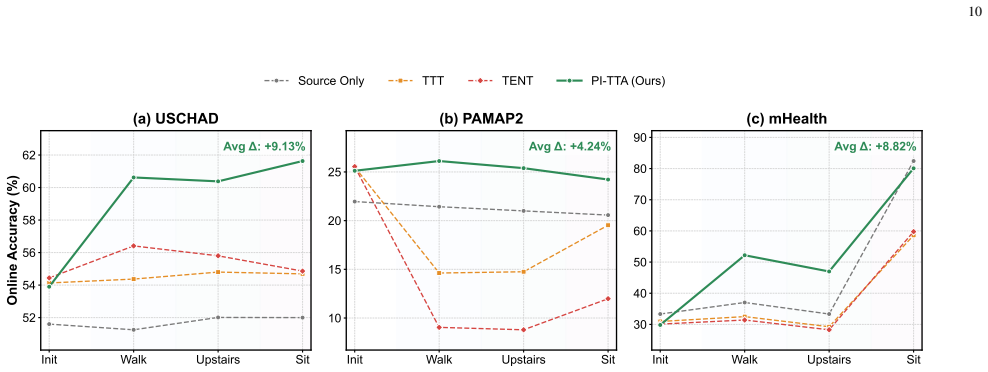
- Long-sequence accuracy rises by up to 9.13 percent compared with baselines under sustained streaming conditions.
- Physical-violation rates fall by 27.5 percent on USCHAD, 24.1 percent on PAMAP2, and 45.4 percent on mHealth.
- Adaptation remains stable without representation collapse or forgetting when data arrive continuously from mobile sensors.
- The method updates the same small parameter subset as existing source-free baselines and adds only modest overhead.
- On-device personalization becomes feasible for privacy-sensitive wearable sensing without centralizing user data.
Where Pith is reading between the lines
- Similar physics constraints could be derived for other inertial or time-series sensing tasks that obey known physical laws.
- Lower physical-violation rates may translate into more trustworthy alerts in long-term health or safety monitoring applications.
- If the three constraints prove general, the framework could reduce reliance on labeled target data across many sensor-based recognition problems.
Load-bearing premise
The three physics-consistent constraints are sufficient to prevent overconfident errors, representation collapse, and catastrophic forgetting in streaming non-i.i.d. inertial data without labeled target examples or central data access.
What would settle it
A sustained streaming experiment on any of the three datasets in which long-sequence accuracy fails to rise or physical-violation rates fail to drop relative to confidence-driven baselines under the same factorized shift protocols.
Figures




read the original abstract
Source-free test-time adaptation (TTA) is appealing for mobile and wearable sensing because it enables on-device personalization from unlabeled test streams without centralizing private data. However, sensor-based human activity recognition (HAR) poses challenges that are less pronounced in standard vision benchmarks: behavioral inertial streams are temporally correlated and often exhibit within-session shifts caused by sensor rotation, placement change, and sampling-rate drift. Under this streaming non-i.i.d. setting, widely used vision-style TTA objectives can become unstable, leading to overconfident errors, representation collapse, and catastrophic forgetting. We propose PI-TTA, a lightweight source-free adaptation framework that stabilizes online updates through three physics-consistent constraints: gravity consistency, short-horizon temporal continuity, and spectral stability. PI-TTA updates the same small parameter subset as strong source-free baselines and incurs only modest overhead, making it suitable for on-device deployment. Experiments on USCHAD, PAMAP2, and mHealth under long-sequence stress tests and factorized shift protocols show that PI-TTA mitigates the severe degradation observed in confidence-driven baselines and preserves stable adaptation under sustained streaming conditions. It improves long-sequence accuracy by up to 9.13% and reduces physical-violation rates by 27.5%, 24.1%, and 45.4% on USCHAD, PAMAP2, and mHealth, respectively. These results demonstrate that physics-informed adaptation can improve accuracy, stability, and deployment reliability for real-world mobile sensing systems.
Editorial analysis
A structured set of objections, weighed in public.
Referee Report
Summary. The paper proposes PI-TTA, a lightweight source-free test-time adaptation framework for human activity recognition on mobile inertial sensors. It stabilizes online updates in streaming non-i.i.d. settings by enforcing three physics-consistent constraints (gravity consistency, short-horizon temporal continuity, and spectral stability) rather than relying on confidence-driven objectives. Experiments on USCHAD, PAMAP2, and mHealth under long-sequence stress tests and factorized shift protocols report accuracy gains up to 9.13% and physical-violation rate reductions of 27.5%, 24.1%, and 45.4% respectively, while using the same small parameter subset as baselines.
Significance. If the constraints prove sufficient and correctly formulated, the work offers a practical advance for on-device HAR personalization that respects physical signal properties without source data access or labels. This addresses a real deployment gap where vision-style TTA becomes unstable on temporally correlated inertial streams, potentially improving reliability for privacy-sensitive mobile sensing applications. The emphasis on modest overhead and sustained streaming stability is a notable strength.
major comments (2)
- [Abstract] The central claim that the three constraints collectively prevent overconfident errors, representation collapse, and catastrophic forgetting rests on their sufficiency for accelerometer/gyroscope signals, but the abstract provides no enforcement equations or loss formulations, preventing verification that they are non-redundant and do not introduce bias under combined drifts.
- [Experiments] Experiments on long-sequence stress tests report quantitative gains without error bars, multiple-run statistics, or ablations isolating each constraint's contribution; this leaves open whether the mitigation of baseline degradation is due to the physics terms or other protocol choices.
minor comments (1)
- [Abstract] The abstract could briefly quantify the overhead (e.g., FLOPs or latency) to strengthen the on-device deployment claim.
Simulated Author's Rebuttal
We thank the referee for the constructive feedback on our manuscript. We address each major comment point by point below, providing clarifications and committing to revisions that enhance the paper's rigor and clarity while preserving its core contributions on physics-informed TTA for HAR.
read point-by-point responses
-
Referee: [Abstract] The central claim that the three constraints collectively prevent overconfident errors, representation collapse, and catastrophic forgetting rests on their sufficiency for accelerometer/gyroscope signals, but the abstract provides no enforcement equations or loss formulations, preventing verification that they are non-redundant and do not introduce bias under combined drifts.
Authors: The abstract is a concise high-level summary, and journal/conference abstracts typically omit detailed equations due to length limits. The enforcement equations and loss formulations are fully specified in Section 3 (Equations 3-9), where gravity consistency enforces physical orientation via accelerometer norms, short-horizon temporal continuity regularizes adjacent predictions, and spectral stability constrains frequency content under drift. These are non-redundant by design, each targeting a distinct failure mode in inertial streams, and their collective sufficiency without bias is shown via the factorized shift protocols in Section 4.3. To improve verifiability, we will revise the abstract to include a brief clause referencing the physics-consistent losses in Section 3. revision: partial
-
Referee: [Experiments] Experiments on long-sequence stress tests report quantitative gains without error bars, multiple-run statistics, or ablations isolating each constraint's contribution; this leaves open whether the mitigation of baseline degradation is due to the physics terms or other protocol choices.
Authors: We agree this reporting can be strengthened. The long-sequence stress tests in Section 4.2 were computationally intensive, leading to single-run reporting. In the revision, we will add error bars and statistics from 3 independent runs with varied random seeds. We will also expand the ablation analysis (new Table in Section 4.4) to isolate each constraint's incremental contribution by adding them one-by-one to the baseline, directly demonstrating that the physics terms drive the stability gains rather than protocol specifics. revision: yes
Circularity Check
No circularity: derivation applies independent physics constraints to stabilize TTA updates
full rationale
The paper's core derivation introduces PI-TTA by adding three externally motivated physics constraints (gravity consistency, short-horizon temporal continuity, spectral stability) as regularizers on source-free online updates for inertial HAR streams. These constraints are formulated from sensor physics and signal properties rather than being solved for or defined in terms of the adaptation objective, the fitted parameters, or any self-referential loop. No equations reduce the claimed stabilization to a fit on the target data itself, no uniqueness theorem is imported from prior self-work, and no ansatz is smuggled via citation. The reported accuracy and violation-rate gains are presented as empirical outcomes of applying these independent constraints, leaving the derivation self-contained against external benchmarks.
Axiom & Free-Parameter Ledger
axioms (3)
- domain assumption Gravity consistency holds across activity segments in inertial sensor streams
- domain assumption Short-horizon temporal continuity is a reliable property of human activity sequences
- domain assumption Spectral stability can be measured and enforced on short sensor windows
Reference graph
Works this paper leans on
-
[1]
Human activity recognition using wearable sensors by deep convolutional neural networks,
W. Jiang and Z. Yin, “Human activity recognition using wearable sensors by deep convolutional neural networks,” inProceedings of the 23rd ACM International Conference on Multimedia (MM), 2015, pp. 1307–1310
2015
-
[2]
Triple cross-domain attention on human activity recognition using wearable sensors,
Y . Tang, J. Zhang, L. Xiaoet al., “Triple cross-domain attention on human activity recognition using wearable sensors,”IEEE Transactions on Emerging Topics in Computational Intelligence, vol. 6, no. 5, pp. 1167–1176, 2022
2022
-
[3]
A systematic study of unsupervised domain adaptation for robust human-activity recognition,
Y . Chang, A. Mathur, A. Isopoussuet al., “A systematic study of unsupervised domain adaptation for robust human-activity recognition,” Proceedings of the ACM on Interactive, Mobile, Wearable and Ubiquitous Technologies (IMWUT), vol. 4, no. 1, p. Article 39, 2020
2020
-
[4]
Cross-dataset activity recognition via adaptive spatial-temporal transfer learning,
X. Qin, Y . Chen, J. Wanget al., “Cross-dataset activity recognition via adaptive spatial-temporal transfer learning,”Proceedings of the ACM on Interactive, Mobile, Wearable and Ubiquitous Technologies (IMWUT), vol. 3, no. 4, p. Article 148, 2019
2019
-
[5]
METIER: A deep multi-task learning based activity and user recognition model using wearable sensors,
L. Chen, Y . Zhang, and L. Peng, “METIER: A deep multi-task learning based activity and user recognition model using wearable sensors,” Proceedings of the ACM on Interactive, Mobile, Wearable and Ubiquitous Technologies (IMWUT), vol. 4, no. 1, p. Article 5, 2020
2020
-
[6]
Adversarial multi-view networks for activity recognition,
L. Bai, L. Yao, X. Wanget al., “Adversarial multi-view networks for activity recognition,”Proceedings of the ACM on Interactive, Mobile, Wearable and Ubiquitous Technologies (IMWUT), vol. 4, no. 2, p. Article 42, 2020
2020
-
[7]
Edge computing: Vision and challenges,
W. Shi, J. Cao, Q. Zhanget al., “Edge computing: Vision and challenges,” IEEE Internet of Things Journal, vol. 3, no. 5, pp. 637–646, 2016
2016
-
[8]
Federated learning in mobile edge networks: A comprehensive survey,
W. Y . B. Lim, N. C. Luong, D. T. Hoanget al., “Federated learning in mobile edge networks: A comprehensive survey,”IEEE Communications Surveys & Tutorials, vol. 22, no. 3, pp. 2031–2063, 2020
2031
-
[9]
Evaluation of test-time adaptation under computational time constraints,
M. Alfarra, H. Itani, A. Pardoet al., “Evaluation of test-time adaptation under computational time constraints,” inProceedings of the 41st International Conference on Machine Learning (ICML), ser. Proceedings of Machine Learning Research, vol. 235. PMLR, 2024, pp. 976–991. [Online]. Available: https://proceedings.mlr.press/v235/alfarra24a.html
2024
-
[10]
Bi-DeepViT: Binarized transformer for efficient sensor-based human activity recognition,
F. Luo, A. Li, B. Jianget al., “Bi-DeepViT: Binarized transformer for efficient sensor-based human activity recognition,”IEEE Transactions on Mobile Computing, vol. 24, no. 5, pp. 4419–4433, 2025. [Online]. Available: https://ieeexplore.ieee.org/document/10829799
-
[11]
ActivityMamba: A cnn-mamba hybrid neural network for efficient human activity recognition,
F. Luo, A. Li, B. Jianget al., “ActivityMamba: A cnn-mamba hybrid neural network for efficient human activity recognition,”IEEE Transactions on Mobile Computing, vol. 24, no. 8, pp. 6797–6811, 2025. [Online]. Available: https://dblp.org/pid/292/3073
2025
-
[12]
On-body localization of wearable devices: An investigation of position-aware activity recognition,
T. Sztyler and H. Stuckenschmidt, “On-body localization of wearable devices: An investigation of position-aware activity recognition,” in 2016 IEEE International Conference on Pervasive Computing and Communications (PerCom), 2016, pp. 1–9. 16
2016
-
[13]
IMUTube: Automatic extraction of virtual on-body accelerometry from video for human activity recognition,
H. Kwon, C. Tong, H. Haresamudramet al., “IMUTube: Automatic extraction of virtual on-body accelerometry from video for human activity recognition,”Proceedings of the ACM on Interactive, Mobile, Wearable and Ubiquitous Technologies (IMWUT), vol. 4, no. 3, p. Article 87, 2020
2020
-
[14]
Tent: Fully test-time adaptation by entropy minimization.arXiv preprint arXiv:2006.10726, 2020
D. Wang, E. Shelhamer, S. Liuet al., “Tent: Fully test-time adaptation by entropy minimization,” inInternational Conference on Learning Representations (ICLR), 2021. [Online]. Available: https://arxiv.org/abs/2006.10726
-
[15]
Batch normalization: Accelerating deep network training by reducing internal covariate shift,
S. Ioffe and C. Szegedy, “Batch normalization: Accelerating deep network training by reducing internal covariate shift,” inProceedings of the 32nd International Conference on Machine Learning (ICML), ser. Proceedings of Machine Learning Research, vol. 37. PMLR, 2015, pp. 448–456. [Online]. Available: https://proceedings.mlr.press/v37/ioffe15.html
2015
-
[16]
Revisiting batch normalization for practical domain adaptation,
Y . Li, N. Wang, J. Shiet al., “Revisiting batch normalization for practical domain adaptation,”arXiv preprint arXiv:1603.04779, 2016. [Online]. Available: https://arxiv.org/abs/1603.04779
-
[17]
Test-time training with self-supervision for generalization under distribution shifts,
Y . Sun, X. Wang, Z. Liuet al., “Test-time training with self-supervision for generalization under distribution shifts,” inProceedings of the 37th International Conference on Machine Learning (ICML), ser. Proceedings of Machine Learning Research, vol. 119. PMLR, 2020, pp. 9229–9248. [Online]. Available: https://proceedings.mlr.press/v119/sun20b.html
2020
-
[18]
Continual test-time domain adaptation,
Q. Wang, O. Fink, L. Van Goolet al., “Continual test-time domain adaptation,” inProceedings of the IEEE/CVF Conference on Computer Vision and Pattern Recognition (CVPR), 2022, pp. 7201–7211. [Online]. Available: https://openaccess.thecvf.com/content/CVPR2022/html/Wang _Continual_Test-Time_Domain_Adaptation_CVPR_2022_paper.html
2022
-
[19]
Note: Robust continual test-time adaptation against temporal correlation,
T. Gong, J. Jeong, T. Kimet al., “Note: Robust continual test-time adaptation against temporal correlation,” inAdvances in Neural Information Processing Systems (NeurIPS), 2022. [Online]. Available: https://proceedings.neurips.cc/paper_files/paper/2022/hash/ae6c7dbd942 9b3a75c41b5fb47e57c9e-Abstract-Conference.html
2022
-
[20]
MEMO: Test time robustness via adaptation and augmentation,
M. Zhang, S. Levine, and C. Finn, “MEMO: Test time robustness via adaptation and augmentation,” inAdvances in Neural Information Processing Systems (NeurIPS), 2022. [Online]. Available: https: //proceedings.neurips.cc/paper_files/paper/2022/hash/fc28053a08f59fc cb48b11f2e31e81c7-Abstract-Conference.html
2022
-
[21]
Efficient test-time model adaptation without forgetting,
S. Niu, J. Wu, Y . Zhanget al., “Efficient test-time model adaptation without forgetting,” inProceedings of the 39th International Conference on Machine Learning (ICML), ser. Proceedings of Machine Learning Research, vol. 162. PMLR, 2022, pp. 16 888–16 905. [Online]. Available: https://proceedings.mlr.press/v162/niu22a.html
2022
-
[22]
SoTTA: Robust test-time adaptation on noisy data streams,
T. Gong, Y . Kim, T. Leeet al., “SoTTA: Robust test-time adaptation on noisy data streams,” inAdvances in Neural Information Processing Systems (NeurIPS), 2023. [Online]. Available: https: //nmsl.kaist.ac.kr/projects/sotta/
2023
-
[23]
On pitfalls of test-time adaptation,
H. Zhao, Y . Liu, A. Alahiet al., “On pitfalls of test-time adaptation,” inProceedings of the 40th International Conference on Machine Learning (ICML), ser. Proceedings of Machine Learning Research, vol. 202. PMLR, 2023, pp. 42 058–42 080. [Online]. Available: https://proceedings.mlr.press/v202/zhao23d.html
2023
-
[24]
M. Raissi, P. Perdikaris, and G. E. Karniadakis, “Physics-informed neural networks: A deep learning framework for solving forward and inverse problems involving nonlinear partial differential equations,” Journal of Computational Physics, vol. 378, pp. 686–707, 2019. [Online]. Available: https://doi.org/10.1016/j.jcp.2018.10.045
-
[25]
S. Greydanus, M. Dzamba, and J. Yosinski, “Hamiltonian neural networks,” inAdvances in Neural Information Processing Systems (NeurIPS), 2019. [Online]. Available: https://arxiv.org/abs/1906.01563
-
[26]
Masked reconstruction based self-supervision for human activity recognition,
H. Haresamudram, A. Beedu, V . Agrawalet al., “Masked reconstruction based self-supervision for human activity recognition,” inProceedings of the ACM International Symposium on Wearable Computers (ISWC), 2020
2020
-
[27]
Datta: Domain diversity aware test-time adaptation for dynamic domain shifts,
C. Yeet al., “Datta: Domain diversity aware test-time adaptation for dynamic domain shifts,”arXiv preprint arXiv:2408.08056, 2024. [Online]. Available: https://arxiv.org/abs/2408.08056
-
[28]
Order-aware test-time adaptation: Leveraging temporal dynamics for robust streaming inference,
Y . K. Kim, O. Schlesinger, Q. Wuet al., “Order-aware test-time adaptation: Leveraging temporal dynamics for robust streaming inference,”arXiv preprint arXiv:2601.21012, 2026. [Online]. Available: https://arxiv.org/abs/2601.21012
-
[29]
Temporal test-time adaptation with state-space models,
M. Schirmer, D. Zhang, and E. Nalisnick, “Temporal test-time adaptation with state-space models,”arXiv preprint arXiv:2407.12492, 2024. [Online]. Available: https://arxiv.org/abs/2407.12492
-
[30]
M. Döbler, M. Marencke, and B. Yang, “Diversity-aware buffer for coping with temporally correlated data streams in online test-time adaptation,”arXiv preprint arXiv:2401.00989, 2024. [Online]. Available: https://arxiv.org/abs/2401.00989
-
[32]
Available: https://arxiv.org/abs/2603.03796
[Online]. Available: https://arxiv.org/abs/2603.03796
-
[33]
Federated learning: Challenges, methods, and future directions,
T. Li, A. K. Sahu, A. Talwalkaret al., “Federated learning: Challenges, methods, and future directions,”IEEE Signal Processing Magazine, vol. 37, no. 3, pp. 50–60, 2020
2020
-
[34]
Communication-efficient learning of deep networks from decentralized data,
B. McMahan, E. Moore, D. Ramageet al., “Communication-efficient learning of deep networks from decentralized data,” inArtificial Intelli- gence and Statistics (AISTATS). PMLR, 2017, pp. 1273–1282
2017
-
[35]
Advances and open problems in federated learning,
P. Kairouz, H. B. McMahanet al., “Advances and open problems in federated learning,”Foundations and Trends in Machine Learning, vol. 14, no. 1–2, pp. 1–210, 2021
2021
-
[36]
Practical secure aggregation for privacy-preserving machine learning,
K. Bonawitz, V . Ivanov, B. Kreuteret al., “Practical secure aggregation for privacy-preserving machine learning,” inProceedings of the 2017 ACM SIGSAC Conference on Computer and Communications Security (CCS), 2017, pp. 1175–1191
2017
-
[37]
Federated optimization in heterogeneous networks,
T. Li, A. K. Sahu, M. Zaheeret al., “Federated optimization in heterogeneous networks,”Proceedings of Machine Learning and Systems, vol. 2, pp. 429–450, 2020
2020
-
[38]
Adaptive federated optimization,
S. J. Reddi, Z. Charles, M. Zaheeret al., “Adaptive federated optimization,” inInternational Conference on Learning Representations (ICLR), 2021. [Online]. Available: https://openreview.net/forum?id=Lk FG3lB13U5
2021
-
[39]
Federated learning of large language models with parameter-efficient prompt tuning and adaptive optimization,
T. Che, J. Liu, Y . Zhouet al., “Federated learning of large language models with parameter-efficient prompt tuning and adaptive optimization,” inProceedings of the 2023 Conference on Empirical Methods in Natural Language Processing (EMNLP), 2023, pp. 7871–7888. [Online]. Available: https://aclanthology.org/2023.emnlp-main.488/
2023
-
[40]
OpenFedLLM: Training large language models on decentralized private data via federated learning,
R. Ye, W. Wang, J. Chaiet al., “OpenFedLLM: Training large language models on decentralized private data via federated learning,” inProceedings of the 30th ACM SIGKDD Conference on Knowledge Discovery and Data Mining (KDD), 2024. [Online]. Available: https://arxiv.org/abs/2402.06954
-
[41]
FLoRA: Federated fine-tuning large language models with heterogeneous low-rank adaptations,
Z. Wang, Z. Shen, Y . Heet al., “FLoRA: Federated fine-tuning large language models with heterogeneous low-rank adaptations,” inAdvances in Neural Information Processing Systems (NeurIPS), 2024. [Online]. Available: https://neurips.cc/virtual/2024/poster/95025
2024
-
[42]
Federated fine-tuning of large language models under heterogeneous tasks and client resources,
J. Bai, D. Chen, B. Qianet al., “Federated fine-tuning of large language models under heterogeneous tasks and client resources,” inAdvances in Neural Information Processing Systems (NeurIPS), 2024. [Online]. Available: https://neurips.cc/virtual/2024/poster/94124
2024
-
[43]
Heterogeneous LoRA for federated fine-tuning of on-device foundation models,
Y . J. Cho, L. Liu, Z. Xuet al., “Heterogeneous LoRA for federated fine-tuning of on-device foundation models,” inProceedings of the 2024 Conference on Empirical Methods in Natural Language Processing (EMNLP), 2024, pp. 12 903–12 913. [Online]. Available: https://aclanthology.org/2024.emnlp-main.717/
2024
-
[44]
USC-HAD: a daily activity dataset for ubiquitous activity recognition using wearable sensors,
M. Zhang and A. A. Sawchuk, “USC-HAD: a daily activity dataset for ubiquitous activity recognition using wearable sensors,” inProceedings of the 2012 ACM Conference on Ubiquitous Computing (UbiComp), 2012, pp. 1036–1043. [Online]. Available: https://dblp.org/rec/conf/huc/ZhangS12a
2012
-
[45]
Introducing a new benchmarked dataset for activity monitoring,
A. Reiss and D. Stricker, “Introducing a new benchmarked dataset for activity monitoring,” in2012 16th International Symposium on Wearable Computers (ISWC), 2012, pp. 108–109. [Online]. Available: https: //www.dfki.de/web/forschung/projekte-publikationen/publikation/6359
2012
-
[46]
MHEALTH [dataset],
O. Banos, R. Garcia, and A. Saez, “MHEALTH [dataset],” UCI Machine Learning Repository, 2014. [Online]. Available: https: //archive.ics.uci.edu/dataset/319/mhealth%2Bdataset%29
2014
-
[47]
Towards stable test-time adaptation in dynamic wild world,
S. Niu, J. Wu, Y . Zhanget al., “Towards stable test-time adaptation in dynamic wild world,” inInternational Conference on Learning Representations (ICLR), 2023. [Online]. Available: https://openreview.net/forum?id=g2YraF75Tj
2023
discussion (0)
Sign in with ORCID, Apple, or X to comment. Anyone can read and Pith papers without signing in.