Recognition: unknown
Differentiation of electron doping and oxygen reduction in electron-doped cuprates
Pith reviewed 2026-05-07 14:21 UTC · model grok-4.3
The pith
Pseudogap in electron-doped cuprates persists with added electrons but requires oxygen removal to disappear.
A machine-rendered reading of the paper's core claim, the machinery that carries it, and where it could break.
Core claim
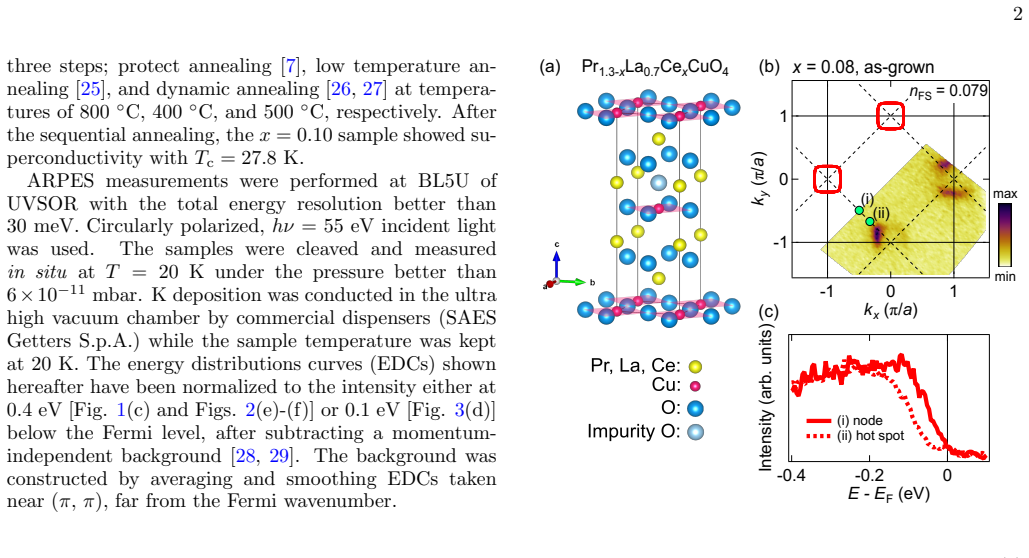
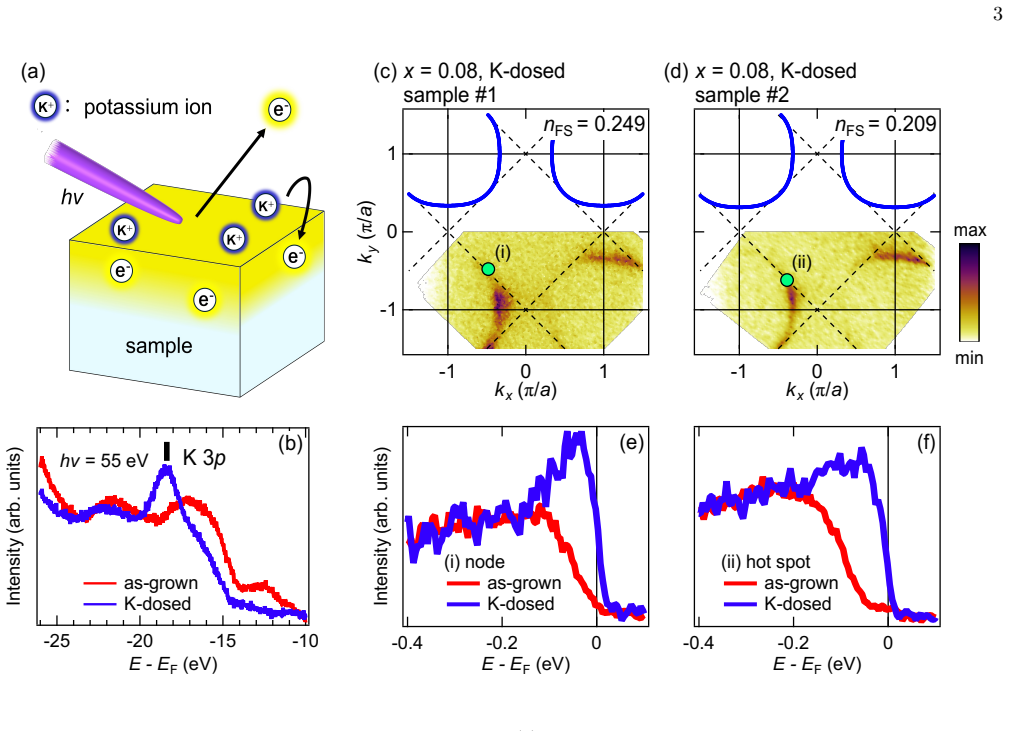
By dosing alkali metals onto the surface of an electron-doped cuprate, the authors introduce additional electrons while holding oxygen stoichiometry fixed. ARPES reveals that this extra electron doping eliminates the Fermi surface reconstruction from long-range antiferromagnetic order yet leaves the pseudogap intact. In contrast, the pseudogap is suppressed by reduction annealing that removes oxygen. The authors therefore conclude that impurity oxygen atoms contribute significantly to pseudogap formation, separate from the influence of electron concentration.
What carries the argument
Alkali-metal surface dosing combined with ARPES, which adds electrons without altering oxygen non-stoichiometry and thereby isolates the two variables.
If this is right
- Long-range antiferromagnetic order responds primarily to electron concentration, while the pseudogap is more sensitive to oxygen impurities.
- Reduction annealing achieves its main effect by removing oxygen atoms rather than by carrier adjustment alone.
- The pseudogap and antiferromagnetic reconstruction have distinct microscopic origins in these materials.
- Superconductivity requires both sufficient electron doping and removal of oxygen impurities to suppress the pseudogap.
Where Pith is reading between the lines
- Theoretical models of the pseudogap should incorporate explicit oxygen defect states in addition to carrier density.
- Surface dosing techniques could be used in other correlated electron systems to disentangle doping from stoichiometry effects.
- Further optimization of reduction annealing protocols may improve superconducting transition temperatures beyond what carrier tuning alone can achieve.
Load-bearing premise
Alkali-metal deposition adds electrons to the surface without modifying oxygen content or introducing independent changes to the electronic structure.
What would settle it
If the pseudogap were observed to disappear after alkali-metal deposition in the same way it disappears after reduction annealing, or if post-deposition measurements detected a change in oxygen content, the separation of effects would be falsified.
Figures

read the original abstract
Electron-doped cuprates require not only electron doping by chemical substitution but also post-growth reduction annealing for realizing superconductivity. However, electron concentration can also be varied by reduction annealing, making it challenging to disentangle the respective influences of electron concentration and oxygen non-stoichiometry. Here, by combining alkali-metal dosing and angle-resolved photoemission spectroscopy, we monitored changes in the electronic structure of an electron-doped cuprate while supplying additional electrons to its surface without modifying oxygen content. Whereas a Fermi surface reconstruction due to long-range antiferromagnetic order was suppressed by alkali-metal deposition, the pseudogap -- which is associated with short-range spin/charge correlations and can be suppressed by efficient reduction annealing -- was found to persist. The results highlight significant contribution of impurity oxygen atoms to pseudogap formation in electron-doped cuprates.
Editorial analysis
A structured set of objections, weighed in public.
Referee Report
Summary. The paper claims that alkali-metal dosing on electron-doped cuprates adds electrons without changing oxygen content, leading to suppression of long-range AF order but persistence of the pseudogap, in contrast to reduction annealing which suppresses the pseudogap, thus highlighting the role of impurity oxygen atoms in pseudogap formation.
Significance. This experimental approach to separate electron doping from oxygen reduction effects is significant for cuprate physics if the key assumption holds. It provides a direct contrast between two methods of modifying the electronic structure and attributes the pseudogap to oxygen impurities rather than just carrier density. The absence of circular reasoning or free parameters in the claim is a strength.
major comments (1)
- [Experimental Methods / Alkali-metal deposition] The central claim depends on alkali-metal deposition changing only the electron concentration while leaving oxygen content unchanged. However, the manuscript does not report any in-situ probe (e.g., O 1s XPS, Auger electron spectroscopy, or calibrated work-function measurements) to verify that oxygen stoichiometry is invariant under dosing. This omission leaves room for alternative explanations where dosing affects oxygen or introduces other effects that stabilize the pseudogap.
minor comments (1)
- [Abstract] The abstract does not specify the particular electron-doped cuprate material or its nominal doping level, which would provide better context for the observed phenomena.
Simulated Author's Rebuttal
We thank the referee for the careful reading of our manuscript and the positive evaluation of its significance. We provide a point-by-point response to the major comment below.
read point-by-point responses
-
Referee: [Experimental Methods / Alkali-metal deposition] The central claim depends on alkali-metal deposition changing only the electron concentration while leaving oxygen content unchanged. However, the manuscript does not report any in-situ probe (e.g., O 1s XPS, Auger electron spectroscopy, or calibrated work-function measurements) to verify that oxygen stoichiometry is invariant under dosing. This omission leaves room for alternative explanations where dosing affects oxygen or introduces other effects that stabilize the pseudogap.
Authors: We acknowledge that our study does not include additional in-situ spectroscopic probes such as O 1s XPS or Auger electron spectroscopy to directly confirm the invariance of oxygen stoichiometry during alkali-metal dosing. The dosing experiments were conducted in ultra-high vacuum (UHV) conditions, where the only source of electrons is the deposited alkali metals, with no oxygen atoms introduced or removed. This methodology follows established practices in the field for surface electron doping without altering the bulk oxygen content. Furthermore, the contrasting behavior observed—suppression of long-range antiferromagnetic order without affecting the pseudogap—differs markedly from the effects of reduction annealing, which reduces both the pseudogap and oxygen-related features. To address the referee's concern, we will revise the manuscript to include a more detailed discussion of the alkali-metal dosing process, citing relevant literature that validates the assumption of unchanged oxygen content, and explicitly discuss why alternative explanations involving oxygen modification are unlikely. revision: partial
Circularity Check
No circularity: direct experimental contrast with no derivations or self-referential fits
full rationale
The manuscript reports ARPES measurements on alkali-metal dosed surfaces of an electron-doped cuprate, observing suppression of long-range AF order while the pseudogap persists, in contrast to reduction annealing. No equations, fitted parameters, predictions, or uniqueness theorems appear in the provided text. The central claim follows from the measured spectral changes under the stated experimental conditions rather than reducing to any input by construction. Self-citations, if present, are not load-bearing for any derivation. This is a standard experimental paper whose conclusions rest on observable data contrasts, not on circular logic.
Axiom & Free-Parameter Ledger
axioms (1)
- domain assumption ARPES spectra directly reflect bulk-like electronic structure changes induced by surface electron addition.
Reference graph
Works this paper leans on
-
[1]
Tokura, H
Y. Tokura, H. Takagi, and S. Uchida, Nature (London) 337, 345 (1989)
1989
-
[2]
Takagi, S
H. Takagi, S. Uchida, and Y. Tokura, Phys. Rev. Lett. 62, 1197 (1989)
1989
-
[3]
P. G. Radaelli, J. D. Jorgensen, A. J. Schultz, J. L. Peng, and R. L. Greene, Phys. Rev. B49, 15322 (1994)
1994
-
[4]
A. J. Schultz, J. D. Jorgensen, J. L. Peng, and R. L. Greene, Phys. Rev. B53, 5157 (1996)
1996
-
[5]
Fujita, T
M. Fujita, T. Taniguchi, T. Wang, S. Torii, T. Kamiyama, K. Ohashi, T. Kawamata, T. Taka- matsu, T. Adachi, M. Kato, and Y. Koike, J. Phys. Soc. Jpn.90, 105002 (2021)
2021
-
[6]
Brinkmann, T
M. Brinkmann, T. Rex, H. Bach, and K. Westerholt, Phys. Rev. Lett.74, 4927 (1995)
1995
-
[7]
Adachi, Y
T. Adachi, Y. Mori, A. Takahashi, M. Kato, T. Nishizaki, T. Sasaki, N. Kobayashi, and Y. Koike, J. Phys. Soc. Jpn.82, 063713 (2013)
2013
-
[8]
Tsukada, Y
A. Tsukada, Y. Krockenberger, M. Noda, H. Yamamoto, D. Manske, L. Alff, and M. Naito, Solid State Commun. 133, 427 (2005)
2005
-
[9]
Matsumoto, A
O. Matsumoto, A. Utsuki, A. Tsukada, H. Yamamoto, T. Manabe, and M. Naito, Physica C469, 924 (2009)
2009
-
[10]
Horio, T
M. Horio, T. Adachi, Y. Mori, A. Takahashi, T. Yoshida, H. Suzuki, L. C. C. Ambolode, K. Okazaki, K. Ono, H. Kumigashira, H. Anzai, M. Arita, H. Namatame, M. Taniguchi, D. Ootsuki, K. Sawada, M. Takahashi, T. Mizokawa, Y. Koike, and A. Fujimori, Nat. Commun. 7, 10567 (2016)
2016
-
[11]
D. Song, G. Han, W. Kyung, J. Seo, S. Cho, B. S. Kim, M. Arita, K. Shimada, H. Namatame, M. Taniguchi, Y. Yoshida, H. Eisaki, S. R. Park, and C. Kim, Phys. Rev. Lett.118, 137001 (2017)
2017
-
[12]
Horio, Y
M. Horio, Y. Krockenberger, K. Koshiishi, S. Nakata, K. Hagiwara, M. Kobayashi, K. Horiba, H. Kumigashira, H. Irie, H. Yamamoto, and A. Fujimori, Phys. Rev. B 98, 020505(R) (2018)
2018
-
[13]
C. Lin, T. Adachi, M. Horio, T. Ohgi, M. A. Baqiya, T. Kawamata, H. Sato, T. Sumura, K. Koshiishi, S. Nakata, G. Shibata, K. Hagiwara, M. Suzuki, K. Ono, K. Horiba, H. Kumigashira, S. Ideta, K. Tanaka, Y. Koike, and A. Fujimori, Phys. Rev. Res.3, 013180 (2021)
2021
-
[14]
Miyamoto, M
M. Miyamoto, M. Horio, K. Moriya, A. Takahashi, J. Osiecki, B. Thiagarajan, C. M. Polley, Y. Koike, T. Adachi, T. Mizokawa, and I. Matsuda, Phys. Rev. B111, 125134 (2025)
2025
-
[15]
D. Song, S. Lee, Z. Shen, W. Jung, W. Lee, S. Choi, W. Kyung, S. Jung, C.-M. Cheng, J. Kwon, S. Ishida, Y. Yoshida, S. R. Park, H. Eisaki, Y. Wang, K.-Y. Choi, and C. Kim, Nat. Commun.16, 2764 (2025). 6
2025
-
[16]
Takayama-Muromachi, F
E. Takayama-Muromachi, F. Izumi, Y. Uchida, K. Kato, and H. Asano, Physica C159, 634 (1989)
1989
-
[17]
Suzuki, K
K. Suzuki, K. Kishio, T. Hasegawa, and K. Kitazawa, Physica C166, 357 (1990)
1990
-
[18]
Kim and D
J. Kim and D. Gaskell, Physica C209, 381 (1993)
1993
-
[19]
M. A. Hossain, J. D. F. Mottershead, D. Fournier, A. Bostwick, J. L. McChesney, E. Rotenberg, R. Liang, W. N. Hardy, G. A. Sawatzky, I. S. Elfimov, D. A. Bonn, and A. Damascelli, Nat. Phys.4, 527 (2008)
2008
-
[20]
Y. K. Kim, O. Krupin, J. D. Denlinger, A. Bostwick, E. Rotenberg, Q. Zhao, J. F. Mitchell, J. W. Allen, and B. J. Kim, Science345, 187 (2014)
2014
-
[21]
Miyata, K
Y. Miyata, K. Nakayama, K. Sugawara, T. Sato, and T. Takahashi, Nat. Mater.14, 775 (2015)
2015
-
[22]
M. Ren, Y. Yan, X. Niu, R. Tao, D. Hu, R. Peng, B. Xie, J. Zhao, T. Zhang, and D.-L. Feng, Sci. Adv.3, e1603238 (2017)
2017
-
[23]
C. Hu, J. Zhao, Q. Gao, H. Yan, H. Rong, J. Huang, J. Liu, Y. Cai, C. Li, H. Chen, L. Zhao, G. Liu, C. Jin, Z. Xu, T. Xiang, and X. J. Zhou, Nat. Commun.12, 1356 (2021)
2021
-
[24]
Horio, F
M. Horio, F. Forte, D. Sutter, M. Kim, C. G. Fatuzzo, C. E. Matt, S. Moser, T. Wada, V. Granata, R. Fitti- paldi, Y. Sassa, G. Gatti, H. M. Rønnow, M. Hoesch, T. K. Kim, C. Jozwiak, A. Bostwick, E. Rotenberg, I. Matsuda, A. Georges, G. Sangiovanni, A. Vecchione, M. Cuoco, and J. Chang, Commun. Phys.6, 323 (2023)
2023
-
[25]
Krockenberger, H
Y. Krockenberger, H. Irie, O. Matsumoto, K. Yamagami, M. Mitsuhashi, A. Tsukada, M. Naito, and H. Ya- mamoto, Sci. Rep.3, 2235 (2013)
2013
-
[26]
Y.-L. Wang, Y. Huang, L. Shan, S. L. Li, P. Dai, C. Ren, and H.-H. Wen, Phys. Rev. B80, 094513 (2009)
2009
-
[27]
Sumura, T
T. Sumura, T. Ishimoto, H. Kuwahara, K. Kurashima, Y. Koike, I. Watanabe, M. Miyazaki, A. Koda, R. Kadono, and T. Adachi, JPS Conf. Proc.21, 011027 (2018)
2018
-
[28]
Kaminski, S
A. Kaminski, S. Rosenkranz, H. M. Fretwell, J. Mesot, M. Randeria, J. C. Campuzano, M. R. Norman, Z. Z. Li, H. Raffy, T. Sato, T. Takahashi, and K. Kadowaki, Phys. Rev. B69, 212509 (2004)
2004
-
[29]
C. E. Matt, C. G. Fatuzzo, Y. Sassa, M. M˚ ansson, S. Fa- tale, V. Bitetta, X. Shi, S. Pailh` es, M. H. Berntsen, T. Kurosawa, M. Oda, N. Momono, O. J. Lipscombe, S. M. Hayden, J.-Q. Yan, J.-S. Zhou, J. B. Goodenough, S. Pyon, T. Takayama, H. Takagi, L. Patthey, A. Ben- dounan, E. Razzoli, M. Shi, N. C. Plumb, M. Radovic, M. Grioni, J. Mesot, O. Tjernberg...
2015
-
[30]
Armitage, F
N. Armitage, F. Ronning, D. Lu, C. Kim, A. Damas- celli, K. Shen, D. Feng, H. Eisaki, Z.-X. Shen, P. Mang, N. Kaneko, M. Greven, Y. Onose, Y. Taguchi, and Y. Tokura, Phys. Rev. Lett.88, 257001 (2002)
2002
-
[31]
S. R. Park, Y. S. Roh, Y. K. Yoon, C. S. Leem, J. H. Kim, B. J. Kim, H. Koh, H. Eisaki, N. P. Armitage, and C. Kim, Phys. Rev. B75, 060501 (2007)
2007
-
[32]
Ikeda, T
M. Ikeda, T. Yoshida, A. Fujimori, M. Kubota, K. Ono, H. Das, T. Saha-Dasgupta, K. Unozawa, Y. Kaga, T. Sasagawa, and H. Takagi, Phys. Rev. B80, 014510 (2009)
2009
-
[33]
Horio, S
M. Horio, S. Sakai, H. Suzuki, Y. Nonaka, M. Hashimoto, D. Lu, Z.-X. Shen, T. Ohgi, T. Konno, T. Adachi, Y. Koike, M. Imada, and A. Fujimori, Proc. Natl. Acad. Sci. U.S.A.122, e2406624122 (2025)
2025
-
[34]
Yoshida, X
T. Yoshida, X. J. Zhou, K. Tanaka, W. L. Yang, Z. Hus- sain, Z.-X. Shen, A. Fujimori, S. Sahrakorpi, M. Lin- droos, R. S. Markiewicz, A. Bansil, S. Komiya, Y. Ando, H. Eisaki, T. Kakeshita, and S. Uchida, Phys. Rev. B 74, 224510 (2006)
2006
-
[35]
R. W. Gurney, Phys. Rev.47, 479 (1935)
1935
-
[36]
R. D. Diehl and R. McGrath, J. Phys. Condens. Matter 9, 951 (1997)
1997
-
[37]
STAMPFL and M
C. STAMPFL and M. SCHEFFLER, Surf. Rev. Lett.02, 317 (1995)
1995
-
[38]
Tanuma, C
S. Tanuma, C. J. Powell, and D. R. Penn, Surf. Interface Anal.35, 268 (2003)
2003
-
[39]
Guguchia, T
Z. Guguchia, T. Adachi, Z. Shermadini, T. Ohgi, J. Chang, E. Bozin, F. von Rohr, A. Dos Santos, J. Mo- laison, R. Boehler, Y. Koike, A. Wieteska, B. Frandsen, E. Morenzoni, A. Amato, S. Billinge, Y. Uemura, and R. Khasanov, Phys. Rev. B96, 094515 (2017)
2017
-
[40]
Kyung, C
W. Kyung, C. H. Kim, Y. K. Kim, B. Kim, C. Kim, W. Jung, J. Kwon, M. Kim, A. Bostwick, J. D. Den- linger, Y. Yoshida, and C. Kim, npj Quantum Mater.6, 5 (2021)
2021
-
[41]
Weimer, E
J. Weimer, E. Umbach, and D. Menzel, Surf. Sci.159, 83 (1985)
1985
-
[42]
Matsui, K
H. Matsui, K. Terashima, T. Sato, T. Takahashi, M. Fu- jita, and K. Yamada, Phys. Rev. Lett.95, 017003 (2005)
2005
-
[43]
K.-J. Xu, Q. Guo, M. Hashimoto, Z.-X. Li, S.-D. Chen, J. He, Y. He, C. Li, M. H. Berntsen, C. R. Rotundu, Y. S. Lee, T. P. Devereaux, A. Rydh, D.-H. Lu, D.-H. Lee, O. Tjernberg, and Z.-X. Shen, Nat. Phys.19, 1834 (2023)
2023
-
[44]
Horio, K
M. Horio, K. Koshiishi, S. Nakata, K. Hagiwara, Y. Ota, K. Okazaki, S. Shin, S. Ideta, K. Tanaka, A. Takahashi, T. Ohgi, T. Adachi, Y. Koike, and A. Fujimori, Phys. Rev. B100, 054517 (2019)
2019
-
[45]
Kuroshima, M
S. Kuroshima, M. Fujita, T. Uefuji, M. Matsuda, and K. Yamada, Physica C: Superconductivity392, 216 (2003)
2003
-
[46]
E. M. Motoyama, G. Yu, I. M. Vishik, O. P. Vajk, P. K. Mang, and M. Greven, Nature445, 186 (2007)
2007
-
[47]
N. P. Armitage, D. H. Lu, C. Kim, A. Damascelli, K. M. Shen, F. Ronning, D. L. Feng, P. Bogdanov, Z.- X. Shen, Y. Onose, Y. Taguchi, Y. Tokura, P. K. Mang, N. Kaneko, and M. Greven, Phys. Rev. Lett.87, 147003 (2001)
2001
-
[48]
Matsui, T
H. Matsui, T. Takahashi, T. Sato, K. Terashima, H. Ding, T. Uefuji, and K. Yamada, Phys. Rev. B75, 224514 (2007)
2007
-
[49]
Richard, M
P. Richard, M. Neupane, Y.-M. Xu, P. Fournier, S. Li, P. Dai, Z. Wang, and H. Ding, Phys. Rev. Lett.99, 157002 (2007)
2007
-
[50]
D. Song, S. R. Park, C. Kim, Y. Kim, C. Leem, S. Choi, W. Jung, Y. Koh, G. Han, Y. Yoshida, H. Eisaki, D. H. Lu, Z.-X. Shen, and C. Kim, Phys. Rev. B86, 144520 (2012)
2012
-
[51]
S. R. Park, T. Morinari, D. J. Song, C. S. Leem, C. Kim, S. K. Choi, K. Choi, J. H. Kim, F. Schmitt, S. K. Mo, D. H. Lu, Z.-X. Shen, H. Eisaki, T. Tohyama, J. H. Han, and C. Kim, Phys. Rev. B87, 174527 (2013)
2013
-
[52]
X. Q. Xu, S. N. Mao, W. Jiang, J. L. Peng, and R. L. Greene, Phys. Rev. B53, 871 (1996)
1996
-
[53]
Adachi, A
T. Adachi, A. Takahashi, K. M. Suzuki, M. A. Baqiya, T. Konno, T. Takamatsu, M. Kato, I. Watanabe, A. Koda, M. Miyazaki, R. Kadono, and Y. Koike, J. Phys. Soc. Jpn.85, 114716 (2016). 7
2016
-
[54]
Adachi, T
T. Adachi, T. Kawamata, and Y. Koike, Condens. Mat- ter2, 23 (2017)
2017
-
[55]
Eisaki, N
H. Eisaki, N. Kaneko, D. L. Feng, A. Damascelli, P. K. Mang, K. M. Shen, Z.-X. Shen, and M. Greven, Phys. Rev. B69, 064512 (2004)
2004
discussion (0)
Sign in with ORCID, Apple, or X to comment. Anyone can read and Pith papers without signing in.