Recognition: unknown
Massive scalar quasinormal modes of an asymptotically flat regular black hole supported by a phantom Dirac--Born--Infeld field
Pith reviewed 2026-05-07 15:24 UTC · model grok-4.3
The pith
Massive scalar quasinormal modes provide a sensitive probe of the asymptotically flat regular black hole supported by a phantom Dirac-Born-Infeld field.
A machine-rendered reading of the paper's core claim, the machinery that carries it, and where it could break.
Core claim
The fundamental mode and first two overtones of the massive scalar are calculated for representative values of the regularity parameter and field mass. Increasing the field mass raises the real part of the frequency and reduces the imaginary part, while increasing the regularity scale generally lowers both frequency and damping. For sufficiently large field mass the damping rate approaches zero, indicating the onset of quasiresonant behavior, although late-time power-law tails eventually dominate the time-domain signal. The time-domain profiles agree closely with the WKB-Padé results, confirming the robustness of the spectrum.
What carries the argument
The exact asymptotically flat regular black-hole metric supported by a phantom Dirac-Born-Infeld scalar, on which the Klein-Gordon equation for the massive test scalar is solved via improved WKB and time-domain methods.
If this is right
- Higher scalar masses produce higher frequencies and weaker damping, yielding longer-lived signals.
- Larger regularity scales soften the ringing and extend its lifetime, allowing the parameter to be read off from observed modes.
- The onset of quasiresonant behavior at large masses is masked by late-time tails in the time domain.
- Agreement between frequency-domain and time-domain methods validates the computed spectrum for this geometry.
Where Pith is reading between the lines
- The same computational approach could be applied to electromagnetic or gravitational perturbations to test whether the probe remains sensitive across different fields.
- Detection of these specific mass- and regularity-dependent shifts in gravitational-wave data would constrain the DBI-supported regular geometry.
- Including backreaction of the scalar on the metric would test the limits of the test-field approximation used here.
Load-bearing premise
The massive scalar is treated as a non-backreacting test field on a fixed background geometry.
What would settle it
A high-precision numerical integration of the scalar wave equation for chosen values of mass and regularity parameter that yields frequencies or damping rates inconsistent with the WKB-Padé and time-domain results would falsify the reported spectrum and its sensitivity to the geometry.
Figures



read the original abstract
We study the quasinormal spectrum of a massive test scalar field in the exact asymptotically flat regular black-hole geometry supported by a phantom Dirac--Born--Infeld scalar. Using high-order WKB approximation improved by Pad\'e resummation, together with characteristic time-domain integration and Prony extraction, we compute the fundamental mode and the first two overtones for representative values of the regularity parameter and the field mass. We show that increasing the field mass raises the oscillation frequency and reduces the damping rate, while increasing the regularity scale generally makes the ringing softer and longer lived. The time-domain profiles are in very good agreement with the WKB--Pad\'e results and confirm the robustness of the spectrum. For sufficiently large field mass, the damping tends to zero, indicating the onset of quasiresonant behavior, although in the time domain these modes are eventually masked by oscillatory late-time tails. Our results show that massive scalar ringing provides a sensitive probe of this DBI-supported regular geometry.
Editorial analysis
A structured set of objections, weighed in public.
Referee Report
Summary. The paper computes the quasinormal modes of a massive test scalar field on the fixed background of an asymptotically flat regular black hole sourced by a phantom Dirac-Born-Infeld scalar. High-order WKB with Padé resummation and time-domain integration followed by Prony extraction are used to obtain the fundamental mode and first two overtones for representative values of the regularity parameter and scalar mass. The authors report that increasing the scalar mass raises the real frequency and lowers the damping rate, while increasing the regularity scale softens and lengthens the ringing; the two numerical methods agree well. For large masses the damping approaches zero (quasiresonant behavior), though late-time tails eventually dominate in the time domain. The central conclusion is that massive scalar ringing constitutes a sensitive probe of this DBI-supported geometry.
Significance. If the test-field results hold, the work shows that the QNM spectrum depends measurably on the DBI regularity parameter, potentially allowing observational distinction from Schwarzschild or other regular black-hole spacetimes. Explicit credit is due to the cross-validation between independent WKB-Padé and time-domain Prony methods, which strengthens in the reported frequencies and damping rates. The trend toward vanishing damping at large scalar mass and the associated late-time tails are interesting for the long-term dynamics. The overall significance remains conditional on the unquantified validity of the linear test-field approximation.
major comments (1)
- [Results section (and setup in §2–3)] The central claim that massive scalar ringing provides a sensitive probe of the DBI-supported regular geometry (abstract and results) rests on the scalar remaining a linear test field. The manuscript varies the scalar mass and regularity parameter but supplies no estimate of the amplitude at which the integrated scalar stress-energy would produce O(1) corrections to the background metric, particularly in the large-mass regime where damping approaches zero and late-time tails persist.
minor comments (2)
- [Abstract] The abstract states that the time-domain profiles are 'in very good agreement' with WKB-Padé results; a quantitative measure of the relative difference (e.g., percentage error on the fundamental frequency) would strengthen the cross-check.
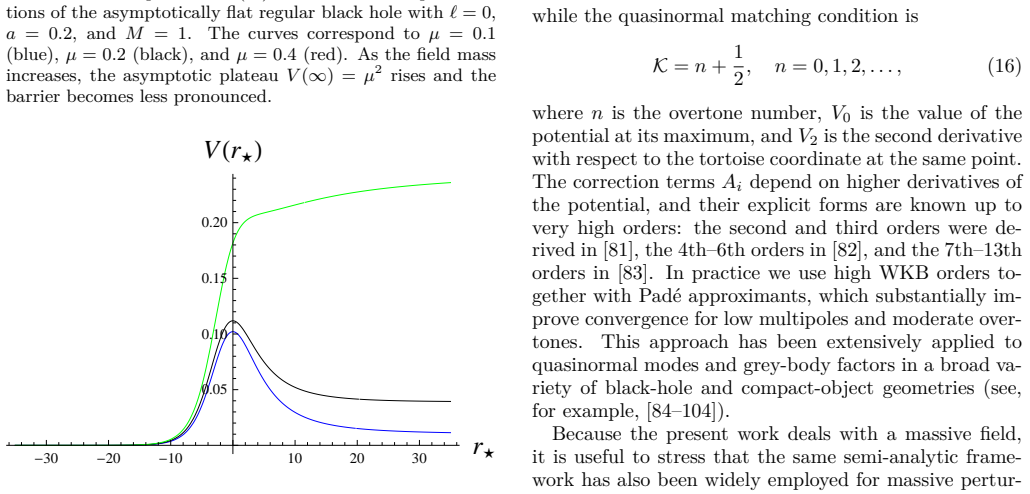
- [Figure captions] Figure captions should explicitly list the numerical values of the regularity parameter and scalar mass used for each curve to improve reproducibility.
Simulated Author's Rebuttal
We thank the referee for their careful reading and constructive feedback. We address the single major comment below.
read point-by-point responses
-
Referee: The central claim that massive scalar ringing provides a sensitive probe of the DBI-supported regular geometry (abstract and results) rests on the scalar remaining a linear test field. The manuscript varies the scalar mass and regularity parameter but supplies no estimate of the amplitude at which the integrated scalar stress-energy would produce O(1) corrections to the background metric, particularly in the large-mass regime where damping approaches zero and late-time tails persist.
Authors: We agree that the central claim is made within the linear test-field approximation, which is stated explicitly in the abstract, introduction, and setup sections. The analysis treats the massive scalar as a probe field on the fixed DBI-supported background and does not include a quantitative estimate of the backreaction threshold. Such an estimate would require a separate nonlinear calculation of the coupled system, which is outside the scope of the present work. We will revise the manuscript by adding a short paragraph in the conclusions that reiterates the test-field regime of validity, notes that the results hold for sufficiently small amplitudes where the scalar stress-energy remains perturbative, and acknowledges that late-time tails are a linear feature. This addition will clarify the domain of applicability without changing the reported spectra or conclusions. revision: partial
Circularity Check
No circularity: QNMs obtained by direct numerical solution on fixed background
full rationale
The paper solves the massive scalar wave equation on a prescribed fixed metric using independent numerical methods (high-order WKB with Padé resummation and characteristic time-domain integration with Prony fitting). No parameters are fitted to a data subset and then relabeled as predictions; the reported frequencies and damping times are direct outputs of the differential-equation solvers. The background geometry is taken as an external input (exact solution supported by phantom DBI field), but the test-field analysis itself contains no self-referential definitions, fitted-input predictions, or load-bearing self-citations that reduce the claimed spectrum to its own inputs by construction. The test-field approximation is an explicit modeling choice whose validity is not quantified, yet this is an assumption limitation rather than a circularity in the derivation chain.
Axiom & Free-Parameter Ledger
axioms (2)
- domain assumption The background metric is an exact solution of the Einstein-DBI equations and is asymptotically flat and regular.
- domain assumption The massive scalar is a test field that does not back-react on the metric.
Forward citations
Cited by 2 Pith papers
-
Scattering of scalar, electromagnetic, and Dirac fields in an asymptotically flat regular black hole supported by primordial dark matter
Raising the regularity parameter in this regular black-hole spacetime lowers the single-barrier potentials for all three fields, shifts transmission to lower frequencies, increases absorption cross sections, and produ...
-
Hawking Temperature, Sparsity and Energy Emission Rate of Regular Black Holes Supported by Primordial Dark Matter
The primordial dark matter scale suppresses Hawking temperature and spectral energy emission rate relative to Schwarzschild while the heat capacity stays negative and the sparsity parameter receives a small negative c...
Reference graph
Works this paper leans on
-
[1]
0 0 .104535 − 0.101138i 0.104552 − 0.100903i 0.163%
-
[2]
0.05 0 .105263 − 0.098960i 0.105290 − 0.098668i 0.203%
-
[3]
0.1 0 .109687 − 0.092588i 0.110148 − 0.091174i 1.04%
-
[4]
0.15 0 .111265 − 0.082667i 0.112144 − 0.082382i 0.666%
-
[5]
Fundamental quasinormal frequencies ( n = 0 ) of the massive scalar field with ℓ = 0 in the asymptotically flat regular black-hole background for M = 1
0.2 0 .113653 − 0.067971i 0.113378 − 0.067895i 0.216% TABLE I. Fundamental quasinormal frequencies ( n = 0 ) of the massive scalar field with ℓ = 0 in the asymptotically flat regular black-hole background for M = 1 . For each pair of parameters (a, µ), we compare the 16th-order WKB result with Padé approximant ˜m = 8 and the 14th-order WKB re- sult with Pad...
-
[6]
0 0 .283009 − 0.094640i 0.283009 − 0.094640i 0%
-
[7]
0.05 0 .284238 − 0.093942i 0.284238 − 0.093942i 0%
-
[8]
0.1 0 .287929 − 0.091834i 0.287929 − 0.091835i 0. × 10-4%
-
[9]
0.15 0 .294100 − 0.088273i 0.294099 − 0.088273i 0.0003%
-
[10]
0.2 0 .302776 − 0.083177i 0.302775 − 0.083176i 0.0002%
-
[11]
0.25 0 .313978 − 0.076415i 0.313978 − 0.076415i 0. × 10-4%
-
[12]
0.3 0 .327706 − 0.067792i 0.327706 − 0.067791i 0.00019%
-
[13]
0.35 0 .343887 − 0.057042i 0.343881 − 0.057056i 0.00431%
-
[14]
0.4 0 .362240 − 0.043968i 0.362234 − 0.043978i 0.00319%
-
[15]
Fundamental quasinormal frequencies ( n = 0 ) of the massive scalar field with ℓ = 1 in the asymptotically flat regular black-hole background for M = 1
0.45 0 .397609 − 0.026875i 0.399679 − 0.024201i 0.849% TABLE II. Fundamental quasinormal frequencies ( n = 0 ) of the massive scalar field with ℓ = 1 in the asymptotically flat regular black-hole background for M = 1 . The columns la- beled WKB16 and WKB14 give the 16th-order and 14th-order WKB results improved by Padé approximants with ˜m = 8 and ˜m = 7, r...
-
[16]
0 0 .468076 − 0.093767i 0.468076 − 0.093767i 0%
-
[17]
0.1 0 .471501 − 0.092646i 0.471501 − 0.092646i 0%
-
[18]
0.2 0 .481815 − 0.089251i 0.481815 − 0.089251i 0%
-
[19]
0.3 0 .499139 − 0.083482i 0.499139 − 0.083482i 0%
-
[20]
0.4 0 .523689 − 0.075132i 0.523689 − 0.075132i 0%
-
[21]
0.5 0 .555782 − 0.063800i 0.555782 − 0.063800i 0%
-
[22]
0.6 0 .595772 − 0.048700i 0.595772 − 0.048700i 0%
-
[23]
Fundamental quasinormal frequencies ( n = 0) of the massive scalar field with ℓ = 2 in the asymptotically flat regular black-hole background for M = 1
0.7 0 .643409 − 0.028568i 0.643368 − 0.028800i 0.0367% TABLE III. Fundamental quasinormal frequencies ( n = 0) of the massive scalar field with ℓ = 2 in the asymptotically flat regular black-hole background for M = 1 . The table com- pares the 16th-order and 14th-order WKB–Padé estimates, corresponding to ˜m = 8 and ˜m = 7 , and the final column lists the re...
-
[24]
0 0 .448790 − 0.286467i 0.448790 − 0.286467i 0%
-
[25]
0.1 0 .450626 − 0.284045i 0.450626 − 0.284045i 0%
-
[26]
0.2 0 .456090 − 0.276713i 0.456090 − 0.276713i 0.00010%
-
[27]
0.3 0 .465029 − 0.264287i 0.465028 − 0.264286i 0.00023%
-
[28]
0.4 0 .477111 − 0.246470i 0.477111 − 0.246468i 0.00031%
-
[29]
0.5 0 .491694 − 0.222958i 0.491675 − 0.222959i 0.00357%
-
[30]
0.6 0 .507730 − 0.193690i 0.507725 − 0.193263i 0.0785%
-
[31]
First-overtone quasinormal frequencies ( n = 1 ) of the massive scalar field with ℓ = 2 in the asymptotically flat regular black-hole background for M = 1
0.7 0 .523070 − 0.162093i 0.525714 − 0.162445i 0.487% TABLE IV. First-overtone quasinormal frequencies ( n = 1 ) of the massive scalar field with ℓ = 2 in the asymptotically flat regular black-hole background for M = 1 . As in the previous tables, we compare the 16th-order and 14th-order WKB results improved by Padé approximants with ˜m = 8 and ˜m = 7 , and...
-
[32]
0 0 .416304 − 0.492855i 0.416304 − 0.492848i 0.00112%
-
[33]
0.1 0 .416596 − 0.490680i 0.416596 − 0.490672i 0.00117%
-
[34]
0.2 0 .417405 − 0.484192i 0.417394 − 0.484177i 0.00291%
-
[35]
0.3 0 .418513 − 0.473490i 0.418510 − 0.473486i 0.00078%
-
[36]
0.4 0 .419656 − 0.458844i 0.419635 − 0.458864i 0.00461%
-
[37]
0.5 0 .420548 − 0.440843i 0.420528 − 0.440909i 0.0113%
-
[38]
0.6 0 .419996 − 0.420508i 0.419754 − 0.420523i 0.0409%
-
[39]
Second-overtone quasinormal frequencies ( n = 2 ) of the massive scalar field with ℓ = 2 in the asymptotically flat regular black-hole background for M = 1
0.7 0 .445780 − 0.419267i 0.449860 − 0.413482i 1.16% TABLE V. Second-overtone quasinormal frequencies ( n = 2 ) of the massive scalar field with ℓ = 2 in the asymptotically flat regular black-hole background for M = 1 . As in the previous tables, we compare the 16th-order and 14th-order WKB results improved by Padé approximants with ˜m = 8 and ˜m = 7 , and ...
-
[40]
K. D. Kokkotas and B. G. Schmidt, Living Rev. Rel. 2, 2 (1999), arXiv:gr-qc/9909058
work page internal anchor Pith review arXiv 1999
-
[41]
Quasinormal modes of black holes and black branes
E. Berti, V. Cardoso, and A. O. Starinets, Class. Quant. Grav. 26, 163001 (2009), arXiv:0905.2975 [gr-qc]
work page internal anchor Pith review arXiv 2009
- [42]
- [43]
- [44]
-
[45]
A. Afzal et al. (NANOGrav), Astrophys. J. Lett. 951, L11 (2023), arXiv:2306.16219 [astro-ph.HE]
- [46]
- [47]
- [48]
- [49]
- [50]
- [51]
- [52]
-
[53]
A. Zhidenko, Phys. Rev. D 74, 064017 (2006), arXiv:gr- qc/0607133
- [54]
- [55]
-
[56]
P. Burikham, S. Ponglertsakul, and L. Tannukij, Phys. Rev. D 96, 124001 (2017), arXiv:1709.02716 [gr-qc]
- [57]
-
[58]
J. Percival and S. R. Dolan, Phys. Rev. D 102, 104055 (2020), arXiv:2008.10621 [gr-qc]
- [59]
- [60]
- [61]
-
[62]
S. V. Bolokhov, Phys. Rev. D 109, 064017 (2024)
2024
-
[63]
Bolokhov, Eur
S. Bolokhov, Eur. Phys. J. C 85, 1166 (2025)
2025
-
[64]
S. V. Bolokhov, (2026), arXiv:2604.11845 [gr-qc]
work page internal anchor Pith review Pith/arXiv arXiv 2026
- [65]
- [66]
- [67]
- [68]
- [69]
- [70]
- [71]
- [72]
-
[73]
B. C. Lütfüoğlu, (2026), arXiv:2603.10844 [gr-qc]
work page internal anchor Pith review Pith/arXiv arXiv 2026
-
[74]
B. C. Lütfüoğlu, S. Murodov, M. Abdullaev, J. Ray- imbaev, M. Akhmedov, and M. Matyoqubov, (2026), arXiv:2602.11001 [gr-qc]
work page internal anchor Pith review Pith/arXiv arXiv 2026
-
[75]
B. C. Lütfüoğlu, J. Rayimbaev, B. Rahmatov, F. Shayi- mov, and I. Davletov, Phys. Lett. B 876, 140392 (2026), arXiv:2601.17906 [gr-qc]
work page internal anchor Pith review Pith/arXiv arXiv 2026
-
[76]
Skvortsova, EPL 149, 59001 (2025), arXiv:2503.03650 [gr-qc]
M. Skvortsova, EPL 149, 59001 (2025), arXiv:2503.03650 [gr-qc]
-
[77]
Skvortsova, (2025), arXiv:2509.18061 [gr-qc]
M. Skvortsova, (2025), arXiv:2509.18061 [gr-qc]
-
[78]
Skvortsova, (2026), arXiv:2603.28415 [gr-qc]
M. Skvortsova, (2026), arXiv:2603.28415 [gr-qc]
-
[79]
A. Dubinsky, Int. J. Theor. Phys. 65, 45 (2026), arXiv:2511.00778 [gr-qc]
-
[80]
A. Dubinsky, Eur. Phys. J. C 85, 924 (2025), arXiv:2505.08545 [gr-qc]
discussion (0)
Sign in with ORCID, Apple, or X to comment. Anyone can read and Pith papers without signing in.