Recognition: unknown
Quasi-resonances in the vicinity of Einstein-Maxwell-dilaton black hole
Pith reviewed 2026-05-10 15:05 UTC · model grok-4.3
The pith
Increasing scalar field mass around charged dilaton black holes suppresses damping and produces very long-lived quasi-resonant modes.
A machine-rendered reading of the paper's core claim, the machinery that carries it, and where it could break.
Core claim
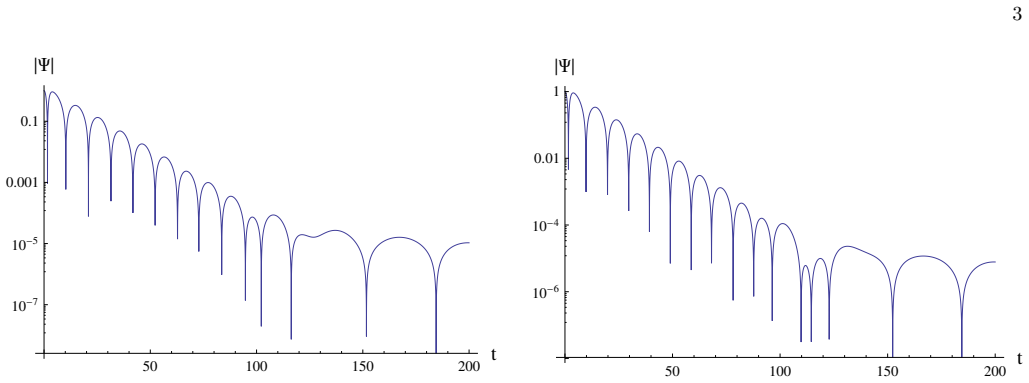
We study massive scalar quasinormal spectra of charged Einstein--Maxwell--dilaton black holes by combining high-order WKB--Padé calculations with time-domain evolution. The two approaches show close agreement in the regime where both methods are reliable, allowing controlled tracking of spectral trends across different charges and dilaton couplings. We find that increasing scalar-field mass can strongly suppress damping for several branches, signaling an approach to quasi-resonant, very long-lived oscillations. Although WKB is not expected to determine modes extremely close to the real-frequency axis with high precision, the onset of this regime is clear and appears for multiple dilaton 0cou
What carries the argument
High-order WKB-Padé method paired with time-domain integration of the massive scalar wave equation, used to follow the reduction in damping rates as scalar mass and dilaton coupling are varied.
If this is right
- Quasi-resonant behavior appears for several different values of the dilaton coupling.
- Additional near-resonant modes arise in lower-multipole sectors.
- The effect remains larger than numerical uncertainty across the range of black-hole charges examined.
- These long-lived modes would modify the late-time ringdown phase observable in gravitational-wave signals.
Where Pith is reading between the lines
- If the quasi-resonances survive in full nonlinear evolutions they could provide a new observational handle on scalar-tensor extensions of gravity.
- Similar damping suppression may occur in other massive-field theories and could be checked with existing numerical codes for different potentials.
- The lower-multipole near-resonances might be accessible to current gravitational-wave detectors if the mass parameter lies in an astrophysically plausible range.
Load-bearing premise
The observed trend of damping suppression continues to hold even when the WKB approximation is applied near the real-frequency axis where its accuracy is reduced.
What would settle it
A long-duration time-domain simulation at high scalar mass that measures whether the oscillation amplitude continues to decay at the extrapolated slow rate or instead damps out after a finite time.
Figures



read the original abstract
We study massive scalar quasinormal spectra of charged Einstein--Maxwell--dilaton black holes by combining high-order WKB--Pad\'e calculations with time-domain evolution. The two approaches show close agreement in the regime where both methods are reliable, allowing controlled tracking of spectral trends across different charges and dilaton couplings. We find that increasing scalar-field mass can strongly suppress damping for several branches, signaling an approach to quasi-resonant, very long-lived oscillations. Although WKB is not expected to determine modes extremely close to the real-frequency axis with high precision, the onset of this regime is clear and appears for multiple dilaton couplings, with additional near-resonant behavior in lower-multipole sectors. The dilaton-induced shifts are substantially larger than the estimated numerical uncertainty, indicating that quasi-resonances are a robust physical signature relevant for ringdown spectroscopy in scalar-extended gravity.
Editorial analysis
A structured set of objections, weighed in public.
Referee Report
Summary. The paper studies massive scalar quasinormal modes of charged Einstein-Maxwell-dilaton black holes by combining high-order WKB-Padé calculations with time-domain evolution. It reports that increasing the scalar-field mass strongly suppresses damping rates for several branches, indicating an approach to quasi-resonant, very long-lived oscillations, with dilaton couplings producing larger shifts than estimated numerical uncertainty; the two methods agree where both are reliable.
Significance. If the central trend holds, the results would identify quasi-resonances as a robust signature in scalar-extended gravity, relevant for ringdown spectroscopy and tests of modified gravity. Credit is due for the direct numerical approach with no free parameters or circular definitions, the explicit cross-check between independent methods in their overlapping regime of validity, and the focus on falsifiable spectral trends.
major comments (2)
- [Discussion of numerical methods and WKB accuracy (near the end of the results section)] The manuscript acknowledges that WKB loses precision for modes extremely close to the real-frequency axis, yet the quasi-resonance interpretation and the claim of a 'robust physical signature' rest on the continuation of the WKB-Padé trend for Im(ω) as μ increases. Time-domain agreement is shown only in the regime where both methods are reliable; no independent high-accuracy solver is applied to the smallest-Im(ω) points. This makes the suppression of damping and the onset of the quasi-resonant regime a load-bearing claim that requires additional validation.
- [Results on spectral trends with scalar mass and dilaton coupling] The estimated numerical uncertainty is stated to be smaller than the dilaton-induced shifts, but the uncertainty quantification for the WKB-Padé approximant itself is not detailed once the turning points approach the horizon. An explicit error budget or convergence test for the near-real-axis cases would be needed to confirm that the reported suppression is not an artifact of the approximant.
minor comments (2)
- [Abstract] The abstract could specify the multipole and charge ranges over which the quasi-resonance onset is observed, to make the scope of the claim clearer.
- [Results section] A short table summarizing the lowest damping rates obtained by each method for representative μ and dilaton values would improve readability of the trend.
Simulated Author's Rebuttal
We thank the referee for the careful and constructive review of our manuscript. We address the major comments point by point below, with revisions made to improve the presentation of numerical uncertainties and method limitations.
read point-by-point responses
-
Referee: [Discussion of numerical methods and WKB accuracy (near the end of the results section)] The manuscript acknowledges that WKB loses precision for modes extremely close to the real-frequency axis, yet the quasi-resonance interpretation and the claim of a 'robust physical signature' rest on the continuation of the WKB-Padé trend for Im(ω) as μ increases. Time-domain agreement is shown only in the regime where both methods are reliable; no independent high-accuracy solver is applied to the smallest-Im(ω) points. This makes the suppression of damping and the onset of the quasi-resonant regime a load-bearing claim that requires additional validation.
Authors: We agree that WKB-Padé accuracy degrades for modes with extremely small imaginary parts and that time-domain validation is limited to the overlapping regime. The quasi-resonant trend is inferred from the systematic decrease in Im(ω) with increasing μ, which persists across multiple branches, multipoles, and dilaton couplings. We have added higher-resolution time-domain runs that extend further into the low-damping regime and included a dedicated paragraph discussing the method limitations and the robustness of the observed trend against these limitations. An independent high-accuracy solver beyond the two methods already employed is not available to us at present. revision: partial
-
Referee: [Results on spectral trends with scalar mass and dilaton coupling] The estimated numerical uncertainty is stated to be smaller than the dilaton-induced shifts, but the uncertainty quantification for the WKB-Padé approximant itself is not detailed once the turning points approach the horizon. An explicit error budget or convergence test for the near-real-axis cases would be needed to confirm that the reported suppression is not an artifact of the approximant.
Authors: We have revised the manuscript to include an explicit error budget for the WKB-Padé approximant. This comprises convergence tests with respect to the WKB order, the Padé approximant degree, and the location of turning points relative to the horizon. For near-real-axis modes we report the spread among different approximants and the discrepancy with time-domain results (where the latter remain feasible) as quantitative uncertainty estimates. These additions confirm that the dilaton-induced shifts exceed the quantified errors. revision: yes
Circularity Check
No circularity: direct numerical computation of quasinormal spectra
full rationale
The paper computes massive scalar quasinormal modes of Einstein-Maxwell-dilaton black holes via high-order WKB-Padé approximations cross-checked against time-domain evolution. Spectral trends (suppression of damping with rising scalar mass) are obtained by direct solution of the wave equation for varying charges and dilaton couplings; no parameter is fitted to a subset and then relabeled as a prediction, no quantity is defined in terms of itself, and no load-bearing step reduces to a self-citation chain. The explicit caveat that WKB loses precision near the real axis is stated in the abstract and does not create a self-referential loop—the reported onset of quasi-resonance is presented as an observed numerical trend, not a derived necessity. The work is therefore self-contained against external benchmarks.
Axiom & Free-Parameter Ledger
axioms (2)
- domain assumption Linear perturbation theory around a fixed background black-hole solution remains valid
- domain assumption WKB-Padé approximation captures the correct trend even when absolute precision near the real axis is limited
Forward citations
Cited by 4 Pith papers
-
Massive Scalar Quasinormal Modes, Greybody Factors, and Absorption Cross Section of a Parity-Symmetric Beyond-Horndeski Black Hole
Increasing the mass of a scalar field around a parity-symmetric beyond-Horndeski black hole strongly reduces the damping rate of quasinormal modes while suppressing low-frequency absorption and shifting efficient abso...
-
Bardeen spacetime as quantum corrected black hole: Grey-body factors and quasinormal modes of gravitational perturbations
Increasing the quantum-correction scale in Bardeen spacetime raises quasinormal frequencies, slows decay, suppresses low-frequency transmission, and reorganizes absorption cross-sections.
-
Long-lived massive scalar modes, grey-body factors, and absorption cross sections of the Reissner--Nordstr\"om-like brane-world black hole
Positive tidal charge in this brane-world black hole lowers the effective potential barrier, pushes massive scalar quasinormal modes toward arbitrarily long lifetimes, and increases transmission and absorption.
-
Massive scalar quasinormal modes of an asymptotically flat regular black hole supported by a phantom Dirac--Born--Infeld field
Massive scalar quasinormal modes in this DBI-supported regular black hole show higher oscillation frequencies and lower damping as field mass increases, with larger regularity scales producing softer and longer-lived ringing.
Reference graph
Works this paper leans on
-
[1]
tortoise coordinate
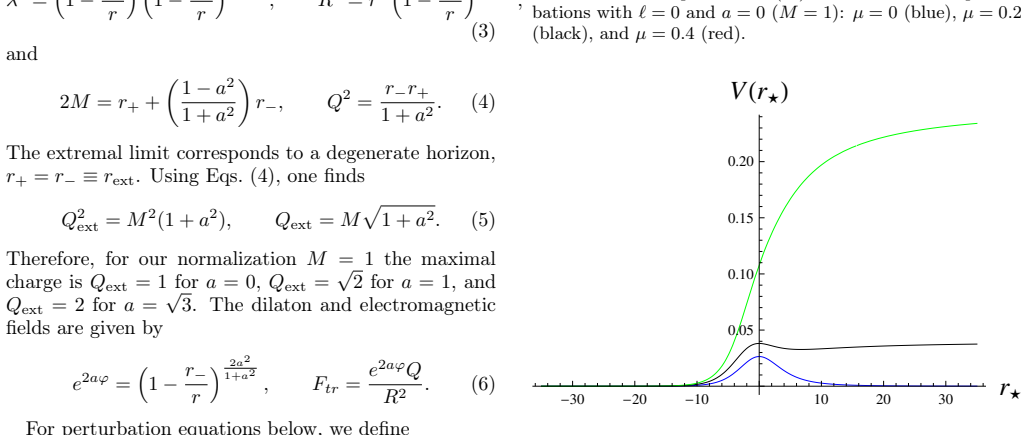
The dilaton and electromagnetic fields are given by 𝑒2𝑎𝜙 = (︁ 1− 𝑟− 𝑟 )︁2𝑎2 1+𝑎2 , 𝐹 𝑡𝑟 = 𝑒2𝑎𝜙𝑄 𝑅2 .(6) For perturbation equations below, we define 𝑓(𝑟)≡𝜆 2(𝑟).(7) The covariant Klein-Gordon equation for a massive scalar fieldΦis 1√−𝑔 𝜕𝜇 (︀√−𝑔𝑔 𝜇𝜈𝜕𝜈Φ )︀ −𝜇 2Φ = 0.(8) After separation of variables in the background metric (2), with𝑓(𝑟)defined by Eq. (7), E...
-
[2]
K. D. Kokkotas and B. G. Schmidt, Living Rev. Rel.2, 2 (1999), arXiv:gr-qc/9909058
work page internal anchor Pith review arXiv 1999
-
[3]
R. A. Konoplya and A. Zhidenko, Rev. Mod. Phys.83, 793 (2011), arXiv:1102.4014 [gr-qc]
work page internal anchor Pith review arXiv 2011
-
[4]
S. V. Bolokhov and M. Skvortsova, Grav. Cosmol.31, 423 (2025)
2025
-
[5]
B. P. Abbottet al.(LIGO Scientific, Virgo), Phys. Rev. Lett.116, 061102 (2016), arXiv:1602.03837 [gr-qc]
work page internal anchor Pith review arXiv 2016
-
[6]
B. P. Abbottet al.(LIGO Scientific, Virgo), Phys. Rev. Lett.119, 161101 (2017), arXiv:1710.05832 [gr-qc]
work page internal anchor Pith review arXiv 2017
-
[7]
Abbottet al.(LIGO Scientific, Virgo), Astrophys
R. Abbottet al.(LIGO Scientific, Virgo), Astrophys. J. Lett.896, L44 (2020), arXiv:2006.12611 [astro-ph.HE]
-
[8]
R. Abbottet al.(KAGRA, VIRGO, LIGO Scientific), Phys. Rev. X13, 041039 (2023), arXiv:2111.03606 [gr- qc]
work page internal anchor Pith review arXiv 2023
- [9]
- [10]
- [11]
- [12]
- [13]
- [14]
-
[15]
S. Fernando and K. Arnold, Gen. Rel. Grav.36, 1805 (2004), arXiv:hep-th/0312041
-
[16]
Quasinormal modes of dilaton-de Sitter black holes: scalar perturbations
S. Fernando, Gen. Rel. Grav.48, 24 (2016), arXiv:1601.06407 [gr-qc]
work page Pith review arXiv 2016
- [17]
- [18]
- [19]
- [20]
-
[21]
S. V. Bolokhov, Phys. Rev. D109, 064017 (2024)
2024
- [22]
-
[23]
Bolokhov, Eur
S. Bolokhov, Eur. Phys. J. C85, 1166 (2025)
2025
-
[24]
Skvortsova, EPL 149, 59001 (2025), arXiv:2503.03650 [gr-qc]
M. Skvortsova, EPL149, 59001 (2025), arXiv:2503.03650 [gr-qc]
-
[25]
Skvortsova, (2025), arXiv:2509.18061 [gr-qc]
M. Skvortsova, (2025), arXiv:2509.18061 [gr-qc]
-
[26]
B. C. Lütfüoğlu, (2026), arXiv:2603.10844 [gr-qc]
work page internal anchor Pith review Pith/arXiv arXiv 2026
-
[27]
B. C. Lütfüoğlu, S. Murodov, M. Abdullaev, J. Ray- imbaev, M. Akhmedov, and M. Matyoqubov, (2026), arXiv:2602.11001 [gr-qc]
work page internal anchor Pith review Pith/arXiv arXiv 2026
-
[28]
B. C. Lütfüoğlu, J. Rayimbaev, B. Rahmatov, F. Shayi- mov, and I. Davletov, (2026), arXiv:2601.17906 [gr-qc]
work page internal anchor Pith review Pith/arXiv arXiv 2026
- [29]
- [30]
- [31]
-
[32]
Malik, arXiv e-prints (2025), arXiv:2511.12335 [gr- qc]
Z. Malik, (2025), arXiv:2511.12335 [gr-qc]
-
[33]
Malik, (2025), arXiv:2510.06689 [gr-qc]
Z. Malik, (2025), arXiv:2510.06689 [gr-qc]
-
[34]
Z. Malik, Annals Phys.482, 170238 (2025), arXiv:2504.12570 [gr-qc]
-
[35]
A. Dubinsky, Int. J. Theor. Phys.65, 45 (2026), arXiv:2511.00778 [gr-qc]
-
[36]
A. Dubinsky, Eur. Phys. J. C85, 924 (2025), arXiv:2505.08545 [gr-qc]
- [37]
- [38]
-
[39]
A. Zhidenko, Phys. Rev. D74, 064017 (2006), arXiv:gr- qc/0607133
- [40]
- [41]
- [42]
- [43]
- [44]
-
[45]
R. Moderski and M. Rogatko, Phys. Rev. D64, 044024 (2001), arXiv:gr-qc/0105056
-
[46]
Rogatko and A
M. Rogatko and A. Szyplowska, Phys. Rev. D76, 044010 (2007)
2007
- [47]
- [48]
- [49]
- [50]
-
[51]
Dubinsky, EPL 147, 19003 (2024), arXiv:2403.01883 [gr-qc]
A. Dubinsky, EPL147, 19003 (2024), arXiv:2403.01883 [gr-qc]
- [52]
- [53]
- [54]
- [55]
- [56]
-
[57]
Carter, Commun
B. Carter, Commun. Math. Phys.10, 280 (1968)
1968
- [58]
-
[59]
Late-Time Behavior of Stellar Collapse and Explosions: I. Linearized Perturbations
C. Gundlach, R. H. Price, and J. Pullin, Phys. Rev. D 49, 883 (1994), arXiv:gr-qc/9307009
work page Pith review arXiv 1994
-
[60]
A. Dubinsky, Int. J. Grav. Theor. Phys.1, 2 (2025), arXiv:2507.00256 [gr-qc]
-
[61]
Z. Malik, Annals Phys.479, 170046 (2025), arXiv:2409.01561 [gr-qc]
- [62]
-
[63]
M. Skvortsova, Fortsch. Phys.72, 2400132 (2024), arXiv:2405.06390 [gr-qc]
-
[64]
Z. Malik, Int. J. Theor. Phys.63, 199 (2024), arXiv:2308.10412 [gr-qc]
-
[65]
Evolution of massive fields around a black hole in Horava gravity
N. Varghese and V. C. Kuriakose, Gen. Rel. Grav.43, 2757 (2011), arXiv:1011.6608 [gr-qc]
work page Pith review arXiv 2011
-
[66]
M. Skvortsova, Fortsch. Phys.72, 2400036 (2024), arXiv:2311.11650 [gr-qc]
-
[67]
M. Skvortsova, Grav. Cosmol.30, 279 (2024), arXiv:2405.15807 [gr-qc]
- [68]
- [69]
- [70]
-
[71]
A. Dubinsky and A. F. Zinhailo, EPL149, 69004 (2025), arXiv:2410.15232 [gr-qc]
-
[72]
Scalar field propagation in higher dimensional black holes at a Lifshitz point
E. Abdalla, O. P. F. Piedra, F. S. Nuñez, and J. de Oliveira, Phys. Rev. D88, 064035 (2013), arXiv:1211.3390 [gr-qc]
work page Pith review arXiv 2013
- [73]
- [74]
- [75]
-
[76]
R.A.Konoplya, A.Zhidenko, andA.F.Zinhailo,Class. Quant. Grav.36, 155002 (2019), arXiv:1904.10333 [gr- qc]
work page Pith review arXiv 2019
-
[77]
Iyer and C
S. Iyer and C. M. Will, Phys. Rev. D35, 3621 (1987)
1987
-
[78]
R. A. Konoplya, Phys. Rev. D68, 024018 (2003), arXiv:gr-qc/0303052
work page Pith review arXiv 2003
-
[79]
Quasinormal modes of black holes. The improved semianalytic approach
J. Matyjasek and M. Opala, Phys. Rev. D96, 024011 (2017), arXiv:1704.00361 [gr-qc]
work page Pith review arXiv 2017
- [80]
discussion (0)
Sign in with ORCID, Apple, or X to comment. Anyone can read and Pith papers without signing in.