Recognition: unknown
Adaptable phase retrieval for coherent transition radiation spectroscopy based on differentiable physics information
Pith reviewed 2026-05-07 14:08 UTC · model grok-4.3
The pith
A differentiable physics model allows gradient descent to retrieve electron bunch profiles from coherent transition radiation spectra by optimizing phase under real-space constraints.
A machine-rendered reading of the paper's core claim, the machinery that carries it, and where it could break.
Core claim
The work establishes that a phase-only gradient descent algorithm, using a differentiable model of coherent transition radiation generation, successfully reconstructs the longitudinal electron bunch profile. It does so by treating the measured frequency-domain amplitude as an unchangeable constraint and varying the phase to minimize inconsistencies with chosen real-space physical priors, such as smoothness or support limits on the bunch.
What carries the argument
The phase-only gradient descent (GD-Phase) that enforces spectral amplitude as a hard constraint and optimizes Fourier phase with real-space priors through a differentiable forward model.
If this is right
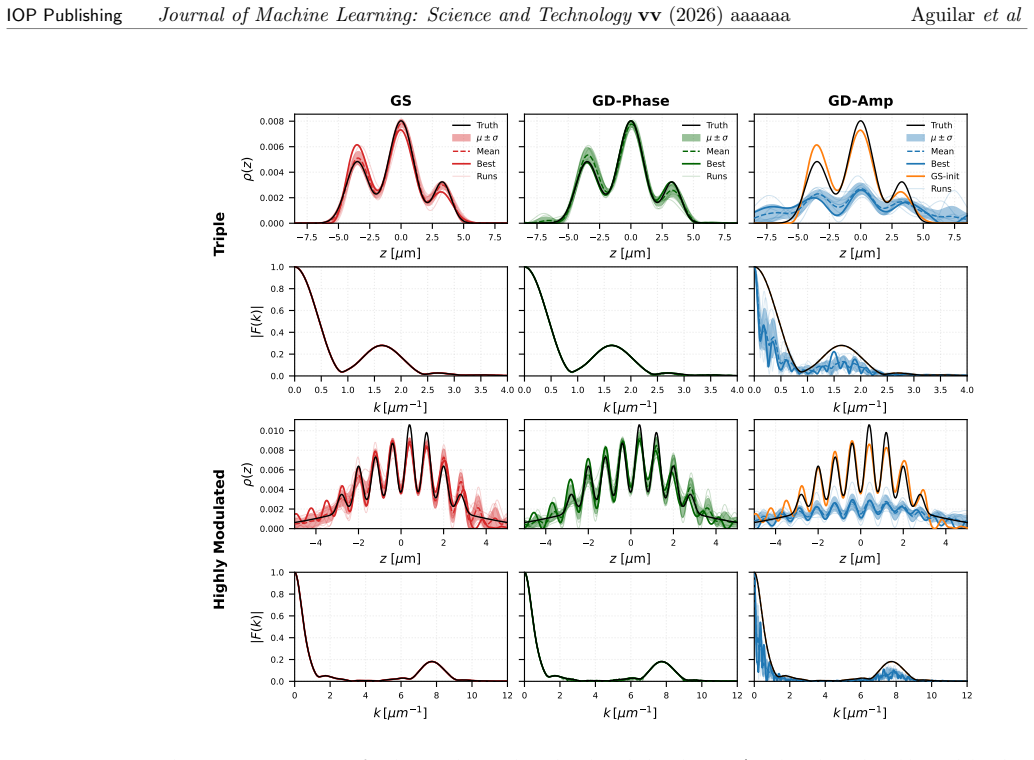
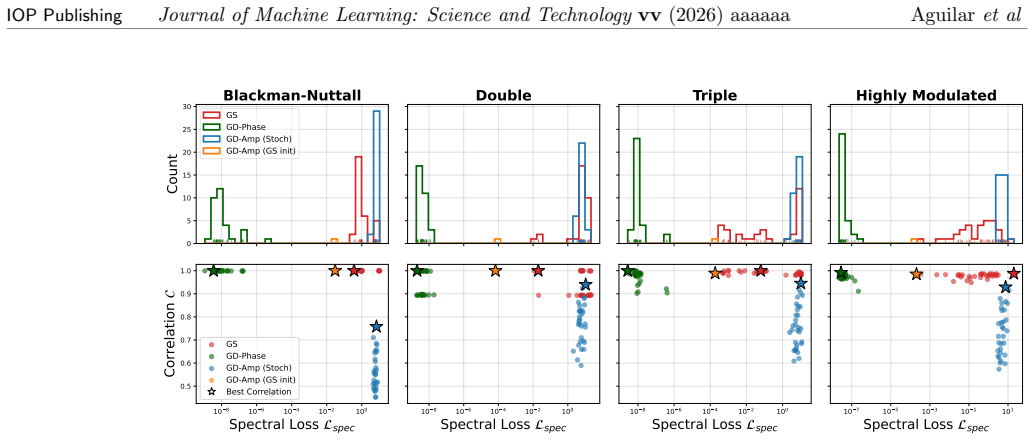
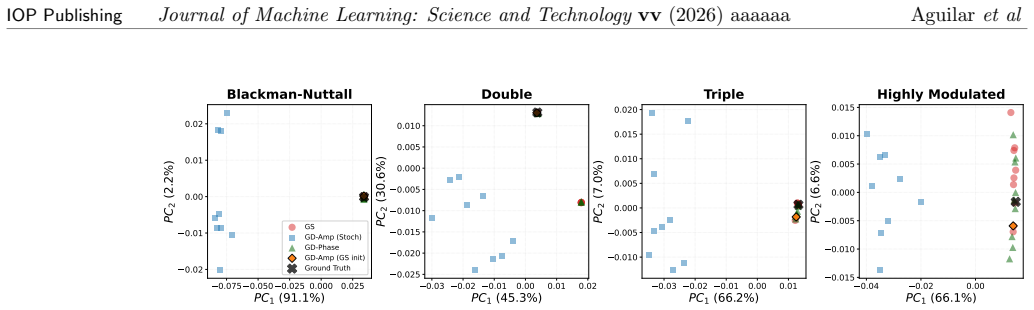
- The method achieves reconstruction fidelity comparable to Gerchberg-Saxton algorithms for synthetic multi-peaked and modulated profiles.
- It permits direct inclusion of arbitrary differentiable experimental effects without needing custom inverse operators.
- The framework serves as a starting point for integrating constraints from multiple diagnostics and performing uncertainty quantification.
- This supports extension to higher-dimensional reconstructions and multimodal data in realistic accelerator settings.
Where Pith is reading between the lines
- The approach could make it easier to handle uncertainties in bunch length measurements for optimizing laser-plasma accelerators.
- Similar differentiable frameworks might apply to other ill-posed inverse problems in radiation diagnostics where forward models are known.
- Combining this with automatic differentiation libraries could speed up real-time analysis during experiments.
Load-bearing premise
The chosen real-space physical priors must be sufficient to resolve phase ambiguities, and the forward model must accurately represent the experiment in a differentiable way.
What would settle it
A case where the GD-Phase reconstruction deviates significantly from the true bunch profile on synthetic data that includes known experimental distortions, while traditional methods succeed.
Figures




read the original abstract
Coherent transition radiation (CTR) spectroscopy is a critical diagnostic for characterizing the longitudinal structure of relativistic electron bunches in laser-plasma and conventional accelerators. In practice, recovering the bunch profile from a measured CTR spectrum is an ill-posed phase-retrieval problem. Traditionally, this is addressed using Gerchberg-Saxton (GS)-type iterative algorithms. However, these implementations often rely on explicit inverse propagators, making them difficult to adapt to sophisticated experimental forward models. In this work, we introduce a flexible gradient-based framework for CTR phase retrieval. By leveraging a differentiable forward model, we propose a phase-only gradient descent (GD-Phase) approach that enforces the measured spectral amplitude as a hard constraint while optimizing the Fourier phase under physical real-space priors. Using synthetic CTR spectra spanning multi-peaked and strongly modulated profiles, we benchmark GD-Phase against traditional GS and a real-space amplitude-parametrized gradient descent (GD-Amp) algorithm. Unlike traditional methods, this formulation allows for the seamless inclusion of arbitrary differentiable experimental effects into the reconstruction loop. We demonstrate that this physics-informed approach not only reproduces the fidelity of GS methods but also establishes a robust baseline for incorporating multi-diagnostic constraints and uncertainty quantification. This enables the systematic extension to higher-dimensional, multimodal, and uncertainty-aware diagnostics, facilitating fast and scalable phase retrieval in realistic experimental settings.
Editorial analysis
A structured set of objections, weighed in public.
Referee Report
Summary. The manuscript introduces a flexible gradient-based framework for phase retrieval in coherent transition radiation (CTR) spectroscopy. It proposes a phase-only gradient descent (GD-Phase) algorithm that leverages a differentiable forward model to enforce measured spectral amplitudes as hard constraints while optimizing the Fourier phase under physical real-space priors. The approach is benchmarked on synthetic CTR spectra with multi-peaked and strongly modulated profiles against traditional Gerchberg-Saxton (GS) iterations and a real-space amplitude-parametrized gradient descent (GD-Amp) variant, with claims that GD-Phase reproduces GS fidelity while enabling seamless inclusion of arbitrary differentiable experimental effects, multi-diagnostic constraints, and uncertainty quantification.
Significance. If the quantitative validation holds, this work offers a valuable methodological advance for ill-posed phase-retrieval problems in accelerator beam diagnostics. The differentiable-physics formulation directly addresses the rigidity of GS-type methods that depend on explicit inverse propagators, providing a natural route to incorporate complex forward models. The emphasis on hard amplitude constraints combined with real-space priors, together with the synthetic benchmarking strategy, constitutes a solid baseline for extensible, uncertainty-aware diagnostics in laser-plasma and conventional accelerator settings.
major comments (1)
- [Abstract] Abstract: the benchmarking claim that GD-Phase 'reproduces the fidelity of GS methods' on synthetic multi-peaked and modulated profiles is stated without any quantitative metrics, error bars, fidelity measures (e.g., RMS error, overlap integrals), or tabulated comparisons; this absence makes it impossible to evaluate whether the reproduction is statistically meaningful or merely qualitative.
Simulated Author's Rebuttal
We thank the referee for their positive assessment of the manuscript and for the constructive comment on the abstract. We address the point below and will make the corresponding revision.
read point-by-point responses
-
Referee: [Abstract] Abstract: the benchmarking claim that GD-Phase 'reproduces the fidelity of GS methods' on synthetic multi-peaked and modulated profiles is stated without any quantitative metrics, error bars, fidelity measures (e.g., RMS error, overlap integrals), or tabulated comparisons; this absence makes it impossible to evaluate whether the reproduction is statistically meaningful or merely qualitative.
Authors: We agree that the abstract would be improved by including quantitative support for the fidelity claim. The body of the manuscript (Section 3) already contains the detailed synthetic benchmarks, including RMS errors, overlap integrals, and direct comparisons of GD-Phase against GS and GD-Amp across the multi-peaked and modulated test cases. We will revise the abstract to incorporate the key quantitative metrics from those results so that the reproduction of GS fidelity is stated with explicit numerical evidence rather than qualitatively. revision: yes
Circularity Check
No significant circularity in methodological proposal
full rationale
The paper introduces GD-Phase as an explicit algorithmic construction: a phase-only gradient descent that hard-constrains measured spectral amplitudes while optimizing under real-space priors, using a differentiable forward model. This is benchmarked directly against GS and GD-Amp on synthetic multi-peaked and modulated CTR spectra. No load-bearing step equates a claimed first-principles result or prediction to its own fitted inputs or prior self-citations by construction; the framework is a self-contained optimization definition whose validity is tested via independent synthetic validation rather than tautological reduction.
Axiom & Free-Parameter Ledger
axioms (2)
- domain assumption The CTR forward model is differentiable and accurately represents experimental effects
- domain assumption Physical real-space priors are sufficient to constrain the phase retrieval solution
Reference graph
Works this paper leans on
-
[1]
Free-electron lasing at 27 nanometres based on a laser wakefield accelerator
Wentao Wang et al. “Free-electron lasing at 27 nanometres based on a laser wakefield accelerator”. en. In:Nature595.7868 (July 2021), pp. 516–520.issn: 0028-0836, 1476-4687. doi:10.1038/s41586-021-03678-x.url: https://www.nature.com/articles/s41586-021-03678-x
-
[2]
Seeded free-electron laser driven by a compact laser plasma accelerator
Marie Labat et al. “Seeded free-electron laser driven by a compact laser plasma accelerator”. en. In:Nature Photonics17.2 (Feb. 2023), pp. 150–156.issn: 1749-4885, 1749-4893.doi: 10.1038/s41566-022-01104-w.url: https://www.nature.com/articles/s41566-022-01104-w
-
[3]
Free-electron lasing with compact beam-driven plasma wakefield accelerator
R. Pompili et al. “Free-electron lasing with compact beam-driven plasma wakefield accelerator”. en. In:Nature605.7911 (May 2022), pp. 659–662.issn: 0028-0836, 1476-4687. doi:10.1038/s41586-022-04589-1.url: https://www.nature.com/articles/s41586-022-04589-1
-
[4]
S.K. Barber et al. “Greater than 1000-fold Gain in a Free-Electron Laser Driven by a Laser-Plasma Accelerator with High Reliability”. en. In:Physical Review Letters135.5 (July 2025), p. 055001.issn: 0031-9007, 1079-7114.doi:10.1103/vh62-gz1p.url: https://link.aps.org/doi/10.1103/vh62-gz1p
-
[5]
Experimental Measurements of Electron-Bunch Trains in a Laser-Plasma Accelerator
O. Lundh et al. “Experimental Measurements of Electron-Bunch Trains in a Laser-Plasma Accelerator”. en. In:Physical Review Letters110.6 (Feb. 2013), p. 065005.issn: 0031-9007, 1079-7114.doi:10.1103/PhysRevLett.110.065005.url: https://link.aps.org/doi/10.1103/PhysRevLett.110.065005
-
[6]
Temporal evolution of longitudinal bunch profile in a laser wakefield accelerator
M. Heigoldt et al. “Temporal evolution of longitudinal bunch profile in a laser wakefield accelerator”. en. In:Physical Review Special Topics - Accelerators and Beams18.12 (Dec. 2015), p. 121302.issn: 1098-4402.doi:10.1103/PhysRevSTAB.18.121302.url: https://link.aps.org/doi/10.1103/PhysRevSTAB.18.121302
-
[7]
Maxwell LaBerge et al. “Revealing the three-dimensional structure of microbunched plasma-wakefield-accelerated electron beams”. en. In:Nature Photonics18.9 (Sept. 2024), pp. 952–959.issn: 1749-4885, 1749-4893.doi:10.1038/s41566-024-01475-2.url: https://www.nature.com/articles/s41566-024-01475-2
-
[8]
Long-Range Persistence of Femtosecond Modulations on Laser-Plasma-Accelerated Electron Beams
C. Lin et al. “Long-Range Persistence of Femtosecond Modulations on Laser-Plasma-Accelerated Electron Beams”. en. In:Physical Review Letters108.9 (Mar. 2012), p. 094801.issn: 0031-9007, 1079-7114.doi:10.1103/PhysRevLett.108.094801.url: https://link.aps.org/doi/10.1103/PhysRevLett.108.094801
-
[9]
C. Behrens et al. “Constraints on photon pulse duration from longitudinal electron beam diagnostics at a soft x-ray free-electron laser”. en. In:Physical Review Special Topics - Accelerators and Beams15.3 (Mar. 2012), p. 030707.issn: 1098-4402.doi: 10.1103/PhysRevSTAB.15.030707.url: https://link.aps.org/doi/10.1103/PhysRevSTAB.15.030707
-
[10]
T. J. Maxwell et al. “Coherent-Radiation Spectroscopy of Few-Femtosecond Electron Bunches Using a Middle-Infrared Prism Spectrometer”. en. In:Physical Review Letters111.18 (Oct. 2013), p. 184801.issn: 0031-9007, 1079-7114.doi:10.1103/PhysRevLett.111.184801.url: https://link.aps.org/doi/10.1103/PhysRevLett.111.184801
-
[11]
Diagnostics for plasma-based electron accelerators
M. C. Downer et al. “Diagnostics for plasma-based electron accelerators”. en. In:Reviews of Modern Physics90.3 (Aug. 2018), p. 035002.issn: 0034-6861, 1539-0756.doi: 10.1103/RevModPhys.90.035002.url: https://link.aps.org/doi/10.1103/RevModPhys.90.035002. 15 IOP PublishingJournal of Machine Learning: Science and Technologyvv(2026) aaaaaa Aguilaret al
-
[12]
Bernhard Schmidt et al. “Benchmarking coherent radiation spectroscopy as a tool for high-resolution bunch shape reconstruction at free-electron lasers”. en. In:Physical Review Accelerators and Beams23.6 (June 2020), p. 062801.issn: 2469-9888.doi: 10.1103/PhysRevAccelBeams.23.062801.url: https://link.aps.org/doi/10.1103/PhysRevAccelBeams.23.062801
-
[13]
Omid Zarini et al. “Multioctave high-dynamic range optical spectrometer for single-pulse, longitudinal characterization of ultrashort electron bunches”. en. In:Physical Review Accelerators and Beams25.1 (Jan. 2022), p. 012801.issn: 2469-9888.doi: 10.1103/PhysRevAccelBeams.25.012801.url: https://link.aps.org/doi/10.1103/PhysRevAccelBeams.25.012801
-
[14]
Temporal profile monitor based on electro-optic spatial decoding for low-energy bunches
Wei Wang et al. “Temporal profile monitor based on electro-optic spatial decoding for low-energy bunches”. en. In:Physical Review Accelerators and Beams20.11 (Nov. 2017), p. 112801.issn: 2469-9888.doi:10.1103/PhysRevAccelBeams.20.112801.url: https://link.aps.org/doi/10.1103/PhysRevAccelBeams.20.112801
-
[15]
Few-femtosecond time-resolved measurements of X-ray free-electron lasers
C. Behrens et al. “Few-femtosecond time-resolved measurements of X-ray free-electron lasers”. en. In:Nature Communications5.1 (Apr. 2014), p. 3762.issn: 2041-1723.doi: 10.1038/ncomms4762.url:https://www.nature.com/articles/ncomms4762(visited on 01/28/2026)
work page doi:10.1038/ncomms4762.url:https://www.nature.com/articles/ncomms4762(visited 2014
-
[16]
Phase retrieval algorithms: a comparison
J. R. Fienup. “Phase retrieval algorithms: a comparison”. en. In:Applied Optics21.15 (Aug. 1982), p. 2758.issn: 0003-6935, 1539-4522.doi:10.1364/AO.21.002758.url: https://opg.optica.org/abstract.cfm?URI=ao-21-15-2758
-
[17]
R. Lai and A. J. Sievers. “Phase problem associated with the determination of the longitudinal shape of a charged particle bunch from its coherent far-ir spectrum”. en. In: Physical Review E52.4 (Oct. 1995), pp. 4576–4579.issn: 1063-651X, 1095-3787.doi: 10.1103/PhysRevE.52.4576.url: https://link.aps.org/doi/10.1103/PhysRevE.52.4576
-
[18]
Determination of bunch asymmetry from coherent radiation in the frequency domain
R. Lai and A. J. Sievers. “Determination of bunch asymmetry from coherent radiation in the frequency domain”. en. In:AIP Conference Proceedings. Vol. 367. Upton, New York (USA): AIP, 1996, pp. 312–326.doi:10.1063/1.50316.url: https://pubs.aip.org/aip/acp/article/367/1/312-326/753981
-
[19]
S. I. Bajlekov et al. “Longitudinal electron bunch profile reconstruction by performing phase retrieval on coherent transition radiation spectra”. en. In:Physical Review Special Topics - Accelerators and Beams16.4 (Apr. 2013), p. 040701.issn: 1098-4402.doi: 10.1103/PhysRevSTAB.16.040701.url: https://link.aps.org/doi/10.1103/PhysRevSTAB.16.040701
-
[20]
Reconstructing light field by two intersities in Fourier plane
RW Gerchberg and WO Saxton. “Reconstructing light field by two intersities in Fourier plane”. In:Optik35.1 (1972), pp. 23–30
1972
-
[21]
Advanced Methods for Temporal Reconstruction of Modulated Electron Bunches
Omid Zarini et al. “Advanced Methods for Temporal Reconstruction of Modulated Electron Bunches”. In:2018 IEEE Advanced Accelerator Concepts Workshop (AAC). Breckenridge, CO, USA: IEEE, Aug. 2018, pp. 1–5.isbn: 978-1-5386-7721-6.doi: 10.1109/AAC.2018.8659388.url:https://ieeexplore.ieee.org/document/8659388/
work page doi:10.1109/aac.2018.8659388.url:https://ieeexplore.ieee.org/document/8659388/ 2018
-
[22]
Alexander Scheinker. “Adaptive Machine Learning for Robust Diagnostics and Control of Time-Varying Particle Accelerator Components and Beams”. en. In:Information12.4 (Apr. 2021), p. 161.issn: 2078-2489.doi:10.3390/info12040161.url: https://www.mdpi.com/2078-2489/12/4/161
-
[23]
Machine learning for beam dynamics studies at the CERN Large Hadron Collider
P. Arpaia et al. “Machine learning for beam dynamics studies at the CERN Large Hadron Collider”. en. In:Nuclear Instruments and Methods in Physics Research Section A: Accelerators, Spectrometers, Detectors and Associated Equipment985 (Jan. 2021), p. 164652. issn: 01689002.doi:10.1016/j.nima.2020.164652.url: https://linkinghub.elsevier.com/retrieve/pii/S01...
-
[24]
R. Roussel et al. “Phase Space Reconstruction from Accelerator Beam Measurements Using Neural Networks and Differentiable Simulations”. en. In:Physical Review Letters130.14 (Apr. 2023), p. 145001.issn: 0031-9007, 1079-7114.doi:10.1103/PhysRevLett.130.145001. url:https://link.aps.org/doi/10.1103/PhysRevLett.130.145001. 16 IOP PublishingJournal of Machine L...
-
[25]
Machine learning for combined scalar and spectral longitudinal phase space reconstruction
Jan Kaiser et al. “Machine learning for combined scalar and spectral longitudinal phase space reconstruction”. en. In: (). Ed. by Assmann, Ralph et al. Artwork Size: 4464-4467 pages, 0.75 MB ISBN: 9783954502318 Medium: PDF, 4464–4467 pages, 0.75 MB.issn: 2673-5490.doi: 10.18429/JACOW-IPAC2023-THPL019.url: https://jacow.org/ipac2023/doi/jacow-ipac2023-thpl019
-
[26]
Francisco Huhn and Francesco M. Velotti. “Differentiable simulations for particle tracking in accelerators: Analysis, benchmarking, and optimization”. en. In:Physical Review Accelerators and Beams28.11 (Nov. 2025), p. 114603.issn: 2469-9888.doi:10.1103/cbds-lst1.url: https://link.aps.org/doi/10.1103/cbds-lst1
-
[27]
Ryan Roussel et al. “Efficient six-dimensional phase space reconstructions from experimental measurements using generative machine learning”. en. In:Physical Review Accelerators and Beams27.9 (Sept. 2024), p. 094601.issn: 2469-9888.doi: 10.1103/PhysRevAccelBeams.27.094601.url: https://link.aps.org/doi/10.1103/PhysRevAccelBeams.27.094601
-
[28]
Development and applications of differentiable coherent optical transition radiation simulations
Ryan Roussel et al. “Development and applications of differentiable coherent optical transition radiation simulations”. In:Proceedings of NAPAC2025. California, USA: JACoW Publishing, Aug. 2025, pp. 110–112.doi:doi:10.18429/JACoW-NAPAC2025-MOP029
-
[29]
Phase imaging with an untrained neural network
Fei Wang et al. “Phase imaging with an untrained neural network”. en. In:Light: Science & Applications9.1 (May 2020), p. 77.issn: 2047-7538.doi:10.1038/s41377-020-0302-3. url:https://www.nature.com/articles/s41377-020-0302-3
-
[30]
PhaseGAN: a deep-learning phase-retrieval approach for unpaired datasets
Yuhe Zhang et al. “PhaseGAN: a deep-learning phase-retrieval approach for unpaired datasets”. en. In:Optics Express29.13 (June 2021), p. 19593.issn: 1094-4087.doi: 10.1364/OE.423222.url:https://opg.optica.org/abstract.cfm?URI=oe-29-13-19593
work page doi:10.1364/oe.423222.url:https://opg.optica.org/abstract.cfm 2021
-
[31]
Chanseok Lee et al. “Deep learning based on parameterized physical forward model for adaptive holographic imaging with unpaired data”. en. In:Nature Machine Intelligence5.1 (Jan. 2023), pp. 35–45.issn: 2522-5839.doi:10.1038/s42256-022-00584-3.url: https://www.nature.com/articles/s42256-022-00584-3
-
[32]
Transition radiation in the pre-wave zone
VL Ginzburg and IM Frank. “Transition radiation in the pre-wave zone”. In:Sov. Phys. JETP16.15 (1946), p. 222
1946
-
[33]
Theory of coherent transition radiation generated at a plasma-vacuum interface
C. B. Schroeder et al. “Theory of coherent transition radiation generated at a plasma-vacuum interface”. en. In:Physical Review E69.1 (Jan. 2004), p. 016501.issn: 1539-3755, 1550-2376. doi:10.1103/PhysRevE.69.016501.url: https://link.aps.org/doi/10.1103/PhysRevE.69.016501
-
[34]
Fast Change of Windows Properties
M. Jaskula. “Fast Change of Windows Properties”. In:2006 IEEE Instrumentation and Measurement Technology Conference Proceedings. 2006, pp. 1043–1046.doi: 10.1109/IMTC.2006.328341
-
[35]
Adam: A Method for Stochastic Optimization
Diederik P Kingma. “Adam: A method for stochastic optimization”. In:arXiv preprint arXiv:1412.6980(2014). 17
work page internal anchor Pith review arXiv 2014
discussion (0)
Sign in with ORCID, Apple, or X to comment. Anyone can read and Pith papers without signing in.