Recognition: unknown
Orchestration paradoxes in national quantum computing innovation ecosystems
Pith reviewed 2026-05-07 14:36 UTC · model grok-4.3
The pith
Orchestrators in national quantum computing innovation ecosystems must balance paradoxical tensions rather than eliminate them.
A machine-rendered reading of the paper's core claim, the machinery that carries it, and where it could break.
Core claim
Through interviews in the Finnish QCI ecosystem, core paradoxical tensions are identified that arise from heterogeneous actor goals, roles, and power relations. These tensions confront orchestrators with situations requiring navigation of trade-offs between competing demands. The study establishes that to orchestrate the ecosystem effectively, these tensions must be recognized and balanced rather than eliminated, yielding insights into their origins and dynamics in multi-actor settings.
What carries the argument
Paradox theory applied as an analytical lens to identify and navigate tensions in national quantum computing innovation ecosystem orchestration.
If this is right
- Effective orchestration requires recognizing tensions and balancing trade-offs instead of resolving them.
- Tensions originate in the heterogeneous goals, roles, and power relations across firms, research organizations, funding bodies, and government actors.
- Insights into the origins and dynamics of these tensions apply to orchestrating any multi-actor ecosystem.
- Prior research focused mainly on interfirm relationships has overlooked these paradoxes in government-led national settings.
Where Pith is reading between the lines
- The same tensions may appear in quantum computing ecosystems of other countries and warrant direct comparison.
- Balancing these tensions could be tested against concrete outcomes such as project completion rates or cross-actor patent filings.
- Alternative frameworks like stakeholder theory or network governance might identify different management approaches for the same ecosystem.
Load-bearing premise
The paradoxical tensions found through interviews in one national ecosystem generalize to other quantum computing innovation contexts and paradox theory adequately captures the orchestration challenges.
What would settle it
A study of another national QCI ecosystem showing that orchestrators can eliminate the identified tensions with no negative effects on collaboration or innovation progress would falsify the claim.
Figures
read the original abstract
Effective orchestration is a critical driver of success in quantum computing innovation (QCI) ecosystems. Heterogeneous actor goals, roles, and power relations, however, produce tensions that confront orchestrators with paradoxical situations in which they must navigate trade-offs between competing demands. To orchestrate an ecosystem effectively, these tensions must be recognized and balanced rather than eliminated. Prior research has largely overlooked the role of paradoxes in ecosystem orchestration or has focused mainly on interfirm relationships. This study addresses this gap by examining a government led national QCI ecosystem that includes firms, research organizations, funding bodies, and governmental actors. Using an explorative case study with 15 informants from the Finnish QCI ecosystem and drawing on paradox theory as an analytical lens, we identify core paradoxical tensions and show how they challenge ecosystem orchestration. We contribute nuanced insights into the origins and dynamics of paradoxical tensions and discuss the implications for orchestrating multi-actor ecosystems.
Editorial analysis
A structured set of objections, weighed in public.
Referee Report
Summary. This paper claims that in national quantum computing innovation ecosystems, orchestrators face paradoxical tensions due to heterogeneous actor goals and power relations. Based on an explorative case study of the Finnish QCI ecosystem with 15 informants and using paradox theory, it identifies these tensions and argues that they must be recognized and balanced rather than eliminated for effective orchestration. The work contributes nuanced insights into the origins and dynamics of such paradoxes in multi-actor, government-led settings.
Significance. The result, if substantiated, offers a novel application of paradox theory to the orchestration of quantum computing ecosystems, an area previously underexplored in this context. It provides practical insights for managing trade-offs in national innovation initiatives involving diverse stakeholders. The empirical grounding in interview data from a real-world case is a positive aspect, though the single-case design constrains the strength of general implications.
major comments (2)
- [Research Methods] The manuscript provides limited information on the analytical methods used to derive the paradoxical tensions from the interview data. For instance, there is no mention of the coding scheme, inter-coder reliability, or how potential biases from the government-led ecosystem focus were mitigated. This is critical for assessing the validity of the core findings.
- [Implications for Practice] The central prescriptive claim (abstract: 'these tensions must be recognized and balanced rather than eliminated') is extended beyond the Finnish case to national QCI ecosystems broadly. However, the evidence is drawn solely from one context without comparative analysis or discussion of boundary conditions, making the generalizability a load-bearing assumption that requires further support or qualification.
minor comments (2)
- [Abstract] Consider specifying one or two example tensions identified in the study to better orient the reader to the specific contributions.
- [Literature Review] The review of prior work on ecosystem orchestration could be expanded to include more recent studies on multi-stakeholder innovation in emerging technologies.
Simulated Author's Rebuttal
We thank the referee for the detailed and constructive comments on our manuscript. We have carefully considered each point and provide our responses below, along with planned revisions to strengthen the paper.
read point-by-point responses
-
Referee: [Research Methods] The manuscript provides limited information on the analytical methods used to derive the paradoxical tensions from the interview data. For instance, there is no mention of the coding scheme, inter-coder reliability, or how potential biases from the government-led ecosystem focus were mitigated. This is critical for assessing the validity of the core findings.
Authors: We agree that additional details on the analytical methods would enhance the transparency and rigor of our study. In the revised version, we will expand the 'Data Analysis' subsection to describe the coding process in greater depth. Specifically, we employed a deductive-inductive approach guided by paradox theory, where initial codes were derived from the literature on paradoxical tensions and then refined through iterative analysis of the 15 interview transcripts. We will also clarify that while formal inter-coder reliability metrics were not calculated due to the exploratory nature and single primary analyst, we mitigated subjectivity through regular team discussions, peer debriefing, and member checking with select informants. Regarding potential biases from the government-led focus, we will add a limitations paragraph explaining how we selected a diverse set of informants across firms, research organizations, funding bodies, and government to balance perspectives, and how we probed for critical views during interviews. These additions will not change the identified tensions but will better substantiate their derivation. revision: yes
-
Referee: [Implications for Practice] The central prescriptive claim (abstract: 'these tensions must be recognized and balanced rather than eliminated') is extended beyond the Finnish case to national QCI ecosystems broadly. However, the evidence is drawn solely from one context without comparative analysis or discussion of boundary conditions, making the generalizability a load-bearing assumption that requires further support or qualification.
Authors: We appreciate this observation and recognize that the single-case, exploratory design inherently limits broad generalizations. The prescriptive statement in the abstract is intended to reflect the implications drawn from our findings in the Finnish context, which we believe offers transferable insights to similar government-led national QCI ecosystems due to shared characteristics like heterogeneous actors and early-stage development. However, to address the concern, we will revise the abstract and the 'Discussion' and 'Implications' sections to explicitly qualify the scope. We will state that the findings are based on the Finnish QCI ecosystem and discuss potential boundary conditions, such as the level of government involvement, the maturity of the quantum computing field, and cultural factors in innovation ecosystems. We will also temper the language to suggest that these tensions 'should be considered' in other contexts rather than asserting they 'must be' balanced universally. This qualification maintains the contribution while aligning with the evidence base. revision: yes
Circularity Check
No circularity; empirical case study with external theoretical lens
full rationale
The paper is an explorative qualitative case study drawing on 15 interviews from one national ecosystem and applying paradox theory as an external analytical lens. No equations, fitted parameters, model predictions, or self-referential derivations appear in the provided text or abstract. The central claim—that paradoxical tensions must be recognized and balanced—arises from interpretive analysis of interview data rather than reducing by construction to the inputs or prior self-citations. Self-citation is absent from the load-bearing steps, and the method does not rename known results or smuggle ansatzes. This is a standard empirical social-science study whose conclusions remain independent of any internal tautology.
Axiom & Free-Parameter Ledger
axioms (1)
- domain assumption Paradox theory is an appropriate analytical lens for examining tensions in multi-actor ecosystem orchestration
Reference graph
Works this paper leans on
-
[1]
contradictory yet interrelated elements that exist simultaneously and persist over time
1 ORCHESTRATION PARADOXES IN NATIONAL QUANTUM COMPUTING INNOVATION ECOSYSTEMS Jori Taipale, Olli Tyrväinen, Tuure Tuunanen, Joel Mero, Teiko Heinosaari Abstract Effective orchestration is a critical driver of success in quantum computing innovation (QCI) ecosystems. Heterogeneous actor goals, roles, and power relations, however, produce tensions that conf...
2024
-
[2]
Thus, the participants differed in organizational structures, expectations, resources, and capabilities—and competed, particularly for resources
The informant selection followed a purposive sampling strategy (Patton, 2002), focusing on those organizations and individuals likeliest to offer valuable insights into the phenomenon under study. Thus, the participants differed in organizational structures, expectations, resources, and capabilities—and competed, particularly for resources. This created a...
2002
-
[3]
The data were examined inductively with the aim of identifying opinions that articulated divergent interpretations of the same phenomenon within the ecosystem
was used, and the data coding was guided by our theoretical pre-understanding and conceptual framework with four paradoxes (organizing, performing, belonging and learning). The data were examined inductively with the aim of identifying opinions that articulated divergent interpretations of the same phenomenon within the ecosystem. For example, regarding c...
2017
-
[4]
identifying
Sectors, industries, and roles of the interviewed QCI ecosystem actors. 2 https://meetiqm.com 3 https://algorithmiq.fi/ 4 https://bluefors.com/ Quantum computing ecosystems: orchestration paradoxes 5 4 Preliminary Findings In this section, we apply the four paradox categories introduced by Smith and Lewis (2011) to examine the tensions and resulting parad...
2011
-
[5]
godfather
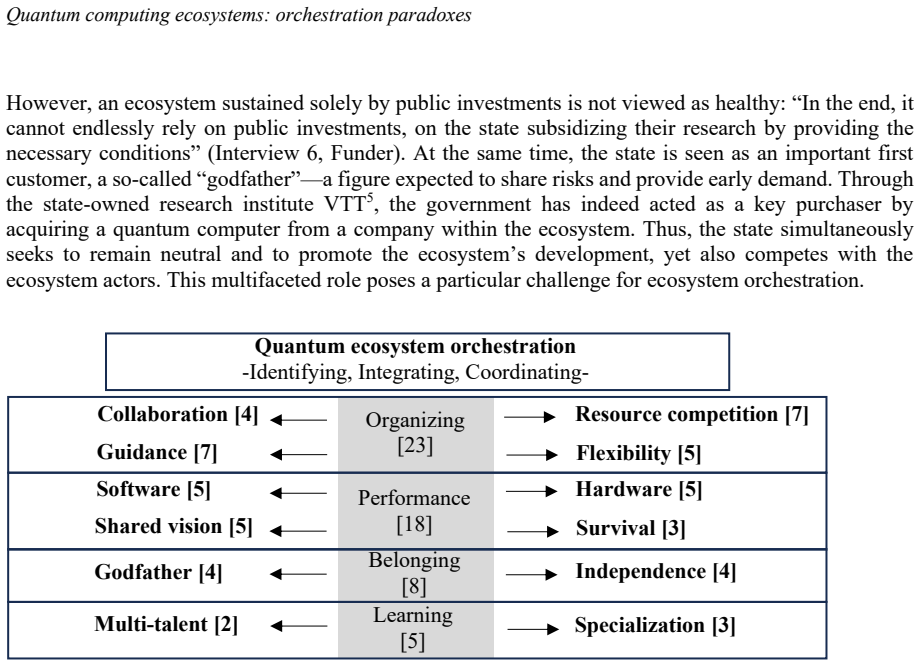
Paradoxes in Finnish QCI ecosystem orchestration. Note: The number in brackets represents how frequently observations of that specific tension occurred in the data. 5 Discussion and Future Research Agenda A successful ecosystem orchestrator requires a fundamental mindset shift from an inward-looking orientation to an outward-looking orientation (Mann et a...
2022
-
[6]
The Finnish QCI ecosystem is still emerging and seeking more industry-driven orchestration
as an analytical lens, we identified six paradoxical tensions that affect the three key activities of ecosystem orchestrators—identifying, integrating, and coordinating (Mann et al., 2022). The Finnish QCI ecosystem is still emerging and seeking more industry-driven orchestration. Our results suggest that an orchestrator is likely to confront, in particul...
2022
-
[7]
Quantum computing ecosystems: orchestration paradoxes 7 Our findings resonate with earlier work on orchestration and paradoxical tensions (Smania et al., 2024; Tóth et al., 2022), revealing shared tensions related, for example, to goal divergence and coopetition. At the same time, we contribute nuanced insights into the mechanisms through which these tens...
discussion (0)
Sign in with ORCID, Apple, or X to comment. Anyone can read and Pith papers without signing in.