Recognition: no theorem link
The Physical Limit of Neural Hypoxia Detection in the Black Sea from Satellite Observations
Pith reviewed 2026-05-12 01:51 UTC · model grok-4.3
The pith
Neural networks trained on model data can detect only 38 percent of Black Sea summer hypoxic events from satellite surface observations at 47 percent precision.
A machine-rendered reading of the paper's core claim, the machinery that carries it, and where it could break.
Core claim
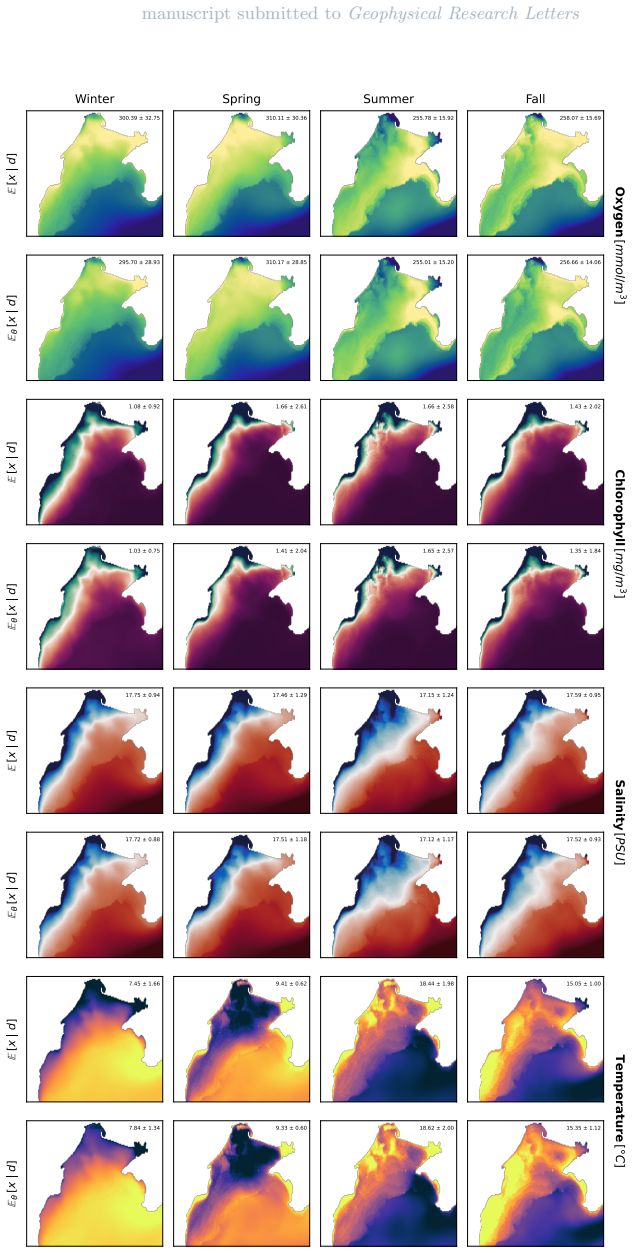
We solve the Bayesian inverse problem relating surface observations to complete Black Sea states using a deep generative neural network trained on numerical model outputs, providing a tractable approximation of the true posterior. Accurate state estimation is limited to the mixed layer because its homogeneity makes surface conditions representative of subsurface states. During summer, we detect 38 percent of all hypoxic events shelf-wide with a precision of 47 percent. Improving results will likely require longer assimilation windows or sub-surface observations.
What carries the argument
A deep generative neural network trained on model outputs that approximates the posterior distribution of sea states given only surface satellite observations.
If this is right
- State estimation remains accurate only inside the mixed layer where vertical homogeneity links surface and subsurface conditions.
- Satellite data alone supports 38 percent detection of hypoxic events shelf-wide during summer at 47 percent precision.
- The network supplies a practical approximation to the full posterior distribution of ocean states.
- Longer time windows of surface observations or direct subsurface measurements would be needed to extend detection below the mixed layer.
Where Pith is reading between the lines
- The same surface-to-subsurface limitation is likely to appear in any stratified coastal sea where satellites cannot see through the pycnocline.
- Periodic deployment of a few subsurface sensors could be combined with the neural network to calibrate deeper estimates without full coverage.
- The approach could be tested on other oxygen-depleted shelves to determine whether the 38 percent / 47 percent numbers are specific to Black Sea circulation or more general.
- Extending the training data to multi-year model runs might reveal seasonal patterns that improve detection without new observations.
Load-bearing premise
The numerical ocean model outputs used for training accurately represent the statistical relationship between surface observations and subsurface oxygen that exists in the real Black Sea.
What would settle it
Independent in-situ oxygen profiles collected across the Black Sea shelf during summer stratification could be compared directly against the neural network outputs to check whether the inferred subsurface values match real measurements.
Figures


read the original abstract
Coastal hypoxia (O_2 < 63 [mmol / m^3]) threatens ocean health worldwide. On continental shelves, summer stratification prevents bottom oxygen consumed by respiration from being renewed, making monitoring essential to protect vulnerable ecosystems and reduce biodiversity loss. Although satellite observations are increasingly available, their potential to infer subsurface oxygen remains largely unexplored. This can be framed as a Bayesian inverse problem relating surface observations to the complete Black Sea states. Here, we solve it using a deep generative neural network trained on numerical model outputs, providing a tractable and computationally efficient approximation of the true posterior distribution of sea states. We find that accurate state estimation is limited to the mixed layer, because its homogeneity makes surface conditions representative of subsurface states. During summer, we detect 38% of all hypoxic events shelf-wide with a precision of 47%. Improving results will likely require longer assimilation windows or sub-surface observations.
Editorial analysis
A structured set of objections, weighed in public.
Referee Report
Summary. The paper frames subsurface hypoxia detection in the Black Sea as a Bayesian inverse problem and solves it with a deep generative neural network trained on numerical ocean model outputs. It reports that accurate state estimation from surface satellite observations is limited to the mixed layer due to homogeneity, and that the network detects 38% of hypoxic events (O₂ < 63 mmol m⁻³) shelf-wide in summer with 47% precision. The network approximates the posterior over full sea states efficiently from surface fields.
Significance. If the numerical model's surface-subsurface oxygen joint statistics match those of the real Black Sea, the work would establish a clear physical limit on satellite-based hypoxia monitoring and demonstrate an efficient generative-network approximation to an otherwise intractable inverse problem. The approach of training on model ensembles to sample the posterior is a methodological strength that could be extended to other coastal systems.
major comments (2)
- [Abstract and Results] The 38% recall and 47% precision figures (Abstract; Results) are obtained exclusively by training and evaluating the network on held-out outputs from the same numerical ocean model. This quantifies inversion fidelity within the model's dynamics rather than transfer to real Black Sea observations; no independent in-situ validation dataset is described.
- [Abstract and §4] The central claim that estimation accuracy is limited to the mixed layer (Abstract; §4) rests on the untested assumption that the model's stratification, respiration, and circulation statistics reproduce the real Black Sea surface-subsurface oxygen relationship. No comparison to in-situ profiles or literature values for these processes is provided.
minor comments (1)
- [Abstract] Clarify in the abstract and methods whether the reported posterior is that of the numerical model or claimed to be the true physical posterior; the current wording risks overstating transferability.
Simulated Author's Rebuttal
We thank the referee for the constructive feedback, which helps clarify the scope and assumptions of our model-based analysis. We address each major comment below and will revise the manuscript accordingly to better articulate the physical limits demonstrated within the numerical model framework.
read point-by-point responses
-
Referee: [Abstract and Results] The 38% recall and 47% precision figures (Abstract; Results) are obtained exclusively by training and evaluating the network on held-out outputs from the same numerical ocean model. This quantifies inversion fidelity within the model's dynamics rather than transfer to real Black Sea observations; no independent in-situ validation dataset is described.
Authors: We agree that the reported recall and precision are computed via cross-validation on held-out samples from the same numerical model ensemble. Our primary objective is to quantify the information content of surface satellite observations for subsurface state estimation, thereby establishing a physical limit under the model's joint surface-subsurface oxygen statistics. Because the study does not incorporate an independent in-situ dataset, we cannot demonstrate direct transfer to real Black Sea satellite observations. We will revise the abstract, results, and discussion to explicitly frame the metrics as model-internal, discuss the implications for real-world deployment, and outline how the trained generative network could be applied to actual satellite fields in future work. revision: yes
-
Referee: [Abstract and §4] The central claim that estimation accuracy is limited to the mixed layer (Abstract; §4) rests on the untested assumption that the model's stratification, respiration, and circulation statistics reproduce the real Black Sea surface-subsurface oxygen relationship. No comparison to in-situ profiles or literature values for these processes is provided.
Authors: The limitation to the mixed layer arises directly from the vertical homogeneity present in the model simulations: surface fields are representative of subsurface oxygen only where mixing erases vertical gradients. We acknowledge that this result depends on the fidelity of the model's representation of stratification, respiration, and circulation. Although the manuscript does not include explicit comparisons, the underlying Black Sea model is a standard, observationally constrained configuration. We will revise §4 to incorporate comparisons against published in-situ oxygen profiles and literature values for summer mixed-layer depth and oxygen concentrations in the Black Sea, thereby providing quantitative support for the assumption and strengthening the physical interpretation. revision: yes
Circularity Check
Hypoxia detection metrics (38% recall, 47% precision) computed exclusively inside the training numerical model
specific steps
-
fitted input called prediction
[Abstract]
"a deep generative neural network trained on numerical model outputs, providing a tractable and computationally efficient approximation of the true posterior distribution of sea states. We find that accurate state estimation is limited to the mixed layer... During summer, we detect 38% of all hypoxic events shelf-wide with a precision of 47%."
The 38% and 47% figures are obtained by running the trained network on surface data from the numerical model and scoring against the model's subsurface oxygen fields. The reported detection statistics therefore quantify recovery of the model's own simulated hypoxia patterns; they do not constitute an external test of what satellite observations can achieve in the actual ocean.
full rationale
The paper trains a deep generative network on numerical model outputs to approximate the posterior relating surface observations to full states, then reports shelf-wide hypoxic-event detection rates by applying that network to surface fields drawn from the same model and comparing against the model's own subsurface oxygen. This makes the quoted performance figures a measure of how well the network inverts the model's internal surface-subsurface relationships rather than an independent physical limit observable in the real Black Sea. No separate in-situ validation set is invoked to test transfer; the central claim therefore rests on the untested premise that the model's joint statistics match reality.
Axiom & Free-Parameter Ledger
axioms (1)
- domain assumption Numerical model outputs are statistically representative of real Black Sea states
Reference graph
Works this paper leans on
-
[1]
Elucidating the Design Space of Diffusion-Based Generative Models
Karras, T., Aittala, M., Aila, T., & Laine, S. (2022, 6). Elucidating the design space of diffusion-based generative models.Advances in Neural Infor- mation Processing Systems,35. Retrieved from https://arxiv.org/abs/2206.00364v2
work page internal anchor Pith review arXiv 2022
- [2]
discussion (0)
Sign in with ORCID, Apple, or X to comment. Anyone can read and Pith papers without signing in.