Intergalactic Magnetic Field constraints from detected very high-energy Gamma-Ray Bursts using the Cherenkov Telescope Array Observatory
Pith reviewed 2026-05-07 15:27 UTC · model grok-4.3
The pith
The Cherenkov Telescope Array Observatory can constrain the intergalactic magnetic field to strengths as high as 10^{-15} G by observing very high-energy gamma-ray bursts.
A machine-rendered reading of the paper's core claim, the machinery that carries it, and where it could break.
Core claim
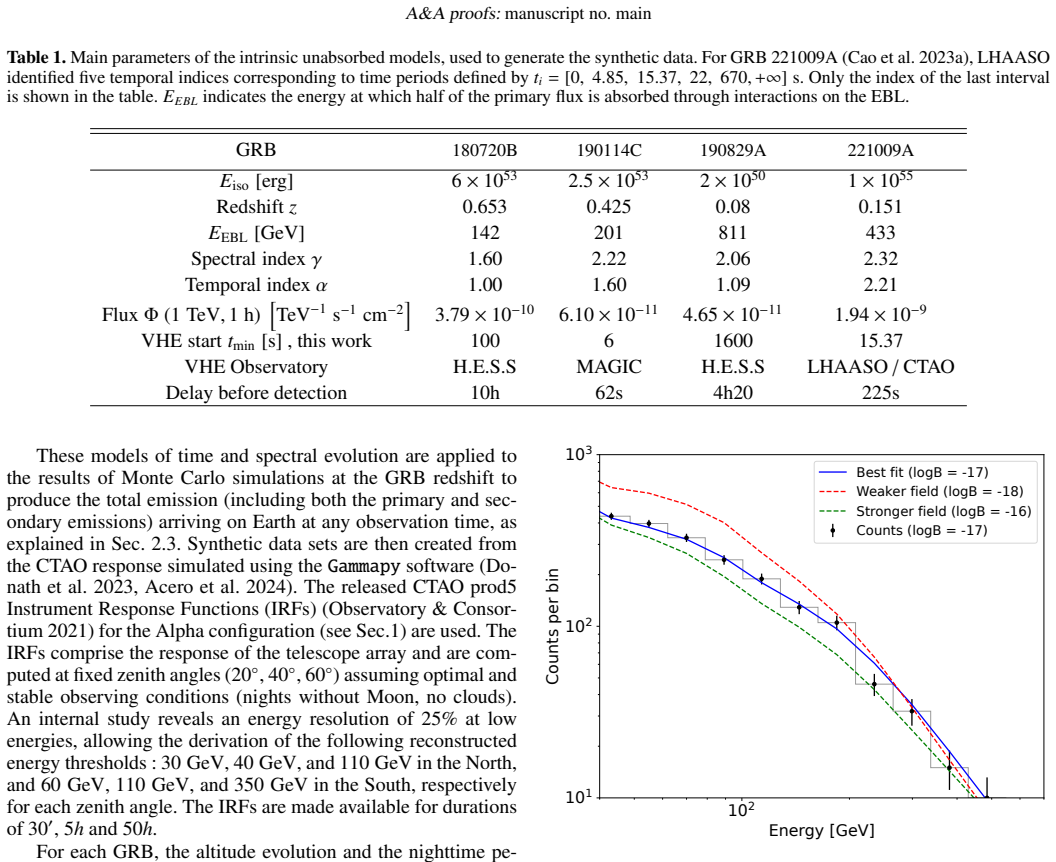
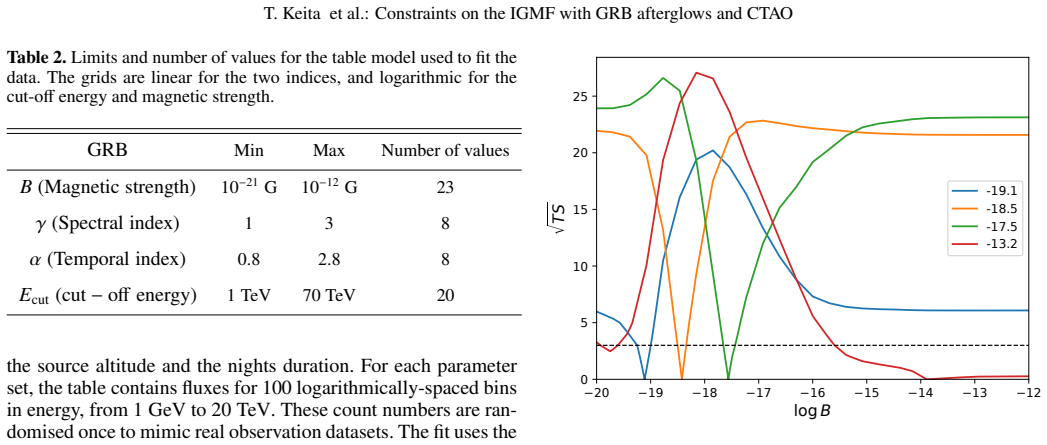
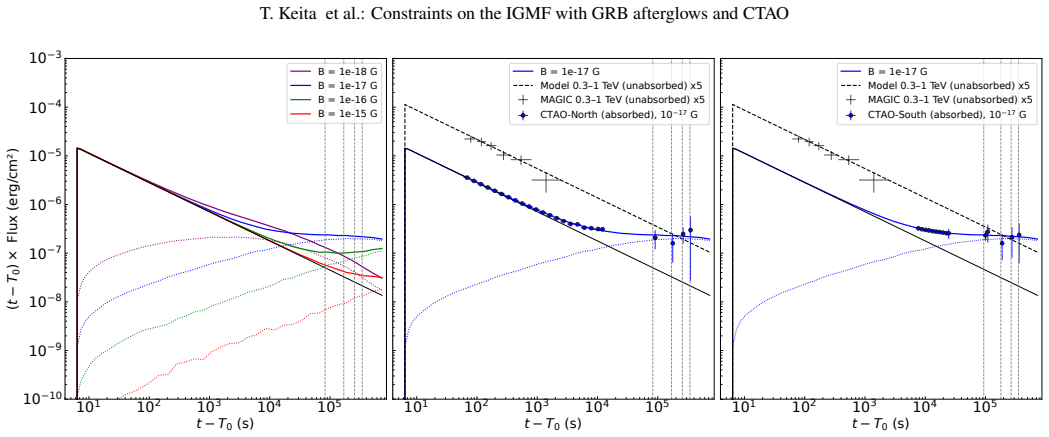
By modeling the spectral and temporal signatures of the electromagnetic cascade initiated by VHE GRB photons, the authors find that CTAO observations of sources comparable to GRB 221009A and GRB 190114C will be sensitive to IGMF strengths up to approximately 10^{-15} G. They further report that the currently available LST-1 observations of GRB 221009A are best fit by a field strength of 3 times 10^{-17} G under the assumed source and cascade parameters.
What carries the argument
The time-delayed secondary gamma-ray emission produced by pair cascades, whose angular and temporal spread is controlled by deflection of electron-positron pairs in the IGMF.
Load-bearing premise
The results depend on the assumed redshift, spectrum, and duration of the GRBs together with the accuracy of the pair-production and inverse-Compton cascade model; any mismatch in these inputs would change the derived field strengths.
What would settle it
A high-statistics CTAO spectrum and light curve of a future VHE GRB like 221009A that shows no measurable time delay or secondary component would rule out an IGMF strength near 3 times 10^{-17} G.
Figures




read the original abstract
Defined as the magnetic field permeating cosmic voids, the Intergalactic Magnetic Field (IGMF) is thought to be a relic of the Big Bang, tracing a primordial magnetic seed at the origin of all astrophysical fields. Yet, it has thus far escaped detection. Lower limits on the IGMF strength can be established by observing very high-energy (VHE) photons from extragalactic sources. Specifically, this can be achieved by characterising the time-delayed secondary emission induced by highly energetic transient sources, such as gamma-ray bursts (GRBs). Most studies exclude values of the IGMF below $10^{-17}\;\mathrm{G}$ by comparing the expected effect to the sensitivity curves of various instruments in the $\mathrm{GeV}$ range or above. In this work, we simulate CTAO observation data under realistic observation conditions and perform spectral-temporal fits to estimate the constraints CTAO will bring on the IGMF once fully deployed. We apply the methodology to simulated sources with properties comparable to the few GRBs detected at VHE. In particular, we show that CTAO will probe strengths up to $\sim 10^{-15}\;\mathrm{G}$ when detecting sources similar to GRBs 221009A and 190114C. We also show that existing observations of GRB 221009A by the first CTAO Large Sized Telescope LST-1 favour a strength of $3\times 10^{-17}\;\mathrm{G}$.
Editorial analysis
A structured set of objections, weighed in public.
Referee Report
Summary. The manuscript describes simulations of CTAO observations of very high-energy gamma-ray bursts (GRBs) with properties similar to GRB 221009A and GRB 190114C. Using spectral-temporal fits to the expected time-delayed cascade emission, it estimates that the full CTAO will be able to constrain IGMF strengths up to approximately 10^{-15} G. Additionally, it analyzes existing LST-1 observations of GRB 221009A and finds that they favor an IGMF strength of 3×10^{-17} G.
Significance. If the cascade development model and the simulation of observational conditions are reliable, this study would provide valuable forecasts for IGMF constraints from CTAO and an early constraint from LST-1 data. The approach of using realistic conditions strengthens the applicability of the results to actual observations. Credit is due for applying the method to both simulated future data and existing observations.
major comments (2)
- The favored IGMF strength of 3×10^{-17} G from the LST-1 analysis of GRB 221009A is derived under the assumption of a fixed coherence length λ = 1 Mpc. However, the time delay of the cascade scales proportionally to B √λ / E, introducing a degeneracy between the magnetic field strength B and the coherence length λ. The manuscript does not appear to marginalize over λ or test alternative values, which undermines the robustness of the specific point estimate presented.
- The projected sensitivity to IGMF strengths of ∼10^{-15} G for sources like GRB 221009A and 190114C relies on the same fixed coherence length assumption. To support this claim, the paper should include an assessment of how the constraints vary with different plausible coherence lengths, as independent constraints on λ are weak.
minor comments (2)
- The abstract mentions 'spectral-temporal fits' but the main text should provide more detail on the fitting procedure, including the likelihood function or chi-squared definition used.
- Ensure that all figures showing simulated spectra or light curves explicitly state the assumed IGMF parameters, including the coherence length.
Simulated Author's Rebuttal
We thank the referee for the constructive feedback on our manuscript. We agree that the degeneracy between IGMF strength B and coherence length λ is an important consideration that was not fully explored in the original submission. We will revise the paper to address both major comments by including additional analyses and discussions of how results depend on λ.
read point-by-point responses
-
Referee: The favored IGMF strength of 3×10^{-17} G from the LST-1 analysis of GRB 221009A is derived under the assumption of a fixed coherence length λ = 1 Mpc. However, the time delay of the cascade scales proportionally to B √λ / E, introducing a degeneracy between the magnetic field strength B and the coherence length λ. The manuscript does not appear to marginalize over λ or test alternative values, which undermines the robustness of the specific point estimate presented.
Authors: We agree that the reported value is for a fixed λ = 1 Mpc and that a degeneracy exists, as the observable time delay constrains the product B √λ. This choice of fiducial λ follows standard practice in the literature when independent constraints on λ are unavailable. In the revised manuscript we will add a dedicated subsection (or appendix) that recomputes the LST-1 fit for a range of plausible coherence lengths (0.01–10 Mpc) and explicitly shows how the favored B scales as 1/√λ. We will also rephrase the result to state that the data favor B √λ ≈ 3×10^{-17} G Mpc^{1/2} (for the fiducial case) while retaining the conventional B value for direct comparison with prior work. revision: yes
-
Referee: The projected sensitivity to IGMF strengths of ∼10^{-15} G for sources like GRB 221009A and 190114C relies on the same fixed coherence length assumption. To support this claim, the paper should include an assessment of how the constraints vary with different plausible coherence lengths, as independent constraints on λ are weak.
Authors: We concur that the projected CTAO sensitivity should be shown to be robust against variations in λ. We will revise the relevant sections to include a brief parameter study demonstrating that the upper limit on B scales approximately as 1/√λ. For λ values between 0.1 and 10 Mpc the CTAO reach remains within a factor of a few of 10^{-15} G for GRB-like sources; we will add a short table or figure summarizing this dependence and update the abstract and conclusions to qualify the quoted sensitivity accordingly. revision: yes
Circularity Check
No significant circularity; constraints arise from forward simulation and fitting, not reduction to inputs.
full rationale
The paper derives IGMF constraints by simulating CTAO observations of GRB-like sources under varying IGMF strengths, then performing spectral-temporal fits to the simulated data. This forward-modeling approach produces projected sensitivities (e.g., up to ~10^{-15} G) and a fitted value from LST-1 data (~3×10^{-17} G) that are not equivalent to the simulation inputs by construction. No self-definitional equations, fitted parameters renamed as independent predictions, or load-bearing self-citations appear in the derivation chain. Model assumptions such as fixed coherence length represent standard parameter choices and limitations rather than circular reductions. The central claims remain independently falsifiable against external data and benchmarks.
Axiom & Free-Parameter Ledger
free parameters (1)
- GRB source parameters (redshift, spectrum, duration)
axioms (1)
- domain assumption Pair-production and inverse-Compton cascade development in the presence of a weak intergalactic magnetic field produces observable time-delayed secondary emission
Reference graph
Works this paper leans on
-
[1]
Abdalla, H. et al. 2019, Nature, 575, 464–467
work page 2019
-
[2]
Abdalla, H. et al. 2021, Science, 372, 1081–1085
work page 2021
-
[3]
Abe, H. et al. 2023, Monthly Notices of the Royal Astronomical Society, 527, 5856–5867
work page 2023
-
[4]
Abe, K. et al. 2024, PoS, HEPROVIII, 058
work page 2024
-
[5]
Abe, K. et al. 2025, GRB 221009A: Observations with LST-1 of CTAO and implications for structured jets in long gamma-ray bursts
work page 2025
-
[6]
Abramowski, A. et al. 2014, A&A, 562, A145
work page 2014
-
[7]
Acciari, V . A. et al. 2019, Nature, 575, 455–458
work page 2019
-
[8]
Acciari, V . A. et al. 2023, Astronomy & Astrophysics, 670, A145
work page 2023
-
[9]
Acero, F. et al. 2024, Gammapy v1.2: Python toolbox for gamma-ray astronomy
work page 2024
-
[10]
Acharya, B. S. et al. 2018, Science with the Cherenkov Telescope Array (WORLD SCIENTIFIC)
work page 2018
-
[11]
Ackermann, M. et al. 2012, The Astrophysical Journal Supplement Series, 203, 4
work page 2012
-
[12]
Ade, P. A. R. et al. 2016, A&A, 594, A19
work page 2016
-
[13]
Agazie, G. et al. 2023, The Astrophysical Journal Letters, 951, L8
work page 2023
-
[14]
Aharonian, F. et al. 2023, The Astrophysical Journal Letters, 946, L27
work page 2023
-
[15]
Ahnen, M. et al. 2017, Astroparticle Physics, 94, 29–41
work page 2017
-
[16]
Ajello, M. et al. 2020, The Astrophysical Journal, 890, 9 Alves Batista, R. et al. 2022, Journal of Cosmology and Astroparticle Physics, 2022, 035
work page 2020
-
[17]
Archambault, S. et al. 2017, The Astrophysical Journal, 835, 288
work page 2017
-
[18]
2002, PhD thesis, Ludwig-Maximilians-Universitat
Banerjee, R. 2002, PhD thesis, Ludwig-Maximilians-Universitat
work page 2002
-
[19]
2007, Astronomy & Astrophysics, 466, 1219–1229
Berge, D., Funk, S., & Hinton, J. 2007, Astronomy & Astrophysics, 466, 1219–1229
work page 2007
-
[20]
Bernet, M. L., Miniati, F., Lilly, S. J., Kronberg, P. P., & Dessauges–Zavadsky, M. 2008, Nature, 454, 302–304
work page 2008
-
[21]
Blanch, O. & Sitarek, J. 2024, The Major Gamma-Ray Imaging Cherenkov Tele- scopes (MAGIC) (Springer Nature Singapore), 2667–2701
work page 2024
- [22]
-
[23]
Blunier, J., Neronov, A., & Semikoz, D. 2026, Revision of conservative lower bound on intergalactic magnetic field from Fermi and Cherenkov telescope observations of extreme blazars
work page 2026
-
[24]
Boeckel, T. & Schaffner-Bielich, J. 2012, Physical Review D, 85
work page 2012
-
[25]
Broderick, A. E., Chang, P., & Pfrommer, C. 2012, The Astrophysical Journal, 752, 22
work page 2012
-
[26]
Cao, Z. et al. 2022, The Large High Altitude Air Shower Observatory (LHAASO) Science Book (2021 Edition)
work page 2022
-
[27]
J., Sanchez-Ramirez, R., Hu, Y
Castro-Tirado, A. J., Sanchez-Ramirez, R., Hu, Y . D., et al. 2022, GRB Coordi- nates Network, 32686, 1
work page 2022
-
[28]
Cecchini, C. & Rinaldi, M. 2023, Inflationary helical magnetic fields with a saw- tooth coupling Domínguez, A. et al. 2011, Monthly Notices of the Royal Astronomical Society, 410, 2556
work page 2023
-
[29]
Donath, A. et al. 2023, Astronomy & Astrophysics, 678, A157
work page 2023
-
[30]
Donati, J. F. & Landstreet, J. D. 2009, ARA&A, 47, 333
work page 2009
-
[31]
Durrer, R. & Neronov, A. 2013, The Astronomy and Astrophysics Review, 21
work page 2013
-
[32]
Dzhatdoev, T. A., Podlesnyi, E. I., & Rubtsov, G. I. 2023, Monthly Notices of the Royal Astronomical Society: Letters, 527, L95–L102
work page 2023
-
[33]
Dzhatdoev, T. A., Podlesnyi, E. I., & Vaiman, I. A. 2020, Physical Review D, 102
work page 2020
-
[34]
Feretti, L., Giovannini, G., Govoni, F., & Murgia, M. 2012, A&A Rev., 20, 54
work page 2012
-
[35]
2017, Monthly Notices of the Royal Astronomical Society, 466, 3472–3487
Fitoussi, T., Belmont, R., Malzac, J., et al. 2017, Monthly Notices of the Royal Astronomical Society, 466, 3472–3487
work page 2017
-
[36]
Foffano, L. & Tavani, M. 2025, TeV Afterglows of Gamma-Ray Bursts: Theo- retical Analysis and Prospects for Future Observations
work page 2025
-
[37]
Hanna, D. & Mukherjee, R. 2024, The Very Energetic Radiation Imaging Tele- scope Array System (VERITAS) (Springer Nature Singapore), 2703–2743
work page 2024
-
[38]
2023, The Astrophysical Journal Letters, 955, L10
Huang, Y .-Y ., Dai, C.-Y ., Zhang, H.-M., Liu, R.-Y ., & Wang, X.-Y . 2023, The Astrophysical Journal Letters, 955, L10
work page 2023
-
[39]
J., Konstandin, T., Prokopec, T., & Schmidt, M
Huber, S. J., Konstandin, T., Prokopec, T., & Schmidt, M. G. 2006, Nuclear Physics B, 757, 172–196
work page 2006
- [40]
- [41]
-
[42]
2025, Hints of Primordial Magnetic Fields at Recombination and Implications for the Hubble Tension
Jedamzik, K., Pogosian, L., & Abel, T. 2025, Hints of Primordial Magnetic Fields at Recombination and Implications for the Hubble Tension
work page 2025
- [43]
-
[44]
Joyce, M. & Shaposhnikov, M. 1997, Physical Review Letters, 79, 1193–1196
work page 1997
-
[45]
Kalashev, O. et al. 2023, Astronomy & Astrophysics, 675, A132
work page 2023
-
[46]
Keita, T., Belmont, R., & Stolarczyk, T. 2025, PoS, ICRC2025, 710
work page 2025
-
[47]
P., Xu, Y ., Habib, S., & Dufton, Q
Kronberg, P. P., Xu, Y ., Habib, S., & Dufton, Q. W. 2006, in American Astro- nomical Society Meeting Abstracts, V ol. 207, American Astronomical Soci- ety Meeting Abstracts #207, 208.14
work page 2006
-
[48]
Lesage, S. et al. 2019, GRB Coordinates Network, 25575, 1
work page 2019
-
[49]
Lesage, S. et al. 2023, The Astrophysical Journal Letters, 952, L42
work page 2023
- [50]
- [51]
-
[52]
Morris, B. M. et al. 2018, The Astronomical Journal, 155, 128
work page 2018
-
[53]
Navas, S. et al. 2024, Phys. Rev. D, 110, 030001
work page 2024
-
[54]
Neronov, A. & Semikoz, D. 2020, Viscous damping of chiral dynamos in the early universe
work page 2020
- [55]
- [56]
- [57]
-
[58]
Observatory, C. T. A. & Consortium, C. T. A. 2021, CTAO Instrument Response Functions - prod5 version v0.1
work page 2021
-
[59]
1995, Nature, 374, 430 Pühlhofer, G., Leuschner, F., & Salzmann, H
Plaga, R. 1995, Nature, 374, 430 Pühlhofer, G., Leuschner, F., & Salzmann, H. 2023, H.E.S.S.: The High Energy Stereoscopic System (Springer Nature Singapore), 1–41
work page 1995
-
[60]
Ravasio, M. E. et al. 2019, A&A, 626
work page 2019
-
[61]
Roberts, O. J. & Meegan, C. 2018, GRB Coordinates Network, 22981, 1 Roper Pol, A., Caprini, C., Neronov, A., & Semikoz, D. 2022, Physical Review D, 105
work page 2018
-
[62]
Schwarz, D. J. & Stuke, M. 2009, JCAP, 11, 025, [Erratum: JCAP 10, E01 (2010)]
work page 2009
-
[63]
Selsing, J., Fynbo, J. P. U., Heintz, K. E., & Watson, D. 2019, GRB Coordinates Network, 23695, 1
work page 2019
-
[64]
Tripathy, S., Chowdhury, D., Ragavendra, H., Jain, R. K., & Sriramkumar, L. 2023, Physical Review D, 107
work page 2023
-
[65]
Valeev, A. F. et al. 2019, GRB Coordinates Network, 25565, 1
work page 2019
- [66]
-
[67]
Vreeswijk, P. M. et al. 2018, GRB Coordinates Network, 22996, 1
work page 2018
-
[68]
2024, Nature Communications, 15 Article number, page 18 of 18
Xia, Z.-Q., Wang, Y ., Yuan, Q., & Fan, Y .-Z. 2024, Nature Communications, 15 Article number, page 18 of 18
work page 2024
discussion (0)
Sign in with ORCID, Apple, or X to comment. Anyone can read and Pith papers without signing in.