Recognition: unknown
Collective neutrino-antineutrino pair oscillations
Pith reviewed 2026-05-07 15:53 UTC · model grok-4.3
The pith
In anisotropic neutrino gases, collective neutrino-antineutrino pairing instabilities emerge when the excessive pair-occupation number distribution changes sign.
A machine-rendered reading of the paper's core claim, the machinery that carries it, and where it could break.
Core claim
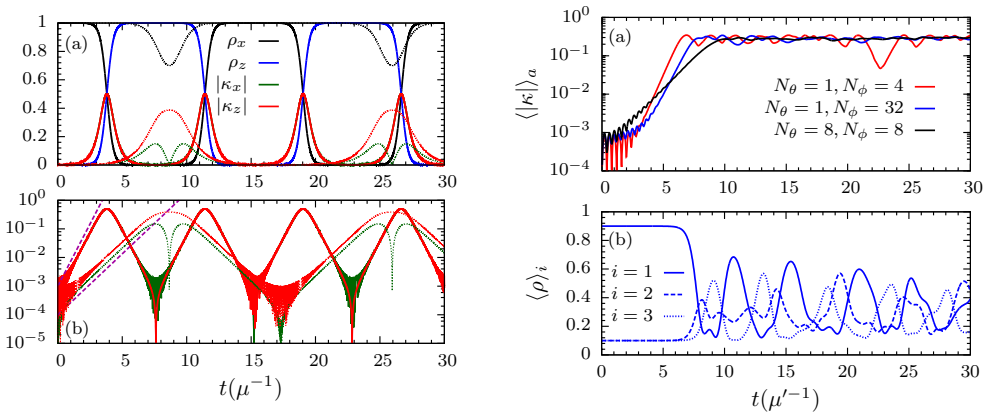
In dense neutrino gas, pairing correlations between neutrinos and antineutrinos with opposite momenta can be nonzero in generalized neutrino quantum kinetic equations at the mean-field level. Using discretized homogeneous toy models, the authors find that in anisotropic systems, νν-bar pairing instabilities generally emerge when the phase space distribution of the excessive pair-occupation number changes signs. The associated instability growth rate is set by the forward scattering potential and is comparable to that of collective fast neutrino flavor instabilities. The instabilities can result in pair conversions of νν-bar occupation numbers between different momentum modes.
What carries the argument
The excessive pair-occupation number, defined as the sum of the neutrino and antineutrino occupation numbers of a pair minus 1, whose sign change in phase space distribution triggers the instability.
If this is right
- Pair conversions of νν-bar occupation numbers occur between different momentum modes.
- The instability growth rate is set by the forward scattering potential and matches that of fast flavor instabilities.
- These instabilities motivate further assessment of νν-bar pairing effects in realistic astrophysical and cosmological environments.
Where Pith is reading between the lines
- The effect may require updating neutrino transport models in supernova simulations to include pairing correlations.
- Pairing instabilities could compete with or enhance flavor oscillations in anisotropic environments such as accretion disks.
- Extending the toy models to inhomogeneous cases would test if the sign-change condition generalizes to realistic settings.
Load-bearing premise
The mean-field approximation in generalized neutrino quantum kinetic equations captures pairing correlations and the homogeneous discretized toy models adequately represent realistic inhomogeneous astrophysical environments.
What would settle it
A simulation of the quantum kinetic equations in which the excessive pair-occupation number distribution changes sign without producing exponential growth of the pairing correlations.
Figures

read the original abstract
In dense neutrino gas, pairing correlations between neutrinos and antineutrinos with opposite momenta can be nonzero in generalized neutrino quantum kinetic equations at the mean-field level. In this Letter, we investigate for the first time the condition under which collective neutrino-antineutrino ($\nu\bar\nu$) pairing instabilities can occur, using simplified toy models consisting of discretized $\nu\bar\nu$ pairs in a homogeneous neutrino gas. We find that, in ansiotropic systems, $\nu\bar\nu$ pairing instabilities generally emerge when the phase space distribution of the excessive pair-occupation number, defined as the sum of the neutrino and antineutrino occupation numbers of a pair minus 1, changes signs. The associated instability growth rate is set by the forward scattering potential and is comparable to that of collective fast neutrino flavor instabilities. The instabilities can result in pair conversions of $\nu\bar\nu$ occupation numbers between different momentum modes. Our results motivate further studies to assess the relevance of $\nu\bar\nu$ pairing effects in realistic astrophysical and cosmological environments.
Editorial analysis
A structured set of objections, weighed in public.
Referee Report
Summary. The manuscript investigates collective neutrino-antineutrino pairing instabilities in dense neutrino gases. Using simplified toy models consisting of discretized νν-bar pairs in a homogeneous neutrino gas at the mean-field level of generalized quantum kinetic equations, it reports that in anisotropic systems such instabilities generally emerge when the phase-space distribution of the excessive pair-occupation number (n_ν + n_νbar − 1) changes sign. The associated growth rate is set by the forward-scattering potential and is comparable to that of collective fast neutrino flavor instabilities; the instabilities can induce pair conversions of occupation numbers between different momentum modes. The work motivates further studies in realistic astrophysical and cosmological environments.
Significance. If the central finding holds beyond the toy models, the paper would identify a new collective neutrino oscillation channel with potential relevance to neutrino transport in anisotropic environments such as core-collapse supernovae or neutron-star mergers, on timescales similar to fast flavor instabilities. The mean-field treatment of generalized quantum kinetic equations and the explicit link to the sign-change condition in the excessive pair-occupation number constitute a clear, falsifiable prediction that could be tested with more complete simulations.
major comments (2)
- [Toy-model description] Toy-model section: the claim that νν-bar pairing instabilities 'generally emerge' when the excessive pair-occupation number changes sign is derived exclusively from discretized homogeneous models. The manuscript does not demonstrate that this homogeneous discretization captures the essential dynamics once spatial inhomogeneities (position-dependent potentials and mode couplings) are restored, which is load-bearing for extending the result to astrophysical settings.
- [Mean-field level discussion] Mean-field treatment paragraph: the assumption that pairing correlations are adequately described at the mean-field level without higher-order fluctuation terms is not independently verified within the models (e.g., by comparison to the full kinetic equations or by error estimates), yet this assumption underpins the reported instability condition and growth rates.
minor comments (2)
- [Abstract] Abstract: 'ansi otropic' is a typographical error and should read 'anisotropic'.
- [Throughout] Notation consistency: the manuscript should adopt a uniform symbol for the excessive pair-occupation number (e.g., always n_ν + n_νbar − 1) rather than alternating between verbal descriptions and symbols.
Simulated Author's Rebuttal
We thank the referee for their careful reading of our manuscript and for the constructive comments. We address each major point below. Where appropriate, we have revised the manuscript to clarify the scope and limitations of our toy-model analysis while preserving the core findings.
read point-by-point responses
-
Referee: [Toy-model description] Toy-model section: the claim that νν-bar pairing instabilities 'generally emerge' when the excessive pair-occupation number changes sign is derived exclusively from discretized homogeneous models. The manuscript does not demonstrate that this homogeneous discretization captures the essential dynamics once spatial inhomogeneities (position-dependent potentials and mode couplings) are restored, which is load-bearing for extending the result to astrophysical settings.
Authors: We agree that our analysis is restricted to homogeneous systems and that spatial inhomogeneities, including position-dependent potentials and mode couplings, are not included. The discretized homogeneous models were chosen to isolate the pairing instability and to derive the sign-change condition directly from the linearized mean-field equations. In this controlled setting the discretization is exact for the retained modes. We have added explicit language in the revised manuscript (new paragraph in the discussion section) stating that the homogeneous approximation is a first step, that the sign-change criterion may or may not survive in inhomogeneous environments, and that full numerical simulations of the position-dependent generalized quantum kinetic equations are required to assess relevance to supernovae or mergers. This limitation is now clearly flagged as motivation for future work rather than a demonstrated general result. revision: partial
-
Referee: [Mean-field level discussion] Mean-field treatment paragraph: the assumption that pairing correlations are adequately described at the mean-field level without higher-order fluctuation terms is not independently verified within the models (e.g., by comparison to the full kinetic equations or by error estimates), yet this assumption underpins the reported instability condition and growth rates.
Authors: Our study is performed entirely within the mean-field truncation of the generalized quantum kinetic equations, which is the standard framework used for collective neutrino oscillations. The instability condition and growth rates follow directly from linearizing these mean-field equations; no claim is made that the truncation is exact. We have revised the relevant paragraph to state explicitly that higher-order correlation terms are neglected and that their quantitative impact remains to be quantified by future comparisons with the full kinetic hierarchy. Because the present Letter focuses on identifying the new instability channel at the mean-field level, a systematic error estimate or direct comparison to the untruncated equations lies outside its scope. revision: partial
Circularity Check
No circularity: instability condition derived from explicit toy-model analysis
full rationale
The paper's central result—that νν-bar pairing instabilities emerge when the excessive pair-occupation number (n_ν + n_νbar − 1) changes sign—is obtained by direct analysis of the mean-field generalized quantum kinetic equations on discretized homogeneous toy models. The occupation quantity is defined once, the equations are solved within the toy setup, and the sign-change criterion follows as an output rather than an input. No self-citations, fitted parameters renamed as predictions, or self-referential definitions appear in the derivation chain. The result is therefore self-contained against the stated assumptions of the models.
Axiom & Free-Parameter Ledger
axioms (1)
- domain assumption Mean-field approximation in generalized neutrino quantum kinetic equations captures nonzero pairing correlations between neutrinos and antineutrinos.
Reference graph
Works this paper leans on
-
[1]
Navaset al.(Particle Data Group), Phys
S. Navaset al.(Particle Data Group), Phys. Rev. D 110, 030001 (2024)
2024
-
[2]
T. Fischer, G. Guo, K. Langanke, G. Martinez-Pinedo, Y.-Z. Qian, and M.-R. Wu, Prog. Part. Nucl. Phys. 137, 104107 (2024), arXiv:2308.03962 [astro-ph.HE]
-
[3]
E. Di Valentino, S. Gariazzo, and O. Mena, (2024), arXiv:2404.19322 [astro-ph.CO]
-
[4]
I. Tamborra, Nature Rev. Phys.7, 285 (2025), arXiv:2412.09699 [astro-ph.HE]
- [5]
- [6]
- [7]
-
[8]
Many-Body Collective Neutrino Oscillations: Recent Developments,
A. V. Patwardhan, M. J. Cervia, E. Rrapaj, P. Si- wach, and A. B. Balantekin, “Many-Body Collective Neutrino Oscillations: Recent Developments,” inHand- book of Nuclear Physics, edited by I. Tanihata, H. Toki, and T. Kajino (2023) pp. 1–16, arXiv:2301.00342 [hep- ph]
- [9]
- [10]
-
[11]
S. Bhattacharyya and B. Dasgupta, Phys. Rev. D102, 063018 (2020), arXiv:2005.00459 [hep-ph]
-
[12]
S. Bhattacharyya and B. Dasgupta, Phys. Rev. Lett. 126, 061302 (2021), arXiv:2009.03337 [hep-ph]
- [13]
-
[14]
F. Capozzi, M. Chakraborty, S. Chakraborty, and M. Sen, Phys. Rev. Lett.125, 251801 (2020), arXiv:2005.14204 [hep-ph]
-
[15]
I. Padilla-Gay, S. Shalgar, and I. Tamborra, JCAP01, 017 (2021), arXiv:2009.01843 [astro-ph.HE]
-
[16]
L. Johns, Phys. Rev. Lett.130, 191001 (2023), arXiv:2104.11369 [hep-ph]
- [17]
-
[18]
A. Roggero, Phys. Rev. D104, 123023 (2021), arXiv:2103.11497 [hep-ph]
-
[19]
H. Nagakura, L. Johns, A. Burrows, and G. M. Fuller, Phys. Rev. D104, 083025 (2021), arXiv:2108.07281 [astro-ph.HE]
- [20]
-
[22]
I. Padilla-Gay, I. Tamborra, and G. G. Raffelt, Phys. Rev. Lett.128, 121102 (2022), arXiv:2109.14627 [astro- ph.HE]
- [23]
-
[24]
S. Richers, D. Willcox, and N. Ford, Phys. Rev. D104, 103023 (2021), arXiv:2109.08631 [astro-ph.HE]
-
[25]
Z. Xiong, Phys. Rev. D105, 103002 (2022), arXiv:2111.00437 [astro-ph.HE]
- [26]
-
[27]
L. Johns and Z. Xiong, Phys. Rev. D106, 103029 (2022), arXiv:2208.11059 [hep-ph]
- [28]
- [29]
-
[30]
A. Roggero, E. Rrapaj, and Z. Xiong, Phys. Rev. D 106, 043022 (2022), arXiv:2203.02783 [astro-ph.HE]
-
[31]
S. Shalgar and I. Tamborra, Phys. Rev. D107, 063025 (2023), arXiv:2207.04058 [astro-ph.HE]
-
[32]
M. Illa and M. J. Savage, Phys. Rev. Lett.130, 221003 (2023), arXiv:2210.08656 [nucl-th]
-
[33]
S. Richers, H. Duan, M.-R. Wu, S. Bhattacharyya, M. Zaizen, M. George, C.-Y. Lin, and Z. Xiong, Phys. Rev. D106, 043011 (2022), arXiv:2205.06282 [astro- ph.HE]
-
[34]
Z. Xiong, M.-R. Wu, G. Mart´ ınez-Pinedo, T. Fischer, M. George, C.-Y. Lin, and L. Johns, Phys. Rev. D 107, 083016 (2023), arXiv:2210.08254 [astro-ph.HE]
-
[35]
I. Padilla-Gay, I. Tamborra, and G. G. Raffelt, Phys. Rev. D106, 103031 (2022), arXiv:2209.11235 [hep-ph]
-
[36]
M. Zaizen and H. Nagakura, Phys. Rev. D107, 103022 (2023), arXiv:2211.09343 [astro-ph.HE]
- [37]
-
[38]
S. Abbar, Phys. Rev. D107, 103006 (2023), arXiv:2303.05560 [astro-ph.HE]
-
[39]
S. Shalgar and I. Tamborra, Phys. Rev. D107, 123004 (2023), arXiv:2304.13050 [astro-ph.HE]
- [40]
- [41]
-
[42]
Z. Xiong, M.-R. Wu, S. Abbar, S. Bhattacharyya, M. George, and C.-Y. Lin, Phys. Rev. D108, 063003 (2023), arXiv:2307.11129 [astro-ph.HE]
- [43]
-
[44]
H. Nagakura, Phys. Rev. Lett.130, 211401 (2023), arXiv:2301.10785 [astro-ph.HE]
-
[45]
L. Johns, Phys. Rev. D112, 063032 (2025), arXiv:2306.14982 [hep-ph]
-
[46]
L. Johns, Int. J. Mod. Phys. A39, 2450122 (2024), arXiv:2305.04916 [hep-ph]
- [47]
-
[48]
J. Froustey, S. Richers, E. Grohs, S. D. Flynn, F. Fou- cart, J. P. Kneller, and G. C. McLaughlin, Phys. Rev. D109, 043046 (2024), arXiv:2311.11968 [astro-ph.HE]
-
[49]
S. Abbar, M.-R. Wu, and Z. Xiong, Phys. Rev. D109, 043024 (2024), arXiv:2311.15656 [astro-ph.HE]
-
[50]
H. Nagakura, Phys. Rev. D108, 103014 (2023), arXiv:2306.10108 [astro-ph.HE]
-
[51]
H. Nagakura, L. Johns, and M. Zaizen, Phys. Rev. D 109, 083013 (2024), arXiv:2312.16285 [astro-ph.HE]
- [52]
-
[53]
S. Abbar, M.-R. Wu, and Z. Xiong, Phys. Rev. D109, 083019 (2024), arXiv:2401.17424 [astro-ph.HE]
-
[54]
L. Johns, Phys. Rev. D112, 043024 (2025), arXiv:2401.15247 [astro-ph.HE]
- [55]
-
[56]
Z. Xiong, M.-R. Wu, M. George, C.-Y. Lin, N. K. Largani, T. Fischer, and G. Mart´ ınez-Pinedo, Phys. Rev. D109, 123008 (2024), arXiv:2402.19252 [astro- ph.HE]
-
[57]
M. Zaizen and H. Nagakura, Phys. Rev. D107, 123021 (2023), arXiv:2304.05044 [astro-ph.HE]
-
[58]
Z. Xiong, M.-R. Wu, M. George, and C.-Y. Lin, Phys. Rev. Lett.134, 051003 (2025), arXiv:2403.17269 [astro- ph.HE]
-
[59]
M. Cornelius, S. Shalgar, and I. Tamborra, JCAP11, 060 (2024), arXiv:2407.04769 [astro-ph.HE]
- [60]
- [61]
- [62]
- [63]
-
[64]
Bhaskar, A
R. Bhaskar, A. Roggero, and M. J. Savage, Phys. Rev. C110, 045801 (2024)
2024
-
[65]
I. Chernyshev, C. E. P. Robin, and M. J. Savage, Phys. Rev. Res.7, 023228 (2025), arXiv:2411.04203 [quant- ph]
-
[66]
S. Richers, J. Froustey, S. Ghosh, F. Foucart, and J. Gomez, Phys. Rev. D110, 103019 (2024), arXiv:2409.04405 [astro-ph.HE]
- [67]
-
[68]
D. Lacroix, A. Bauge, B. Yilmaz, M. Mangin-Brinet, A. Roggero, and A. B. Balantekin, Phys. Rev. D110, 103027 (2024), arXiv:2409.20215 [hep-ph]
- [69]
-
[70]
J. Froustey, J. P. Kneller, and G. C. McLaughlin, Phys. Rev. D111, 063022 (2025), arXiv:2409.05807 [hep-ph]
-
[71]
S. Shalgar and I. Tamborra, JCAP09, 021 (2024), arXiv:2406.09504 [astro-ph.HE]
- [72]
- [73]
-
[74]
M. Goimil-Garc´ ıa, S. Shalgar, and I. Tamborra, Phys. Rev. D111, 083054 (2025), arXiv:2412.12268 [astro- ph.HE]
- [75]
- [76]
-
[77]
T. Wang and A. Burrows, (2025), 10.3847/1538- 4357/add889, arXiv:2503.04896 [astro-ph.HE]
- [78]
-
[79]
S. Bhattacharyya, M.-R. Wu, and Z. Xiong, (2025), arXiv:2504.11316 [astro-ph.HE]
- [80]
- [81]
discussion (0)
Sign in with ORCID, Apple, or X to comment. Anyone can read and Pith papers without signing in.