Recognition: unknown
Characterisation of the Clouds' young stellar Bridge using Gaia DR3
Pith reviewed 2026-05-07 15:50 UTC · model grok-4.3
The pith
Young stars in the Magellanic Bridge travel from the SMC to the LMC at 114 km/s over 15 kpc, with a 125 Myr crossing time that matches the galaxies' last interaction.
A machine-rendered reading of the paper's core claim, the machinery that carries it, and where it could break.
Core claim
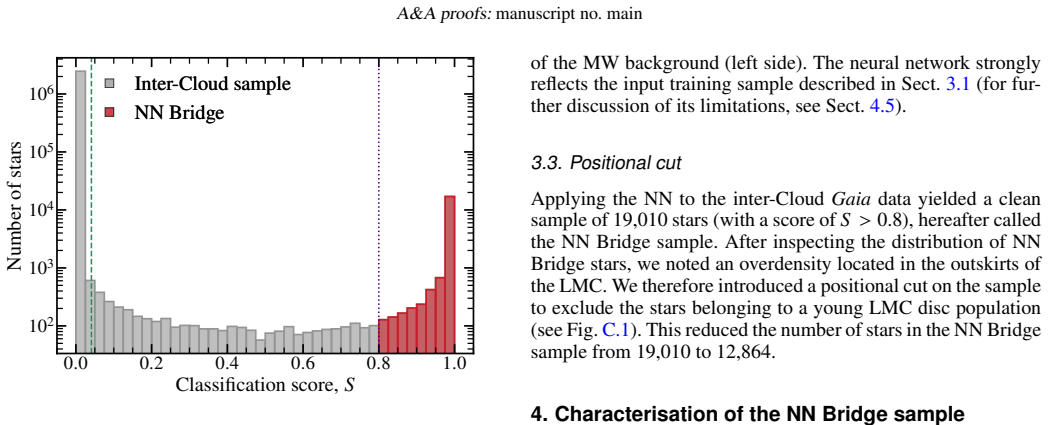
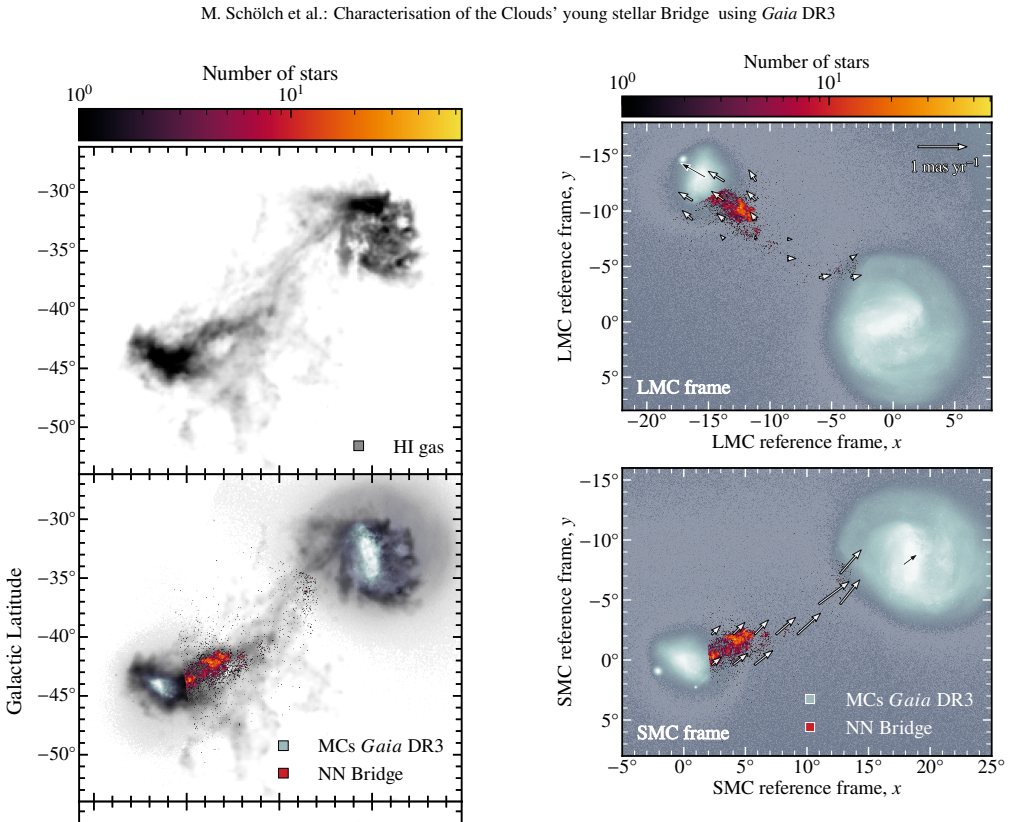
A neural network trained on young stars from the outskirts of the SMC and LMC, after UMAP dimensionality reduction of Gaia DR3 data, classifies sources in the inter-Cloud region as candidate Bridge members. The resulting sample shows good spatial alignment with HI gas, clusters, and Cepheids, spans about 15 kpc, and exhibits a median tangential velocity of 114 km/s from the SMC to the LMC, implying a crossing time of 125 Myr that lies within the timeframe of the Clouds' last interaction and thereby supports tidal stripping as a viable formation scenario.
What carries the argument
Neural network classifier trained on UMAP-reduced Gaia DR3 astrometry and photometry of young stars from the SMC and LMC outskirts, then applied to sources between the Clouds to select Bridge candidates.
Load-bearing premise
The neural network reliably separates true young Bridge stars from Milky Way foreground stars and other unrelated populations with low contamination.
What would settle it
Radial velocity or proper motion measurements for a large fraction of the candidate stars that place them in the Milky Way disk rather than at the distance and velocity of the Bridge.
Figures



read the original abstract
The interaction between the LMC and SMC (the Clouds) has resulted in prominent tidal features, including an extended bridge of gas and stars connecting the two galaxies. This Bridge has likely formed during the most recent interaction between the Clouds, about 150-250 Myr ago. While some young stars observed in the Bridge have formed in-situ from the tidally stripped gas, stellar populations may also have been drawn out of the SMC during the tidal interaction. We aim to identify a clean sample of likely Bridge stars in the region between the LMC and SMC using Gaia DR3 astrometric and photometric data combined with machine-learning techniques. We use the dimensionality-reduction algorithm UMAP to construct a training sample of young stars in the outskirts of the SMC and LMC. A neural network trained on this sample is then applied to Gaia sources in the inter-Cloud region to classify the stars and identify candidate Bridge members. We present and characterise a new sample of young candidate Bridge stars, selected from Gaia DR3. We investigate its spatial distribution, kinematic properties and colour-magnitude diagram and validate it using existing Bridge samples. The young stellar Bridge aligns well with HI gas, clusters, and cepheid samples, apart from a small offset near the LMC outer disc. We measure a Bridge length of ~15 kpc and the stars are travelling from the SMC to the LMC at a median tangential velocity of ~114 km/s. This implies a crossing time of ~125 Myr, which is within the timeframe of the last interaction of the Clouds and therefore supports tidal stripping as a possible formation scenario of the Bridge.
Editorial analysis
A structured set of objections, weighed in public.
Referee Report
Summary. The paper uses Gaia DR3 astrometric and photometric data with UMAP dimensionality reduction and a neural network classifier, trained on young stars from the SMC and LMC outskirts, to identify a new sample of candidate young stars in the inter-Cloud Bridge region. The sample is shown to align spatially with HI gas, star clusters, and Cepheids (with a noted small offset near the LMC), yielding a Bridge length of ~15 kpc, a median tangential velocity of ~114 km/s directed from SMC to LMC, and a derived crossing time of ~125 Myr that falls within the 150-250 Myr interaction timescale, supporting tidal stripping as a formation mechanism.
Significance. If the sample purity holds, the work supplies direct kinematic evidence linking young stellar populations to the recent LMC-SMC interaction, strengthening the case for tidal stripping over purely in-situ formation and providing a measurable crossing timescale. The ML pipeline on Gaia data offers a reproducible template for mapping other low-density tidal features.
major comments (2)
- [Classification and validation sections] The neural network classification step (described in the methods and applied to the inter-Cloud region) provides no quantified purity, false-positive rate, or control-field test against Milky Way foreground contamination. Because the line of sight passes through the Galactic disk, even modest leakage of stars with discrepant proper-motion distributions would systematically bias the reported median tangential velocity of 114 km/s and the 125 Myr crossing-time inference that underpins the tidal-stripping conclusion.
- [Kinematic analysis] The kinematic results (median velocity and crossing time) are presented without explicit propagation of classification uncertainties or membership probabilities; it is therefore unclear how robust the ~114 km/s value remains under plausible contamination fractions of 10-20%.
minor comments (2)
- [Results] The abstract states alignment 'apart from a small offset near the LMC outer disc' but does not quantify the offset in position or velocity; this detail should be reported with error bars in the main text or a dedicated figure.
- [Spatial distribution] Notation for the Bridge length (~15 kpc) and velocity (~114 km/s) should be accompanied by the precise definition of the endpoints used (e.g., which density contours or coordinate cuts define the 15 kpc span).
Simulated Author's Rebuttal
We thank the referee for their thorough and constructive review of our manuscript. The comments on classification purity and kinematic uncertainty propagation are well taken and will improve the clarity and robustness of the results. We address each major comment below and will incorporate the suggested additions in the revised version.
read point-by-point responses
-
Referee: [Classification and validation sections] The neural network classification step provides no quantified purity, false-positive rate, or control-field test against Milky Way foreground contamination. The line of sight through the Galactic disk could bias the median tangential velocity of 114 km/s and the 125 Myr crossing-time inference.
Authors: We agree that explicit quantification of purity and control-field tests would strengthen the analysis. The original manuscript validates the sample via spatial coincidence with HI gas, star clusters, and Cepheids plus comparison to existing Bridge catalogues, but does not report numerical purity or false-positive rates. In the revision we will add a control-field analysis using regions at comparable Galactic latitudes but offset from the Bridge, compute a purity estimate from the neural-network output probabilities, and assess the impact of plausible Milky Way leakage on the reported median velocity and crossing time. revision: yes
-
Referee: [Kinematic analysis] The kinematic results are presented without explicit propagation of classification uncertainties or membership probabilities; it is therefore unclear how robust the ~114 km/s value remains under plausible contamination fractions of 10-20%.
Authors: We acknowledge that the median tangential velocity and crossing time were derived from the hard-classified sample without weighting by membership probability or propagating classification uncertainty. The revised manuscript will weight the velocity statistics by the neural-network output probabilities and include a sensitivity analysis that injects 10-20% contamination with typical Galactic-disk proper motions to quantify the stability of the 114 km/s median and 125 Myr crossing time. This will directly demonstrate the robustness of the tidal-stripping interpretation. revision: yes
Circularity Check
No significant circularity detected in the derivation chain
full rationale
The paper constructs a training set of young stars from the known outskirts of the SMC and LMC using UMAP on Gaia astrometric and photometric features, trains a neural network, and applies the classifier to sources in the distinct inter-Cloud region to obtain a candidate sample. Spatial extent, median tangential velocity (~114 km/s), and crossing time (~125 Myr) are then computed directly from the Gaia astrometry and photometry of the classified stars. These quantities are independent measurements on the output sample rather than being enforced by construction through the selection features or any self-referential loop. Validation against external HI, cluster, and Cepheid data further separates the classification step from the reported kinematics. No load-bearing self-citations, fitted parameters renamed as predictions, or definitional equivalences appear in the chain from abstract through the described method.
Axiom & Free-Parameter Ledger
axioms (1)
- domain assumption Young stellar populations in the SMC and LMC outskirts can be cleanly isolated using Gaia DR3 astrometry and photometry to serve as a training set for the inter-Cloud region.
Reference graph
Works this paper leans on
-
[1]
Bagheri, G., Cioni, M. R. L., & Napiwotzki, R. 2013, A&A, 551, A78
2013
-
[2]
J., et al
Belokurov, V ., Erkal, D., Deason, A. J., et al. 2017, MNRAS, 466, 4711
2017
-
[3]
2012, MNRAS, 421, 2109
Besla, G., Kallivayalil, N., Hernquist, L., et al. 2012, MNRAS, 421, 2109
2012
-
[4]
Bica, E., Westera, P., Kerber, L. d. O., et al. 2020, AJ, 159, 82
2020
-
[5]
C., Noël, N
Carrera, R., Conn, B. C., Noël, N. E. D., Read, J. I., & López Sánchez, Á. R. 2017, MNRAS, 471, 4571
2017
-
[6]
L., Olsen, K., et al
Choi, Y ., Nidever, D. L., Olsen, K., et al. 2018, ApJ, 866, 90
2018
-
[7]
Choi, Y ., Olsen, K. A. G., Besla, G., et al. 2022, ApJ, 927, 153 de Jong, R. S., Agertz, O., Berbel, A. A., et al. 2019, The Messenger, 175, 3
2022
-
[8]
Diaz, J. D. & Bekki, K. 2012, ApJ, 750, 36
2012
-
[9]
2026, arXiv e-prints, arXiv:2602.12929 Article number, page 7 of 10 A&A proofs:manuscript no
Ficara, F., Ripepi, V ., Cignoni, M., et al. 2026, arXiv e-prints, arXiv:2602.12929 Article number, page 7 of 10 A&A proofs:manuscript no. main Gaia Collaboration, Brown, A. G. A., Vallenari, A., et al. 2018, A&A, 616, A1 Gaia Collaboration, Luri, X., Chemin, L., et al. 2021, A&A, 649, A7 Gaia Collaboration, Vallenari, A., Brown, A. G. A., et al. 2023, A&...
-
[10]
Gardiner, L. T. & Noguchi, M. 1996, MNRAS, 278, 191
1996
-
[11]
2026, arXiv e-prints, arXiv:2602.05021
Garver, B., Nidever, D., Debattista, V ., & Deg, N. 2026, arXiv e-prints, arXiv:2602.05021
-
[12]
2007, ApJ, 658, 345
Harris, J. 2007, ApJ, 658, 345
2007
-
[13]
V ., Kerr, F
Hindman, J. V ., Kerr, F. J., & McGee, R. X. 1963, Australian Journal of Physics, 16, 570
1963
-
[14]
M., Skowron, D
Jacyszyn-Dobrzeniecka, A. M., Skowron, D. M., Mróz, P., et al. 2016, Acta As- tron., 66, 149 Jiménez-Arranz, Ó., Chemin, L., Romero-Gómez, M., et al. 2024a, A&A, 683, A102 Jiménez-Arranz, Ó., Horta, D., van der Marel, R. P., et al. 2025, A&A, 698, A88 Jiménez-Arranz, Ó., Roca-Fàbrega, S., Romero-Gómez, M., et al. 2024b, A&A, 688, A51 Jiménez-Arranz, Ó. & ...
2016
-
[15]
Kalberla, P. M. W. & Haud, U. 2015, A&A, 578, A78
2015
-
[16]
2023, A&A, 674, A5
Katz, D., Sartoretti, P., Guerrier, A., et al. 2023, A&A, 674, A5
2023
-
[17]
J., Hindman, J
Kerr, F. J., Hindman, J. F., & Robinson, B. J. 1954, Australian Journal of Physics, 7, 297
1954
-
[18]
Kingma, D. P. & Ba, J. 2017, Adam: A Method for Stochastic Optimization
2017
-
[19]
A., Rix, H.-W., Aerts, C., et al
Kollmeier, J. A., Rix, H.-W., Aerts, C., et al. 2026, AJ, 171, 52
2026
-
[20]
SDSS-V: Pioneering Panoptic Spectroscopy
Kollmeier, J. A., Zasowski, G., Rix, H.-W., et al. 2017, arXiv e-prints, arXiv:1711.03234
work page internal anchor Pith review arXiv 2017
-
[21]
Lucchini, S., D’Onghia, E., & Fox, A. J. 2021, ApJL, 921, L36
2021
-
[22]
A Unified Approach to Interpreting Model Predictions
Lundberg, S. & Lee, S.-I. 2017, arXiv e-prints, arXiv:1705.07874
work page Pith review arXiv 2017
-
[23]
2023, Cross-Entropy Loss Functions: Theoret- ical Analysis and Applications
Mao, A., Mohri, M., & Zhong, Y . 2023, Cross-Entropy Loss Functions: Theoret- ical Analysis and Applications
2023
-
[24]
M., Pisano, D
McClure-Griffiths, N. M., Pisano, D. J., Calabretta, M. R., et al. 2009, ApJS, 181, 398
2009
-
[25]
2020, UMAP: Uniform Manifold Approx- imation and Projection for Dimension Reduction
McInnes, L., Healy, J., & Melville, J. 2020, UMAP: Uniform Manifold Approx- imation and Projection for Dimension Reduction
2020
-
[26]
2009, ApJ, 695, 1382
Hawthorn, J. 2009, ApJ, 695, 1382
2009
-
[27]
& Fujimoto, M
Murai, T. & Fujimoto, M. 1980, PASJ, 32, 581
1980
-
[28]
L., Majewski, S
Nidever, D. L., Majewski, S. R., Muñoz, R. R., et al. 2011, The Astrophysical Journal Letters, 733, L10
2011
-
[29]
L., Monachesi, A., Bell, E
Nidever, D. L., Monachesi, A., Bell, E. F., et al. 2013, ApJ, 779, 145 Noël, N. E. D., Conn, B. C., Carrera, R., et al. 2013, ApJ, 768, 109
2013
-
[30]
Oden, S. J., Nidever, D. L., Povick, J., et al. 2025, arXiv e-prints, arXiv:2512.04200
-
[31]
Oliveira, R. A. P., Maia, F. F. S., Barbuy, B., et al. 2023, MNRAS, 524, 2244
2023
-
[32]
Olsen, K. A. G. & Salyk, C. 2002, AJ, 124, 2045
2002
-
[33]
A., D’Onghia, E., & Fox, A
Pardy, S. A., D’Onghia, E., & Fox, A. J. 2018, ApJ, 857, 101
2018
-
[34]
Queiroz, A. B. A., Anders, F., Santiago, B. X., et al. 2018, MNRAS, 476, 2556
2018
-
[35]
P., & Kallivayalil, N
Rathore, H., Besla, G., van der Marel, R. P., & Kallivayalil, N. 2026, ApJ, 1000, 50
2026
-
[36]
L., Moretti, M
Ripepi, V ., Cioni, M.-R. L., Moretti, M. I., et al. 2017, MNRAS, 472, 808
2017
-
[37]
2020, A&A, 639, L3
Ruiz-Lara, T., Gallart, C., Monelli, M., et al. 2020, A&A, 639, L3
2020
-
[38]
L., Niederhofer, F., et al
Schmidt, T., Cioni, M.-R. L., Niederhofer, F., et al. 2020, A&A, 641, A134
2020
-
[39]
M., Jacyszyn, A
Skowron, D. M., Jacyszyn, A. M., Udalski, A., et al. 2014, ApJ, 795, 108 Stanimirovi´c, S., Staveley-Smith, L., & Jones, P. A. 2004, ApJ, 604, 176
2014
-
[40]
& Subramaniam, A
Subramanian, S. & Subramaniam, A. 2012, ApJ, 744, 128 van der Marel, R. P. 2001, AJ, 122, 1827
2012
-
[41]
2004, ApJ, 614, L37
Zaritsky, D. 2004, ApJ, 614, L37
2004
-
[42]
2019, ApJ, 874, 78
Zivick, P., Kallivayalil, N., Besla, G., et al. 2019, ApJ, 874, 78
2019
-
[43]
Zivick, P., Kallivayalil, N., & van der Marel, R. P. 2021, ApJ, 910, 36 Article number, page 8 of 10 M. Schölch et al.: Characterisation of the Clouds’ young stellar Bridge usingGaiaDR3 310◦ 300◦ 290◦ 280◦ □30◦ □35◦ □40◦ □45◦ □50◦ Galactic Longitude Galactic Latitude HI gas UMAP LMC UMAP SMC Fig. A.1: Density plot of theGaiainter-Cloud stars selected from...
2021
discussion (0)
Sign in with ORCID, Apple, or X to comment. Anyone can read and Pith papers without signing in.