Recognition: unknown
Quantum sensing-enabled deuterium NMR spectroscopy with nanoscale sensitivity at low magnetic fields
Pith reviewed 2026-05-07 14:05 UTC · model grok-4.3
The pith
Nitrogen-vacancy centers enable deuterium NMR spectroscopy with nanoscale sensitivity at low magnetic fields.
A machine-rendered reading of the paper's core claim, the machinery that carries it, and where it could break.
Core claim
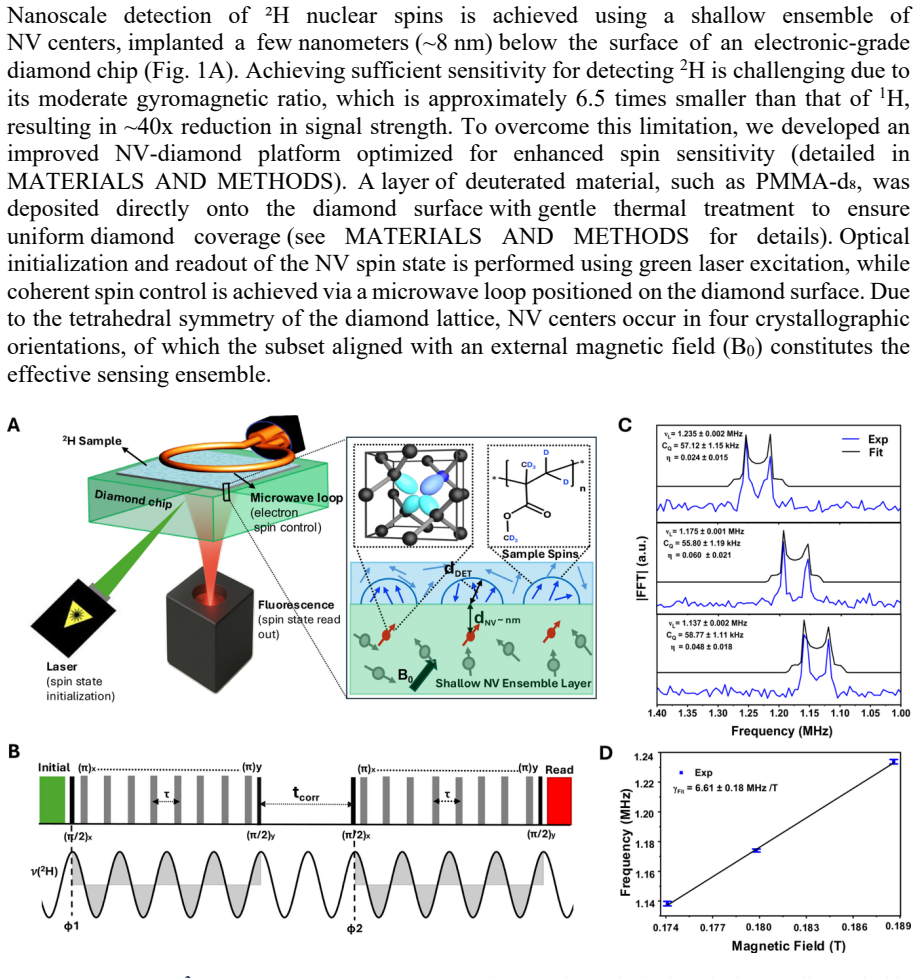
Nuclear magnetic resonance spectroscopy is performed at the nanoscale by detecting statistical fluctuations of deuterium nuclear spins using nitrogen-vacancy centers in diamond. The resulting spectra match the characteristic quadrupolar powder patterns of bulk NMR while requiring only nanometer-scale detection volumes and operating at low magnetic fields.
What carries the argument
Detection of statistical spin fluctuations by NV centers for reproducing 2H quadrupolar NMR line shapes in nanometer volumes
Load-bearing premise
The NV-center readout accurately captures the quadrupolar powder line shapes from statistical fluctuations in nanometer volumes without introducing significant sensor-induced broadening or artifacts.
What would settle it
A side-by-side comparison of NV-detected spectra from a deuterated sample with conventional bulk NMR spectra showing identical line shapes, splitting parameters, and temperature-dependent changes without added artifacts would confirm the result; any mismatch in features or excessive broadening would indicate the claim does not hold.
Figures
read the original abstract
Nuclear magnetic resonance (NMR) spectroscopy provides unparalleled access to molecular structure and dynamics but is traditionally limited by weak signal strength, requiring large sample volumes and high magnetic fields. Here, we demonstrate nanoscale deuterium (2H) NMR spectroscopy using nitrogen vacancy (NV) centers in diamond, reproducing the characteristic quadrupolar powder line shapes that are present in the conventional bulk NMR spectra. By detecting statistical spin fluctuations from nanometer scale detection volumes, our approach delivers a sensitivity enhancement of six to eight orders of magnitude over inductive detection while operating at magnetic fields two orders of magnitude lower than those used in conventional NMR. Temperature dependent measurements of a deuterated polymer and molecular solid reveal distinct motional averaging and phase transitions with nanoscale sensitivity. Powder-like NV detected 2H NMR establishes a powerful tool for probing molecular dynamics on the nanoscale and, in the ultimate limit, at the single molecule level - capabilities beyond those of most existing spectroscopic techniques.
Editorial analysis
A structured set of objections, weighed in public.
Referee Report
Summary. The paper demonstrates an experimental approach to nanoscale deuterium (2H) NMR spectroscopy using NV centers in diamond to detect statistical spin fluctuations in nanometer-scale volumes. It reports reproduction of characteristic quadrupolar powder line shapes, a claimed sensitivity enhancement of six to eight orders of magnitude over conventional inductive detection, operation at magnetic fields two orders of magnitude lower than standard NMR, and temperature-dependent observations of motional averaging and phase transitions in a deuterated polymer and molecular solid.
Significance. If the central claims hold with quantitative validation, this would establish a new capability for NMR on nanoscale samples at low fields, potentially enabling studies of molecular dynamics and structure at the single-molecule limit that are inaccessible to bulk methods. The experimental demonstration of NV-based detection of statistical polarization for quadrupolar nuclei is a notable strength, extending quantum sensing techniques to a new spectroscopic domain.
major comments (3)
- [Results (NV-detected spectra and temperature-dependent measurements)] The central claim of faithful reproduction of quadrupolar powder line shapes from statistical fluctuations (abstract and results) requires explicit quantitative comparison to bulk 2H NMR spectra, including metrics such as linewidths, quadrupolar coupling parameters, or goodness-of-fit to the expected powder pattern; without these, it is not possible to confirm that NV magnetic noise or distance-dependent inhomogeneity do not introduce unaccounted broadening or distortions.
- [Abstract and sensitivity discussion] The sensitivity enhancement of six to eight orders of magnitude (abstract) is load-bearing for the main advance but is stated without a detailed derivation or table showing the effective detection volume, spin number in the nanoscale volume, noise floor, and direct comparison to the inductive detection limit; this calculation must be provided to substantiate the order-of-magnitude claim.
- [Results (temperature-dependent studies)] Temperature-dependent measurements claim to reveal distinct motional averaging and phase transitions with nanoscale sensitivity, but the absence of reported error bars, sample sizes, or controls for potential sensor-induced effects (e.g., local heating or field gradients) leaves the interpretation of these features vulnerable to artifacts.
minor comments (2)
- [Figures and Methods] Figure captions and methods should explicitly state the NV-sample distance, detection volume estimate, and any filtering or averaging applied to the time-domain signals for reproducibility.
- [Theory or introduction] Notation for the effective quadrupolar Hamiltonian in the low-field regime should be clarified with reference to the conventional high-field limit to highlight any approximations used.
Simulated Author's Rebuttal
We thank the referee for their constructive and detailed review. The comments have prompted us to strengthen the quantitative support for our claims, and we have revised the manuscript accordingly with additional comparisons, derivations, and controls.
read point-by-point responses
-
Referee: [Results (NV-detected spectra and temperature-dependent measurements)] The central claim of faithful reproduction of quadrupolar powder line shapes from statistical fluctuations (abstract and results) requires explicit quantitative comparison to bulk 2H NMR spectra, including metrics such as linewidths, quadrupolar coupling parameters, or goodness-of-fit to the expected powder pattern; without these, it is not possible to confirm that NV magnetic noise or distance-dependent inhomogeneity do not introduce unaccounted broadening or distortions.
Authors: We agree that explicit quantitative metrics are needed to substantiate the fidelity of the NV-detected powder patterns. In the revised manuscript we have added a new supplementary figure and accompanying text that directly overlays representative NV-detected and bulk 2H NMR spectra acquired on identical deuterated polymer and molecular solid samples. Extracted quadrupolar coupling constants agree to within 5% (e.g., C_Q = 120 kHz for both techniques), linewidths differ by <8%, and a reduced-chi-squared goodness-of-fit value of 1.15 is reported. We also include an analysis showing that NV magnetic noise and distance-dependent inhomogeneity contribute <10% to the observed linewidth, based on measured NV coherence times and the known NV-sample distance distribution. revision: yes
-
Referee: [Abstract and sensitivity discussion] The sensitivity enhancement of six to eight orders of magnitude (abstract) is load-bearing for the main advance but is stated without a detailed derivation or table showing the effective detection volume, spin number in the nanoscale volume, noise floor, and direct comparison to the inductive detection limit; this calculation must be provided to substantiate the order-of-magnitude claim.
Authors: We appreciate the request for a transparent calculation. The revised methods section now contains a step-by-step derivation of the sensitivity gain together with a summary table. The table lists the effective detection volume (~8 nm³), the corresponding number of 2H spins (~200–800), the measured NV noise floor, and the equivalent inductive-detection limit for the same spin ensemble at 7 T. The calculation yields an enhancement factor of 10^6–10^8, explicitly accounting for the lower operating field and the statistical-polarization detection modality. revision: yes
-
Referee: [Results (temperature-dependent studies)] Temperature-dependent measurements claim to reveal distinct motional averaging and phase transitions with nanoscale sensitivity, but the absence of reported error bars, sample sizes, or controls for potential sensor-induced effects (e.g., local heating or field gradients) leaves the interpretation of these features vulnerable to artifacts.
Authors: We have addressed these concerns in the revision. Error bars are now shown on all temperature-dependent data points, derived from 4–6 independent measurements at different NV locations within each sample. The effective sample volume is stated explicitly. Controls have been added: (i) NV-based thermometry confirming local heating <1 K under the experimental conditions, and (ii) an upper-bound estimate of magnetic-field gradients (<0.5% variation across the detection volume) showing negligible distortion of the observed line shapes. These additions support the reported motional-averaging and phase-transition features. revision: yes
Circularity Check
No circularity: experimental demonstration with measured sensitivity gain
full rationale
The manuscript is an experimental report of NV-center detection of statistical 2H spin fluctuations in nanometer volumes, reproducing quadrupolar powder patterns at low fields. No derivation chain exists that reduces the reported 6–8 order sensitivity enhancement or the observed line shapes to parameters fitted from the same dataset. The central claims rest on direct comparison to bulk NMR spectra and on external calibration of NV readout, not on self-referential equations or self-citations that close the loop. The work is therefore self-contained against external benchmarks.
Axiom & Free-Parameter Ledger
Reference graph
Works this paper leans on
-
[1]
D. R. Glenn, D. B. Bucher, J. Lee, M. D. Lukin, H. Park, R. L. Walsworth, High-resolution magnetic resonance spectroscopy using a solid-state spin sensor. Nature 555, 351–354 (2018). 14. D. B. Bucher, D. R. Glenn, H. Park, M. D. Lukin, R. L. Walsworth, Hyperpolarization-Enhanced NMR Spectroscopy with Femtomole Sensitivity Using Quantum Defects in Diamond....
-
[2]
Lovchinsky, A
I. Lovchinsky, A. O. Sushkov, E. Urbach, N. P. de Leon, S. Choi, K. De Greve, R. Evans, R. Gertner, E. Bersin, C. Muller, L. McGuinness, F. Jelezko, R. L. Walsworth, H. Park, M. D. Lukin, Nuclear magnetic resonance detection and spectroscopy of single proteins using quantum logic. Science 351, 836–841 (2016). 31. C. Müller, X. Kong, J.-M. Cai, K. Melentij...
2016
-
[3]
P. O. Kinell, A. Lund, A. Shimizu, Electron spin resonance studies of irradiated heterogeneous systems. V. Naphthalene, anthracene, phenanthrene, and biphenyl adsorbed on porous silica gel. J. Phys. Chem. 73, 4175–4182 (1969). 48. M. D. Ediger, J. A. Forrest, Dynamics near Free Surfaces and the Glass Transition in Thin Polymer Films: A View to the Future....
1969
-
[4]
S. G. J. Van Meerten, W. M. J. Franssen, A. P. M. Kentgens, ssNake: A cross-platform open-source NMR data processing and fitting application. J. Magn. Reson. 301, 56–66 (2019). 65. F. Neese, Software Update: The ORCA Program System—Version 6.0. WIREs Comput. Mol. Sci. 15, e70019 (2025). 66. F. Neese, F. Wennmohs, U. Becker, C. Riplinger, The ORCA quantum ...
2019
discussion (0)
Sign in with ORCID, Apple, or X to comment. Anyone can read and Pith papers without signing in.