Recognition: unknown
Pareto Frontier of Neural Quantum States: Scalable, Affordable, and Accurate Convolutional Backflow for Strongly Correlated Lattice Fermions
Pith reviewed 2026-05-07 14:51 UTC · model grok-4.3
The pith
Two new convolutional backflow methods for neural quantum states reduce scaling to O(N^3) and set accuracy records for Hubbard and t-J models.
A machine-rendered reading of the paper's core claim, the machinery that carries it, and where it could break.
Core claim
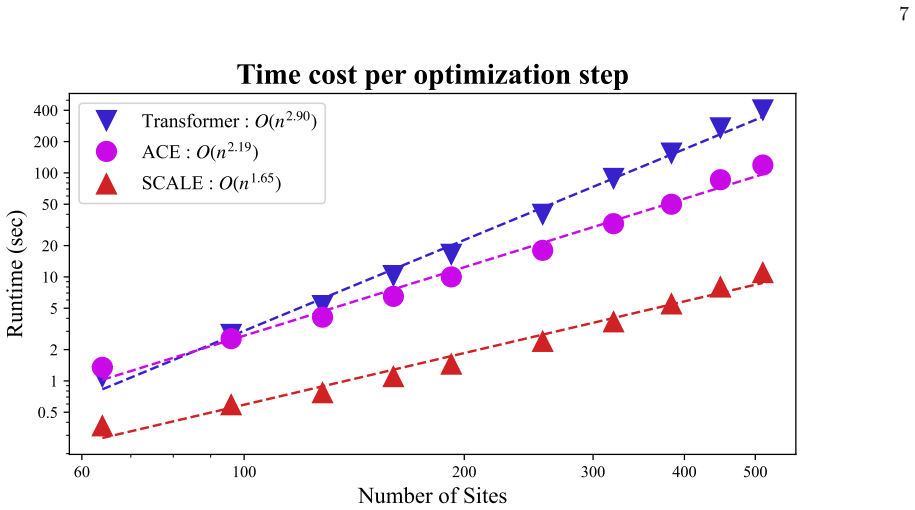
The authors introduce the Sparse Convolutional Ansatz for Lattice Electrons (SCALE) and the Accurate Convolutional ansatz for lattice Electrons (ACE) as complementary backflow-related architectures that together define a Pareto frontier for neural quantum states of lattice fermions. SCALE achieves O(N^3) scaling and more than 40 times practical speedup through tailored convolutions that permit efficient local updates, while ACE maximizes expressive power with a deep convolutional stack; both are benchmarked on Hubbard and t-J models, with SCALE providing competitive energies at reduced cost and ACE establishing new accuracy records, for example on 16 by 4 systems at one-sixth the runtime of
What carries the argument
The Sparse Convolutional Ansatz for Lattice Electrons (SCALE) employs a tailored convolutional design that enables efficient local updates via low-rank determinant updates; the Accurate Convolutional ansatz for lattice Electrons (ACE) uses a deep convolutional stack to increase expressive power of the variational wavefunction.
If this is right
- Simulation of the 1/8-doped pure Hubbard model becomes feasible up to 32 by 32 lattices, revealing no significant energy difference between horizontal and vertical filled stripe states.
- Variational energies competitive with leading methods are obtained at a fraction of the usual computational cost.
- New accuracy benchmarks are set on 16 by 4 systems while using only one-sixth the runtime of recent approaches.
- Scalable, affordable tools are now available for investigating microscopic mechanisms of unconventional superconductivity in strongly correlated fermionic systems.
Where Pith is reading between the lines
- The cubic scaling of SCALE could make routine studies of doping dependence or disorder on lattices beyond 32 by 32 practical.
- The accuracy gains of ACE may help distinguish between competing ground-state proposals for the Hubbard model at intermediate doping.
- These convolutional backflow forms could be transferred to related fermionic problems such as the extended Hubbard model or quantum chemistry Hamiltonians.
- The finding that stripe orientation is insensitive to horizontal versus vertical filling only in the pure Hubbard model highlights the role of next-nearest-neighbor terms in selecting stripe direction.
Load-bearing premise
The specific convolutional designs in SCALE and ACE are assumed to capture the dominant correlations in the Hubbard and t-J models without needing post-hoc adjustments or losing accuracy when lattices grow larger than those with existing benchmarks.
What would settle it
A comparison of the variational energies obtained from SCALE or ACE against exact diagonalization results on a small lattice (such as 4 by 4) or against other high-accuracy reference methods on a 16 by 4 or 32 by 4 system would directly test whether the reported energies and speedups hold.
Figures



read the original abstract
Neural Quantum States (NQS) are now among the most accurate methods for studying strongly correlated many-fermion systems, outperforming existing many-body approaches for large systems. However, NQS calculations remain extremely resource-intensive. Here, we introduce a new Pareto frontier of efficiency and accuracy for NQS in simulating strongly correlated lattice fermions, defined by two complementary backflow-related architectures: the Sparse Convolutional Ansatz for Lattice Electrons (SCALE) (state-of-the-art efficiency) and the Accurate Convolutional ansatz for lattice Electrons (ACE) (state-of-the-art accuracy), benchmarked on the iconic Hubbard and $t-J$ models for large lattices. SCALE uses a tailored convolutional design enabling efficient local updates via low-rank determinant updates, reducing computational scaling from $O(N^4)$ to $O(N^3)$ in backflow methods and yielding a >40$\times$ practical speed-up in tests while maintaining high variational accuracy. As an application, we study the previously inaccessible 1/8-doped pure Hubbard model up to $32 \times 32$, finding no significant energy difference between horizontal and vertical filled stripe states - contrasting with half-filled stripe states when next-nearest-neighbor hoppings are included. ACE employs a deep convolutional stack to maximize expressive power, achieving unprecedented accuracy on large systems. Extensive benchmarks on Hubbard and $t-J$ models show SCALE delivers variational energies competitive with leading methods at a fraction of the cost, while ACE sets a new accuracy benchmark, surpassing recent results with only 1/6 the runtime for $16 \times 4$ systems. These new NQS approaches provide scalable, affordable, and accurate tools for exploring strongly correlated fermionic physics, such as the microscopic mechanism of unconventional superconductivity.
Editorial analysis
A structured set of objections, weighed in public.
Referee Report
Summary. The manuscript introduces two complementary convolutional backflow architectures for neural quantum states (NQS) on lattice fermions: SCALE (Sparse Convolutional Ansatz for Lattice Electrons), which uses tailored convolutions to enable low-rank determinant updates for O(N^3) scaling and >40x practical speedups, and ACE (Accurate Convolutional ansatz for lattice Electrons), which employs deeper stacks for higher expressivity. Both are benchmarked on Hubbard and t-J models, with SCALE applied to previously inaccessible 32x32 1/8-doped Hubbard systems, where it finds no significant energy difference between horizontal and vertical filled stripes (contrasting with next-nearest-neighbor cases). Claims include competitive variational energies at reduced cost for SCALE and new accuracy benchmarks for ACE at 1/6 the runtime on 16x4 systems.
Significance. If the scaling and accuracy claims hold under verification, the work would meaningfully advance NQS applicability to large fermionic systems by reducing computational barriers while preserving variational quality, enabling studies of stripe physics and superconductivity mechanisms on scales beyond current DMRG reach. The explicit application to 32x32 lattices and reported speedups represent concrete progress over prior backflow NQS.
major comments (3)
- [Application section on 32x32 systems] Application to 32x32 Hubbard (stripe comparison): the reported lack of horizontal/vertical energy difference is load-bearing for the physical conclusion, yet the convolutional locality in SCALE may introduce an implicit bias that suppresses stripe orientation dependence; no DMRG or exact benchmarks are provided for this size, and error bars on the energies are absent, leaving open whether the result is physical or ansatz-limited.
- [SCALE ansatz and computational scaling discussion] SCALE scaling claim (low-rank updates): the reduction from O(N^4) to O(N^3) via low-rank determinant updates is central to the efficiency narrative and >40x speedup, but requires explicit confirmation that the update rank remains bounded on the 32x32 lattices used for the stripe result; the abstract and methods provide no rank bounds or scaling plots versus system size to rule out rank growth that would invalidate the O(N^3) claim.
- [Results and benchmarks sections] Benchmark comparisons: claims of competitive energies and speedups rest on variational results, but the absence of error bars, full training protocol details (e.g., optimization steps, data exclusion), and side-by-side tables versus DMRG/exact baselines on identical large systems undermines assessment of whether accuracy is truly maintained without post-hoc adjustments.
minor comments (2)
- [Abstract] Abstract: the 'Pareto frontier' framing is not illustrated with a cost-accuracy plot comparing SCALE/ACE against prior NQS and traditional methods; adding such a figure would strengthen the efficiency-accuracy positioning.
- [Throughout methods and results] Notation consistency: ensure N is unambiguously defined as number of sites (or electrons) in all scaling discussions and equations.
Simulated Author's Rebuttal
We thank the referee for their careful reading and constructive comments on our manuscript. We address each major comment point-by-point below, indicating where revisions will be made to improve clarity and rigor.
read point-by-point responses
-
Referee: [Application section on 32x32 systems] Application to 32x32 Hubbard (stripe comparison): the reported lack of horizontal/vertical energy difference is load-bearing for the physical conclusion, yet the convolutional locality in SCALE may introduce an implicit bias that suppresses stripe orientation dependence; no DMRG or exact benchmarks are provided for this size, and error bars on the energies are absent, leaving open whether the result is physical or ansatz-limited.
Authors: We agree that DMRG or exact benchmarks for 32x32 doped Hubbard systems are unavailable, as these sizes remain beyond the reach of DMRG due to entanglement growth. Our variational results provide rigorous upper bounds, and we have cross-validated the ansatz on smaller lattices (up to 16x16) where DMRG data exists, showing consistent accuracy. Regarding potential bias, the SCALE convolutional kernels are designed to be fully translationally invariant and treat horizontal and vertical directions symmetrically via isotropic filter supports, allowing the variational optimization to freely select stripe orientation. To address the lack of error bars, we will add statistical uncertainties estimated from multiple independent training runs in the revised application section. revision: partial
-
Referee: [SCALE ansatz and computational scaling discussion] SCALE scaling claim (low-rank updates): the reduction from O(N^4) to O(N^3) via low-rank determinant updates is central to the efficiency narrative and >40x speedup, but requires explicit confirmation that the update rank remains bounded on the 32x32 lattices used for the stripe result; the abstract and methods provide no rank bounds or scaling plots versus system size to rule out rank growth that would invalidate the O(N^3) claim.
Authors: The low-rank determinant updates in SCALE stem from the local support of the convolutional backflow transformations, where each update affects only a fixed number of rows/columns in the Slater determinant matrix (bounded by the kernel size, e.g., 3x3). This rank is independent of system size N. We will add explicit rank bounds (rank ≤ kernel support size) and computational scaling plots versus N in a new methods subsection to rigorously confirm the O(N^3) scaling holds through 32x32. revision: yes
-
Referee: [Results and benchmarks sections] Benchmark comparisons: claims of competitive energies and speedups rest on variational results, but the absence of error bars, full training protocol details (e.g., optimization steps, data exclusion), and side-by-side tables versus DMRG/exact baselines on identical large systems undermines assessment of whether accuracy is truly maintained without post-hoc adjustments.
Authors: We will expand the methods and results sections with full training protocol details (optimization steps, learning schedules, and any data handling), error bars from ensemble runs, and additional side-by-side comparison tables against DMRG/exact results for all smaller systems where such data is available. For the largest lattices, we will explicitly note the absence of reference data from other methods while reporting direct runtime measurements on identical hardware. revision: yes
- Providing DMRG or exact benchmarks for the 32x32 Hubbard systems, as these sizes are currently inaccessible to those methods for doped cases.
Circularity Check
New convolutional NQS architectures introduce independent scaling and accuracy claims without reducing to self-fitted inputs or self-citations by construction.
full rationale
The paper defines SCALE via a tailored convolutional design that enables low-rank determinant updates, directly yielding the stated O(N^3) scaling as a property of the chosen architecture rather than any fitted parameter or prior result. ACE is defined via a deep convolutional stack for expressivity. No equations in the abstract or described claims equate a reported energy or speedup to an input fit by construction. No load-bearing self-citations, uniqueness theorems, or ansatzes imported from prior author work are referenced. Benchmarks on Hubbard and t-J models are presented as empirical tests of the new methods, not as predictions forced by the inputs. This is a standard self-contained methodological contribution with no circular steps.
Axiom & Free-Parameter Ledger
free parameters (1)
- neural network weights
axioms (1)
- standard math Variational principle: the trial wavefunction energy is an upper bound to the true ground-state energy
invented entities (2)
-
SCALE ansatz
no independent evidence
-
ACE ansatz
no independent evidence
Reference graph
Works this paper leans on
-
[1]
We focus on the most challenging and intriguing regime withU= 8, and hole dopingδ= 1/8
and is believed to be relevant for Cuprate super- conductors [46]. We focus on the most challenging and intriguing regime withU= 8, and hole dopingδ= 1/8. We compare the ACE and SCALE results with several leading methods to demonstrate their superior accuracy and efficiency
-
[2]
In Fig 4(a), we plot the ground state energy against the total computational cost, comparing the energies from ACE with previous state-of-the-art re- sults
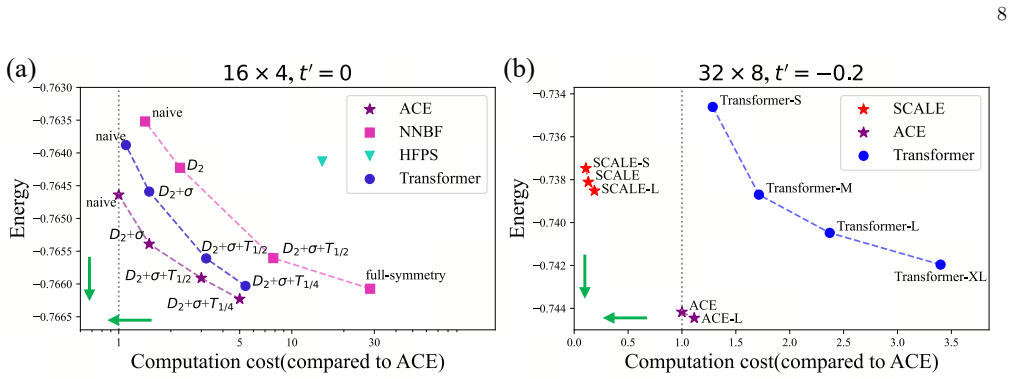
Accuracy on16×4systems We focus first on a relatively small system with size 16×4 under PBC. In Fig 4(a), we plot the ground state energy against the total computational cost, comparing the energies from ACE with previous state-of-the-art re- sults. As it is well established that explicitly projecting a wavefunction onto the correct symmetry subspace can ...
-
[3]
Accuracy on large systems We then study a large system with size 32×8 and in- cluding the next-nearest-neighboring hoppingt ′ =−0.2, a challenging regime where the trade-off between varia- tional accuracy and computational cost is critical. Our new results with SCALE and ACE and the comparison with the transformer backflow results [21] are summa- rized in...
-
[4]
We consider systems under different bound- ary conditions, i.e., OBC and PBC, and systems with and withoutt ′
Comparison with other leading methods In this subsection, we show a comparison of our re- sults with other leading methods for a large-scale 16×16 system. We consider systems under different bound- ary conditions, i.e., OBC and PBC, and systems with and withoutt ′. As shown in Table I, both SCALE and ACE demonstrate exceptional performance. SCALE is highl...
-
[5]
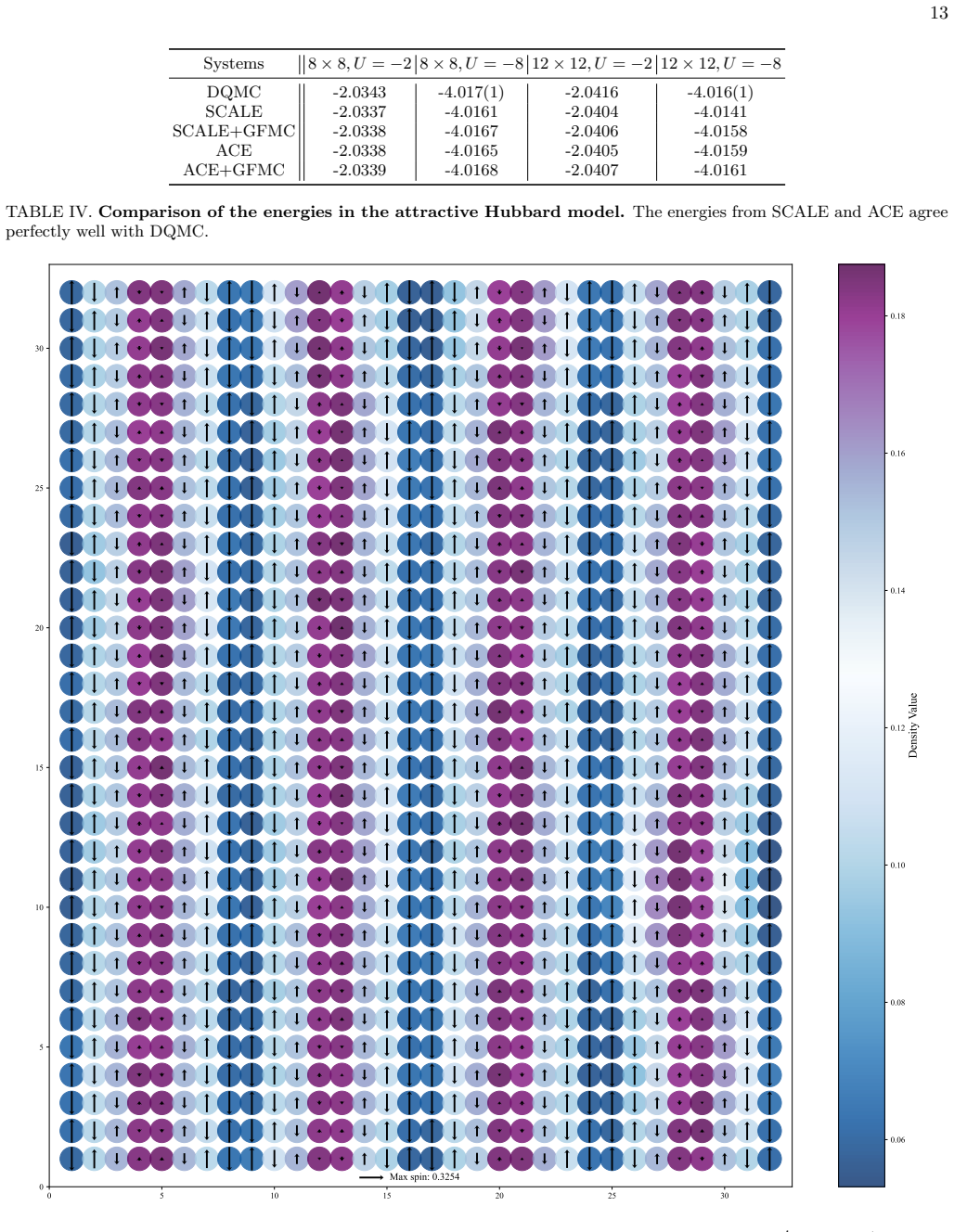
Orientation of Stripe Order In a previous work [21], it was found that the half-filled stripe state for the Hubbard model witht ′ =−0.2 tends to align along the horizontal direction when the studied system has a rectangular geometry (i.e., the lengthL x is greater than the widthL y). In this context, a hor- izontal stripe refers to states where the rivers...
-
[6]
E. H. Lieb and F. Y. Wu, Absence of mott transition in an exact solution of the short-range, one-band model in one dimension, Phys. Rev. Lett.20, 1445 (1968)
1968
-
[7]
Fradkin, S
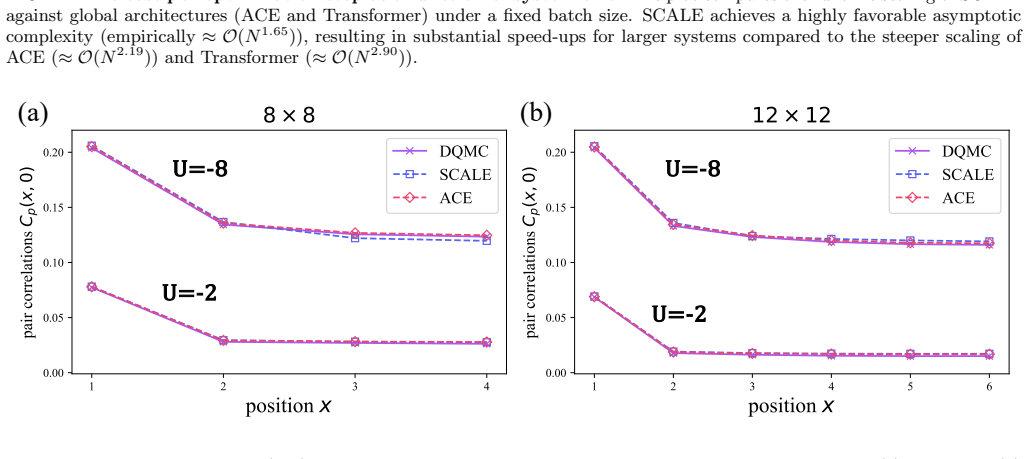
E. Fradkin, S. A. Kivelson, and J. M. Tranquada, Collo- quium: Theory of intertwined orders in high temperature superconductors, Rev. Mod. Phys.87, 457 (2015). 13 Systems 8×8, U=−2 8×8, U=−8 12×12, U=−2 12×12, U=−8 DQMC -2.0343 -4.017(1) -2.0416 -4.016(1) SCALE -2.0337 -4.0161 -2.0404 -4.0141 SCALE+GFMC -2.0338 -4.0167 -2.0406 -4.0158 ACE -2.0338 -4.0165 ...
2015
-
[8]
M. Qin, T. Sch¨ afer, S. Andergassen, P. Corboz, and E. Gull, The hubbard model: A computational perspec- tive, Annual Review of Condensed Matter Physics13, 275 (2022)
2022
-
[9]
D. P. Arovas, E. Berg, S. A. Kivelson, and S. Raghu, The hubbard model, Annual review of condensed matter physics13, 239 (2022)
2022
-
[10]
Chung, M
C.-M. Chung, M. Qin, S. Zhang, U. Schollw¨ ock, and S. R. White (The Simons Collaboration on the Many-Electron Problem), Plaquette versus ordinaryd-wave pairing in thet ′ -hubbard model on a width-4 cylinder, Phys. Rev. B102, 041106 (2020)
2020
-
[11]
H. Xu, C.-M. Chung, M. Qin, U. Schollw¨ ock, S. R. White, and S. Zhang, Coexistence of su- perconductivity with partially filled stripes in the hubbard model, Science384, eadh7691 (2024), https://www.science.org/doi/pdf/10.1126/science.adh7691
-
[12]
Y. Shen, X. Qian, and M. Qin, The ground state of electron-doped t- t’- j model on cylinders: an investiga- tion of finite size and boundary condition effects, Chinese Physics B (2025)
2025
-
[13]
X. Lu, F. Chen, W. Zhu, D. N. Sheng, and S.-S. Gong, Emergent superconductivity and competing charge or- ders in hole-doped square-latticet−jmodel, Phys. Rev. Lett.132, 066002 (2024)
2024
- [14]
-
[15]
J. P. LeBlanc, A. E. Antipov, F. Becca, I. W. Bulik, G. K.-L. Chan, C.-M. Chung, Y. Deng, M. Ferrero, T. M. Henderson, C. A. Jim´ enez-Hoyos,et al., Solutions of the two-dimensional hubbard model: Benchmarks and re- sults from a wide range of numerical algorithms, Physical Review X5, 041041 (2015)
2015
-
[16]
S. R. White, Density matrix formulation for quantum renormalization groups, Phys. Rev. Lett.69, 2863 (1992)
1992
-
[17]
¨Ostlund and S
S. ¨Ostlund and S. Rommer, Thermodynamic limit of den- sity matrix renormalization, Phys. Rev. Lett.75, 3537 (1995)
1995
-
[18]
Schollw¨ ock, The density-matrix renormalization group in the age of matrix product states, Annals of Physics 326, 96 (2011), january 2011 Special Issue
U. Schollw¨ ock, The density-matrix renormalization group in the age of matrix product states, Annals of Physics 326, 96 (2011), january 2011 Special Issue
2011
-
[19]
J. I. Cirac, D. P´ erez-Garc´ ıa, N. Schuch, and F. Ver- straete, Matrix product states and projected entangled pair states: Concepts, symmetries, theorems, Rev. Mod. Phys.93, 045003 (2021)
2021
-
[20]
Renormalization algorithms for Quantum-Many Body Systems in two and higher dimensions
F. Verstraete and J. I. Cirac, Renormalization al- gorithms for quantum-many body systems in two and higher dimensions (2004), arXiv:cond-mat/0407066 [cond-mat.str-el]
work page internal anchor Pith review arXiv 2004
-
[21]
Or´ us, A practical introduction to tensor networks: Matrix product states and projected entangled pair states, Annals of Physics349, 117 (2014)
R. Or´ us, A practical introduction to tensor networks: Matrix product states and projected entangled pair states, Annals of Physics349, 117 (2014)
2014
-
[22]
Xiang,Density Matrix and Tensor Network Renor- malization(Cambridge University Press, 2023)
T. Xiang,Density Matrix and Tensor Network Renor- malization(Cambridge University Press, 2023)
2023
-
[23]
Carleo and M
G. Carleo and M. Troyer, Solving the quantum many- body problem with artificial neural networks, Science 355, 602 (2017)
2017
-
[24]
Luo and B
D. Luo and B. K. Clark, Backflow transformations via neural networks for quantum many-body wave functions, Physical review letters122, 226401 (2019)
2019
-
[25]
Robledo Moreno, G
J. Robledo Moreno, G. Carleo, A. Georges, and J. Stokes, Fermionic wave functions from neural-network con- strained hidden states, Proceedings of the National Academy of Sciences119, e2122059119 (2022)
2022
- [26]
-
[27]
X. Liang, Investigating the fermi-hubbard model by the tensor-backflow method, arXiv preprint arXiv:2507.01856 (2025)
-
[28]
A. Chen, Z.-Q. Wan, A. Sengupta, A. Georges, and C. Roth, Neural network-augmented pfaffian wave- functions for scalable simulations of interacting fermions, arXiv preprint arXiv:2507.10705 (2025)
- [29]
-
[30]
K. Loehr and B. K. Clark, Enhancing neural network backflow (2025), arXiv:2510.26906 [cond-mat.str-el]
-
[31]
Blankenbecler, D
R. Blankenbecler, D. J. Scalapino, and R. L. Sugar, Monte carlo calculations of coupled boson-fermion sys- tems. i, Phys. Rev. D24, 2278 (1981)
1981
-
[32]
J. E. Hirsch, Two-dimensional hubbard model: Numeri- cal simulation study, Phys. Rev. B31, 4403 (1985)
1985
-
[33]
J. E. Hirsch, Discrete hubbard-stratonovich transforma- tion for fermion lattice models, Phys. Rev. B28, 4059 (1983)
1983
-
[34]
Y.-Y. He, H. Shi, and S. Zhang, Reaching the continuum limit in finite-temperature ab initio field-theory compu- tations in many-fermion systems, Phys. Rev. Lett.123, 136402 (2019)
2019
-
[35]
W.-Y. Liu, H. Zhai, R. Peng, Z.-C. Gu, and G. K.-L. Chan, Accurate simulation of the hubbard model with fi- nite fermionic projected entangled pair states, Phys. Rev. Lett.134, 256502 (2025)
2025
-
[36]
M. Scherbela, N. Gao, P. Grohs, and S. G¨ unnemann, Accurate ab-initio neural-network solutions to large- scale electronic structure problems, arXiv preprint arXiv:2504.06087 (2025)
-
[37]
Wigner, On the interaction of electrons in metals, Phys
E. Wigner, On the interaction of electrons in metals, Phys. Rev.46, 1002 (1934)
1934
-
[38]
R. P. Feynman and M. Cohen, Energy spectrum of the excitations in liquid helium, Phys. Rev.102, 1189 (1956)
1956
-
[39]
L. F. Tocchio, F. Becca, A. Parola, and S. Sorella, Role of backflow correlations for the nonmagnetic phase of the t–t ′ hubbard model, Phys. Rev. B78, 041101 (2008)
2008
-
[40]
K. He, X. Zhang, S. Ren, and J. Sun, Deep residual learn- ing for image recognition, inProceedings of the IEEE con- ference on computer vision and pattern recognition(2016) pp. 770–778
2016
-
[41]
Elfwing, E
S. Elfwing, E. Uchibe, and K. Doya, Sigmoid-weighted linear units for neural network function approximation in reinforcement learning, Neural networks107, 3 (2018)
2018
-
[42]
S. R. White, D. J. Scalapino, R. L. Sugar, E. Y. Loh, J. E. Gubernatis, and R. T. Scalettar, Numerical study of the two-dimensional hubbard model, Phys. Rev. B40, 506 (1989)
1989
-
[43]
J. L. Ba, J. R. Kiros, and G. E. Hinton, Layer normal- ization, arXiv preprint arXiv:1607.06450 (2016)
work page internal anchor Pith review arXiv 2016
-
[44]
An Image is Worth 16x16 Words: Transformers for Image Recognition at Scale
A. Dosovitskiy, L. Beyer, A. Kolesnikov, D. Weissenborn, X. Zhai, T. Unterthiner, M. Dehghani, M. Minderer, 16 G. Heigold, S. Gelly,et al., An image is worth 16x16 words: Transformers for image recognition at scale, arXiv preprint arXiv:2010.11929 (2020)
work page internal anchor Pith review arXiv 2010
-
[45]
Trivedi and D
N. Trivedi and D. M. Ceperley, Ground-state correlations of quantum antiferromagnets: A green-function monte carlo study, Phys. Rev. B41, 4552 (1990)
1990
-
[46]
D. F. B. ten Haaf, H. J. M. van Bemmel, J. M. J. van Leeuwen, W. van Saarloos, and D. M. Ceperley, Proof for an upper bound in fixed-node monte carlo for lattice fermions, Phys. Rev. B51, 13039 (1995)
1995
-
[47]
Hubbard, Electron Correlations in Narrow Energy Bands, Proc
J. Hubbard, Electron Correlations in Narrow Energy Bands, Proc. R. Soc. Lond. A276, 238 (1963)
1963
-
[48]
Bardeen, L
J. Bardeen, L. N. Cooper, and J. R. Schrieffer, Micro- scopic theory of superconductivity, Physical Review106, 162 (1957)
1957
-
[49]
R. T. Scalettar, E. Y. Loh, J. E. Gubernatis, A. Moreo, S. R. White, D. J. Scalapino, R. L. Sugar, and E. Dagotto, Phase diagram of the two-dimensional negative-u hubbard model, Phys. Rev. Lett.62, 1407 (1989)
1989
-
[50]
C. N. Yang, Concept of off-diagonal long-range order and the quantum phases of liquid he and of superconductors, Rev. Mod. Phys.34, 694 (1962)
1962
-
[51]
Zhang and T
F. Zhang and T. Rice, Effective hamiltonian for the su- perconducting cu oxides, Physical Review B37, 3759 (1988)
1988
- [52]
-
[53]
L. L. Viteritti, R. Rende, A. Parola, S. Goldt, and F. Becca, Transformer wave function for two dimensional frustrated magnets: Emergence of a spin-liquid phase in the shastry-sutherland model, Physical Review B111, 134411 (2025)
2025
discussion (0)
Sign in with ORCID, Apple, or X to comment. Anyone can read and Pith papers without signing in.