Sketch2Arti: Sketch-based Articulation Modeling of CAD Objects
Pith reviewed 2026-07-01 08:46 UTC · model grok-4.3
The pith
Sketch2Arti maps simple 2D user sketches on a CAD model to 3D movable parts and motion parameters without category labels.
A machine-rendered reading of the paper's core claim, the machinery that carries it, and where it could break.
Core claim
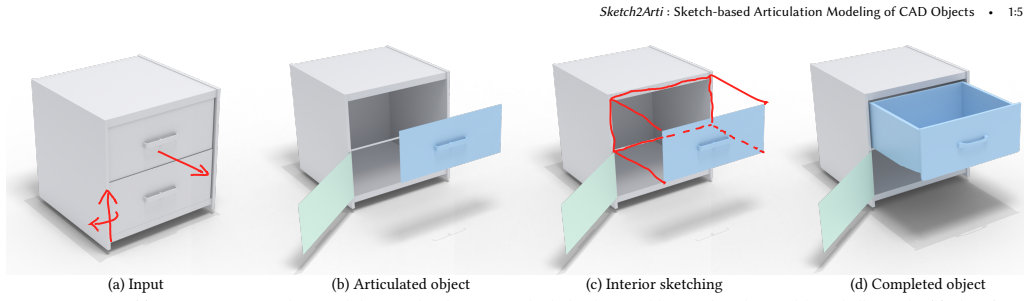
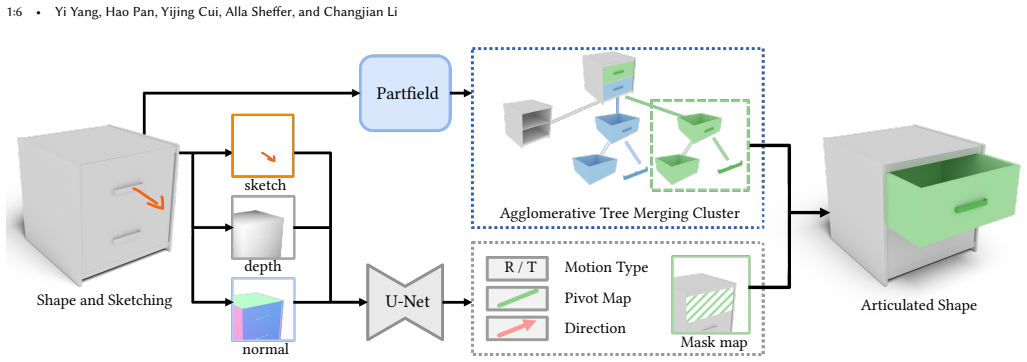
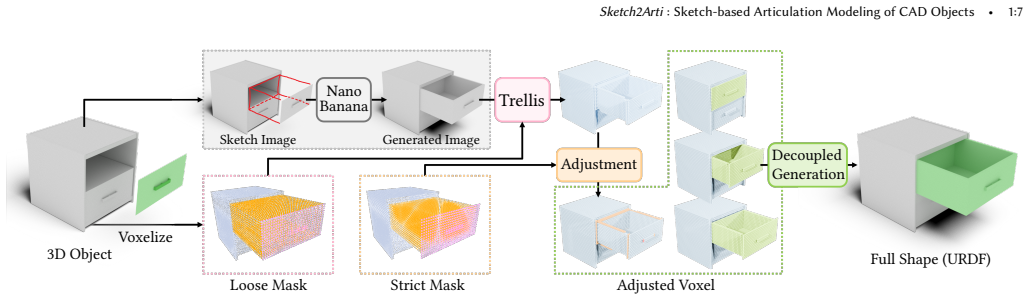
Given a CAD model and user sketches drawn from a chosen viewpoint, Sketch2Arti automatically discovers movable parts and predicts their motion parameters, allowing iterative modeling of multiple articulations on complex objects with fine-grained control; the system is trained category-agnostic without object category information and additionally supports controllable internal completion for shell models.
What carries the argument
A category-agnostic neural mapping that takes 2D sketches (arrows and strokes) together with the 3D CAD geometry and outputs corresponding movable parts plus motion parameters.
If this is right
- Designers can add and refine multiple articulations iteratively on the same complex CAD object.
- The resulting articulated models support downstream tasks such as interactive animation and simulation.
- Internal structures can be completed for shell-type CAD models while remaining consistent with the predicted motions.
- The approach applies to objects outside the categories seen in existing articulation datasets.
Where Pith is reading between the lines
- The same sketch-driven interface could be adapted to scanned real-world objects if the underlying geometry representation is adjusted.
- Integration into existing CAD tools would let users test motion constraints directly during the design loop.
- The category-agnostic training suggests the method may scale to larger collections of unlabeled CAD data.
- Extending the input to include multiple viewpoints or temporal sketch sequences could increase precision on ambiguous cases.
Load-bearing premise
Sketches drawn from one viewpoint can be mapped reliably to 3D parts and motions even when no category information is supplied during training.
What would settle it
Run the trained model on a held-out collection of CAD objects with independently verified ground-truth articulations and measure whether predicted parts and motion parameters match the verified ones at rates comparable to the reported experiments.
Figures


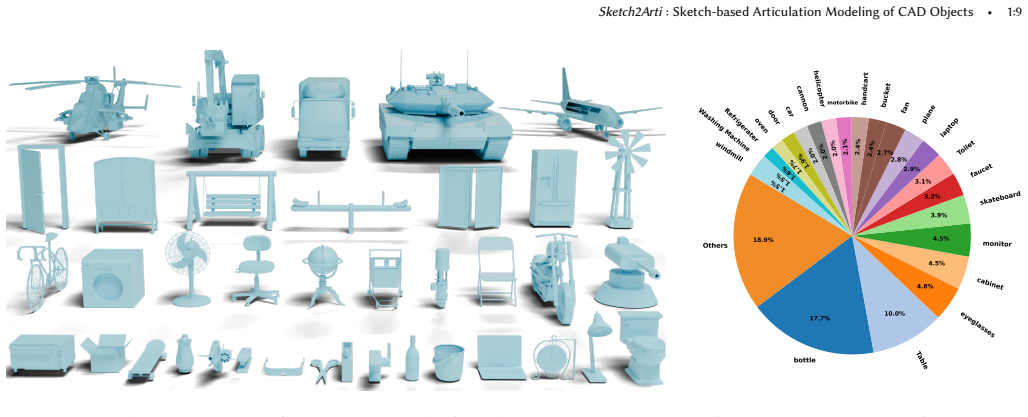


read the original abstract
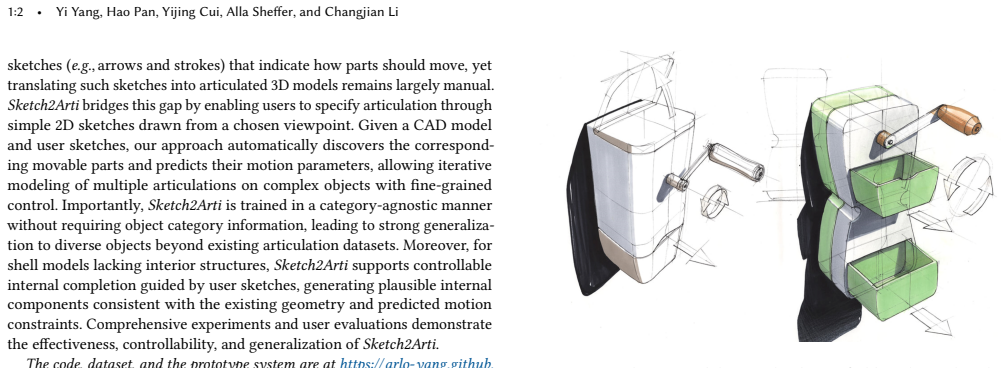
Articulation modeling aims to infer movable parts and their motion parameters for a 3D object, enabling interactive animation, simulation, and shape editing. In this paper, we present Sketch2Arti, the first sketch-based articulation modeling system for CAD objects. Our key observation is that designers naturally communicate articulation intent through lightweight sketches (e.g., arrows and strokes) that indicate how parts should move, yet translating such sketches into articulated 3D models remains largely manual. Sketch2Arti bridges this gap by enabling users to specify articulation through simple 2D sketches drawn from a chosen viewpoint. Given a CAD model and user sketches, our approach automatically discovers the corresponding movable parts and predicts their motion parameters, allowing iterative modeling of multiple articulations on complex objects with fine-grained control. Importantly, Sketch2Arti is trained in a category-agnostic manner without requiring object category information, leading to strong generalization to diverse objects beyond existing articulation datasets. Moreover, for shell models lacking interior structures, Sketch2Arti supports controllable internal completion guided by user sketches, generating plausible internal components consistent with the existing geometry and predicted motion constraints. Comprehensive experiments and user evaluations demonstrate the effectiveness, controllability, and generalization of Sketch2Arti. The code, dataset, and the prototype system are at https://arlo-yang.github.io/Sketch2Arti.
Editorial analysis
A structured set of objections, weighed in public.
Referee Report
Summary. The paper presents Sketch2Arti, the first sketch-based system for articulation modeling of CAD objects. Given a CAD model and lightweight 2D user sketches (arrows/strokes) drawn from a single chosen viewpoint, the method automatically discovers movable parts, predicts motion parameters (rotation/translation), supports iterative multi-articulation modeling with fine-grained control, operates in a fully category-agnostic manner, and performs controllable internal structure completion for shell models. The abstract asserts that comprehensive experiments and user studies demonstrate effectiveness, controllability, and generalization beyond existing articulation datasets.
Significance. If the core mapping from single-view sketches to 3D articulations holds with reliable accuracy and generalization, the work would introduce a practical, intuitive interface that reduces manual effort in articulation modeling for CAD, animation, and simulation pipelines. The category-agnostic training and internal-completion capability would be notable strengths for broad applicability.
major comments (2)
- [Abstract] Abstract: the central claim that single-view 2D sketches suffice to discover movable parts and predict motion parameters in a category-agnostic manner is geometrically under-constrained (multiple 3D axes, centers, and motion types are consistent with one 2D arrow once depth and segmentation are unknown), yet the abstract provides no explicit mechanism (multi-view consistency, geometric priors, uncertainty modeling, or learned disambiguation) that would resolve these ambiguities for arbitrary CAD geometry. This is load-bearing for the claims of reliable inference and strong generalization.
- [Abstract] Abstract: the assertion of 'comprehensive experiments and user evaluations' demonstrating effectiveness is stated without any methods description, dataset details, error metrics, baselines, or quantitative results, preventing verification of whether the reported generalization and controllability are supported by evidence or undermined by post-hoc choices.
Simulated Author's Rebuttal
We thank the referee for their review and the opportunity to clarify points in the abstract. We respond to each major comment below, focusing on the manuscript's content and standard practices for abstracts.
read point-by-point responses
-
Referee: [Abstract] Abstract: the central claim that single-view 2D sketches suffice to discover movable parts and predict motion parameters in a category-agnostic manner is geometrically under-constrained (multiple 3D axes, centers, and motion types are consistent with one 2D arrow once depth and segmentation are unknown), yet the abstract provides no explicit mechanism (multi-view consistency, geometric priors, uncertainty modeling, or learned disambiguation) that would resolve these ambiguities for arbitrary CAD geometry. This is load-bearing for the claims of reliable inference and strong generalization.
Authors: The abstract provides a concise overview and does not enumerate technical mechanisms, which are detailed in the method section. Sketch2Arti employs a neural network trained category-agnostically on diverse CAD articulation data; the learned priors, combined with consistency to the input CAD geometry and sketch projection, enable disambiguation of motion parameters. This data-driven approach supports the reported generalization without requiring multi-view input or explicit uncertainty modeling at inference time. revision: no
-
Referee: [Abstract] Abstract: the assertion of 'comprehensive experiments and user evaluations' demonstrating effectiveness is stated without any methods description, dataset details, error metrics, baselines, or quantitative results, preventing verification of whether the reported generalization and controllability are supported by evidence or undermined by post-hoc choices.
Authors: Abstracts are intentionally brief summaries and do not contain full experimental details by convention. The manuscript body includes dedicated sections describing the dataset construction, training procedure, quantitative metrics (e.g., motion parameter error, part segmentation IoU), baselines, ablation studies, and user study protocols that substantiate the claims of effectiveness and generalization. revision: no
Circularity Check
No circularity detected in derivation chain
full rationale
The paper describes an ML-based sketch-to-articulation system trained category-agnostically on data, with claims resting on empirical training, generalization tests, and user studies rather than any closed mathematical derivation. No equations, fitted parameters presented as predictions, self-definitional constructs, or load-bearing self-citations appear in the abstract or described approach. The central mapping from 2D sketches to 3D motions is handled via learned inference, not by construction from inputs, making the derivation self-contained against external benchmarks.
discussion (0)
Sign in with ORCID, Apple, or X to comment. Anyone can read and Pith papers without signing in.