Recognition: unknown
Unfitted Multi-Level hp Refinement for Localized and Moving Solution Features
Pith reviewed 2026-05-07 13:51 UTC · model grok-4.3
The pith
Unfitted multi-level hp-refinement with independent overlay meshes captures localized and moving features efficiently without base mesh modifications.
A machine-rendered reading of the paper's core claim, the machinery that carries it, and where it could break.
Core claim
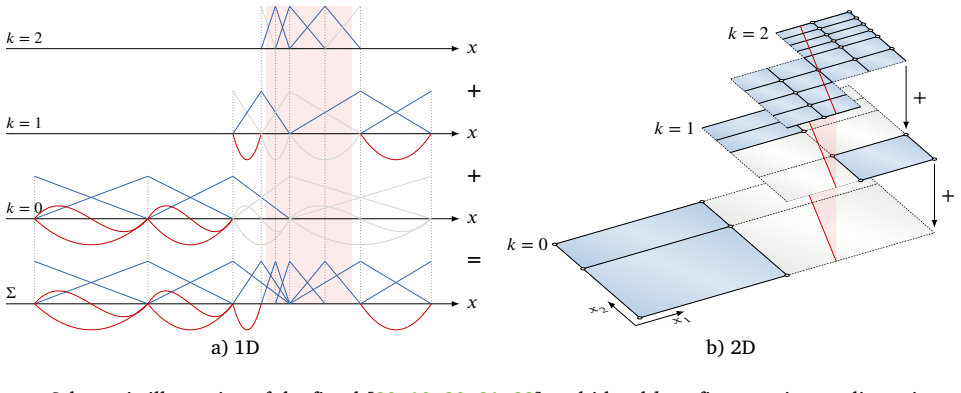
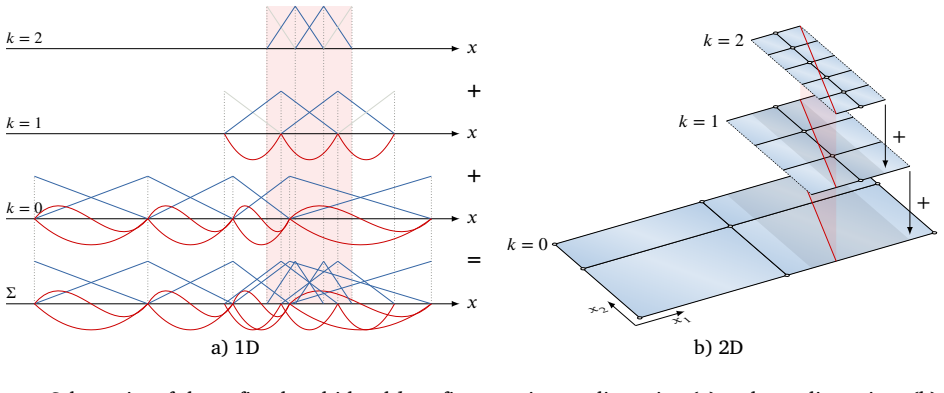
The authors establish that a global C0-continuous approximation space can be constructed by superposing the active finite element spaces from a fixed base mesh and independently placed overlay meshes at multiple hp-refinement levels. Homogeneous constraints on the artificial boundaries of the overlays enforce continuity, while the system is assembled using integration domains defined by intersections of the element partitions. This unfitted construction permits refinement zones to be inserted, translated, and removed without altering the base discretization or requiring alignment of overlay boundaries with base mesh interfaces.
What carries the argument
The unfitted multi-level hp-refinement framework that superposes active spaces across refinement levels and assembles couplings over admissible intersection regions with homogeneous constraints for continuity.
If this is right
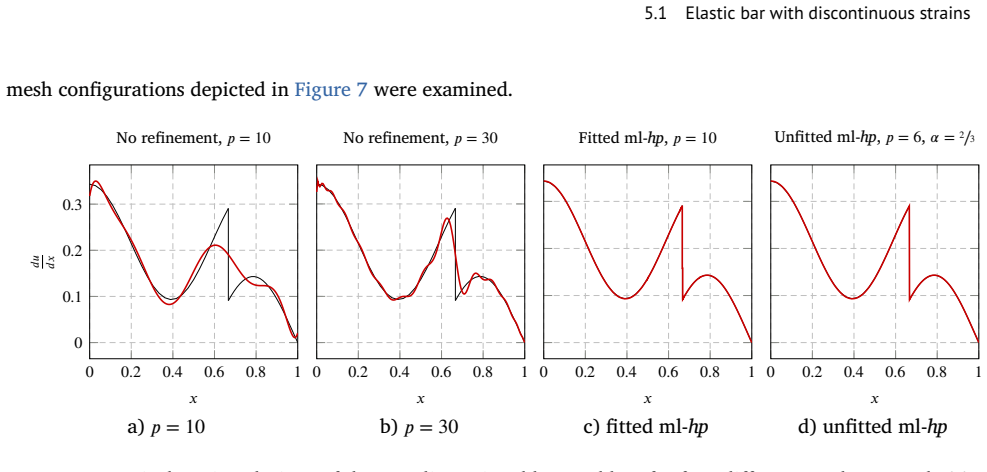
- The unfitted approach retains exponential convergence for non-smooth problems such as those with discontinuities and singularities.
- It achieves improved error-to-cost ratios compared to fitted multi-level hp-refinement strategies.
- Comparable accuracy can be obtained with substantially fewer degrees of freedom in representative cases.
- Localized high-order refinement can accurately track moving solution features over time.
Where Pith is reading between the lines
- This framework may reduce the complexity of implementing adaptive simulations for problems with evolving domains or interfaces.
- Extensions could include integration with other discretization techniques to handle even more complex moving features without custom remeshing algorithms.
- Potential applications arise in engineering simulations where computational resources are limited but high local accuracy is needed around critical points.
Load-bearing premise
Homogeneous constraints on artificial overlay boundaries ensure global C0 continuity and that coupling assembled over intersections of element partitions produces accurate results without requiring alignment of overlay boundaries with the base mesh.
What would settle it
Demonstrating that the global solution loses C0 continuity or that accuracy degrades significantly for a non-smooth benchmark when overlay meshes are placed without alignment to the base mesh would falsify the central claim.
Figures





read the original abstract
Localized features such as singularities, sharp gradients, discontinuities, and moving sources require adaptive finite element discretizations. Conventional refinement strategies introduce significant computational overhead through mesh-topology modifications, constraint handling for non-matching interfaces, and repeated remeshing with state transfer. This work presents an unfitted multi-level hp-refinement strategy that enriches a fixed base discretization by independently positioned overlay meshes. The global approximation space is constructed by superposition of the active spaces across all refinement levels, while homogeneous constraints on artificial overlay boundaries ensure global $C^0$ continuity. Coupling between non-matching meshes is assembled over admissible integration regions defined by intersections of element partitions, enabling reuse of standard element-level finite element routines within a lightweight superposition framework. In contrast to fitted multi-level approaches, overlay boundaries are not required to align with underlying mesh interfaces. This reduces inter-level coupling and allows refinement zones to be inserted, translated, and removed without modifying the base discretization. Numerical studies for discontinuous and singular benchmark problems, as well as a moving source, demonstrate the performance of the method. The unfitted approach retains exponential convergence for non-smooth problems and achieves improved error-to-cost ratios compared to fitted multi-level hp-refinement. For representative cases, comparable accuracy is obtained with substantially fewer degrees of freedom, while localized high-order refinement accurately tracks moving features.
Editorial analysis
A structured set of objections, weighed in public.
Referee Report
Summary. The manuscript introduces an unfitted multi-level hp-refinement strategy for adaptive finite element discretizations of problems featuring localized singularities, discontinuities, sharp gradients, and moving sources. A fixed base discretization is enriched by independently positioned overlay meshes; the global approximation space is formed by superposition of active spaces from all levels, with homogeneous constraints imposed on artificial overlay boundaries to enforce global C0 continuity. Coupling is performed by assembly over admissible integration regions obtained from intersections of element partitions, allowing standard element routines to be reused without requiring overlay boundaries to align with the base mesh. Numerical studies on discontinuous and singular benchmark problems as well as a moving-source example are reported to demonstrate that the method retains exponential convergence for non-smooth solutions and yields improved error-to-cost ratios relative to fitted multi-level hp-refinement, achieving comparable accuracy with substantially fewer degrees of freedom.
Significance. If the central claims are substantiated, the approach would provide a practical simplification for adaptive hp-FEM by removing the need for repeated remeshing, topology modifications, and inter-level alignment, while preserving the exponential convergence properties that make hp-refinement attractive for non-smooth problems. The reuse of standard finite-element kernels inside a lightweight superposition framework and the ability to insert, translate, or remove refinement zones without altering the base mesh are concrete engineering advantages. The reported numerical comparisons to fitted counterparts, if quantified, would strengthen the case for the method in computational mechanics applications involving moving features or localized non-smoothness.
major comments (2)
- [Abstract] Abstract: the central claims of retained exponential convergence for non-smooth problems and improved error-to-cost ratios rest on the numerical studies, yet the abstract supplies no quantitative data (convergence rates, error norms, DOF counts, or direct comparisons), rendering the magnitude of the reported gains unverifiable from the given information.
- [Method description] Method description (space construction): the homogeneous constraints on artificial overlay boundaries are asserted to enforce global C0 continuity while coupling non-matching hp-spaces over intersection-based integration regions; because this step is load-bearing for conformity and for preservation of hp-approximation power, the manuscript must demonstrate (via explicit construction or numerical verification) that the constraints fully couple spaces of differing polynomial degrees without degrading the exponential rates or introducing quadrature artifacts.
minor comments (1)
- [Abstract] Abstract: the phrase 'admissible integration regions defined by intersections of element partitions' would benefit from a short clarifying sentence or reference to the precise quadrature rule employed, to aid readers unfamiliar with unfitted intersection-based assembly.
Simulated Author's Rebuttal
We thank the referee for the thoughtful and constructive report. The two major comments identify areas where the manuscript can be strengthened for clarity and rigor. We address each point below and indicate planned revisions.
read point-by-point responses
-
Referee: [Abstract] Abstract: the central claims of retained exponential convergence for non-smooth problems and improved error-to-cost ratios rest on the numerical studies, yet the abstract supplies no quantitative data (convergence rates, error norms, DOF counts, or direct comparisons), rendering the magnitude of the reported gains unverifiable from the given information.
Authors: We agree that the abstract would benefit from concise quantitative indicators to allow readers to gauge the scale of the improvements directly. In the revised version we will incorporate selected quantitative highlights drawn from the numerical studies (e.g., observed exponential convergence behavior and the reported DOF reductions for comparable accuracy) while remaining within standard abstract length constraints. revision: yes
-
Referee: [Method description] Method description (space construction): the homogeneous constraints on artificial overlay boundaries are asserted to enforce global C0 continuity while coupling non-matching hp-spaces over intersection-based integration regions; because this step is load-bearing for conformity and for preservation of hp-approximation power, the manuscript must demonstrate (via explicit construction or numerical verification) that the constraints fully couple spaces of differing polynomial degrees without degrading the exponential rates or introducing quadrature artifacts.
Authors: The space construction, constraint imposition, and intersection-based assembly are presented in Sections 3–4. Global C0 continuity follows from the homogeneous Dirichlet constraints on artificial boundaries, and the formulation permits arbitrary polynomial degrees on overlay elements. Preservation of exponential hp-convergence is shown by the benchmark results in Section 5, which include cases with varying polynomial degrees across levels and exhibit the expected rates without visible degradation or quadrature-induced oscillations. To make the coupling property more explicit, we will add a short, isolated verification example (a simple patch test with deliberately mismatched degrees) that compares the constrained solution against a reference and confirms absence of artifacts. revision: partial
Circularity Check
No circularity: method construction and claims are independent of inputs
full rationale
The paper constructs an unfitted multi-level hp space via superposition of active overlay spaces with homogeneous boundary constraints and intersection-based assembly. These steps are presented as direct extensions of standard finite-element superposition and quadrature practices, without any equation reducing a claimed result (e.g., exponential convergence or error-to-cost improvement) to a fitted parameter or prior self-citation by construction. Numerical benchmarks on discontinuous, singular, and moving-source problems are used to demonstrate retention of hp-rates and DOF savings; no load-bearing premise is justified solely by self-reference or by renaming an input as a prediction. The derivation chain therefore remains self-contained against external benchmarks.
Axiom & Free-Parameter Ledger
axioms (1)
- standard math Standard assumptions of the finite element method hold, including suitable Sobolev spaces for the approximation and accurate quadrature over element intersections.
Reference graph
Works this paper leans on
-
[1]
Verhoosel, Gert J
Frits de Prenter, Clemens V. Verhoosel, Gert J. van Zwieten, and E. Harald van Brummelen. Condition number analysis and preconditioning of the finite cell method.Computer Methods in Applied Mechanics and Engineering, 316:297–327, 2017
2017
-
[2]
Verhoosel, E
Frits de Prenter, Clemens V. Verhoosel, E. Harald van Brummelen, Mats G. Larson, and Santiago Badia. Stability and conditioning of immersed finite element methods: analysis and remedies.Archives of Computational Methods in Engineering, 30(6):3617–3656, 2023
2023
-
[3]
Stein K. F. Stoter, Sai C. Divi, E. Harald van Brummelen, Mats G. Larson, Frits de Prenter, and Clemens V. Verhoosel. Critical time-step size analysis and mass scaling by ghost-penalty for immersogeometric explicit dynamics.Computer Methods in Applied Mechanics and Engineering, 412:116074, 2023
2023
-
[4]
Storti, Alejandro E
Bruno A. Storti, Alejandro E. Albanesi, Ignacio Peralta, Mario A. Storti, and Víctor D. Fachinotti. On the performance of a Chimera-FEM implementation to treat moving heat sources and moving boundaries in time-dependent problems.Finite Elements in Analysis and Design, 208:103789, 2022. 29 of 29
2022
discussion (0)
Sign in with ORCID, Apple, or X to comment. Anyone can read and Pith papers without signing in.