Recognition: unknown
Geometric Constraints on the Pre-Recombination Expansion History from the Hubble Tension
Pith reviewed 2026-05-07 14:49 UTC · model grok-4.3
The pith
A model-independent reconstruction shows that a smooth 15% faster pre-recombination expansion can resolve the Hubble tension while matching CMB geometric constraints.
A machine-rendered reading of the paper's core claim, the machinery that carries it, and where it could break.
Core claim
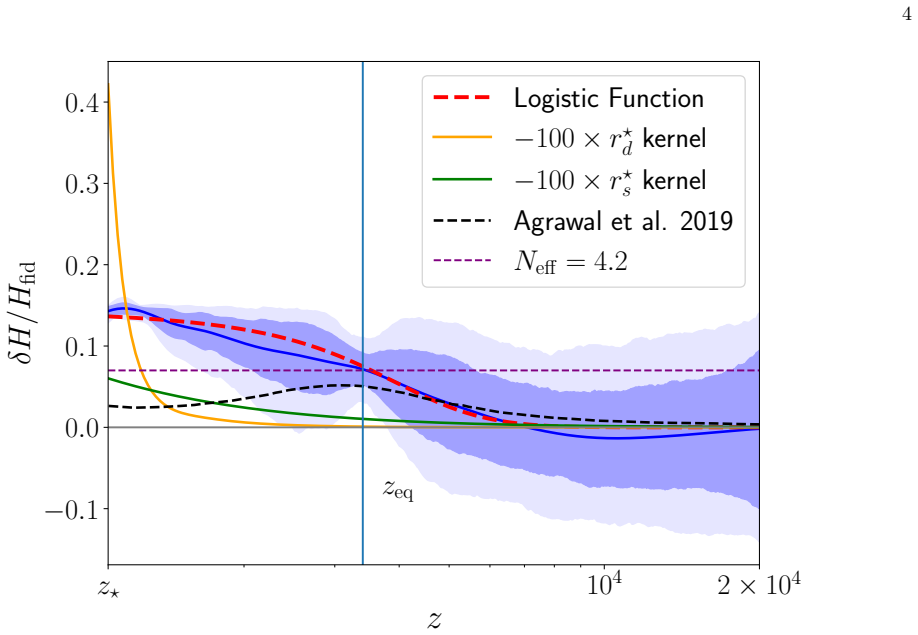
A model-independent reconstruction of the background pre-recombination expansion history demonstrates that purely early-time resolutions to the Hubble tension exist at the background level. These solutions require a smooth transition around matter-radiation equality characterized by a roughly 15% expansion rate enhancement prior to recombination.
What carries the argument
The model-independent reconstruction of the pre-recombination expansion history that isolates and enforces the geometric constraints from CMB observations.
If this is right
- Purely early-time modifications can resolve the Hubble tension without requiring late-time changes if the expansion history follows the reconstructed smooth profile.
- The reconstructed history provides a specific target shape for new physics models to match at the background level.
- Any Hubble tension proposal must pass this background stress-test before its perturbation-level predictions are considered viable.
Where Pith is reading between the lines
- Specific models such as early dark energy would need to produce exactly this smooth transition to qualify as background solutions.
- Extending the same reconstruction approach to include CMB power spectrum perturbations could test whether the background solutions remain viable at the full observational level.
- The result suggests that late-universe modifications are not strictly required if early-universe physics can be tuned to the identified expansion profile.
Load-bearing premise
The reconstruction method accurately isolates the geometric CMB constraints at the background level without introducing hidden model assumptions that would rule out the required smooth transition.
What would settle it
A calculation demonstrating that no smooth expansion history can simultaneously raise the early expansion rate enough to resolve the Hubble tension and match the observed CMB geometric quantities would falsify the central claim.
Figures


read the original abstract
I perform a model-independent reconstruction of the background pre-recombination expansion history of the Universe. I find that purely early-time resolutions to the Hubble tension, satisfying the geometric CMB constraints, exist at the background level. This class of solutions requires a smooth transition around matter-radiation equality, characterized by a $\simeq 15\%$ expansion rate enhancement prior to recombination. This result serves as a blueprint for future model-building approaches, providing a background stress-test for Hubble tension proposals.
Editorial analysis
A structured set of objections, weighed in public.
Referee Report
Summary. The manuscript performs a model-independent reconstruction of the pre-recombination expansion history H(z) using geometric CMB constraints (primarily the angular scale of the sound horizon and related distance measures). It concludes that purely early-time background solutions to the Hubble tension exist and that any such solution must feature a smooth transition near matter-radiation equality with a ≃15% enhancement in the expansion rate prior to recombination. The result is positioned as a blueprint for model-building.
Significance. If the reconstruction is robust and the smoothness requirement is data-driven rather than method-driven, the result would provide a useful background-level stress test for early-time Hubble-tension proposals, narrowing the space of viable modifications to the expansion history while remaining consistent with CMB geometry. The absence of machine-checked proofs or fully reproducible code is noted, but the model-independent framing is a positive feature if validated.
major comments (2)
- [§3] §3 (reconstruction method): The central claim that solutions 'require' a smooth transition with a specific ~15% enhancement is load-bearing, yet the manuscript does not demonstrate stability of this feature under changes to the function basis (e.g., PCA modes vs. splines) or regularization strength. Without such tests, it remains possible that the smoothness and transition location near equality are partly enforced by the chosen function space rather than required by the geometric constraints alone.
- [§4] §4 (results and validation): The abstract and results assert that the reconstruction isolates geometric constraints at the background level without hidden model assumptions, but no explicit comparison is shown against known limits (e.g., standard ΛCDM or other reconstructions) or against synthetic data with injected sharp features. This validation is necessary to secure the existence claim and the 'requires smooth' characterization.
minor comments (2)
- Notation for the expansion-rate enhancement (e.g., the precise definition of the 15% figure relative to a reference model) should be clarified in the text and figures for reproducibility.
- Figure captions for the reconstructed H(z) should include the full set of data constraints used and the uncertainty bands from the reconstruction.
Simulated Author's Rebuttal
We thank the referee for their careful and constructive review of our manuscript. We address each major comment point by point below, providing the strongest honest defense of the work while incorporating revisions where the concerns are valid and the manuscript can be strengthened without misrepresentation.
read point-by-point responses
-
Referee: [§3] §3 (reconstruction method): The central claim that solutions 'require' a smooth transition with a specific ~15% enhancement is load-bearing, yet the manuscript does not demonstrate stability of this feature under changes to the function basis (e.g., PCA modes vs. splines) or regularization strength. Without such tests, it remains possible that the smoothness and transition location near equality are partly enforced by the chosen function space rather than required by the geometric constraints alone.
Authors: We acknowledge that explicit robustness tests against alternative bases and regularization choices would strengthen the claim that the smoothness and transition are data-driven. In the revised manuscript we have added a dedicated subsection with reconstructions using both the original PCA basis and an independent cubic-spline parametrization (with varying knot spacing), as well as a scan over regularization strength. These tests show that the location of the transition near matter-radiation equality and the ≃15 % pre-recombination enhancement remain stable features. We note, however, that the geometric CMB observables are integrated distance measures; any viable reconstruction must therefore be sufficiently smooth to satisfy the angular-scale constraint, so a degree of smoothness is physically required rather than purely methodological. revision: yes
-
Referee: [§4] §4 (results and validation): The abstract and results assert that the reconstruction isolates geometric constraints at the background level without hidden model assumptions, but no explicit comparison is shown against known limits (e.g., standard ΛCDM or other reconstructions) or against synthetic data with injected sharp features. This validation is necessary to secure the existence claim and the 'requires smooth' characterization.
Authors: We agree that direct validation against both ΛCDM and synthetic data with controlled features is necessary. The revised manuscript now includes (i) an explicit overlay of the reconstructed H(z) against the standard ΛCDM expansion history, quantifying the required deviation, and (ii) a validation suite on synthetic geometric CMB data generated from ΛCDM (recovered within uncertainties) and from toy models containing sharp transitions (which are disfavored by the data and produce poor fits). These additions confirm that the smoothness requirement is enforced by the geometric constraints themselves. revision: yes
Circularity Check
Model-independent reconstruction of pre-recombination H(z) shows no load-bearing circularity
full rationale
The paper performs a model-independent reconstruction of the background pre-recombination expansion history and reports that early-time Hubble-tension resolutions satisfying geometric CMB constraints exist and require a smooth transition near matter-radiation equality with ~15% enhancement. No equations or sections in the abstract or described text reduce the claimed existence or smoothness requirement to a fitted parameter renamed as prediction, a self-definitional loop, or a self-citation chain whose validity is presupposed. The reconstruction is presented as isolating geometric constraints (angular scale of sound horizon and related distances) without hidden model assumptions that would force the transition by construction. This is the most common honest finding for a data-driven reconstruction paper; the central claim retains independent content from the geometric observables.
Axiom & Free-Parameter Ledger
axioms (1)
- standard math The universe follows the standard Friedmann-Lemaître-Robertson-Walker metric and background evolution equations.
Reference graph
Works this paper leans on
-
[1]
Quan- tum Fields in Gravity, Cosmology and BHs
while the sound horizon scale kernelK s(z) re- mains broadly active, extended or high-redshift injec- tions of energy—such as those characteristic of extra- relativistic degrees of freedom and standard Early Dark Energy models—fall short on this geometric requirement, by inevitably decoupling ther ⋆ s andr ⋆ d scales. As demon- strated by my model-indepen...
-
[2]
Tensions between the Early and the Late Universe
L. Verde, T. Treu, and A. G. Riess, Nature Astron.3, 891 (2019), arXiv:1907.10625 [astro-ph.CO]
work page internal anchor Pith review arXiv 2019
-
[3]
In the realm of the Hubble tension—a review of solutions,
E. Di Valentino, O. Mena, S. Pan, L. Visinelli, W. Yang, A. Melchiorri, D. F. Mota, A. G. Riess, and J. Silk, Class. Quant. Grav.38, 153001 (2021), arXiv:2103.01183 [astro-ph.CO]
-
[4]
E. Di Valentinoet al., Astropart. Phys.131, 102604 (2021), arXiv:2008.11285 [astro-ph.CO]. 6
-
[5]
L. Perivolaropoulos and F. Skara, New Astron. Rev.95, 101659 (2022), arXiv:2105.05208 [astro-ph.CO]
- [6]
-
[7]
E. Abdallaet al., JHEAp34, 49 (2022), arXiv:2203.06142 [astro-ph.CO]
work page internal anchor Pith review arXiv 2022
-
[8]
Di Valentino, Universe8, 399 (2022)
E. Di Valentino, Universe8, 399 (2022)
2022
-
[9]
Hubble Tension: The Evidence of New Physics,
J.-P. Hu and F.-Y. Wang, Universe9, 94 (2023), arXiv:2302.05709 [astro-ph.CO]
- [10]
-
[11]
E. Di Valentinoet al.(CosmoVerse Network), Phys. Dark Univ.49, 101965 (2025), arXiv:2504.01669 [astro- ph.CO]
-
[12]
S. Casertanoet al.(H0DN), (2025), arXiv:2510.23823 [astro-ph.CO]
work page internal anchor Pith review Pith/arXiv arXiv 2025
-
[13]
E. Camphuiset al.(SPT-3G), Phys. Rev. D113, 083504 (2026), arXiv:2506.20707 [astro-ph.CO]
work page internal anchor Pith review arXiv 2026
- [14]
-
[15]
E. Di Valentino, A. Melchiorri, and J. Silk, Phys. Lett. B761, 242 (2016), arXiv:1606.00634 [astro-ph.CO]
-
[16]
M. Benetti, L. L. Graef, and J. S. Alcaniz, JCAP07, 066 (2018), arXiv:1712.00677 [astro-ph.CO]
-
[17]
S. Kumar and R. C. Nunes, Eur. Phys. J. C77, 734 (2017), arXiv:1709.02384 [astro-ph.CO]
- [18]
- [19]
- [20]
- [21]
-
[22]
S. Vagnozzi, Phys. Rev. D102, 023518 (2020), arXiv:1907.07569 [astro-ph.CO]
-
[23]
E. Di Valentino, A. Melchiorri, O. Mena, and S. Vagnozzi, Phys. Dark Univ.30, 100666 (2020), arXiv:1908.04281 [astro-ph.CO]
-
[24]
E. Di Valentino, A. Melchiorri, O. Mena, and S. Vagnozzi, Phys. Rev. D101, 063502 (2020), arXiv:1910.09853 [astro-ph.CO]
-
[25]
C. Krishnan, E. ´O. Colg´ ain, Ruchika, A. A. Sen, M. M. Sheikh-Jabbari, and T. Yang, Phys. Rev. D102, 103525 (2020), arXiv:2002.06044 [astro-ph.CO]
-
[26]
G. Alestas, L. Kazantzidis, and L. Perivolaropoulos, Phys. Rev. D101, 123516 (2020), arXiv:2004.08363 [astro-ph.CO]
-
[27]
S. Roy Choudhury, S. Hannestad, and T. Tram, JCAP 03, 084 (2021), arXiv:2012.07519 [astro-ph.CO]
-
[28]
T. Brinckmann, J. H. Chang, and M. LoVerde, Phys. Rev. D104, 063523 (2021), arXiv:2012.11830 [astro- ph.CO]
- [29]
-
[30]
V. Marra and L. Perivolaropoulos, Phys. Rev. D104, L021303 (2021), arXiv:2102.06012 [astro-ph.CO]
- [31]
-
[32]
C. Krishnan, R. Mohayaee, E. ´O. Colg´ ain, M. M. Sheikh-Jabbari, and L. Yin, Class. Quant. Grav.38, 184001 (2021), arXiv:2105.09790 [astro-ph.CO]
-
[33]
F.-Y. Cyr-Racine, F. Ge, and L. Knox, Phys. Rev. Lett. 128, 201301 (2022), arXiv:2107.13000 [astro-ph.CO]
- [34]
-
[35]
N. Sch¨ oneberg, G. Franco Abell´ an, A. P´ erez S´ anchez, S. J. Witte, V. Poulin, and J. Lesgourgues, Phys. Rept. 984, 1 (2022), arXiv:2107.10291 [astro-ph.CO]
- [36]
-
[37]
A. Banerjee, H. Cai, L. Heisenberg, E. ´O. Colg´ ain, M. M. Sheikh-Jabbari, and T. Yang, Phys. Rev. D103, L081305 (2021), arXiv:2006.00244 [astro-ph.CO]
-
[38]
R. de S´ a, M. Benetti, and L. L. Graef, Eur. Phys. J. Plus137, 1129 (2022), arXiv:2209.11476 [astro-ph.CO]
- [39]
- [40]
-
[41]
A. G´ omez-Valent, N. E. Mavromatos, and J. Sol` a Per- acaula, Class. Quant. Grav.41, 015026 (2024), arXiv:2305.15774 [gr-qc]
-
[42]
Ruchika, H. Rathore, S. Roy Choudhury, and V. Rentala, JCAP06, 056 (2024), arXiv:2306.05450 [astro-ph.CO]
- [43]
- [44]
-
[45]
A. G´ omez-Valent, A. Favale, M. Migliaccio, and A. A. Sen, Phys. Rev. D109, 023525 (2024), arXiv:2309.07795 [astro-ph.CO]
- [46]
- [47]
-
[48]
$\Lambda_{\rm s}$CDM cosmology from a type-II minimally modified gravity
¨O. Akarsu, A. De Felice, E. Di Valentino, S. Kumar, R. C. Nunes, E. ¨Oz¨ ulker, J. A. Vazquez, and A. Yadav, (2024), arXiv:2402.07716 [astro-ph.CO]
work page internal anchor Pith review Pith/arXiv arXiv 2024
-
[49]
W. Giar` e, Y. Zhai, S. Pan, E. Di Valentino, R. C. Nunes, and C. van de Bruck, Phys. Rev. D110, 063527 (2024), arXiv:2404.02110 [astro-ph.CO]
-
[50]
W. Giar` e, M. A. Sabogal, R. C. Nunes, and E. Di Valentino, Phys. Rev. Lett.133, 251003 (2024), arXiv:2404.15232 [astro-ph.CO]
- [51]
- [52]
-
[53]
S. Roy Choudhury and T. Okumura, Astrophys. J. Lett. 976, L11 (2024), arXiv:2409.13022 [astro-ph.CO]. 7
- [54]
-
[55]
D. Pedrotti, L. A. Escamilla, V. Marra, L. Perivolaropoulos, and S. Vagnozzi, Phys. Rev. D113, 043507 (2026), arXiv:2510.01974 [astro-ph.CO]
-
[56]
Y.-M. Zhang, T.-N. Li, G.-H. Du, S.-H. Zhou, L.- Y. Gao, J.-F. Zhang, and X. Zhang, (2025), arXiv:2510.12627 [astro-ph.CO]
- [57]
-
[58]
T.-N. Li, G.-H. Du, Y.-H. Li, P.-J. Wu, S.-J. Jin, J.-F. Zhang, and X. Zhang, (2025), arXiv:2501.07361 [astro- ph.CO]
- [59]
- [60]
- [61]
-
[62]
M. H¨ og˚ as, E. M¨ ortsell, H. Desmond, and A. Riess, (2025), arXiv:2512.14814 [astro-ph.CO]
-
[63]
On the origin of the BAOtr-DESI tension
I. Pantos and L. Perivolaropoulos, (2026), arXiv:2604.11106 [astro-ph.CO]
work page internal anchor Pith review Pith/arXiv arXiv 2026
-
[64]
Planck 2018 results. VI. Cosmological parameters
N. Aghanimet al.(Planck), Astron. Astrophys.641, A6 (2020), [Erratum: Astron.Astrophys. 652, C4 (2021)], arXiv:1807.06209 [astro-ph.CO]
work page internal anchor Pith review arXiv 2020
- [65]
- [66]
- [67]
- [68]
-
[69]
L. Knox and M. Millea, Phys. Rev. D101, 043533 (2020), arXiv:1908.03663 [astro-ph.CO]
- [70]
-
[71]
N. Sch¨ oneberg, J. Lesgourgues, and D. C. Hooper, JCAP10, 029 (2019), arXiv:1907.11594 [astro-ph.CO]
-
[72]
N. Arendseet al., Astron. Astrophys.639, A57 (2020), arXiv:1909.07986 [astro-ph.CO]
-
[73]
Efstathiou,To H0 or not to H0?,Mon
G. Efstathiou, Mon. Not. Roy. Astron. Soc.505, 3866 (2021), arXiv:2103.08723 [astro-ph.CO]
- [74]
- [75]
-
[76]
L. Huang, S.-J. Wang, and W.-W. Yu, Sci. China Phys. Mech. Astron.68, 220413 (2025), arXiv:2401.14170 [astro-ph.CO]
- [77]
-
[78]
T. Karwal and M. Kamionkowski, Phys. Rev. D94, 103523 (2016), arXiv:1608.01309 [astro-ph.CO]
-
[79]
Early Dark Energy Can Resolve The Hubble Tension,
V. Poulin, T. L. Smith, T. Karwal, and M. Kamionkowski, Phys. Rev. Lett.122, 221301 (2019), arXiv:1811.04083 [astro-ph.CO]
- [80]
discussion (0)
Sign in with ORCID, Apple, or X to comment. Anyone can read and Pith papers without signing in.