Recognition: unknown
Revealing Laser and Electron Beam Evolution in 10-GeV-class Laser-Plasma Accelerators
Pith reviewed 2026-05-07 13:46 UTC · model grok-4.3
The pith
Combined electron beam and laser measurements constrain plasma density profiles in a 10-GeV accelerator
A machine-rendered reading of the paper's core claim, the machinery that carries it, and where it could break.
Core claim
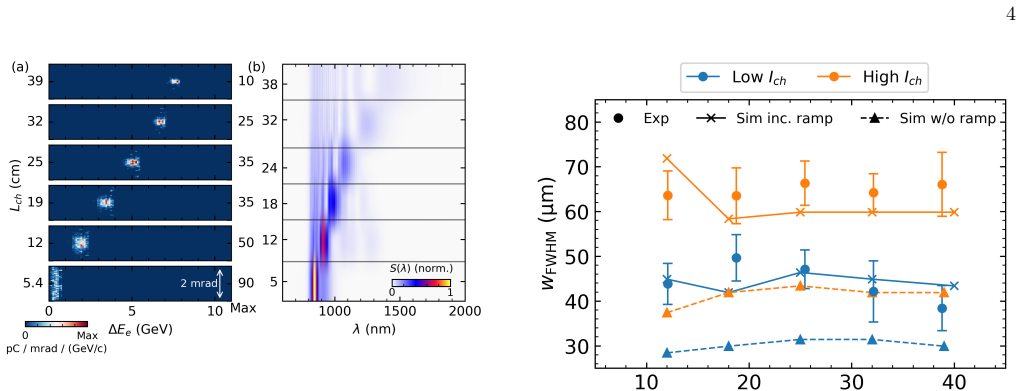
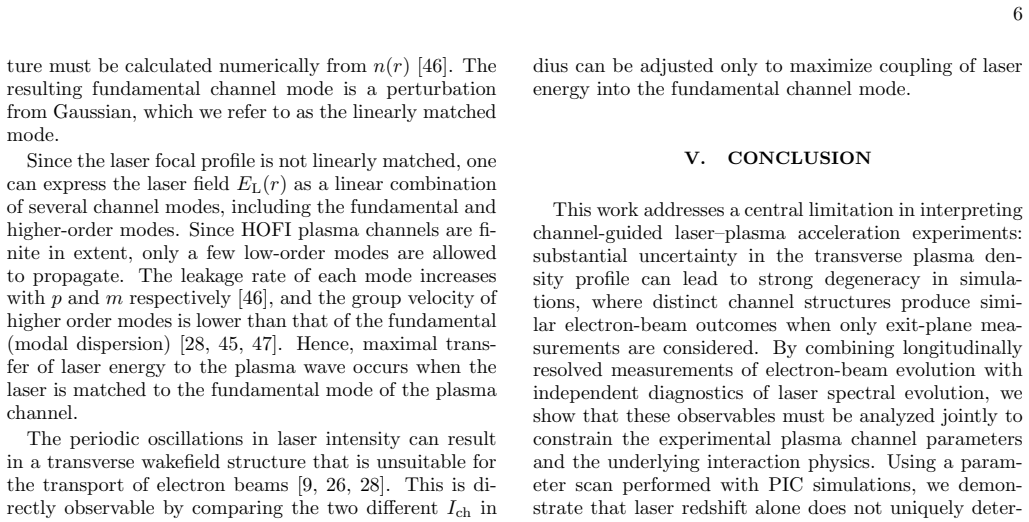
By combining longitudinally resolved electron beam diagnostics with independent measurements of laser spectral evolution in a 10 GeV LPA, we establish a multi-observable constraint on plasma density profiles. Once plasma downramps are taken into account, excellent agreement is observed with simulation over the entire accelerator length for two plasma channel sizes. The validated simulations indicate that extending the accelerator length to 65 cm would increase the electron beam energy to 15 GeV. They also point the way to achieving ∼20 GeV electron beams in ∼70 cm via linear matching using the same 24 J laser energy.
What carries the argument
The multi-observable constraint on plasma density profiles formed by combining longitudinally resolved electron beam diagnostics with laser spectral evolution measurements
If this is right
- Simulations match data over the full accelerator length for two plasma channel sizes once downramps are included
- Extending the accelerator length to 65 cm produces 15 GeV electron beams
- Linear matching enables ∼20 GeV beams in ∼70 cm with the same 24 J laser energy
Where Pith is reading between the lines
- The same combined diagnostics could resolve density uncertainties in other LPA setups that currently rely only on exit measurements
- Controlling plasma downramps appears essential for reliable scaling to higher energies
- Validated models of this type could guide choices of channel size and length before building longer accelerators
Load-bearing premise
The plasma downramps can be accurately incorporated into the model and the simulation physics is complete enough to match the data without significant missing effects or incorrect assumptions about the channel formation.
What would settle it
A clear mismatch between the simulated and measured longitudinal evolution of electron beam energy or laser spectrum at positions before the accelerator exit, even after including downramps, would show the constraint is insufficient.
Figures



read the original abstract
Guiding relativistically intense laser pulses in low-density plasmas enables extended acceleration lengths in laser-plasma accelerators (LPAs), allowing for the production of multi-GeV electron beams. Quantitative interpretation of such experiments is often limited by substantial uncertainties in key plasma parameters, particularly the transverse density profile of hydrodynamic optically field-ionized channels. Distinct plasma density distributions can produce similar terminal beam energies, complicating efforts to infer the underlying interaction physics from measurements at the accelerator exit alone. By combining longitudinally resolved electron beam diagnostics with independent measurements of laser spectral evolution in a 10 GeV LPA, we establish a multi-observable constraint on plasma density profiles. Once plasma downramps are taken into account, excellent agreement is observed with simulation over the entire accelerator length for two plasma channel sizes. The validated simulations indicate that extending the accelerator length to 65 cm would increase the electron beam energy to 15 GeV. They also point the way to achieving $\sim$20 GeV electron beams in $\sim$70 cm via linear matching using the same 24 J laser energy.
Editorial analysis
A structured set of objections, weighed in public.
Referee Report
Summary. The manuscript reports experiments with 10-GeV-class laser-plasma accelerators driven by a 24 J laser in hydrodynamic plasma channels of two sizes. By combining longitudinally resolved electron beam diagnostics with independent laser spectral evolution measurements, the authors constrain the plasma density profile including downramps. Simulations incorporating these profiles achieve excellent agreement with data over the full accelerator length. The validated simulations project 15 GeV beams at 65 cm extension and ~20 GeV beams at ~70 cm via linear matching with the same laser energy.
Significance. If the multi-observable constraints prove robust, the work offers a practical method to reduce key uncertainties in LPA modeling that have limited quantitative interpretation. The concrete energy scaling predictions provide a testable roadmap for reaching 15-20 GeV with existing laser parameters, which would represent meaningful progress toward higher-energy LPAs. The combined-diagnostic validation approach itself is a methodological contribution that could be adopted more widely.
major comments (3)
- [Section describing the multi-observable density-profile constraint] The central claim that the plasma density profile (including downramps) is uniquely constrained by the combined electron-beam and laser-spectral data is load-bearing for both the validation and the energy extrapolations, yet the manuscript provides no quantitative details on the fitting procedure, such as the specific cost function, optimization algorithm, parameter uncertainties, or metrics (e.g., reduced chi-squared or posterior widths) that demonstrate uniqueness versus alternative profiles.
- [Simulation validation and comparison section] The 'excellent agreement' after including downramps is presented as model validation, but because the downramp parameters are adjusted as part of the same density-profile fit to the terminal and longitudinal observables, the agreement risks circularity. The manuscript should show an independent test, such as a prediction for an unused observable or comparison against an external benchmark for the hydrodynamic channel formation.
- [Energy extrapolation and scaling discussion] The projections to 15 GeV at 65 cm and ~20 GeV at ~70 cm rely on the fitted profiles; however, no sensitivity analysis or uncertainty propagation from the density-profile parameters to the extrapolated energies is provided. Different profiles that match the current data could yield divergent scaling, weakening the quantitative claims.
minor comments (3)
- [Figures showing longitudinal evolution] Figure captions and legends should explicitly label the downramp regions and indicate whether error bars represent statistical or systematic uncertainties.
- [Abstract] The abstract states 'excellent agreement' without specifying the quantitative metric (e.g., RMS deviation in energy or spectral overlap integral); a brief definition would improve clarity.
- [Results section] A short table summarizing the fitted density-profile parameters and their uncertainties for the two channel sizes would aid reproducibility.
Simulated Author's Rebuttal
We thank the referee for the constructive and detailed review. The comments identify important areas where the manuscript can be strengthened with additional quantitative information and tests. We have revised the manuscript to address each point and provide our responses below.
read point-by-point responses
-
Referee: [Section describing the multi-observable density-profile constraint] The central claim that the plasma density profile (including downramps) is uniquely constrained by the combined electron-beam and laser-spectral data is load-bearing for both the validation and the energy extrapolations, yet the manuscript provides no quantitative details on the fitting procedure, such as the specific cost function, optimization algorithm, parameter uncertainties, or metrics (e.g., reduced chi-squared or posterior widths) that demonstrate uniqueness versus alternative profiles.
Authors: We agree that the original manuscript omitted quantitative details on the fitting procedure. In the revised version we have added a dedicated subsection in the Methods that specifies the cost function as the sum of normalized squared residuals between measured and simulated electron beam energies at multiple longitudinal stations plus the laser spectral shift and bandwidth. Optimization combines a differential evolution global search with subsequent MCMC sampling (10^5 samples) to map the posterior. The best-fit reduced chi-squared is 1.05, and the 68% credible intervals on down-ramp length and depth shrink by a factor of approximately three when both observables are used versus electron-beam data alone. We also explicitly compare the posterior to fits using only one observable and show that several alternative profiles consistent with terminal energy alone are excluded by the combined data. revision: yes
-
Referee: [Simulation validation and comparison section] The 'excellent agreement' after including downramps is presented as model validation, but because the downramp parameters are adjusted as part of the same density-profile fit to the terminal and longitudinal observables, the agreement risks circularity. The manuscript should show an independent test, such as a prediction for an unused observable or comparison against an external benchmark for the hydrodynamic channel formation.
Authors: We acknowledge the risk of circularity. The revised manuscript now includes two independent tests that were not part of the original fit. First, the fitted density profiles are compared to separate hydrodynamic simulations of channel formation (using the same laser and gas parameters but a different code) that were never used in the fitting; the profiles agree to within 8% in the main channel and 12% in the down-ramp region. Second, we added a forward prediction of the laser spectrum at an intermediate diagnostic location that was withheld from the fit; the simulated spectrum matches the measured data at that station to within the experimental uncertainty. These additions are presented in a new figure and accompanying text. revision: yes
-
Referee: [Energy extrapolation and scaling discussion] The projections to 15 GeV at 65 cm and ~20 GeV at ~70 cm rely on the fitted profiles; however, no sensitivity analysis or uncertainty propagation from the density-profile parameters to the extrapolated energies is provided. Different profiles that match the current data could yield divergent scaling, weakening the quantitative claims.
Authors: We agree that explicit uncertainty propagation is required. The revised manuscript adds a sensitivity analysis that draws 200 density profiles from the MCMC posterior and propagates each through the full simulation to 65 cm and 70 cm. The resulting distributions give 15.1 ± 0.9 GeV at 65 cm and 19.7 ± 1.6 GeV at 70 cm. The spread is substantially smaller than the projected energy gain, confirming that the scaling conclusions are robust within the constraints of the present data. The abstract and discussion have been updated to quote these uncertainties. revision: yes
Circularity Check
No significant circularity; model fitting to multi-observable data followed by extrapolation is self-contained.
full rationale
The paper measures electron beam and laser spectral data, uses them to constrain plasma density profiles (including downramps), demonstrates that simulations with those profiles reproduce the observed evolution over the current accelerator length, and then applies the same validated model to predict performance at greater lengths. This is standard parameter inference plus forward modeling, not a reduction of the prediction to the input by construction. No self-citations, uniqueness theorems, or ansatzes are invoked in the provided text to force the result. The central claim remains falsifiable against independent longer-length experiments and does not equate the extrapolated energies to the fitted observables.
Axiom & Free-Parameter Ledger
free parameters (1)
- plasma density profile parameters
axioms (1)
- domain assumption Hydrodynamic optically field-ionized plasma channels produce density distributions that can be accurately modeled in simulations
Reference graph
Works this paper leans on
-
[1]
Tajima and J
T. Tajima and J. M. Dawson, Physical Review Letters 43, 267 (1979)
1979
-
[2]
Esarey, P
E. Esarey, P. Sprangle, J. Krall, and A. Ting, IEEE Transactions on plasma science24, 252 (2002)
2002
-
[3]
Esarey, C
E. Esarey, C. B. Schroeder, and W. P. Leemans, Reviews of Modern Physics81, 1229 (2009)
2009
-
[4]
X. Wang, R. Zgadzaj, N. Fazel, Z. Li, S. Yi, X. Zhang, W. Henderson, Y.-Y. Chang, R. Korzekwa, H.-E. Tsai, et al., Nature Communications4, 1988 (2013)
1988
-
[5]
W. P. Leemans, A. J. Gonsalves, H.-S. Mao, K. Naka- mura, C. Benedetti, C. B. Schroeder, C. T´ oth, J. Daniels, D. E. Mittelberger, S. S. Bulanov, J.-L. Vay, C. G. R. Geddes, and E. Esarey, Phys. Rev. Lett.113, 245002 (2014)
2014
-
[6]
A. J. Gonsalves, K. Nakamura, J. Daniels, C. Benedetti, C. Pieronek, T. C. H. de Raadt, S. Steinke, J. H. Bin, S. S. Bulanov, J. van Tilborg, C. G. R. Ged- des, C. B. Schroeder, C. T´ oth, E. Esarey, K. Swanson, L. Fan-Chiang, G. Bagdasarov, N. Bobrova, V. Gasilov, G. Korn, P. Sasorov, and W. P. Leemans, Physical Re- view Letters122, 084801 (2019)
2019
-
[7]
B. Miao, J. Shrock, L. Feder, R. Hollinger, J. Morrison, R. Nedbailo, A. Picksley, H. Song, S. Wang, J. Rocca, et al., Physical Review X12, 031038 (2022)
2022
-
[8]
Aniculaesei, T
C. Aniculaesei, T. Ha, S. Yoffe, L. Labun, S. Milton, E. McCary, M. M. Spinks, H. J. Quevedo, O. Z. Labun, R. Sain,et al., Matter and Radiation at Extremes9 (2024)
2024
-
[9]
Picksley, J
A. Picksley, J. Stackhouse, C. Benedetti, K. Nakamura, H. Tsai, R. Li, B. Miao, J. Shrock, E. Rockafellow, H. Milchberg,et al., Physical Review Letters133, 255001 (2024)
2024
-
[10]
Rockafellow, J
E. Rockafellow, J. E. Shrock, B. Miao, A. J. Sloss, M. S. Le, S. W. Hancock, S. Zahedpour, R. C. Hollinger, S. Wang, J. King,et al., Nuclear Instruments and Meth- ods in Physics Research Section A: Accelerators, Spec- trometers, Detectors and Associated Equipment1077, 170586 (2025)
2025
-
[11]
C. B. Schroeder, E. Esarey, C. Geddes, C. Benedetti, and W. P. Leemans, Physical Review Special Top- ics—Accelerators and Beams13, 101301 (2010)
2010
-
[12]
Schroeder, F
C. Schroeder, F. Albert, C. Benedetti, J. Bromage, D. Bruhwiler, S. Bulanov, E. Campbell, N. Cook, B. Cros, M. Downer,et al., Journal of Instrumentation 18, T06001 (2023)
2023
-
[13]
W. Wang, K. Feng, L. Ke, C. Yu, Y. Xu, R. Qi, Y. Chen, Z. Qin, Z. Zhang, M. Fang,et al., Nature595, 516 (2021)
2021
-
[14]
Labat, J
M. Labat, J. C. Cabada˘ g, A. Ghaith, A. Irman, A. Berlioux, P. Berteaud, F. Blache, S. Bock, F. Bou- vet, F. Briquez,et al., Nature Photonics17, 150 (2023)
2023
-
[15]
Barber, F
S. Barber, F. Kohrell, C. Doss, K. Jensen, C. Berger, F. Isono, Z. Eisentraut, S. Schr¨ oder, A. Gonsalves, K. Nakamura,et al., Physical Review Letters135, 055001 (2025)
2025
-
[16]
C. G. Geddes, S. Rykovanov, N. H. Matlis, S. Steinke, J.- L. Vay, E. H. Esarey, B. Ludewigt, K. Nakamura, B. J. Quiter, C. B. Schroeder,et al., Nuclear Instruments and Methods in Physics Research Section B: Beam Interac- tions with Materials and Atoms350, 116 (2015)
2015
-
[17]
Albert and A
F. Albert and A. G. Thomas, Plasma Physics and Con- trolled Fusion58, 103001 (2016)
2016
-
[18]
Lemos, T
N. Lemos, T. Grismayer, L. Cardoso, G. Figueira, R. Is- sac, D. Jaroszynski, and J. Dias, Physics of Plasmas20 (2013)
2013
-
[19]
R. J. Shalloo, C. Arran, L. Corner, J. Holloway, J. Jon- nerby, R. Walczak, H. Milchberg, and S. M. Hooker, Physical Review E97, 053203 (2018)
2018
-
[20]
R. J. Shalloo, C. Arran, A. Picksley, A. von Boetticher, L. Corner, J. Holloway, G. Hine, J. Jonnerby, H. M. Milchberg, C. Thornton, R. Walczak, and S. M. Hooker, Physical Review Accelerators and Beams22, 041302 (2019)
2019
-
[21]
Smartsev, C
S. Smartsev, C. Caizergues, K. Oubrerie, J. Gautier, J.-P. Goddet, A. Tafzi, K. T. Phuoc, V. Malka, and C. Thaury, Optics letters44, 3414 (2019)
2019
-
[22]
Morozov, A
A. Morozov, A. Goltsov, Q. Chen, M. Scully, and S. Suckewer, Physics of Plasmas25(2018)
2018
-
[23]
Picksley, A
A. Picksley, A. Alejo, R. Shalloo, C. Arran, A. Von Boet- ticher, L. Corner, J. Holloway, J. Jonnerby, O. Jakobs- son, C. Thornton,et al., Physical Review E102, 053201 (2020)
2020
-
[24]
Feder, B
L. Feder, B. Miao, J. Shrock, A. Goffin, and H. Milch- berg, Physical Review Research2, 043173 (2020)
2020
-
[25]
Oubrerie, A
K. Oubrerie, A. Leblanc, O. Kononenko, R. Lahaye, I. A. Andriyash, J. Gautier, J.-P. Goddet, L. Martelli, A. Tafzi, K. Ta Phuoc,et al., Light: Science & Applica- tions11, 180 (2022)
2022
-
[26]
Picksley, J
A. Picksley, J. Chappell, E. Archer, N. Bourgeois, J. Cowley, D. R. Emerson, L. Feder, X. J. Gu, O. Jakob- sson, A. J. Ross, W. Wang, R. Walczak, and S. M. Hooker, Physical Review Letters131, 245001 (2023)
2023
-
[27]
Lahaye, K
R. Lahaye, K. Oubrerie, O. Kononenko, J. Gautier, I. A. Andriyash, and C. Thaury, Physical Review Accelerators and Beams28, 091301 (2025)
2025
-
[28]
Shrock, E
J. Shrock, E. Rockafellow, B. Miao, M. Le, R. Hollinger, S. Wang, A. Gonsalves, A. Picksley, J. Rocca, and H. Milchberg, Physical Review Letters133, 045002 (2024)
2024
-
[29]
Nakamura, H.-S
K. Nakamura, H.-S. Mao, A. J. Gonsalves, H. Vincenti, D. E. Mittelberger, J. Daniels, A. Magana, C. Toth, and W. P. Leemans, IEEE Journal of Quantum Electronics 53, 1 (2017)
2017
-
[30]
Picksley, A
A. Picksley, A. J. Gonsalves, M. Turner, K. Nakamura, L. Obst-Huebl, C. Toth, J. Stackhouse, J. van Tilborg, C. Schroeder, E. Esarey,et al., in2022 IEEE Advanced Accelerator Concepts Workshop (AAC)(IEEE, 2022)
2022
-
[31]
Turner, S
M. Turner, S. Bulanov, C. Benedetti, A. Gon- salves, W. Leemans, K. Nakamura, J. Van Tilborg, C. Schroeder, C. Geddes, and E. Esarey, The European Physical Journal D76, 205 (2022)
2022
-
[32]
R. Li, A. Picksley, C. Benedetti, F. Filippi, J. Stackhouse, L. Fan-Chiang, H. Tsai, K. Nakamura, C. Schroeder, J. van Tilborg,et al., Review of Scientific Instruments 96(2025)
2025
-
[33]
A. Pak, K. Marsh, S. Martins, W. Lu, W. Mori, and C. Joshi, Physical Review Letters104, 025003 (2010). 8
2010
-
[34]
McGuffey, A
C. McGuffey, A. Thomas, W. Schumaker, T. Matsuoka, V. Chvykov, F. Dollar, G. Kalintchenko, V. Yanovsky, A. Maksimchuk, K. Krushelnick,et al., Physical Review Letters104, 025004 (2010)
2010
-
[35]
M. Chen, E. Esarey, C. Schroeder, C. Geddes, and W. Leemans, Physics of Plasmas19(2012)
2012
-
[36]
Gonsalves, T
A. Gonsalves, T. Rowlands-Rees, B. Broks, J. Van der Mullen, and S. Hooker, Physical Review Letters98, 025002 (2007)
2007
-
[37]
Point, Y
G. Point, Y. Brelet, L. Arantchouk, J. Carbonnel, B. Prade, A. Mysyrowicz, and A. Houard, Review of Scientific Instruments85(2014)
2014
-
[38]
B. Miao, E. Rockafellow, J. E. Shrock, S. W. Hancock, D. Gordon, and H. M. Milchberg, Physical Review Ac- celerators and Beams27, 081302 (2024)
2024
-
[39]
Nakamura, D
K. Nakamura, D. Mittelberger, A. Gonsalves, J. Daniels, H. Mao, F. Stulle, J. Bergoz, and W. Leemans, Plasma Physics and Controlled Fusion58, 034010 (2016)
2016
-
[40]
Benedetti, C
C. Benedetti, C. Schroeder, E. Esarey, C. Geddes, and W. Leemans, inAIP Conference Proceedings, Vol. 1299 (American Institute of Physics, 2010) pp. 250–255
2010
-
[41]
Benedetti, C
C. Benedetti, C. Schroeder, C. Geddes, E. Esarey, and W. Leemans, Plasma Physics and Controlled Fusion60, 014002 (2017). [42]https://blast.lbl.gov/
2017
-
[42]
N. M. Cook, K. Wolfinger, C. Hall, C. Benedetti, E. Esarey, A. Gonsalves, R. Lehe, A. Picksley, C. Mc- Combs, and C. Schroeder, Nuclear Instruments and Methods in Physics Research Section A: Accelerators, Spectrometers, Detectors and Associated Equipment , 170610 (2025)
2025
-
[43]
McCombs, Manuscript in preparation
C. McCombs, Manuscript in preparation
-
[44]
Esarey and W
E. Esarey and W. P. Leemans, Phys. Rev. E59, 1082 (1999)
1999
-
[45]
Clark and H
T. Clark and H. Milchberg, Physical Review E61, 1954 (2000)
1954
-
[46]
Schroeder, C
C. Schroeder, C. Benedetti, E. Esarey, J. van Tilborg, and W. Leemans, Physics of Plasmas18(2011)
2011
discussion (0)
Sign in with ORCID, Apple, or X to comment. Anyone can read and Pith papers without signing in.