Recognition: unknown
Shear band patterns by boundary integral equations
Pith reviewed 2026-05-07 13:38 UTC · model grok-4.3
The pith
Boundary integral equations are formulated to model perturbations from finite-length shear bands in prestressed elastic materials.
A machine-rendered reading of the paper's core claim, the machinery that carries it, and where it could break.
Core claim
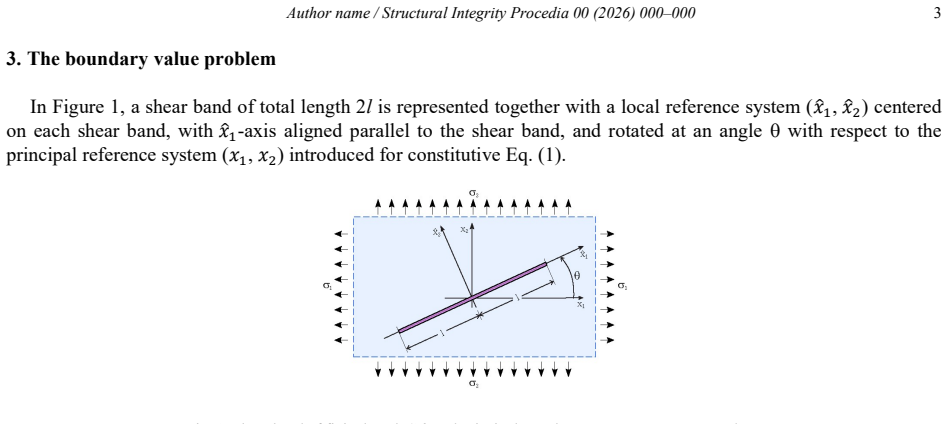
Boundary integral equations are presented to analyze perturbations in terms of small elastic deformations superimposed upon an arbitrary, homogeneous strain. Plane strain deformations of an incompressible, prestressed, anisotropic, elastic solid are considered assuming the Biot constitutive framework. The special case of perturbations of stress/deformation incident wave fields, caused by a shear band of finite length formed inside the material at a certain stage of the deformation path, is formulated.
What carries the argument
Boundary integral equations that enforce continuity of traction and displacement across the surfaces of a finite-length shear band while satisfying the incremental equilibrium equations of the Biot prestressed solid.
If this is right
- The equations allow direct computation of the scattered fields produced by a shear band of prescribed length and orientation.
- Numerical quadrature of the integrals yields the local perturbation in stress and deformation at any point outside the band.
- Repeated solution for bands at successive stages of loading can trace the evolution of band patterns.
- The same integral operators can be reused for different incident wave fields, reducing the cost of parametric studies.
Where Pith is reading between the lines
- The formulation could be coupled to a criterion for band growth to simulate spontaneous pattern formation under continued loading.
- Similar integral equations might be written for three-dimensional shear bands or for bands that interact with free surfaces or interfaces.
- The approach shares structure with boundary-element methods already used for cracks, suggesting possible cross-fertilization of numerical techniques.
- Validation could be performed by comparing predicted surface displacements with digital-image-correlation data from experiments on soft prestressed solids.
Load-bearing premise
The material is treated as an incompressible, prestressed, anisotropic elastic solid that obeys the Biot constitutive framework under plane strain.
What would settle it
Laboratory measurements of the strain or stress field immediately surrounding a controlled finite-length shear band in a prestressed specimen that deviate systematically from the fields predicted by solving the boundary integral equations would falsify the formulation.
Figures

read the original abstract
Boundary integral equations are presented to analyze perturbations in terms of small elastic deformations superimposed upon an arbitrary, homogeneous strain. Plane strain deformations of an incompressible, prestressed, anisotropic, elastic solid are considered assuming the Biot constitutive framework. The special case of perturbations of stress/deformation incident wave fields, caused by a shear band of finite length formed inside the material at a certain stage of the deformation path, is formulated.
Editorial analysis
A structured set of objections, weighed in public.
Referee Report
Summary. The paper presents boundary integral equations for analyzing perturbations consisting of small elastic deformations superimposed on an arbitrary homogeneous strain. It considers plane strain deformations of an incompressible, prestressed, anisotropic elastic solid under the Biot constitutive framework and formulates the special case of perturbations to stress/deformation fields caused by a finite-length shear band formed during the deformation path.
Significance. If the derivations are correct, the work supplies a boundary-integral formulation for incremental problems in prestressed solids that could support numerical studies of shear-band perturbations without requiring domain discretization. The explicit statement of assumptions (incompressibility, Biot model, plane strain) and the focus on a finite-length band are clear strengths for reproducibility.
minor comments (2)
- [Abstract / Introduction] The abstract and title refer to 'shear band patterns,' yet the stated contribution is limited to formulation of the governing integral equations; if the manuscript contains no explicit pattern predictions or solutions, a brief clarifying sentence in the introduction would align title and content.
- [Formulation section] Notation for the incremental fields and the incident wave fields should be defined at first use to aid readers unfamiliar with the Biot framework.
Simulated Author's Rebuttal
We thank the referee for the positive assessment of our manuscript and for recommending acceptance. The review accurately captures the scope of the boundary-integral formulation for incremental perturbations in prestressed incompressible anisotropic solids under the Biot framework, and we are pleased that the explicit assumptions and focus on finite-length shear bands were viewed as strengths for reproducibility.
Circularity Check
No significant circularity; formulation is self-contained
full rationale
The paper derives and presents boundary integral equations for incremental perturbations superimposed on homogeneous finite strain in an incompressible prestressed anisotropic elastic solid under the Biot constitutive model. This is a standard mathematical formulation task in incremental elasticity with explicit assumptions (plane strain, Biot framework, incompressibility) that are internally consistent and do not reduce any result to fitted parameters, self-definitions, or self-citation chains. No predictions, uniqueness theorems, or ansatzes are invoked that collapse by construction to the inputs; the work is a direct setup of the equations without empirical fitting or renaming of known results.
Axiom & Free-Parameter Ledger
axioms (3)
- domain assumption Biot constitutive framework applies to the prestressed elastic solid
- domain assumption The solid is incompressible
- domain assumption Plane strain conditions hold
Reference graph
Works this paper leans on
-
[1]
Macroscopic constitutive relations for elastomers reinforced with short aligned fibers: instabilities and post-bifurcation response
Avazmohammadi, R., Ponte Castañeda, P., 2016. Macroscopic constitutive relations for elastomers reinforced with short aligned fibers: instabilities and post-bifurcation response. Journal of the Mechanics and Physics of Solids 97, 37-67
2016
-
[2]
Green’s function for incremental nonlinear elasticity: shear bands and boundary integral formulation
Bigoni, D., Capuani, D., 2002. Green’s function for incremental nonlinear elasticity: shear bands and boundary integral formulation. Journal of the Mechanics and Physics of Solids 50, 471-500
2002
-
[3]
Time-harmonic Green’s function and boundary integral formulation for incremental nonlinear elasticity: dynamics of wave patterns and shear bands
Bigoni, D., Capuani, D., 2005. Time-harmonic Green’s function and boundary integral formulation for incremental nonlinear elasticity: dynamics of wave patterns and shear bands. Journal of the Mechanics and Physics of Solids 53, 1163-1187
2005
-
[4]
Mechanics of Incremental Deformations
Biot, M.A., 1965. Mechanics of Incremental Deformations. Wiley, New York
1965
-
[5]
Analysis of the dynamic propagation of adiabatic shear bands
Bonnet-Lebouvier, A.S., Molinari, A., Lipinski, P., 2002. Analysis of the dynamic propagation of adiabatic shear bands. International Journal of Solids and Structures 39, 4249-4269
2002
-
[6]
The dynamics of a shear band
Giarola, D., Capuani, D., Bigoni, D., 2018. The dynamics of a shear band. Journal of the Mechanics and Physics of Solids 112, 472-490
2018
-
[7]
Local microstructure evolution at shear bands in metallic glasses with nanoscale phase separation
He, J., et al., 2016. Local microstructure evolution at shear bands in metallic glasses with nanoscale phase separation. Scientific Reports 6, 25832
2016
-
[8]
Proceedings of the IUTAM Symposium on Finite Elasticity
Hutchinson, J.W., Neale, K.W., 1979. Finite strain J2-deformation theory. In “Proceedings of the IUTAM Symposium on Finite Elasticity”. In:
1979
-
[9]
Progressive shear band propagation in metallic glasses under compression
Qu, R.T., Liu, Z.Q., Wang, G., Zhang, Z.F., 2015. Progressive shear band propagation in metallic glasses under compression. Acta Materialia 91, 19-33
2015
-
[10]
Plasticity and Soil Mechancs
Rice, J.R., 1973. The initiation and growth of shear bands. In “Plasticity and Soil Mechancs”. In: Palmer, A.C. (Ed.), Cambridge University Engineering Department, Cambridge, UK, pp. 263-274
1973
discussion (0)
Sign in with ORCID, Apple, or X to comment. Anyone can read and Pith papers without signing in.