Recognition: unknown
Excluded volume and molecular field in the Lennard-Jones fluid: a modified first-order perturbation theory
Pith reviewed 2026-05-07 13:41 UTC · model grok-4.3
The pith
A range-based split of the Lennard-Jones potential lets first-order perturbation theory match simulation data when state derivatives are retained.
A machine-rendered reading of the paper's core claim, the machinery that carries it, and where it could break.
Core claim
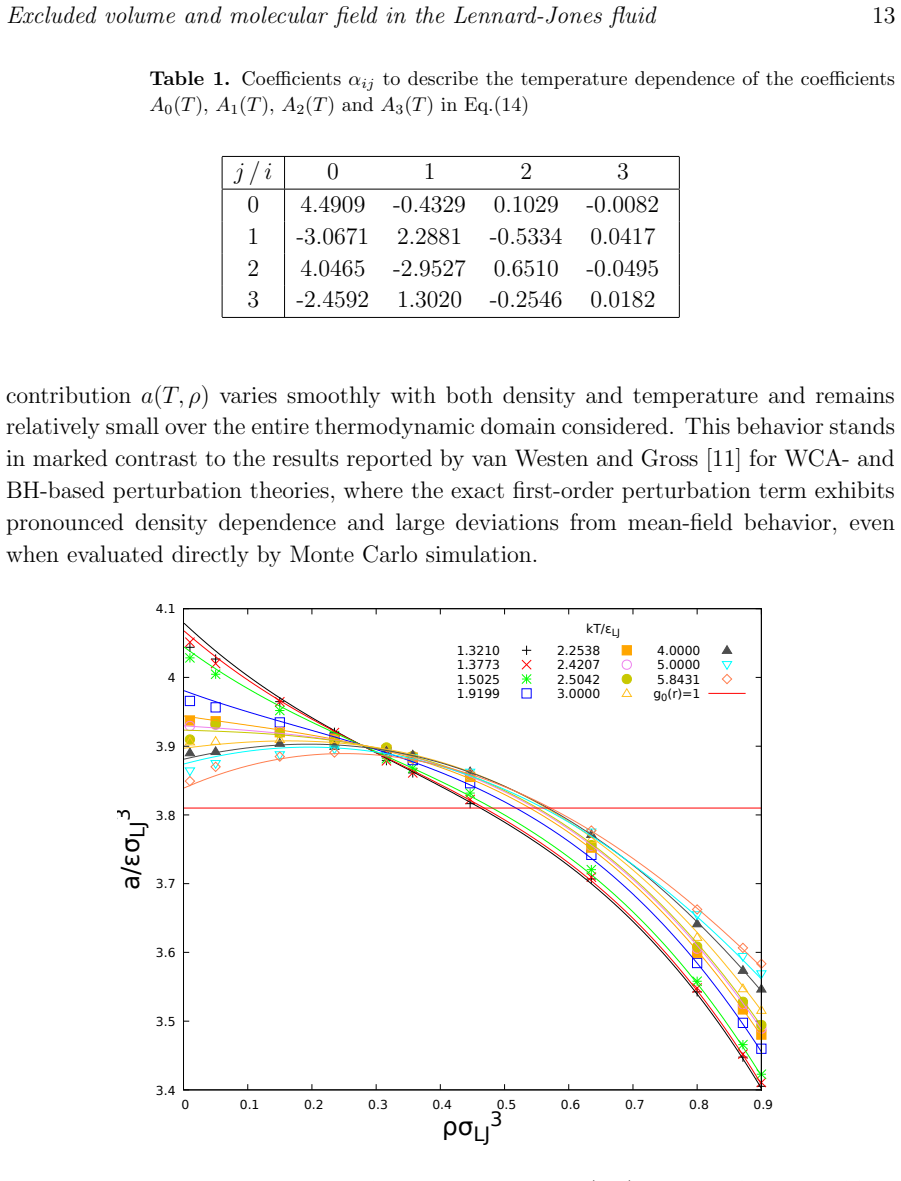
In this modified first-order perturbation theory the reference system incorporates the full short-range part of the Lennard-Jones interaction while the perturbation is confined to the remaining long-range tail. The range-based decomposition transforms the perturbation contribution into a small, smoothly varying, near-mean-field quantity. Retaining its density and temperature derivatives produces an equation of state that reproduces high-accuracy reference data with excellent fidelity across a broad supercritical thermodynamic domain. The work establishes that the success of first-order perturbation theory is governed by the physical content of the reference system and by the consistent state
What carries the argument
The range-based decomposition that assigns the entire short-range interaction to the reference system and the long-range tail to the perturbation, together with consistent retention of its density and temperature derivatives.
Load-bearing premise
The range-based split of the potential turns the perturbation into a small, smoothly varying near-mean-field quantity over a broad supercritical domain without extra parameters or adjustments.
What would settle it
High-accuracy molecular simulations at multiple supercritical temperatures and densities that show large systematic deviations in pressure or internal energy from the predicted equation of state would falsify the claim of excellent fidelity.
Figures




read the original abstract
The equation of state and, more generally, the thermodynamics of the Lennard-Jones fluid have long served as a benchmark problem in the statistical theory of fluids. Among available theoretical approaches, first-order perturbation theory occupies a special position: only at this level does the correction to the Helmholtz free energy admit an exact statistical-mechanical expression. In this work, we present a systematic, simulation-based assessment of a non-classical first-order perturbation theory in which the reference system incorporates the entire short-range part of the interaction, while the perturbation is confined to the remaining long-range tail. We show that this range-based decomposition transforms the perturbation contribution into a small, smoothly varying, near-mean-field quantity over a broad supercritical thermodynamic domain. When its density and temperature derivatives are consistently retained, the resulting equation of state reproduces high-accuracy reference data with excellent fidelity. The results demonstrate that the success of first-order perturbation theory is governed primarily by the physical content of the reference system and by the consistent treatment of its state dependence, rather than by the formal truncation order of the expansion.
Editorial analysis
A structured set of objections, weighed in public.
Referee Report
Summary. The manuscript develops a modified first-order perturbation theory for the Lennard-Jones fluid in which the potential is split at its minimum: the reference system incorporates the entire short-range portion (repulsive core plus the attractive well), while the perturbation is restricted to the long-range tail. The first-order correction to the Helmholtz free energy is computed directly from simulations of the reference system, and the equation of state is obtained by consistent numerical differentiation of the total free energy with respect to density and temperature. The resulting theory is shown to reproduce high-accuracy reference data with excellent fidelity over a broad supercritical domain without adjustable parameters.
Significance. If the reported agreement holds under detailed scrutiny, the work would establish that the physical content of the reference system and the retention of its full state dependence are the dominant factors controlling the accuracy of first-order perturbation theory, rather than the formal truncation order. This parameter-free, simulation-informed approach could simplify thermodynamic calculations for LJ-type fluids and provide a template for range-decomposed treatments of other potentials, bridging analytic theory and direct simulation.
minor comments (3)
- The precise location of the range split (relative to the potential minimum) and its relation to the standard WCA division should be stated explicitly in the methods section, including any rationale for retaining the full short-range well in the reference.
- Figures comparing the EOS to reference data would benefit from explicit uncertainty bands on the simulation-derived perturbation integrals and a statement of the thermodynamic range (densities and temperatures) over which the comparisons were performed.
- A brief discussion of how the numerical differentiation for the pressure and internal energy is implemented (finite-difference step size, smoothing, or analytic alternatives) would improve reproducibility.
Simulated Author's Rebuttal
We thank the referee for the positive assessment of our manuscript and for the accurate summary of its central results. The referee's comments correctly highlight the role of the range-based split and the consistent differentiation of the free energy. No specific major comments were raised in the report.
Circularity Check
No circularity; derivation uses independent simulations and external benchmarks
full rationale
The paper decomposes the LJ potential at its minimum (WCA-style reference plus long-range tail), evaluates the first-order perturbation integral directly from reference-system simulations, and obtains the EOS via numerical differentiation of the total free energy while retaining full state dependence. All reported fidelity is measured against independent high-accuracy simulation data; the range split is an external physical choice, not fitted to the target EOS. No load-bearing self-citation, no fitted parameter renamed as prediction, and no self-definitional reduction appear in the construction.
Axiom & Free-Parameter Ledger
axioms (1)
- domain assumption The Lennard-Jones interaction can be partitioned into a short-range reference part and a long-range perturbation tail on the basis of distance.
Reference graph
Works this paper leans on
-
[1]
J. Kolafa, I. Nezbeda, Fluid Phase Equil.100, 1-34 (1994) DOI: 10.1016/0378-3812(94)80 0 01-4
-
[2]
S. Stephan, J. Staubach, H. Hasse, Fluid Phase Equil.523, 112772 (2020) DOI: 10.1016/j.fluid.2020.112772
-
[3]
Barker, D
J.A. Barker, D. Henderson, Rev. Mod. Phys.,48, 587 (1976)
1976
-
[4]
Weeks, D
J.D. Weeks, D. Chandler, H. Andersen, Science220, 787 (1983)
1983
-
[5]
Hansen, I.R
J.-P. Hansen, I.R. McDonald,Theory of Simple Liquids, Academic Press, London (1986)
1986
-
[6]
Hansen, I.R
J.-P. Hansen, I.R. McDonald,Theory of Simple Liquids, 4th ed., Academic Press, Oxford (2013)
2013
-
[7]
van der Waals,On the continuity of the gaseous and liquid states, Ph.D
J.D. van der Waals,On the continuity of the gaseous and liquid states, Ph.D. thesis, Leiden University (1873)
-
[8]
Barker, D
J.A. Barker, D. Henderson, J. Chem. Phys.,47, 4714 (1967)
1967
-
[9]
Andersen, J.D
H.C. Andersen, J.D. Weeks, D. Chandler, Phys. Rev. A4, 1597 (1971)
1971
-
[10]
Zwanzig, J
R.W. Zwanzig, J. Chem. Phys.22, 1420 (1954)
1954
-
[11]
van Westen, J
T. van Westen, J. Gross, J. Chem. Phys.147, 014503 (2017)
2017
-
[12]
Melnyk, I
R. Melnyk, I. Nezbeda, D. Henderson, A. Trokhymchuk, Fluid Phase Equil.279, 1 (2009)
2009
-
[13]
Nezbeda, R
I. Nezbeda, R. Melnyk, A. Trokhymchuk, J. Supercritical Fluids55, 448 (2010)
2010
-
[14]
Toxvaerd, J.C
S. Toxvaerd, J.C. Dyre, J. Chem. Phys.134, 081102 (2011)
2011
-
[15]
V. Hordiichuk, J. Skvara, A. Trokhymchuk, I. Nezbeda, J. Mol. Liquids386, 122483 (2023) DOI: 10.1016/j.molliq.2023.122483
-
[16]
A. Trokhymchuk, J. Alejandre, J. Chem. Phys.111, 8510 (1999) DOI: 10.1063/1.480192
discussion (0)
Sign in with ORCID, Apple, or X to comment. Anyone can read and Pith papers without signing in.