Recognition: unknown
Thermodynamic Identification of the Internal Superconducting Phase Boundary in UTe₂ for H parallel b
Pith reviewed 2026-05-07 14:20 UTC · model grok-4.3
The pith
Ultrasound detects a bulk phase boundary inside the superconducting state of UTe2 for field along b.
A machine-rendered reading of the paper's core claim, the machinery that carries it, and where it could break.
Core claim
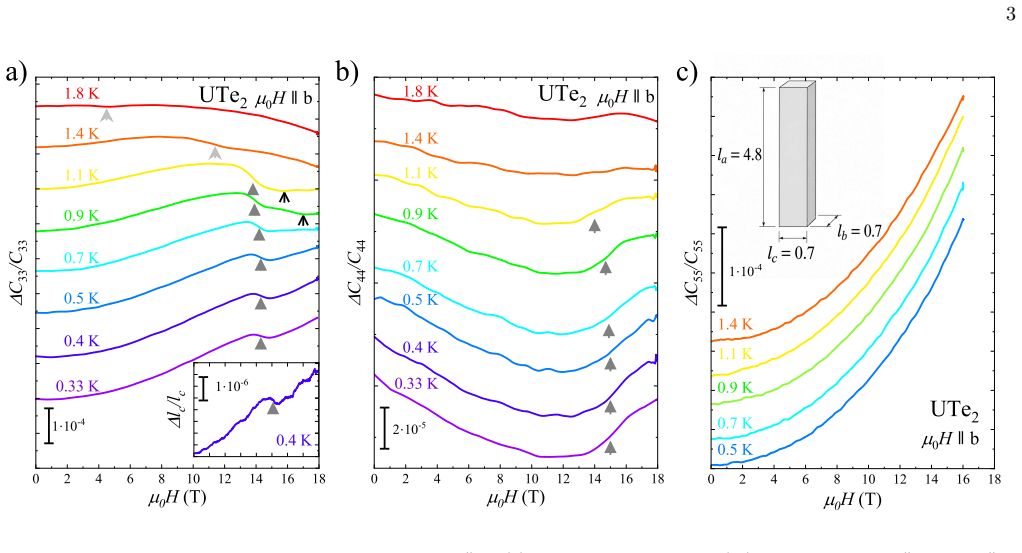
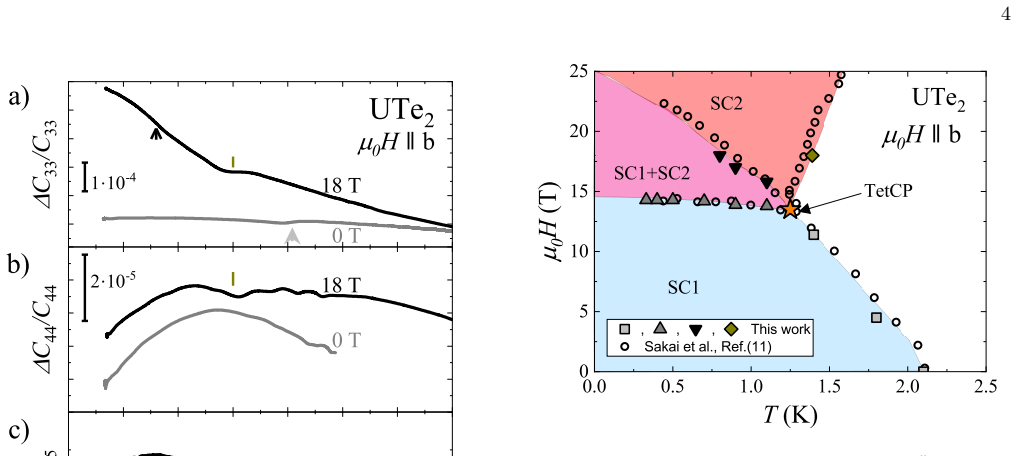
A pronounced anomaly appears in the longitudinal C33 mode, weaker in C44 and absent in C55, establishing the internal feature as a bulk thermodynamic phase boundary. The phase line remains nearly constant near 14 T and terminates near 13.5 T and 1.25 K at a tetracritical point, supplying the thermodynamic evidence for the fourth boundary in the H-T diagram and constraining the order-parameter structure of the high-field phase.
What carries the argument
Symmetry-selective coupling to lattice strain, observed as anomalies in the elastic moduli C33, C44, and C55.
Load-bearing premise
The ultrasound velocity changes arise solely from a thermodynamic transition in the superconducting order parameter rather than from vortex motion or sample inhomogeneity.
What would settle it
Absence of any corresponding feature in specific-heat or magnetization data at the same temperature and field values where the C33 anomaly occurs.
Figures

read the original abstract
The $H$--$T$ phase diagram of UTe$_2$ for magnetic field along the hard $b$ axis contains an unresolved internal boundary near $\mu_0H \sim 14$--15~T, previously inferred from ac susceptibility and transport experiments but lacking thermodynamic evidence. We report ultrasound results for several elastic modes in an ultraclean UTe$_2$ single crystal with $T_c>2$~K for $H \parallel b$ down to 0.33~K and up to 18~T. A pronounced anomaly in the longitudinal $C_{33}$ mode, with a weaker response in $C_{44}$ and no resolvable anomaly in $C_{55}$, establishes this feature as a bulk thermodynamic phase boundary and reveals a symmetry-selective coupling to lattice strain. The phase line remains nearly constant in field near 14~T and terminates near 13.5~T and 1.25~K at a tetracritical point, providing the thermodynamic evidence for the fourth phase boundary in the $H$--$T$ phase diagram. The results constrain the order-parameter structure of the high-field phase and support field-induced multicomponent superconductivity in UTe$_2$.
Editorial analysis
A structured set of objections, weighed in public.
Referee Report
Summary. The paper reports ultrasound velocity and attenuation data on an ultraclean UTe₂ single crystal (Tc > 2 K) for H ∥ b, identifying a pronounced anomaly in the longitudinal C₃₃ elastic mode near 14 T (weaker in C₄₄, absent in C₅₅). This feature is interpreted as a bulk thermodynamic phase boundary that is nearly field-independent and terminates at a tetracritical point near 13.5 T and 1.25 K, supplying the first thermodynamic evidence for the fourth boundary in the H–T diagram and constraining the order-parameter symmetry of the high-field superconducting phase.
Significance. If the central interpretation holds, the result is significant because it supplies the missing thermodynamic anchor for the internal phase boundary previously seen only in transport and susceptibility, thereby tightening constraints on multicomponent superconductivity in UTe₂. The observed symmetry-selective strain coupling is a concrete experimental handle on the order-parameter structure.
major comments (2)
- [Results and Discussion] The assignment of the C₃₃ anomaly to a change in superconducting order-parameter symmetry (rather than vortex-lattice softening, pinning, or minor inhomogeneity) is load-bearing for the claim of a thermodynamic phase boundary. The manuscript should explicitly address why ultrasound anomalies of this magnitude and field dependence cannot arise from vortex dynamics inside a single superconducting phase, for example by comparing the temperature and field scales of the feature with known vortex-related crossovers or by presenting supporting arguments from the attenuation data.
- [Discussion] No independent thermodynamic signature (specific-heat jump, magnetization anomaly, or thermal-expansion feature) is reported at the same (H,T) locus. Because ultrasound can respond to non-thermodynamic degrees of freedom, the manuscript should either provide such cross-validation or explain why its absence does not weaken the thermodynamic identification.
minor comments (3)
- The abstract states the phase line 'remains nearly constant in field near 14 T'; the main text should quantify this constancy (e.g., slope dH/dT or field variation over the measured temperature window) with explicit error bars.
- [Methods] Error analysis, background subtraction procedure, and criteria for declaring an anomaly 'resolvable' or 'absent' in C₅₅ should be stated explicitly so that the mode selectivity can be assessed quantitatively.
- The precise value of Tc and the residual resistivity ratio of the measured crystal should be given in the main text (not only the abstract) to allow direct comparison with prior work.
Simulated Author's Rebuttal
We thank the referee for the careful reading of our manuscript and the constructive comments. We address each major point below and have revised the manuscript to strengthen the presentation where possible.
read point-by-point responses
-
Referee: [Results and Discussion] The assignment of the C₃₃ anomaly to a change in superconducting order-parameter symmetry (rather than vortex-lattice softening, pinning, or minor inhomogeneity) is load-bearing for the claim of a thermodynamic phase boundary. The manuscript should explicitly address why ultrasound anomalies of this magnitude and field dependence cannot arise from vortex dynamics inside a single superconducting phase, for example by comparing the temperature and field scales of the feature with known vortex-related crossovers or by presenting supporting arguments from the attenuation data.
Authors: We agree that a clear distinction from vortex-related effects is essential. In the revised manuscript we have added a new paragraph in the Results section that directly compares the observed anomaly to known vortex phenomena in UTe₂ and other superconductors. The feature remains nearly field-independent near 14 T over a broad temperature range and terminates at a tetracritical point (13.5 T, 1.25 K), whereas vortex-lattice softening or melting lines typically track the upper critical field or vortex density and shift strongly with temperature. The attenuation data show a sharp peak at the same field position, consistent with critical fluctuations rather than the broader dissipation expected from pinning or depinning. In addition, the pronounced elastic-mode selectivity (strong in C₃₃, weaker in C₄₄, absent in C₅₅) is incompatible with isotropic vortex-lattice effects. These arguments, together with the magnitude of the velocity jump, support our interpretation as an order-parameter boundary. revision: yes
-
Referee: [Discussion] No independent thermodynamic signature (specific-heat jump, magnetization anomaly, or thermal-expansion feature) is reported at the same (H,T) locus. Because ultrasound can respond to non-thermodynamic degrees of freedom, the manuscript should either provide such cross-validation or explain why its absence does not weaken the thermodynamic identification.
Authors: We acknowledge that the lack of corroborating data from specific heat or magnetization at the same locus is a genuine limitation. In the revised Discussion we have added an explicit paragraph explaining why the ultrasound anomaly nevertheless constitutes thermodynamic evidence: the elastic moduli are second derivatives of the free energy with respect to strain, so a discontinuity in C₃₃ directly reflects a change in the thermodynamic potential. We also note that the symmetry-selective strain coupling observed here is difficult to reconcile with non-thermodynamic mechanisms. While we cannot supply new specific-heat or magnetization measurements on the identical crystal in this work, we discuss why a small entropy change or weak first-order character could render the anomaly undetectable in those channels, consistent with precedents in other heavy-fermion superconductors where ultrasound first revealed phase boundaries later confirmed by complementary probes. revision: partial
Circularity Check
No circularity: direct experimental observation of elastic anomalies
full rationale
The paper reports measured ultrasound velocity and attenuation anomalies in C33, C44, and C55 modes for H parallel to b in UTe2. No equations, fitted parameters, or derivations are presented that reduce to prior inputs by construction. The central claim—that the C33 anomaly marks a bulk thermodynamic phase boundary terminating at a tetracritical point—rests on the raw observation of symmetry-selective anomalies, not on any self-referential modeling or self-citation chain. This is a standard experimental identification with no load-bearing steps that collapse to tautology.
Axiom & Free-Parameter Ledger
axioms (1)
- domain assumption Elastic modulus anomalies indicate thermodynamic phase transitions in superconductors
Reference graph
Works this paper leans on
-
[1]
( 4) is only of order 10 − 6, two orders of magnitude smaller than ∆ f /f , and is therefore neglected without affecting the anomaly positions
As shown below, the magnetostriction term in Eq. ( 4) is only of order 10 − 6, two orders of magnitude smaller than ∆ f /f , and is therefore neglected without affecting the anomaly positions. The geometry was chosen to maximize sensitivity to the high-field boundary: superconductivity in UTe 2 cou- ples strongly to c-axis strain but only weakly to b-axis s...
-
[2]
Following the no- tation of the pressure-dependent phase diagram [12, 25], we denote the low-field superconducting state as SC1 and the upper high-field state as SC2. The newly resolved, nearly field-constant internal boundary near 14 T sepa- rates SC1 from an intermediate region naturally identi- fied as SC1+SC2 and terminates near 13.5 T and 1.25 K at a tet...
-
[3]
S. Ran, C. Eckberg, Q.-P. Ding, Y. Furukawa, T. Metz, S. R. Saha, I.-L. Liu, M. Zic, H. Kim, J. Paglione, and N. P. Butch, Science 365, 684 (2019)
2019
-
[4]
D. Aoki, A. Nakamura, F. Honda, D. Li, Y. Homma, Y. Shimizu, Y. J. Sato, G. Knebel, J.-P. Bri- son, A. Pourret, D. Braithwaite, G. Lapertot, Q. Niu, M. Valiˇ ska, H. Harima, and J. Flouquet, Journal of the Physical Society of Japan 88, 043702 (2019)
2019
-
[5]
Braithwaite, M
D. Braithwaite, M. Valiˇ ska, G. Knebel, G. Laper- tot, J.-P. Brison, A. Pourret, M. E. Zhito- mirsky, J. Flouquet, F. Honda, and D. Aoki, Communications Physics 2, 147 (2019)
2019
-
[6]
Aoki, J.-P
D. Aoki, J.-P. Brison, J. Flouquet, K. Ishida, G. Knebel, Y. Tokunaga, and Y. Yanase, Journal of Physics: Condensed Matter 34, 243002 (2022)
2022
-
[7]
Knafo, M
W. Knafo, M. Valiˇ ska, D. Braithwaite, G. Lapertot, G. Knebel, A. Pourret, J.- P. Brison, J. Flouquet, and D. Aoki, Journal of the Physical Society of Japan 88, 063705 (2019)
2019
-
[8]
Knebel, W
G. Knebel, W. Knafo, A. Pourret, Q. Niu, M. Valiˇ ska, D. Braithwaite, G. Lapertot, M. Nar- done, A. Zitouni, S. Mishra, I. Sheikin, G. Sey- farth, J.-P. Brison, D. Aoki, and J. Flouquet, Journal of the Physical Society of Japan 88, 063707 (2019)
2019
-
[9]
Knebel, M
G. Knebel, M. Kimata, M. Valiˇ ska, F. Honda, D. Li, D. Braithwaite, G. Lapertot, W. Knafo, A. Pourret, Y. J. Sato, Y. Shimizu, T. Ki- hara, J.-P. Brison, J. Flouquet, and D. Aoki, Journal of the Physical Society of Japan 89, 053707 (2020)
2020
-
[10]
D. Aoki, M. Kimata, Y. J. Sato, G. Knebel, F. Honda, A. Nakamura, D. Li, Y. Homma, Y. Shimizu, W. Knafo, D. Braithwaite, M. Valiˇ ska, A. Pourret, J.-P. Brison, and J. Flouquet, Journal of the Physical Society of Japan 90, 074705 (2021)
2021
-
[11]
Knafo, M
W. Knafo, M. Nardone, M. Valiˇ ska, A. Zitouni, G. Lapertot, D. Aoki, G. Knebel, and D. Braithwaite, Communications Physics 4, 40 (2021)
2021
-
[12]
Valiˇ ska, W
M. Valiˇ ska, W. Knafo, G. Knebel, G. Lapertot, D. Aoki, and D. Braithwaite, Physical Review B 104, 214507 (2021)
2021
-
[13]
Sakai, Y
H. Sakai, Y. Tokiwa, P. Opletal, M. Kimata, S. Awaji, T. Sasaki, D. Aoki, S. Kambe, Y. Tokunaga, and Y. Haga, Physical Review Letters 130, 196002 (2023)
2023
-
[14]
Vasina, D
T. Vasina, D. Aoki, A. Miyake, G. Seyfarth, A. Pourret, C. Marcenat, M. Amano Patino, G. Lapertot, J. Flou- quet, J.-P. Brison, D. Braithwaite, and G. Knebel, Physical Review Letters 134, 096501 (2025)
2025
-
[15]
Sakai, P
H. Sakai, P. Opletal, Y. Tokiwa, E. Ya- mamoto, Y. Tokunaga, S. Kambe, and Y. Haga, Physical Review Materials 6, 073401 (2022)
2022
-
[16]
Aoki, Journal of the Physical Society of Japan 93, 043703 (2024)
D. Aoki, Journal of the Physical Society of Japan 93, 043703 (2024)
2024
-
[17]
Z. Wu, T. I. Weinberger, J. Chen, A. Ca- bala, D. V. Chichinadze, D. Shaffer, J. Posp ´ ıˇ sil, J. Prokleˇ ska, T. Haidamak, G. Bastien, V. Se- chovsk´ y, A. J. Hickey, M. J. Mancera-Ugarte, S. Benjamin, D. E. Graf, Y. Skourski, G. G. Lon- zarich, M. Valiˇ ska, F. M. Grosche, and A. G. Eaton, Proc. Natl. Acad. Sci. U.S.A. 121, e2403067121 (2024)
2024
-
[18]
Y. Haga, P. Opletal, Y. Tokiwa, E. Ya- mamoto, Y. Tokunaga, S. Kambe, and H. Sakai, Journal of Physics: Condensed Matter 34, 175601 (2022)
2022
-
[19]
Svanidze, A
E. Svanidze, A. Leithe-Jasper, M. Schmidt, N. Zaremba, M. Krnel, Y. Prots, U. Burkhardt, M. K¨ onig, R. Ramlau, B. H. Goodge, and Y. Grin, Journal of the American Chemical Society 147, 35809 (2025)
2025
-
[20]
D. Aoki, H. Sakai, P. Opletal, Y. Tokiwa, J. Ishizuka, Y. Yanase, H. Harima, A. Nakamura, D. Li, Y. Homma, Y. Shimizu, G. Knebel, J. Flouquet, and Y. Haga, Journal of the Physical Society of Japan 91, 083704 (2022)
2022
-
[21]
A. G. Eaton, T. I. Weinberger, N. J. M. Popiel, Z. Wu, A. J. Hickey, A. Cabala, J. Posp ´ ıˇ sil, J. Prokleˇ ska, T. Haidamak, G. Bastien, P. Opletal, H. Sakai, Y. Haga, R. Nowell, S. M. Benjamin, V. Sechovsk´ y, G. G. Lonzarich, F. M. Grosche, and M. Valiˇ ska, Nature Communications 15, 223 (2024)
2024
-
[22]
T. I. Weinberger, Z. Wu, D. E. Graf, Y. Skourski, A. Cabala, J. Posp ´ ıˇ sil, J. Prokleˇ ska, T. Haidamak, G. Bastien, V. Sechovsk´ y, G. G. Lonzarich, M. Valiˇ ska, F. M. Grosche, and A. G. Eaton, Physical Review Letters 132, 266503 (2024)
2024
-
[23]
Z. Wu, H. Chen, T. I. Weinberger, A. Cabala, D. E. Graf, Y. Skourski, W. Xie, Y. Ling, Z. Zhu, V. Se- chovsk´ y, M. Valiˇ ska, F. M. Grosche, and A. G. Eaton, Proc. Natl. Acad. Sci. U.S.A. 122, e2422156122 (2025)
2025
-
[24]
Matsumura, Y
H. Matsumura, Y. Takahashi, R. Matsubayashi, K. Kinjo, S. Kitagawa, K. Ishida, Y. Toku- naga, H. Sakai, S. Kambe, M. Kimata, A. Naka- mura, Y. Shimizu, Y. Homma, D. Li, F. Honda, A. Miyake, D. Aoki, T. Furukawa, and T. Sasaki, Physical Review B 113, 094506 (2026)
2026
-
[25]
Tokiwa, H
Y. Tokiwa, H. Sakai, S. Kambe, P. Ople- tal, E. Yamamoto, M. Kimata, S. Awaji, T. Sasaki, Y. Yanase, Y. Haga, and Y. Tokunaga, Physical Review B 108, 144502 (2023)
2023
-
[26]
Machida, Journal of Low Temperature Physics 216, 746 (2024)
K. Machida, Journal of Low Temperature Physics 216, 746 (2024)
2024
- [27]
-
[28]
L¨ uthi,Physical Acoustics in the Solid State (Springer, Berlin and Heidelberg, 2005)
B. L¨ uthi,Physical Acoustics in the Solid State (Springer, Berlin and Heidelberg, 2005)
2005
-
[29]
Sigrist and K
M. Sigrist and K. Ueda, Reviews of Modern Physics 63, 239 (1991)
1991
-
[30]
Theuss, A
F. Theuss, A. Shragai, G. Grissonnanche, I. M. Hayes, S. R. Saha, Y. S. Eo, A. Suarez, T. Shishi- dou, N. P. Butch, J. Paglione, and B. J. Ramshaw, Nature Physics 20, 1124 (2024)
2024
-
[31]
Rosuel, C
A. Rosuel, C. Marcenat, G. Knebel, T. Klein, A. Pourret, N. Marquardt, Q. Niu, S. Rousseau, A. Demuer, G. Sey- farth, G. Lapertot, D. Aoki, D. Braithwaite, J. Flouquet, and J. P. Brison, Physical Review X 13, 011022 (2023)
2023
-
[32]
Valiˇ ska, T
M. Valiˇ ska, T. Haidamak, A. Cabala, J. Posp ´ ıˇ sil, G. Bastien, P. Opletal, H. Sakai, Y. Haga, A. Miyata, D. Gorbunov, S. Zher- litsyn, V. Sechovsk´ y, and J. Prokleˇ ska, Physical Review Materials 8, 094415 (2024)
2024
-
[33]
Yoshizawa, Y
M. Yoshizawa, Y. Shimizu, Y. Nakanishi, Y. Homma, A. Nakamura, F. Honda, and D. Aoki, Journal of the Physical Society of Japan 92, 104603 (2023)
2023
-
[34]
T. N. Haidamak, J. Valenta, J. Prchal, M. Valiˇ ska, J. Posp ´ ıˇ sil, V. Sechovsk´ y, J. Prokleˇ ska, A. A. Zvyagin, and F. Honda, Physical Review B 105, 144428 (2022)
2022
-
[35]
Kappler, M
C. Kappler, M. B. Walker, and J. Luettmer-Strathmann, Physical Review B 51, 11319 (1995)
1995
-
[36]
Z. Wu, J. Chen, T. I. Weinberger, A. Ca- 6 bala, V. Sechovsk´ y, M. Valiˇ ska, P. L. Alireza, A. G. Eaton, and F. M. Grosche, Physical Review Letters 134, 236501 (2025)
2025
-
[37]
Boukhny, G
M. Boukhny, G. L. Bullock, B. S. Shivaram, and D. G. Hinks, Physical Review Letters 73, 1707 (1994)
1994
-
[38]
S. K. Yip, T. Li, and P. Kumar, Physical Review B 43, 2742 (1991)
1991
-
[39]
Adenwalla, J
S. Adenwalla, J. B. Ketterson, S. K. Yip, S. W. Lin, M. Levy, and B. K. Sarma, Physical Review B 46, 9070 (1992)
1992
discussion (0)
Sign in with ORCID, Apple, or X to comment. Anyone can read and Pith papers without signing in.