Recognition: unknown
Planar Gaussian Splatting with Bilinear Spatial Transformer for Wireless Radiance Field Reconstruction
Pith reviewed 2026-05-10 08:01 UTC · model grok-4.3
The pith
Planar Gaussian splatting rendered on angular spectra with bilinear attention reconstructs wireless radiance fields more accurately than NeRF or prior GS approaches.
A machine-rendered reading of the paper's core claim, the machinery that carries it, and where it could break.
Core claim
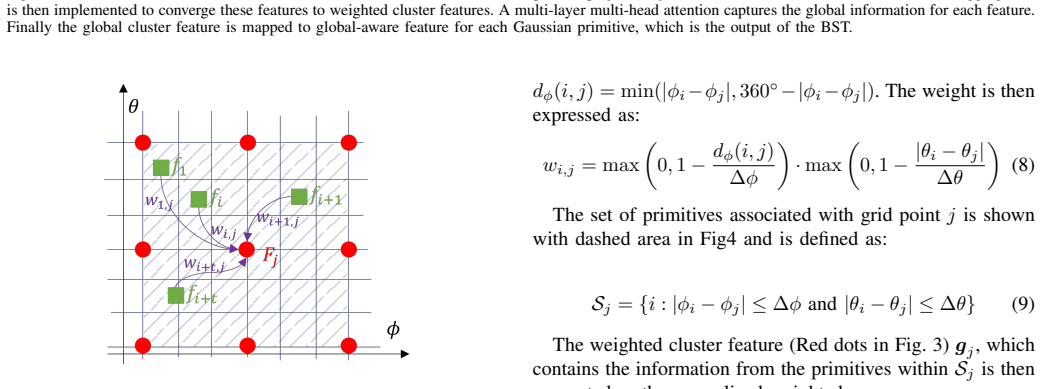
BiSplat-WRF is a planar Gaussian splatting framework in which each primitive is a 2D planar Gaussian with 3D coordinates that is rendered directly onto the angular domain of the SPS. The bilinear spatial transformer aggregates relations among these primitives on an angular grid and applies attention to capture global EM coupling and mutual scattering, thereby enforcing physically consistent long-range interactions. On the spatial spectrum synthesis task the method records higher SSIM than both NeRF-based and earlier GS-based baselines; ablation experiments confirm that the BST component accounts for a measurable fraction of the gain. A scaled-up BiSplat-WRF+ variant further raises SSIM at a
What carries the argument
BiSplat-WRF framework consisting of 2D planar Gaussians rendered directly onto the SPS angular domain together with a bilinear spatial transformer that performs attention-based aggregation of inter-primitive electromagnetic relations.
If this is right
- Higher SSIM scores on spatial spectrum synthesis compared with NeRF and earlier Gaussian-splatting baselines.
- Explicit modeling of global EM coupling and mutual scattering through the bilinear spatial transformer attention mechanism.
- A larger BiSplat-WRF+ variant that trades higher compute cost for still larger SSIM gains.
- Removal of unnecessary 3D-to-2D projection steps while preserving the expressiveness of Gaussian primitives.
- Validation through ablation studies that isolate the contribution of the bilinear spatial transformer.
Where Pith is reading between the lines
- The same planar-plus-attention pattern could be tested on acoustic or optical wave fields that obey similar propagation physics.
- Integration with real-time channel sounding hardware would allow closed-loop validation of predicted spectra against live measurements.
- The angular-grid attention structure might reduce the number of required measurement locations compared with purely local splatting methods.
- If the BST attention can be made sparse, the approach could scale to larger environments without quadratic cost growth.
Load-bearing premise
Rendering 2D planar Gaussians straight onto the angular domain and letting bilinear attention link them is enough to reproduce the global electromagnetic coupling and scattering physics of real wireless channels.
What would settle it
A side-by-side comparison on measured data from a rich-scattering indoor environment where BiSplat-WRF predictions deviate systematically from ground-truth spatial power spectra in directions known to contain strong multipath components not representable by the planar primitives.
Figures




read the original abstract
Wireless radiance field (WRF) reconstruction aims to learn a continuous, queryable representation of radio frequency characteristics over 3D space and direction, from which specific quantities, such as the spatial power spectrum (SPS) at a receiver given a transmitter position, can be predicted. While Gaussian splatting (GS)-based method has surpassed Neural Radiance Fields (NeRF)-based method for this task, existing adaptations largely transplant vision pipelines, limiting physical interpretability and accuracy. We introduce BiSplat-WRF, a planar GS framework that retains the expressiveness of 3D GS while removing unnecessary projections and incorporating global EM coupling and mutual scattering among primitives. Each primitive is a 2D planar Gaussian with 3D coordinates, rendered directly on the angular domain of the SPS. A bilinear spatial transformer (BST) aggregates inter-primitive relations on an angular grid and, via attention, captures long-range electromagnetic dependencies, thereby enforcing globally aware EM interactions that reflect the complex physics of the wireless environment. On spatial spectrum synthesis task, BiSplat-WRF surpasses NeRF-based and prior GS-based baselines with respect to the Structural Similarity Index (SSIM); comprehensive ablation studies validate the contribution of BST. We also provide a larger BiSplat-WRF+ variant that further increases SSIM at a higher computation cost, serving as a strong reference for future studies.
Editorial analysis
A structured set of objections, weighed in public.
Referee Report
Summary. The manuscript introduces BiSplat-WRF, a planar Gaussian splatting framework for wireless radiance field (WRF) reconstruction. Each primitive is a 2D planar Gaussian with 3D coordinates rendered directly onto the angular domain of the spatial power spectrum (SPS). A bilinear spatial transformer (BST) aggregates inter-primitive relations on an angular grid via attention to capture long-range electromagnetic dependencies. The method claims to surpass NeRF-based and prior GS-based baselines in SSIM on the spatial spectrum synthesis task, with ablation studies validating the BST contribution; a larger BiSplat-WRF+ variant is also provided as a reference.
Significance. If the SSIM gains are attributable to the BST's modeling of global EM coupling rather than added capacity alone, the work could advance physically interpretable representations for wireless channel modeling and spectrum prediction, bridging vision-based splatting with electromagnetic principles and providing a stronger baseline for future WRF studies.
major comments (2)
- [§3] §3 (Method): The central claim that BST 'enforces globally aware EM interactions that reflect the complex physics' and captures 'global EM coupling and mutual scattering' is load-bearing for interpreting the SSIM improvements as physically grounded. No derivation is provided showing how the bilinear attention on the angular grid enforces consistency with Maxwell's equations, diffraction, multipath interference, or frequency-dependent behavior; without this, gains may reduce to empirical fitting.
- [§4] §4 (Experiments): The abstract states that 'comprehensive ablation studies validate the contribution of BST' and that BiSplat-WRF surpasses baselines in SSIM, but no quantitative results, error bars, dataset details, or statistical tests are referenced. This undermines assessment of whether the reported superiority is robust or sensitive to post-hoc choices in architecture or training.
minor comments (1)
- [Abstract] Abstract: The title and abstract introduce 'BiSplat-WRF' and 'BST' without immediate expansion; adding a parenthetical definition on first use would improve readability.
Simulated Author's Rebuttal
We thank the referee for the constructive and detailed feedback. We address each major comment below with proposed revisions to improve the manuscript's clarity and rigor.
read point-by-point responses
-
Referee: [§3] §3 (Method): The central claim that BST 'enforces globally aware EM interactions that reflect the complex physics' and captures 'global EM coupling and mutual scattering' is load-bearing for interpreting the SSIM improvements as physically grounded. No derivation is provided showing how the bilinear attention on the angular grid enforces consistency with Maxwell's equations, diffraction, multipath interference, or frequency-dependent behavior; without this, gains may reduce to empirical fitting.
Authors: We agree that the manuscript provides no formal derivation from Maxwell's equations or explicit consistency with diffraction, multipath, or frequency dependence. The BST is a data-driven attention mechanism on the angular grid, motivated by the directional and long-range dependencies inherent in electromagnetic wave propagation. The SSIM gains are empirical, as shown by the ablations. We will revise §3 to moderate the language, framing the BST as capturing global interactions in a manner inspired by EM principles rather than enforcing physical laws, and add a short discussion of these motivations along with a limitations note on the empirical nature of the improvements. revision: yes
-
Referee: [§4] §4 (Experiments): The abstract states that 'comprehensive ablation studies validate the contribution of BST' and that BiSplat-WRF surpasses baselines in SSIM, but no quantitative results, error bars, dataset details, or statistical tests are referenced. This undermines assessment of whether the reported superiority is robust or sensitive to post-hoc choices in architecture or training.
Authors: The full manuscript reports SSIM comparisons, ablation results, and dataset specifications in §4 and the tables. However, the abstract omits specific numbers, and error bars plus statistical tests are absent. We will revise the abstract to include key quantitative SSIM gains, expand dataset details, and add error bars from multiple runs plus statistical significance tests (e.g., t-tests) in the experimental section to better demonstrate robustness. revision: yes
Circularity Check
No circularity: modeling choices validated empirically against external baselines
full rationale
The paper introduces a new planar Gaussian splatting architecture with BST attention for wireless radiance field reconstruction. Claims that the components 'enforce globally aware EM interactions' and 'reflect the complex physics' are interpretive descriptions of the model design rather than a derivation chain that reduces to fitted inputs or self-citations by construction. Performance gains are demonstrated via direct comparisons to NeRF and prior GS baselines plus ablation studies on BST, which are independent external benchmarks. No self-definitional loops, fitted parameters renamed as predictions, or load-bearing self-citations appear in the provided text. The framework is self-contained as an empirical ML proposal.
Axiom & Free-Parameter Ledger
axioms (1)
- domain assumption Planar 2D Gaussians with 3D coordinates can retain expressiveness of 3D GS while enabling direct angular-domain rendering for SPS
invented entities (1)
-
Bilinear Spatial Transformer (BST)
no independent evidence
Reference graph
Works this paper leans on
-
[1]
A survey of various propagation models for mobile communication,
T. K. Sarkar, Z. Ji, K. Kim, A. Medouri, and M. Salazar-Palma, “A survey of various propagation models for mobile communication,”IEEE Antennas and propagation Magazine, vol. 45, no. 3, pp. 51–82, 2003
2003
-
[2]
The design and applications of high-performance ray-tracing simulation platform for 5G and beyond wireless communications: A tutorial,
D. He, B. Ai, K. Guan, L. Wang, Z. Zhong, and T. K ¨urner, “The design and applications of high-performance ray-tracing simulation platform for 5G and beyond wireless communications: A tutorial,”IEEE communications surveys & tutorials, vol. 21, no. 1, pp. 10–27, 2018
2018
-
[3]
Sionna: An Open-Source Library for Next-Generation Physical Layer Research,
J. Hoydis, S. Cammerer, F. A. Aoudia, A. Vem, N. Binder, G. Marcus, and A. Keller, “Sionna: An open-source library for next-generation physical layer research,”arXiv preprint arXiv:2203.11854, 2022
-
[4]
Learnable wireless digital twins: Reconstructing electromagnetic field with neural representations,
S. Jiang, Q. Qu, X. Pan, A. Agrawal, R. Newcombe, and A. Alkhateeb, “Learnable wireless digital twins: Reconstructing electromagnetic field with neural representations,”IEEE Open Journal of the Communications Society, 2025
2025
-
[5]
Generalizable neural ray tracing towards physics-informed intelligent channel modeling,
K. Bian, M. Tao, and S. Sun, “Generalizable neural ray tracing towards physics-informed intelligent channel modeling,” in2025 IEEE/CIC International Conference on Communications in China (ICCC). IEEE, 2025, pp. 1–6
2025
-
[6]
Neural reflectance fields for radio-frequency ray tracing,
H. Jia, X. Chen, Y . Wei, Y . Sun, and Y . Pi, “Neural reflectance fields for radio-frequency ray tracing,” inGLOBECOM 2024-2024 IEEE Global Communications Conference. IEEE, 2024, pp. 4226–4231
2024
-
[7]
NeRF2: Neural radio-frequency radiance fields,
X. Zhao, Z. An, Q. Pan, and L. Yang, “NeRF2: Neural radio-frequency radiance fields,” inProceedings of the 29th Annual International Con- ference on Mobile Computing and Networking, 2023, pp. 1–15
2023
-
[8]
3D Gaussian splatting for real-time radiance field rendering
B. Kerbl, G. Kopanas, T. Leimk ¨uhler, and G. Drettakis, “3D Gaussian splatting for real-time radiance field rendering.”ACM Trans. Graph., vol. 42, no. 4, pp. 139–1, 2023
2023
-
[9]
A Survey on 3D Gaussian Splatting
G. Chen and W. Wang, “A Survey on 3D Gaussian Splatting,” 2025. [Online]. Available: https://arxiv.org/abs/2401.03890
work page internal anchor Pith review Pith/arXiv arXiv 2025
-
[10]
3D Gaussian Splatting as a New Era: A Survey,
B. Fei, J. Xu, R. Zhang, Q. Zhou, W. Yang, and Y . He, “3D Gaussian Splatting as a New Era: A Survey,”IEEE Transactions on Visualization and Computer Graphics, vol. 31, no. 8, pp. 4429–4449, 2025
2025
-
[11]
WRF-GS: Wireless radiation field reconstruction with 3D Gaussian splatting,
C. Wen, J. Tong, Y . Hu, Z. Lin, and J. Zhang, “WRF-GS: Wireless radiation field reconstruction with 3D Gaussian splatting,” inIEEE IN- FOCOM 2025-IEEE Conference on Computer Communications. IEEE, 2025, pp. 1–10
2025
-
[12]
Scalable 3D Gaussian splatting- based RF signal spatial propagation modeling,
K. Yang, W. Du, and M. Srivastava, “Scalable 3D Gaussian splatting- based RF signal spatial propagation modeling,” inProceedings of the 23rd ACM Conference on Embedded Networked Sensor Systems, 2025, pp. 680–681
2025
-
[13]
Neural representation for wireless radiation field reconstruction: A 3D Gaussian splatting approach
C. Wen, J. Tong, Y . Hu, Z. Lin, and J. Zhang, “Neural representation for wireless radiation field reconstruction: A 3D Gaussian splatting approach,”arXiv preprint arXiv:2412.04832, 2024
-
[14]
Rasterizing Wireless Radiance Field via Deformable 2D Gaussian Splatting,
M. Liu, C. Zhang, Q. Yang, Y . Cao, Y . Xu, Y . Xu, S. Sun, M. Dai, and Y . Guan, “Rasterizing Wireless Radiance Field via Deformable 2D Gaussian Splatting,”arXiv preprint arXiv:2506.12787, 2025
-
[15]
RF-PGS: Fully-Structured Spatial Wireless Channel Representation with Planar Gaussian Splatting,
L. Zhang, Z. Li, and H. Sun, “RF-PGS: Fully-structured Spatial Wireless Channel Representation with Planar Gaussian Splatting,”arXiv preprint arXiv:2508.16849, 2025
-
[16]
Survey on 6G frontiers: Trends, applications, re- quirements, technologies and future research,
C. De Alwis, A. Kalla, Q.-V . Pham, P. Kumar, K. Dev, W.-J. Hwang, and M. Liyanage, “Survey on 6G frontiers: Trends, applications, re- quirements, technologies and future research,”IEEE Open Journal of the Communications Society, vol. 2, pp. 836–886, 2021
2021
-
[17]
Attention is all you need,
A. Vaswani, N. Shazeer, N. Parmar, J. Uszkoreit, L. Jones, A. N. Gomez, Ł. Kaiser, and I. Polosukhin, “Attention is all you need,”Advances in neural information processing systems, vol. 30, 2017
2017
-
[18]
V oxelRF: V oxelized radiance field for fast wireless channel modeling,
Z. Zeng, S. Sun, M. Tao, Y . Xu, and X. Yu, “V oxelRF: V oxelized radiance field for fast wireless channel modeling,”arXiv preprint arXiv:2507.09987, 2025
discussion (0)
Sign in with ORCID, Apple, or X to comment. Anyone can read and Pith papers without signing in.