Recognition: unknown
Coherent Rollout Oracles for Finite-Horizon Sequential Decision Problems
Pith reviewed 2026-05-07 17:11 UTC · model grok-4.3
The pith
Composing reversible rank-select circuits with transition and predicate evaluators produces an explicit polynomial-size coherent rollout oracle for finite-horizon planning problems.
A machine-rendered reading of the paper's core claim, the machinery that carries it, and where it could break.
Core claim
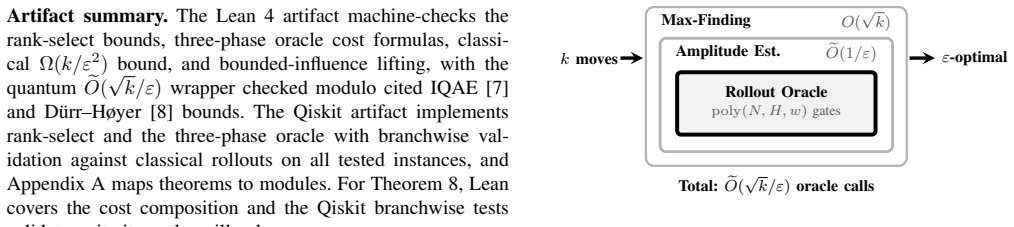
For finite-horizon sequential decision problems whose valid actions admit an entangled N-bit validity mask and whose transition and predicate functions admit reversible circuits, rank-select over that mask can be realized with O(Nw) or O(N log w) gates depending on the gate layout; composing this primitive with the reversible transition and predicate circuits yields a polynomial-size coherent rollout oracle that satisfies the access model of Wang et al.'s best-arm pipeline and therefore requires only O(sqrt(k)/eps) coherent oracle calls rather than the classical Omega(k/eps^2) arm pulls.
What carries the argument
Totalized coherent rank-select over an entangled N-bit validity mask, which returns the position of the r-th set bit or a sentinel value when r exceeds the number of valid bits.
If this is right
- The constructed oracle meets the exact access requirements of the best-arm identification pipeline, replacing classical quadratic arm-pull cost with square-root coherent calls.
- A bounded-influence lifting theorem extends the lower-bound construction from a base configuration to an exponential family of related configurations.
- The method is instantiated on SIR epidemic intervention together with a stochastic placement-game sanity check.
- All main results are machine-checked in Lean 4, with explicit gate counts for the rank-select primitive.
- Across bounded-fan-in layouts the rank-select primitive has an unconditional gate lower bound of Omega(N).
Where Pith is reading between the lines
- The same reversible-selection technique could be applied to coherent simulation of other sequential processes that require state-dependent action filtering, such as quantum control or adaptive sensing.
- If the polynomial-size assumption holds for a given domain, the quadratic quantum advantage immediately transfers to any algorithm that reduces to best-arm identification over rollout trajectories.
- Small-scale implementations on near-term hardware could test whether the coherent oracle overhead remains practical once ancilla and depth costs are included.
- The lifting theorem suggests that hardness results for one epidemic or game configuration can be propagated to many nearby instances without re-deriving the full lower bound.
Load-bearing premise
Branch-dependent valid actions can be represented as an entangled N-bit validity mask that permits totalized coherent rank-select with a sentinel, and the problem admits reversible transition and predicate-evaluation circuits.
What would settle it
A concrete finite-horizon planning instance whose transition or predicate functions have no polynomial-size reversible circuit implementations, or whose validity mask cannot be totalized by rank-select without super-polynomial resources.
Figures

read the original abstract
Coherent quantum rollout for sequential decision problems requires a unitary simulator: randomness must live in explicit quantum registers, and basis-state selectors must be mapped to actions reversibly. With branch-dependent valid actions, this mapping is totalized coherent rank-select over an entangled $N$-bit validity mask: return the position of the $r$-th valid bit, or a sentinel if $r$ is out of range. We give the first reversible-circuit complexity analysis of this primitive. For selector width $w = \lceil \log_2(N+1) \rceil$, rank-select admits an $O(Nw)$-gate low-ancilla bounded-span scan, proved gate-optimal in its model, and an $O(N\log w)$-gate low-ancilla blocked construction when long-range gates are available; across all bounded-fan-in layouts, the unconditional gate lower bound is $\Omega(N)$. Composing rank-select with reversible transition and predicate-evaluation circuits gives an explicit polynomial-size coherent rollout oracle for finite-horizon planning problems satisfying these primitive assumptions. The resulting oracle satisfies the access model of the best-arm pipeline of Wang et al., yielding $\widetilde{O}(\sqrt{k}/\varepsilon)$ coherent oracle calls against the standard classical $\Omega(k/\varepsilon^2)$ arm-pull lower bound. We give a bounded-influence lifting theorem that extends this lower-bound construction from a base configuration to an exponential family of configurations. We instantiate the construction on SIR epidemic intervention, with a stochastic placement-game sanity check, and machine-check the main results in Lean 4. Code and proofs: https://github.com/BinRoot/b01t/tree/main/demos/rollout.
Editorial analysis
A structured set of objections, weighed in public.
Referee Report
Summary. The manuscript claims to deliver the first reversible-circuit analysis of coherent rank-select over an entangled N-bit validity mask (with sentinel) for branch-dependent actions in finite-horizon sequential decision problems. It constructs an O(Nw)-gate low-ancilla bounded-span scan (proved gate-optimal in its model) and an O(N log w)-gate blocked variant, then composes these with assumed reversible transition and predicate-evaluation circuits to obtain an explicit polynomial-size coherent rollout oracle. This oracle matches the access model of Wang et al.'s best-arm pipeline, yielding Õ(√k/ε) coherent calls versus the classical Ω(k/ε²) lower bound. The paper also supplies a bounded-influence lifting theorem extending the lower-bound construction, an SIR epidemic instantiation with a stochastic placement-game check, and Lean 4 machine-checks of the main theorems together with public code.
Significance. If the circuit constructions, composition, and lifting theorem hold under the stated primitive assumptions, the work supplies an explicit, machine-verified route to a polynomial-size coherent oracle that realizes a quadratic quantum advantage in query complexity for a class of finite-horizon planning problems. The Lean 4 machine-checks of the main theorems and the public GitHub repository constitute concrete strengths that enhance verifiability and reproducibility.
major comments (2)
- [Composition section (after the rank-select constructions)] The central composition claim (rank-select plus reversible transition/predicate circuits yielding a polynomial-size coherent rollout oracle) is load-bearing for the query-complexity result; the manuscript should explicitly verify that the total gate count remains polynomial when the transition and predicate circuits are instantiated at the scale required by the finite-horizon problem (e.g., depth linear in horizon length).
- [Lifting theorem and SIR section] The bounded-influence lifting theorem is used to extend the lower-bound construction to an exponential family of configurations; the proof sketch should clarify whether the influence bound is preserved under the entanglement of the validity mask and the sentinel mechanism, as any degradation would affect the applicability to the SIR instantiation.
minor comments (3)
- The definition of the sentinel value and its handling in the rank-select circuit could be stated more explicitly (e.g., as a concrete bit-string or index) to avoid ambiguity when composing with downstream action-selection logic.
- A short table comparing the two rank-select constructions (bounded-span vs. blocked) on gate count, ancilla count, and span would improve readability.
- The abstract states 'explicit gate counts' and 'optimality proofs'; the main text should cross-reference the precise theorem numbers for these claims so readers can locate the formal statements without searching.
Simulated Author's Rebuttal
We thank the referee for their thorough review and constructive feedback on our manuscript. We appreciate the recognition of the strengths in our circuit constructions, Lean verification, and the potential for quadratic quantum advantage. Below, we provide point-by-point responses to the major comments and indicate the revisions we will make.
read point-by-point responses
-
Referee: The central composition claim (rank-select plus reversible transition/predicate circuits yielding a polynomial-size coherent rollout oracle) is load-bearing for the query-complexity result; the manuscript should explicitly verify that the total gate count remains polynomial when the transition and predicate circuits are instantiated at the scale required by the finite-horizon problem (e.g., depth linear in horizon length).
Authors: We agree that making the polynomial gate count explicit under finite-horizon scaling strengthens the composition claim. The manuscript assumes that the reversible transition and predicate-evaluation circuits are polynomial-sized in the state space and horizon length, which is standard for such problems. Composing these with our O(Nw)-gate rank-select circuit (where N is the number of actions and w = O(log N)) yields a total gate complexity that remains polynomial in the overall problem size, including the horizon. In the revised manuscript, we will add an explicit paragraph in the composition section verifying this, including a brief calculation showing the total size is O(poly(state dim, horizon, N)). This does not alter the query complexity result. revision: yes
-
Referee: The bounded-influence lifting theorem is used to extend the lower-bound construction to an exponential family of configurations; the proof sketch should clarify whether the influence bound is preserved under the entanglement of the validity mask and the sentinel mechanism, as any degradation would affect the applicability to the SIR instantiation.
Authors: The bounded-influence lifting theorem applies directly to the classical configurations of the sequential decision problem and is independent of the quantum implementation details. The entanglement of the validity mask and the sentinel are internal to our coherent rank-select construction and do not modify the classical influence bounds or the lower-bound construction. The lifting extends the base configuration to an exponential family while preserving the influence measure, as stated in the theorem. To address the referee's concern, we will add a clarifying remark in the lifting theorem section explicitly noting that the quantum circuit features do not impact the classical lifting. This clarification will also confirm applicability to the SIR instantiation. revision: yes
Circularity Check
No significant circularity; derivation is self-contained
full rationale
The manuscript supplies explicit O(Nw)-gate and O(N log w)-gate reversible rank-select circuits, proves gate-optimality in the bounded-fan-in model, composes them with reversible transition/predicate circuits under explicitly stated primitive assumptions, matches the access model of Wang et al., and derives the query bound via a new bounded-influence lifting theorem. All main theorems are machine-checked in Lean 4 with public code and proofs. No equation reduces to a self-definition, no fitted parameter is relabeled as a prediction, and no load-bearing premise rests on a self-citation chain; the construction is independently verifiable from the given circuit descriptions and formalization.
Axiom & Free-Parameter Ledger
axioms (2)
- standard math Reversible circuits are composed from bounded-fan-in gates with standard models for ancilla and span.
- domain assumption The sequential decision problem admits reversible transition and predicate-evaluation circuits.
Reference graph
Works this paper leans on
-
[1]
Quantum exploration algo- rithms for multi-armed bandits,
D. Wang, X. You, T. Li, and A. M. Childs, “Quantum exploration algo- rithms for multi-armed bandits,” inProceedings of the AAAI Conference on Artificial Intelligence, vol. 35, no. 11, 2021, pp. 10 102–10 110
2021
-
[2]
Quantum-enhanced machine learning,
V . Dunjko, J. M. Taylor, and H. J. Briegel, “Quantum-enhanced machine learning,”Physical Review Letters, vol. 117, no. 13, p. 130501, 2016
2016
-
[3]
Quantum best arm identification with quantum oracles,
X. Wang, Y .-Z. J. Chen, M. Guedes de Andrade, J. Allcock, M. Hajies- maili, J. C. S. Lui, and D. Towsley, “Quantum best arm identification with quantum oracles,” inProceedings of the AAAI Conference on Artificial Intelligence, vol. 39, no. 20, 2025, pp. 21 321–21 329
2025
-
[4]
Quantum speedup of Monte Carlo methods,
A. Montanaro, “Quantum speedup of Monte Carlo methods,”Proceed- ings of the Royal Society A, vol. 471, no. 2181, p. 20150301, 2015
2015
-
[5]
The problem of dynamic programming on a quantum computer,
P. Ronagh, “The problem of dynamic programming on a quantum computer,” 2021
2021
-
[6]
Quantum algorithms for finite-horizon Markov decision processes,
B. Luo, Y . Huang, J. Allcock, X. Lin, S. Zhang, and J. C. S. Lui, “Quantum algorithms for finite-horizon Markov decision processes,” in Proceedings of the 42nd International Conference on Machine Learning (ICML), ser. PMLR, vol. 267, 2025, pp. 41 200–41 234
2025
-
[7]
Iterative quantum amplitude estimation,
D. Grinko, J. Gacon, C. Zoufal, and S. Woerner, “Iterative quantum amplitude estimation,”npj Quantum Information, vol. 7, no. 1, p. 52, 2021
2021
-
[8]
A Quantum Algorithm for Finding the Minimum
C. D ¨urr and P. Høyer, “A quantum algorithm for finding the minimum,” arXiv preprint quant-ph/9607014, 1996
work page Pith review arXiv 1996
-
[9]
Action elimination and stopping conditions for the multi-armed bandit and reinforcement learning problems,
E. Even-Dar, S. Mannor, and Y . Mansour, “Action elimination and stopping conditions for the multi-armed bandit and reinforcement learning problems,”Journal of Machine Learning Research, vol. 7, no. 39, pp. 1079–1105, 2006. [Online]. Available: http://jmlr.org/papers/ v7/evendar06a.html
2006
-
[10]
Quantum amplitude am- plification and estimation,
G. Brassard, P. Høyer, M. Mosca, and A. Tapp, “Quantum amplitude am- plification and estimation,” inQuantum Computation and Information, ser. Contemporary Mathematics, vol. 305. AMS, 2002, pp. 53–74
2002
-
[11]
Multi-armed bandits and quantum channel oracles,
S. Buchholz, J. M. K ¨ubler, and B. Sch ¨olkopf, “Multi-armed bandits and quantum channel oracles,”Quantum, vol. 9, p. 1672, 2025
2025
-
[12]
A fast quantum mechanical algorithm for database search,
L. K. Grover, “A fast quantum mechanical algorithm for database search,” inProceedings of the 28th Annual ACM Symposium on Theory of Computing, 1996, pp. 212–219
1996
-
[13]
Space-efficient static trees and graphs,
G. Jacobson, “Space-efficient static trees and graphs,” in30th Annual Symposium on Foundations of Computer Science, 1989, pp. 549–554
1989
-
[14]
A new quantum ripple-carry addition circuit
S. A. Cuccaro, T. G. Draper, S. A. Kutin, and D. P. Moulton, “A new quantum ripple-carry addition circuit,”arXiv preprint quant-ph/0410184, 2004
work page Pith review arXiv 2004
-
[15]
Optimizing quantum circuits for arithmetic,
T. H ¨aner, M. Roetteler, and K. M. Svore, “Optimizing quantum circuits for arithmetic,”arXiv preprint arXiv:1805.12445, 2018
-
[16]
Encoding electronic spectra in quantum circuits with linear T complexity,
R. Babbush, C. Gidney, D. W. Berry, N. Wiebe, J. McClean, A. Paler, A. Fowler, and H. Neven, “Encoding electronic spectra in quantum circuits with linear T complexity,”Physical Review X, vol. 8, no. 4, p. 041015, 2018
2018
-
[17]
Logical reversibility of computation,
C. H. Bennett, “Logical reversibility of computation,”IBM Journal of Research and Development, vol. 17, no. 6, pp. 525–532, 1973
1973
-
[18]
On the complexity of best- arm identification in multi-armed bandit models,
E. Kaufmann, O. Capp ´e, and A. Garivier, “On the complexity of best- arm identification in multi-armed bandit models,”Journal of Machine Learning Research, vol. 17, no. 1, pp. 1–42, 2016
2016
-
[19]
Lattimore and C
T. Lattimore and C. Szepesv ´ari,Bandit Algorithms. Cambridge University Press, 2020
2020
-
[20]
On the method of bounded differences,
C. McDiarmid, “On the method of bounded differences,” inSurveys in Combinatorics, 1989 (Norwich, 1989), ser. London Math. Soc. Lecture Note Ser. Cambridge Univ. Press, 1989, vol. 141, pp. 148–188
1989
-
[21]
A contribution to the mathemat- ical theory of epidemics,
W. O. Kermack and A. G. McKendrick, “A contribution to the mathemat- ical theory of epidemics,”Proceedings of the Royal Society of London. Series A, vol. 115, no. 772, pp. 700–721, 1927
1927
-
[22]
A quantum algorithm for the Hamiltonian NAND tree,
E. Farhi, J. Goldstone, and S. Gutmann, “A quantum algorithm for the Hamiltonian NAND tree,”Theory of Computing, vol. 4, no. 1, pp. 169– 190, 2008
2008
-
[23]
Any AND-OR formula of sizencan be evaluated in timen 1/2+o(1) on a quantum computer,
A. Ambainis, A. M. Childs, B. W. Reichardt, R. ˇSpalek, and S. Zhang, “Any AND-OR formula of sizencan be evaluated in timen 1/2+o(1) on a quantum computer,”SIAM Journal on Computing, vol. 39, no. 6, pp. 2513–2530, 2010
2010
-
[24]
Quantum algorithm for tree size estimation, with applications to backtracking and 2-player games,
A. Ambainis and M. Kokainis, “Quantum algorithm for tree size estimation, with applications to backtracking and 2-player games,” in Proceedings of the 49th Annual ACM SIGACT Symposium on Theory of Computing, 2017, pp. 989–1002
2017
-
[25]
Machine learning & artificial intelligence in the quantum domain: a review of recent progress,
V . Dunjko and H. J. Briegel, “Machine learning & artificial intelligence in the quantum domain: a review of recent progress,”Reports on Progress in Physics, vol. 81, no. 7, p. 074001, 2018
2018
-
[26]
Quantum-accessible reinforce- ment learning beyond strictly epochal environments,
A. Hamann, V . Dunjko, and S. W ¨olk, “Quantum-accessible reinforce- ment learning beyond strictly epochal environments,”Quantum Machine Intelligence, vol. 3, no. 2, p. 22, 2021
2021
-
[27]
Quantum policy gradient algorithm with optimized action decoding,
S. Wiedemann, D. Hein, S. Udluft, and C. Mendl, “Quantum policy gradient algorithm with optimized action decoding,”arXiv preprint arXiv:2212.06663, 2022
-
[28]
Quantum estimation of delay tail probabilities in scheduling and load balancing,
R. Srikant, “Quantum estimation of delay tail probabilities in scheduling and load balancing,” 2026
2026
-
[29]
Quantum speedups for Monte Carlo tree search,
O. R. L. Peters, “Quantum speedups for Monte Carlo tree search,” Master’s thesis, Leiden University, 2021. [Online]. Available: https://theses.liacs.nl/2033
2021
-
[30]
Option pricing under stochastic volatility on a quantum computer,
G. Wang and A. Kan, “Option pricing under stochastic volatility on a quantum computer,”Quantum, vol. 8, p. 1504, 2024
2024
-
[31]
Deux remarques sur l’estimation,
P. Assouad, “Deux remarques sur l’estimation,”Comptes rendus des s´eances de l’Acad´emie des sciences. S ´erie 1, vol. 296, no. 23, pp. 1021– 1024, 1983
1983
-
[32]
Exploiting fast decaying and locality in multi-agent MDP with tree dependence structure,
G. Qu and N. Li, “Exploiting fast decaying and locality in multi-agent MDP with tree dependence structure,” in2019 IEEE 58th Conference on Decision and Control (CDC), 2019, pp. 6479–6486
2019
-
[33]
A sparse sampling algorithm for near-optimal planning in large Markov decision processes,
M. Kearns, Y . Mansour, and A. Y . Ng, “A sparse sampling algorithm for near-optimal planning in large Markov decision processes,”Machine Learning, vol. 49, no. 2–3, pp. 193–208, 2002
2002
discussion (0)
Sign in with ORCID, Apple, or X to comment. Anyone can read and Pith papers without signing in.