Recognition: unknown
The GlimmIr: Spectroscopic Variability in a z~7 LRD Indicates Rapid Changes in Both the Narrow and Broad Line Regions
Pith reviewed 2026-05-07 15:24 UTC · model grok-4.3
The pith
A z~7 Little Red Dot shows 30% flux changes in continuum, broad lines, and [OIII] over 13 rest-frame days.
A machine-rendered reading of the paper's core claim, the machinery that carries it, and where it could break.
Core claim
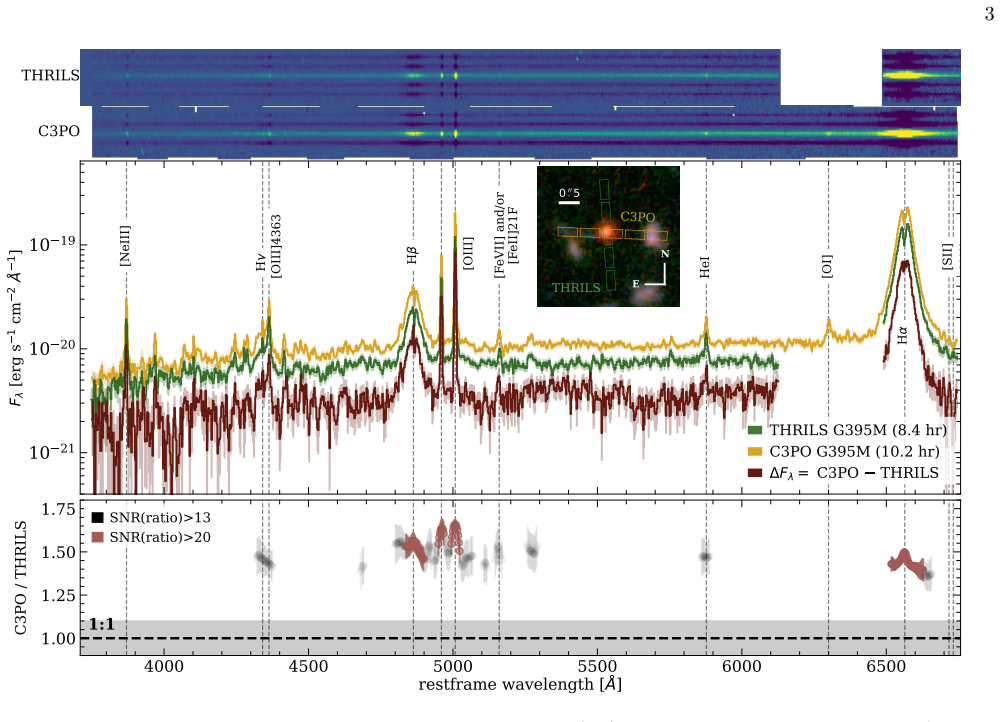
We show for the first time spectroscopic variability in a z ~ 7 LRD. Comparing spectra taken 99 days apart (~13 rest-days), we find a ~30% difference in the continuum and broad-line flux, and a 42% difference in [OIII]5008 flux. Assuming LRDs are a type of accreting black hole system, this implies direct sight-lines must exist from the accretion disk to the surrounding nebular gas on scales beyond the broad-line region, and thus any high-density gas interpretations must allow for covering fractions < 100%. The [OIII] line emission is likely not galaxy process-dominated, with a significant population of the narrow-line emitting gas closest to the broad-line region being directly ionized by Lr
What carries the argument
Multi-epoch comparison of JWST/NIRSpec F290LP/G395M spectra revealing intrinsic flux variations in continuum, broad emission lines, and narrow [OIII]5008.
Load-bearing premise
The measured flux differences between epochs are intrinsic astrophysical variability rather than residual instrumental or calibration effects.
What would settle it
An independent re-reduction or new observation of the same source using identical instrument settings that recovers identical flux levels in all components would falsify the claim of rapid intrinsic changes.
Figures




read the original abstract
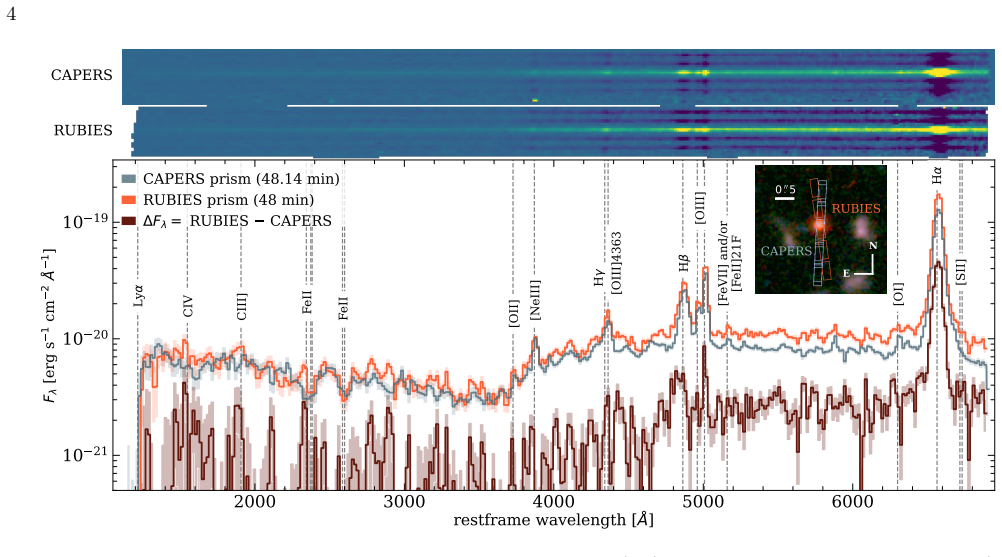
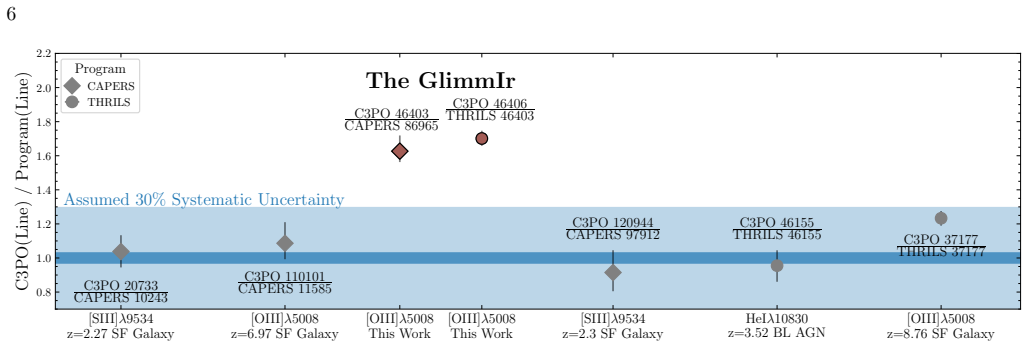
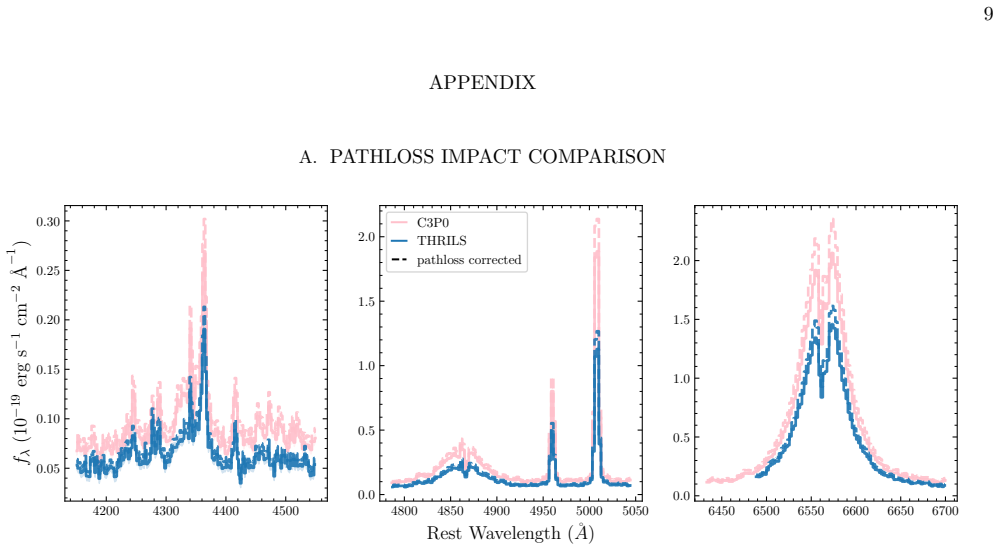
The enigmatic population of ``Little Red Dots'' (LRDs) sit at the center of some of the largest debates in extragalactic astronomy today. The source(s) of ionizing emission and the physical scale over which it governs is still largely unknown. We show for the first time spectroscopic variability in a z ~ 7 LRD. Comparing a recently obtained 10.2 hr JWST/NIRSpec F290LP/G395M spectrum via the C3PO survey to an 8.4 hr F290LP/G395M spectrum taken 99 days earlier (~13 rest-days) via the THRILS survey, we find a ~30% $ difference in the continuum and broad-line flux, and a 42% difference between [OIII]5008 flux in the two epochs. Through rigorous testing, we confirm that such differences are not the result of differing MSA slit placements on source nor merely flux calibration offsets. These results are further corroborated by both a similar continuum and [OIII]5008 flux differences found in NIRSpec prism/clear observations of the source at an epoch taken approximately a year earlier than the THRILS observations via RUBIES and an additional observation fortuitously taken during the THRILS epoch (within a rest-day) via the CAPERS survey. Assuming LRDs are a type of accreting black hole system, this implies direct sight-lines must exist from the accretion disk to the surrounding nebular gas on scales beyond the broad-line region, and thus any high-density gas interpretations must allow for covering fractions < 100%. Furthermore, these results show the [OIII] line emission is likely not galaxy process-dominated, with a significant population of the narrow-line emitting gas closest to the broad-line region being directly ionized by the LRD. Finally, these results highlight the need for new approaches in inferring black hole properties of these systems, accounting for the lack of significant ionization via star formation, and/or exploring more exotic host-galaxy conditions at these early epochs.
Editorial analysis
A structured set of objections, weighed in public.
Referee Report
Summary. The paper reports the first detection of spectroscopic variability in a z~7 Little Red Dot (LRD) using JWST/NIRSpec observations. Comparing two G395M spectra from the THRILS and C3PO surveys separated by 99 observer-frame days (~13 rest-frame days), the authors measure ~30% differences in continuum and broad-line fluxes and a 42% difference in [OIII]5008 flux. These changes are corroborated by prism observations from RUBIES (taken ~1 year earlier) and CAPERS (taken within ~1 rest-day of THRILS). Rigorous tests are claimed to rule out instrumental artifacts from MSA slit placement and flux calibration. The authors interpret this as evidence for direct sight-lines from an accretion disk to nebular gas beyond the broad-line region (assuming LRDs are accreting black holes), implying covering fractions <100% and that [OIII] emission is not purely galaxy-process dominated.
Significance. If the variability is confirmed to be astrophysical rather than residual systematics, this would represent a significant advance as the first spectroscopic variability detection in an LRD at z~7. It would provide direct constraints on the physical scale and geometry of the ionizing source and narrow-line gas, supporting AGN-like models with partial covering and highlighting limitations in current black-hole mass and accretion-rate inferences for these objects. The multi-epoch, multi-instrument cross-checks add strength if quantitative metrics are provided.
major comments (2)
- [Abstract and results section] Abstract and results section: The central claim of intrinsic variability rests on the assertion that 'rigorous testing' rules out MSA slit-placement and flux-calibration effects, yet no quantitative metrics are provided (e.g., modeled slit-loss fractions for the point-source component, continuum overlap residuals between epochs, cross-program flux-calibration precision, or statistical significance/error bars on the 30% and 42% differences). A 30-42% offset is comparable in magnitude to plausible residual systematics in faint high-z NIRSpec data, so these details are load-bearing for distinguishing astrophysical changes from artifacts.
- [Results and discussion] The corroborating prism observations (RUBIES and CAPERS) are presented as independent confirmation, but the manuscript does not quantify the consistency of the flux scales across grating vs. prism modes or address potential differences in absolute calibration between programs.
minor comments (2)
- [Abstract] The abstract would benefit from a brief statement of the measured flux ratios with uncertainties and the exact time baselines in both observer and rest frames.
- [Abstract] Notation for the flux differences (e.g., the ~30% difference symbol) should be clarified for precision.
Simulated Author's Rebuttal
We thank the referee for their detailed and constructive review. The comments correctly identify areas where additional quantitative detail would strengthen the presentation of the variability results. We address each major comment below and have revised the manuscript accordingly to include the requested metrics and comparisons.
read point-by-point responses
-
Referee: [Abstract and results section] Abstract and results section: The central claim of intrinsic variability rests on the assertion that 'rigorous testing' rules out MSA slit-placement and flux-calibration effects, yet no quantitative metrics are provided (e.g., modeled slit-loss fractions for the point-source component, continuum overlap residuals between epochs, cross-program flux-calibration precision, or statistical significance/error bars on the 30% and 42% differences). A 30-42% offset is comparable in magnitude to plausible residual systematics in faint high-z NIRSpec data, so these details are load-bearing for distinguishing astrophysical changes from artifacts.
Authors: We agree that the current manuscript would benefit from explicit quantitative metrics to support the claim that the observed differences are astrophysical. The revised version adds a dedicated subsection in the results that reports: (i) modeled slit-loss fractions for the point-source component using the known MSA shutter geometry and source position, (ii) measured continuum overlap residuals between the two G395M epochs after re-extraction with identical apertures, (iii) cross-program flux-calibration precision estimated from standard-star observations and overlapping sources in the same programs (typically 8-15% at these wavelengths), and (iv) statistical significance of the 30% continuum/broad-line and 42% [OIII] differences with propagated uncertainties. These additions show that the variations exceed the estimated systematic floor. revision: yes
-
Referee: [Results and discussion] The corroborating prism observations (RUBIES and CAPERS) are presented as independent confirmation, but the manuscript does not quantify the consistency of the flux scales across grating vs. prism modes or address potential differences in absolute calibration between programs.
Authors: We acknowledge the need for explicit cross-mode and cross-program calibration comparisons. The revised manuscript now includes a quantitative assessment of the grating-to-prism flux-scale consistency for this source, demonstrating that the continuum and [OIII] trends align within the combined calibration uncertainties. We also report the absolute calibration offsets between the RUBIES, CAPERS, THRILS, and C3PO programs, derived from standard stars and common sources observed across programs, which fall within the 10-20% range typical for NIRSpec at 3-5 microns. These values are now stated explicitly in the text and a new supplementary table. revision: yes
Circularity Check
No circularity: pure observational comparison of independent multi-epoch spectra
full rationale
The paper's central claim is an empirical detection of flux differences (~30% continuum/broad-line, 42% [OIII]) between NIRSpec G395M and prism observations from four separate programs (THRILS, C3PO, RUBIES, CAPERS) separated by ~13–99 rest-days. These differences are presented as direct measurements after the authors describe tests ruling out slit-placement and calibration artifacts; no equations, fitted parameters, model derivations, or ansatzes are invoked to produce the variability result. The BH-system interpretation is explicitly conditional ('Assuming LRDs are...') and does not enter any derivation chain. No self-citations, uniqueness theorems, or renamings of known results are used as load-bearing steps. The result is therefore self-contained against external benchmarks (the raw spectra themselves) and receives a score of 0.
Axiom & Free-Parameter Ledger
axioms (1)
- domain assumption JWST/NIRSpec flux calibration and slit placement effects can be rigorously tested and ruled out as causes of observed differences across epochs
Reference graph
Works this paper leans on
-
[1]
Akins, H. B., Casey, C. M., Lambrides, E., et al. 2024, arXiv e-prints, arXiv:2406.10341, doi: 10.48550/arXiv.2406.10341 Arrabal Haro, P., Dickinson, M., Finkelstein, S. L., et al. 2023, ApJL, 951, L22, doi: 10.3847/2041-8213/acdd54 Astropy Collaboration, Robitaille, T. P., Tollerud, E. J., et al. 2013, AAP, 558, A33, doi: 10.1051/0004-6361/201322068
-
[2]
Barro, G., P´ erez-Gonz´ alez, P. G., Kocevski, D. D., et al. 2024, ApJ, 963, 128, doi: 10.3847/1538-4357/ad167e
-
[3]
Barro, G., Perez-Gonzalez, P. G., Kocevski, D., et al. 2025, arXiv e-prints, arXiv:2512.15853, doi: 10.48550/arXiv.2512.15853
-
[5]
Baskin, A., & Laor, A. 2005b, MNRAS, 358, 1043, doi: 10.1111/j.1365-2966.2005.08841.x
-
[6]
Blandford, R. D., & McKee, C. F. 1982, ApJ, 255, 419, doi: 10.1086/159843
-
[7]
J., Stone, Z., Shen, Y ., & Jiang, Y .-F
Burke, C. J., Stone, Z., Shen, Y., & Jiang, Y.-F. 2025, arXiv e-prints, arXiv:2511.16082, doi: 10.48550/arXiv.2511.16082
-
[8]
2022, JWST Calibration Pipeline, 1.8.5 Zenodo, doi: 10.5281/zenodo.7429939
Bushouse, H., Eisenhamer, J., Dencheva, N., et al. 2022, JWST Calibration Pipeline, 1.8.5 Zenodo, doi: 10.5281/zenodo.7429939
-
[9]
2025, JWST Calibration Pipeline, 1.20.2 Zenodo, doi: 10.5281/zenodo.17515973
Bushouse, H., Eisenhamer, J., Dencheva, N., et al. 2025, JWST Calibration Pipeline, 1.20.2 Zenodo, doi: 10.5281/zenodo.17515973
-
[10]
Dalmasso, N., Watson, P. J., Treu, T., et al. 2025, MNRAS, 544, 1915, doi: 10.1093/mnras/staf1837 11 de Graaff, A., Brammer, G., Weibel, A., et al. 2025a, AAP, 697, A189, doi: 10.1051/0004-6361/202452186 de Graaff, A., Hviding, R. E., Naidu, R. P., et al. 2025b, arXiv e-prints, arXiv:2511.21820, doi: 10.48550/arXiv.2511.21820 D’Eugenio, F., Nelson, E., Ji...
-
[11]
2022, A&A, 661, A81, doi: 10.1051/0004-6361/202142673
Ferruit, P., Jakobsen, P., Giardino, G., et al. 2022, AAP, 661, A81, doi: 10.1051/0004-6361/202142673
-
[12]
Finkelstein, S. L., Leung, G. C. K., Bagley, M. B., et al. 2024, ApJL, 969, L2, doi: 10.3847/2041-8213/ad4495
-
[13]
Foreman-Mackey, D., Hogg, D. W., Lang, D., & Goodman, J. 2013, PASP, 125, 306, doi: 10.1086/670067
-
[14]
J., Labb´ e, I., Zitrin, A., et al
Furtak, L. J., Labb´ e, I., Zitrin, A., et al. 2023, arXiv e-prints, arXiv:2308.05735, doi: 10.48550/arXiv.2308.05735
-
[15]
Furtak, L. J., Secunda, A. R., Greene, J. E., et al. 2025, A&A, 698, A227, doi: 10.1051/0004-6361/202554110
-
[16]
Gaskell, C. M. 2009, NAR, 53, 140, doi: 10.1016/j.newar.2009.09.006 Gravity Collaboration, Sturm, E., Dexter, J., et al. 2018, Nature, 563, 657, doi: 10.1038/s41586-018-0731-9
-
[17]
Greene, J. E., Labbe, I., Goulding, A. D., et al. 2023, arXiv e-prints, arXiv:2309.05714, doi: 10.48550/arXiv.2309.05714
-
[18]
2023, ApJ, 959, 39, doi:10.3847/1538-4357/ad029e
Harikane, Y., Zhang, Y., Nakajima, K., et al. 2023, ApJ, 959, 39, doi: 10.3847/1538-4357/ad029e
- [19]
-
[20]
Hutchison, T. A., Larson, R. L., Arrabal Haro, P., et al. 2025, arXiv e-prints, arXiv:2512.12509. https://arxiv.org/abs/2512.12509 Ili´ c, D., Popovi´ c, L.ˇC., Shapovalova, A. I., et al. 2015, Journal of Astrophysics and Astronomy, 36, 433, doi: 10.1007/s12036-015-9360-y
-
[21]
Inayoshi, K., & Maiolino, R. 2025, ApJL, 980, L27, doi: 10.3847/2041-8213/adaebd
-
[22]
2020, ARA&A, 58, 27, doi: 10.1146/annurev-astro-120419-014455
Inayoshi, K., Visbal, E., & Haiman, Z. 2020, Annual Review of Astronomy and Astrophysics, 58, 27, doi: 10.1146/annurev-astro-120419-014455
-
[23]
2025, arXiv e-prints, arXiv:2501.13082, doi: 10.48550/arXiv.2501.13082
Ji, X., Maiolino, R., ¨Ubler, H., et al. 2025, arXiv e-prints, arXiv:2501.13082, doi: 10.48550/arXiv.2501.13082
-
[24]
Killi, M., Watson, D., Brammer, G., et al. 2024, AAP, 691, A52, doi: 10.1051/0004-6361/202348857
-
[25]
Hidden Little Monsters: Spectroscopic Iden- tification of Low-Mass, Broad-Line AGN atz >5 with CEERS
Kocevski, D. D., Onoue, M., Inayoshi, K., et al. 2023, arXiv e-prints, arXiv:2302.00012, doi: 10.48550/arXiv.2302.00012
-
[26]
Kocevski, D. D., Finkelstein, S. L., Barro, G., et al. 2025, ApJ, 986, 126, doi: 10.3847/1538-4357/adbc7d
-
[27]
Kokorev, V., Fujimoto, S., Labbe, I., et al. 2023, arXiv e-prints, arXiv:2308.11610, doi: 10.48550/arXiv.2308.11610
-
[28]
Kokorev, V., Caputi, K. I., Greene, J. E., et al. 2024, ApJ, 968, 38, doi: 10.3847/1538-4357/ad4265
-
[29]
Labbe, I., Greene, J. E., Bezanson, R., et al. 2025, ApJ, 978, 92, doi: 10.3847/1538-4357/ad3551
-
[30]
The case for super-Eddington accretion in JWST broad-line AGN during the first billion years
Lambrides, E., Garofali, K., Larson, R., et al. 2024, arXiv e-prints, arXiv:2409.13047, doi: 10.48550/arXiv.2409.13047
work page internal anchor Pith review Pith/arXiv arXiv doi:10.48550/arxiv.2409.13047 2024
-
[31]
Lambrides, E., Larson, R., Hutchison, T., et al. 2025, arXiv e-prints, arXiv:2509.09607, doi: 10.48550/arXiv.2509.09607
-
[32]
Landt, H., Ward, M. J., Steenbrugge, K. C., & Ferland, G. J. 2015, MNRAS, 449, 3795, doi: 10.1093/mnras/stv062
-
[33]
Larson, R. L., Finkelstein, S. L., Kocevski, D. D., et al. 2023, arXiv e-prints, arXiv:2303.08918, doi: 10.48550/arXiv.2303.08918
-
[34]
2026, arXiv e-prints, arXiv:2603.01473
Lin, R., Zheng, Z.-Y., Wang, J., et al. 2026, arXiv e-prints, arXiv:2603.01473. https://arxiv.org/abs/2603.01473
-
[35]
L., Ivezi´ c,ˇZ., Sesar, B., et al
MacLeod, C. L., Ivezi´ c,ˇZ., Sesar, B., et al. 2012, ApJ, 753, 106, doi: 10.1088/0004-637X/753/2/106
-
[36]
Matthee, J., Naidu, R. P., Brammer, G., et al. 2023, arXiv e-prints, arXiv:2306.05448, doi: 10.48550/arXiv.2306.05448
-
[37]
P., Matthee, J., Katz, H., et al
Naidu, R. P., Matthee, J., Katz, H., et al. 2025, arXiv e-prints, arXiv:2503.16596, doi: 10.48550/arXiv.2503.16596 P´ erez-Gonz´ alez, P. G., Barro, G., Rieke, G. H., et al. 2024, ApJ, 968, 4, doi: 10.3847/1538-4357/ad38bb P´ erez-Gonz´ alez, P. G., Barro, G., Carniani, S., et al. 2026, arXiv e-prints, arXiv:2602.20247, doi: 10.48550/arXiv.2602.20247
-
[38]
Peterson, B. M. 1993, PASP, 105, 247, doi: 10.1086/133140
-
[39]
Peterson, B. M., Denney, K. D., De Rosa, G., et al. 2013, ApJ, 779, 109, doi: 10.1088/0004-637X/779/2/109
-
[40]
The Astronomical Journal , author =
Price-Whelan, A. M., Sip˝ ocz, B. M., G¨ unther, H. M., et al. 2018, AJ, 156, 123, doi: 10.3847/1538-3881/aabc4f
-
[41]
E., Eckart, A., Valencia-S., M., et al
Rashed, Y. E., Eckart, A., Valencia-S., M., et al. 2015, MNRAS, 454, 2918, doi: 10.1093/mnras/stv2066
-
[42]
Rauscher, B. J. 2024, PASP, 136, 015001, doi: 10.1088/1538-3873/ad1b36
-
[43]
2025, arXiv e-prints, arXiv:2508.20177
Ronayne, K., Papovich, C., Kirkpatrick, A., et al. 2025, arXiv e-prints, arXiv:2508.20177, doi: 10.48550/arXiv.2508.20177
-
[44]
Secunda, A., Somerville, R. S., Jiang, Y.-F., et al. 2026, ApJ, 996, 6, doi: 10.3847/1538-4357/ae1f08 12
-
[45]
2021, MNRAS, 500, 2871, doi: 10.1093/mnras/staa3278
Gorjian, V. 2021, MNRAS, 500, 2871, doi: 10.1093/mnras/staa3278
-
[46]
The Sloan Digital Sky Survey Reverberation Mapping Project: Key Results
Shen, Y., Grier, C. J., Horne, K., et al. 2024, ApJS, 272, 26, doi: 10.3847/1538-4365/ad3936
-
[47]
2019, Contemporary Physics, 60, 111, doi: 10.1080/00107514.2019.1615715
Smith, A., & Bromm, V. 2019, Contemporary Physics, 60, 111, doi: 10.1080/00107514.2019.1615715
-
[48]
Smith, T. B., Fries, L. B., Trump, J. R., et al. 2025, ApJ, 995, 185, doi: 10.3847/1538-4357/ae1f18 Smithsonian Astrophysical Observatory. 2000, SAOImage DS9: A utility for displaying astronomical images in the X11 window environment,, Astrophysics Source Code Library, record ascl:0003.002 http://ascl.net/0003.002
-
[49]
Tang, M., Stark, D. P., Plat, A., et al. 2025, arXiv e-prints, arXiv:2505.06359, doi: 10.48550/arXiv.2505.06359
-
[50]
Taylor, A. J., Finkelstein, S. L., Kocevski, D. D., et al. 2025a, ApJ, 986, 165, doi: 10.3847/1538-4357/add15b
-
[51]
Taylor, A. J., Kokorev, V., Kocevski, D. D., et al. 2025b, ApJL, 989, L7, doi: 10.3847/2041-8213/ade789 Vanden Berk, D. E., Wilhite, B. C., Kron, R. G., et al. 2004, ApJ, 601, 692, doi: 10.1086/380563
-
[52]
Wang, B., Leja, J., de Graaff, A., et al. 2024, ApJL, 969, L13, doi: 10.3847/2041-8213/ad55f7
-
[53]
Wang, B., de Graaff, A., Davies, R. L., et al. 2025a, ApJ, 984, 121, doi: 10.3847/1538-4357/adc1ca
-
[54]
The Missing Hard Photons of Little Red Dots: Their Incident Ionizing Spectra Resemble Massive Stars
Wang, B., Leja, J., Katz, H., et al. 2025b, arXiv e-prints, arXiv:2508.18358, doi: 10.48550/arXiv.2508.18358
work page internal anchor Pith review Pith/arXiv arXiv doi:10.48550/arxiv.2508.18358
-
[56]
Little red dot variability over a century reveals black hole envelope via a giant Einstein cross
Zhang, Z., Li, M., Oguri, M., et al. 2025b, arXiv e-prints, arXiv:2512.05180, doi: 10.48550/arXiv.2512.05180
-
[57]
Zhou, S., Sun, M., Zhang, Z., Chen, J., & Ho, L. C. 2025, ApJ, 991, 137, doi: 10.3847/1538-4357/adfd5f
-
[58]
Zhu, P., Kewley, L. J., & Sutherland, R. S. 2023, ApJ, 954, 175, doi: 10.3847/1538-4357/acd757 All Authors and Affiliations Erini Lambrides ,1, 2, 3 Taylor A. Hutchison ,1, 4, 3,∗ Rebecca L. Larson ,5,† Pablo Arrabal Haro ,6, 1 Casey Papovich ,7, 8 Weida Hu ,7, 8 Nikko J. Cleri ,9, 10, 11 Steven L. Finkelstein ,12, 13 Jonathan R. Trump ,14 Pablo G. P´erez...
discussion (0)
Sign in with ORCID, Apple, or X to comment. Anyone can read and Pith papers without signing in.