Recognition: unknown
Exposing impostor Majorana zero modes through atomic-scale shot-noise
Pith reviewed 2026-05-07 14:14 UTC · model grok-4.3
The pith
Atomic-scale shot-noise measurements distinguish trivial bound states from Majorana zero modes by revealing their particle and hole character.
A machine-rendered reading of the paper's core claim, the machinery that carries it, and where it could break.
Core claim
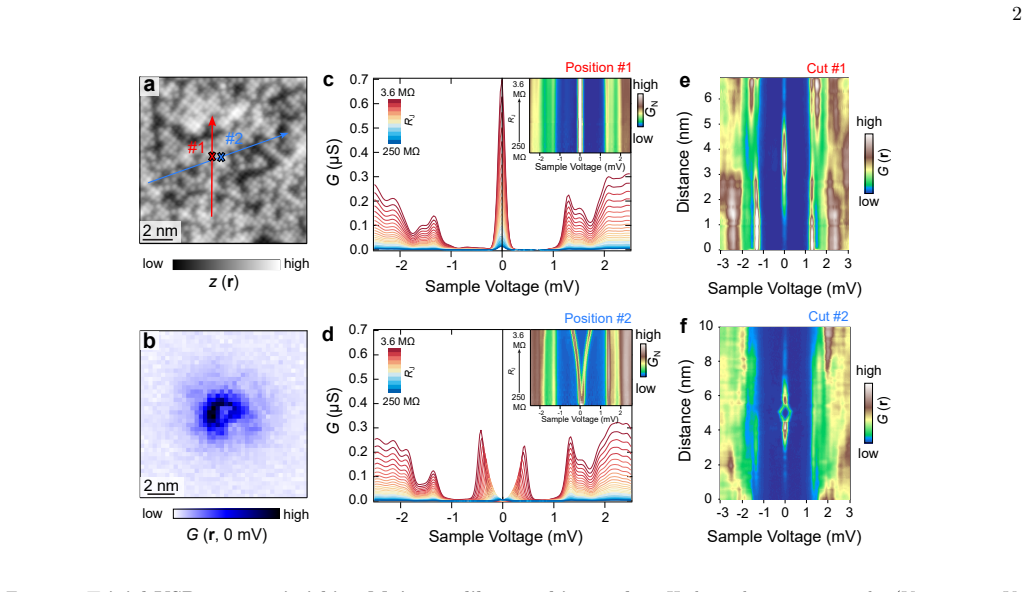
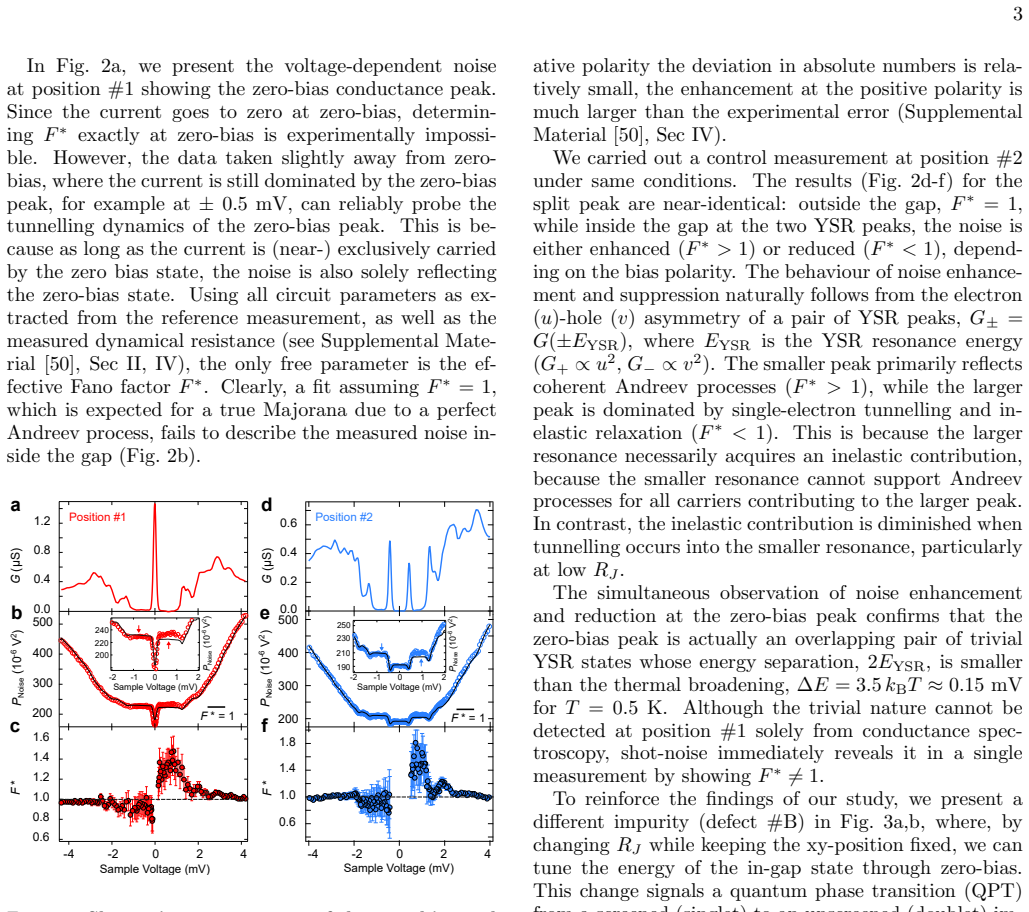
In Fe(Se,Te), multiple defect-bound zero-bias states exhibit robust zero-bias peaks in differential conductance, yet shot-noise spectroscopy consistently uncovers the individual particle and hole character concealed within the tunneling conductance, thereby exposing the trivial nature of these zero-bias peaks and ruling out their interpretation as Majorana zero modes.
What carries the argument
Atomic-scale shot-noise spectroscopy, which probes the fluctuations in tunneling current to separate the particle and hole components of bound states.
If this is right
- Conductance spectroscopy alone is prone to misidentifying trivial states as Majorana zero modes in this material.
- Shot-noise measurements can serve as a decisive test to exclude impostor signatures in atomic-scale experiments.
- Defect-induced bound states can mimic the appearance of Majorana modes in conductance data.
- The method applies to other putative p-wave superconductors where similar ambiguities exist.
Where Pith is reading between the lines
- Similar shot-noise diagnostics could be developed for other candidate Majorana systems to improve identification reliability.
- If genuine Majorana modes produce uniform noise without particle-hole splitting, this would strengthen the distinction.
- Extending this technique to different defects or temperatures might identify conditions that suppress trivial impostors.
Load-bearing premise
Genuine Majorana zero modes lack the particle-hole split signature in shot noise that trivial bound states exhibit in Fe(Se,Te).
What would settle it
Detection of the same shot-noise fingerprint of separate particle and hole character in a system independently confirmed to host Majorana zero modes would falsify the claim that this signature uniquely identifies trivial states.
Figures

read the original abstract
A robust zero-bias conductance peak in putative $p$-wave superconductors is often regarded as the primary signature of a Majorana zero mode. Yet similar features can also arise from trivial bound states. This ambiguity has limited the reliability of conventional spectroscopy as a diagnostic tool, raising a long-standing problem of how to detect such impostors. Here, we address this issue with an alternative approach, atomic-scale shot-noise spectroscopy, that goes beyond conductance measurements. Through a detailed investigation of multiple defect-bound zero-bias states in the widely studied superconductor Fe(Se,Te), we observe that differential conductance can exhibit an apparently `robust' zero-bias peak. However, shot-noise measurements consistently reveal the fingerprint of the individual particle- and hole character hidden in the tunnelling conductance, unambiguously exposing the trivial nature of the zero-bias peak. Our results establish shot-noise spectroscopy as a decisive diagnostic for ruling out false Majorana signatures in atomic-scale experiments.
Editorial analysis
A structured set of objections, weighed in public.
Referee Report
Summary. The paper claims that atomic-scale shot-noise spectroscopy distinguishes trivial defect-bound zero-bias peaks from genuine Majorana zero modes in Fe(Se,Te). While differential conductance shows robust zero-bias peaks, shot-noise measurements reveal particle-hole character in the tunneling process, exposing the states as trivial impostors rather than topological MZMs.
Significance. If the diagnostic holds, this provides a valuable new experimental tool to resolve ambiguities in MZM searches, building on established tunneling physics with consistent observations across multiple defects. The experimental consistency is a strength, but the lack of a material-specific benchmark for true MZMs reduces the immediate impact.
major comments (2)
- [Abstract and results on shot-noise] Abstract and results section on shot-noise interpretation: The claim that measurements 'unambiguously' expose trivial character rests on the assumption that the observed particle-hole fingerprint in differential noise is incompatible with genuine MZMs, yet no BdG or scattering-theory calculation of expected atomic-scale shot noise for a true MZM (under the same tunneling conditions, temperature, and Fe(Se,Te) parameters) is provided; general topological arguments may not capture local geometry or coupling details that could produce similar signatures.
- [Results and discussion] Discussion of quantitative analysis and controls: The manuscript reports consistent observations across multiple defects but provides no explicit quantitative data, error bars, or detailed controls for other tunneling effects that could affect the noise signature, undermining the strength of the distinction as a decisive diagnostic.
minor comments (3)
- [Methods] Notation for differential shot-noise should be explicitly defined in the methods or early results to avoid ambiguity with conductance data.
- [Figures] Figures comparing conductance and noise should include clear annotations for particle-hole asymmetry and consistent scaling across panels for multiple defects.
- [Introduction] Add references to prior theoretical work on shot-noise in topological superconductors to contextualize the uniqueness claim.
Simulated Author's Rebuttal
We thank the referee for the careful reading of our manuscript and the constructive comments. We address each major comment below and have made revisions to improve clarity and rigor where appropriate.
read point-by-point responses
-
Referee: [Abstract and results on shot-noise] Abstract and results section on shot-noise interpretation: The claim that measurements 'unambiguously' expose trivial character rests on the assumption that the observed particle-hole fingerprint in differential noise is incompatible with genuine MZMs, yet no BdG or scattering-theory calculation of expected atomic-scale shot noise for a true MZM (under the same tunneling conditions, temperature, and Fe(Se,Te) parameters) is provided; general topological arguments may not capture local geometry or coupling details that could produce similar signatures.
Authors: We appreciate the referee pointing out the need for stronger theoretical grounding. Our interpretation relies on the established particle-hole symmetry of a true Majorana zero mode, which requires equal particle and hole components and thus a symmetric noise response under the tunneling conditions used. The observed asymmetry is incompatible with this symmetry. We agree that a material-specific BdG or scattering calculation would be valuable but lies beyond the scope of this experimental study. In the revised manuscript we have moderated the language in the abstract and results from 'unambiguously' to 'strongly indicates,' added a dedicated paragraph explaining the symmetry argument, and referenced relevant topological literature to address possible local-geometry effects. revision: partial
-
Referee: [Results and discussion] Discussion of quantitative analysis and controls: The manuscript reports consistent observations across multiple defects but provides no explicit quantitative data, error bars, or detailed controls for other tunneling effects that could affect the noise signature, undermining the strength of the distinction as a decisive diagnostic.
Authors: The referee correctly identifies that additional quantitative detail would strengthen the presentation. We have revised the results and discussion sections to include explicit quantitative values for the noise asymmetry, added error bars to all relevant data points and figures, and expanded the methods and discussion to describe controls for temperature, junction stability, and other potential tunneling artifacts. These additions confirm the consistency of the particle-hole fingerprint across the studied defects. revision: yes
Circularity Check
No circularity: purely experimental claims with no derivations or self-referential reductions
full rationale
The manuscript is an experimental study reporting atomic-scale shot-noise measurements on defect-bound zero-bias states in Fe(Se,Te). No mathematical derivations, equations, fitted parameters, or ansatzes appear in the provided text. All claims rest on direct observations interpreted via established tunneling physics rather than any self-definition, fitted-input prediction, or self-citation chain. The analysis is therefore self-contained against external benchmarks and receives the default non-finding.
Axiom & Free-Parameter Ledger
axioms (1)
- domain assumption Shot-noise spectroscopy can unambiguously reveal the particle-hole character of zero-bias states in tunneling experiments on Fe(Se,Te).
Reference graph
Works this paper leans on
-
[1]
Nayak, S
C. Nayak, S. H. Simon, A. Stern, M. Freedman, and S. Das Sarma, Non-Abelian anyons and topological quan- tum computation, Rev. Mod. Phys.80, 1083 (2008)
2008
-
[2]
A. Y. Kitaev, Fault-tolerant quantum computation by anyons, Ann. Phys.303, 2 (2003)
2003
-
[3]
R. M. Lutchyn, E. P. A. M. Bakkers, L. P. Kouwen- hoven, P. Krogstrup, C. M. Marcus, and Y. Oreg, Majo- rana zero modes in superconductor–semiconductor het- erostructures, Nat. Rev. Mater.3, 52 (2018)
2018
-
[4]
Nadj-Perge, I
S. Nadj-Perge, I. K. Drozdov, B. A. Bernevig, A. Yaz- dani, Proposal for realizing Majorana fermions in chains of magnetic atoms on a superconductor, Phys. Rev. B 88, 020407 (2013)
2013
-
[5]
Pientka, L
F. Pientka, L. I. Glazman, and F. von Oppen, Topological superconducting phase in helical Shiba chains, Phys. Rev. B88, 155420 (2013)
2013
-
[6]
Nadj-Perge, I
S. Nadj-Perge, I. K. Drozdov, J. Li, H. Chen, S. Jeon, J. Seo, A. H. MacDonald, B. A. Bernevig, and A. Yaz- dani, Observation of Majorana fermions in ferromagnetic atomic chains on a superconductor, Science346, 602 (2014)
2014
-
[7]
H. Kim, A. Palacio-Morales, T. Posske, L. Rasche, L. R´ ozsa, K. Palot´ as, L. Szunyogh, M. Thorwart, and R. Wiesendanger, Toward tailoring Majorana bound states in artificially constructed magnetic atom chains on ele- mental superconductors, Sci. Adv.4, eaar5251 (2018)
2018
-
[8]
Schneider, P
L. Schneider, P. Beck, J. Neuhaus-Steinmetz, L. R´ ozsa, T. Posske, J. Wiebe and R. Wiesendanger, Precursors of Majorana modes and their length-dependent energy oscillations probed at both ends of atomic Shiba chains, Nat. Nanotechnol.17, 384 (2022)
2022
-
[9]
J-P. Xu, M-X. Wang, Z. L. Liu, J-F. Ge, X. Yang, C. Liu, Z. A. Xu, D. Guan, C. L. Gao, D. Qian, et al., Experimental detection of a Majorana mode in the core of a magnetic vortex inside a topological in- sulator–superconductor Bi 2Te3/NbSe2 heterostructure, Phys. Rev. Lett.114, 017001 (2015)
2015
-
[10]
Palacio-Morales, E
A. Palacio-Morales, E. Mascot, S. Cocklin, H. Kim, S. Rachel, D. K. Morr, and R. Wiesendanger, Atomic- scale interface engineering of Majorana edge modes in a 2D magnet-superconductor hybrid system, Sci. Adv.5, eaav6600 (2019)
2019
-
[11]
Kezilebieke, M
S. Kezilebieke, M. N. Huda, V. Vaˇ no, M. Aapro, S. C. Ganguli, O. J. Silveira, S. G lodzik, A. S. Foster, T. Oja- nen, and Peter Liljeroth, Topological superconductivity in a van der Waals heterostructure, Nature588, 424 (2020)
2020
-
[12]
Zhang, G
Z Wang, P. Zhang, G. Xu, L. K. Zeng, H. Miao, X. Xu, T. Qian, H. Weng, P. Richard et al., Topological na- ture of the FeSe 0.5Te0.5 superconductor, Phys. Rev. B 92, 115119 (2015)
2015
-
[13]
G. Xu, B. Lian, P. Tang, X.-L. Qi, and S.-C. Zhang, Topological superconductivity on the surface of Fe-based superconductors, Phys. Rev. Lett.117, 047001 (2016)
2016
-
[14]
Zhang, K
P. Zhang, K. Yaji, T. Hashimoto, Y. Ota, T. Kondo, K. Okazaki, Z. Wang, J. Wen, G. D. Gu, H. Ding, and S. Shin, Observation of topological superconductivity on the surface of an iron-based superconductor, Science360, 182 (2018)
2018
-
[15]
Zhang, Z
P. Zhang, Z. Wang, X. Wu, K. Yaji, Y. Ishida, Y. Ko- hama, G. Dai, Y. Sun, C. Bareille, K. Kuroda, et al. Multiple topological states in iron-based superconduc- tors, Nat. Phys.15, 41 (2019)
2019
-
[16]
Yin, J-X
J. Yin, J-X. Yin, Z. Wu, J-H. Wang, Z-Y. Ye, J. Gong, X-Y. Hou, L. Shan, A. Li, X-J. Liang, X-X. Wu, et al, Observation of a robust zero-energy bound state in iron-based superconductor Fe(Te,Se), Nat. Phys.11, 543 (2015)
2015
-
[17]
C. Chen, K. Jiang, Y. Zhang, C. Liu, Y. Liu, Z. Wang, and Jian Wang, Atomic line defects and zero-energy end states in monolayer Fe(Te,Se) high-temperature super- conductors, Nat. Phys.16, 536 (2020)
2020
-
[18]
P. Fan, F. Yang, G. Qian, H. Chen, Y-Y. Zhang, G. Li, Z. Huang, Y. Xing, L. Kong, W. Liu, et al, Observa- tion of magnetic adatom-induced Majorana vortex and its hybridization with field-induced Majorana vortex in an iron-based superconductor, Nat. Commun.12, 1348 (2021)
2021
-
[19]
Q. Liu, C. Chen, T. Zhang, R. Peng, Y-J. Yan, C.-H.- P. Wen, X. Lou, Y.-L. Huang, J.-P. Tian, et al., Ro- bust and clean Majorana zero mode in the vortex core of high-temperature superconductor (Li 0.84Fe0.16)OHFeSe, Phys. Rev. X8, 041056 (2018)
2018
-
[20]
D. Wang, L. Kong, P. Fan, H. Chen, S. Zhu, W. Liu, L. Cao, Y. Sun, S. Du, J. Schneeloch, Evidence for Majo- rana bound states in an iron-based superconductor, Sci- 6 ence362, 333 (2018)
2018
-
[21]
Machida, Y
T. Machida, Y. Sun, S. Pyon, S. Takeda, Y. Kohsaka, T. Hanaguri, T. Sasagawa and T. Tamegai, Zero-energy vortex bound state in the superconducting topological surface state of Fe(Se,Te), Nat. Mater.18, 811 (2019)
2019
-
[22]
S. Zhu, L. Kong, L. Cao, H. Chen, M. Papaj, S. Du, Y. Xing, W. Liu, D. Wang, C. Shen, et al., Nearly quantized conductance plateau of vortex zero mode in an iron-based superconductor, Science367, 189 (2020)
2020
-
[23]
W. Liu, L. Cao, S. Zhu, L. Kong, G. Wang, M. Papaj, P. Zhang, Y-B. Liu, H. Chen, G. Li, et al., A new Majo- rana platform in an Fe-As bilayer superconductor, Nat. Commun.11, 5688 (2020)
2020
-
[24]
L. Kong, L. Cao, S. Zhu, M. Papaj, G. Dai, G. Li, P. Fan, W. Liu, F. Yang, X. Wang, et al., Majorana zero modes in impurity-assisted vortex of LiFeAs superconductor, Nat. Commun.12, 4146 (2021)
2021
-
[25]
J¨ ack, Y
B. J¨ ack, Y. Xie, and A. Yazdani, Detecting and distin- guishing Majorana zero modes with the scanning tun- nelling microscope, Nat. Rev. Phys.3, 541 (2021)
2021
-
[26]
Rachel and R
S. Rachel and R. Wiesendanger, Majorana quasiparticles in atomic spin chains on superconductors, Phys. Rep. 1099, 1 (2025)
2025
-
[27]
G. C. M´ enard, S. Guissart, C. Brun, R. T. Leriche, M. Trif, F. Debontridder, D. Demaille, D. Roditchev, P. Si- mon and T. Cren, Two-dimensional topological super- conductivity in Pb/Co/Si(111), Nat. Commun.8, 2040 (2017)
2040
-
[28]
B. W. Heinrich, J. I. Pascual, and K. J. Franke, Single magnetic adsorbates on s-wave superconductors, Prog. Surf. Sci.93, 1 (2018)
2018
-
[29]
M. Ruby, F. Pientka, Y. Peng, F. von Oppen, B. W. Hein- rich, and K. J. Franke, End states and subgap structure in proximity-coupled chains of magnetic adatoms, Phys. Rev. Lett.115, 197204 (2015)
2015
-
[30]
H. Kim, Y. Nagai, L. R´ ozsa, D. Schreyer, and R. Wiesen- danger, Anisotropic non-split zero-energy vortex bound states in a conventional superconductor, Appl. Phys. Rev.8, 031417 (2021)
2021
-
[31]
J-F. Ge, K. M. Bastiaans, D. Chatzopoulos, D. Cho, W. O. Tromp, T. Benschop, J. Niu, G. Gu and M. P. Allan, Single-electron charge transfer into putative Majorana and trivial modes in individual vortices, Nat. Commun. 14, 3341 (2023)
2023
-
[32]
Chatzopoulos, D
D. Chatzopoulos, D. Cho, K. M. Bastiaans, G. O. Stef- fensen, D. Bouwmeester, A. Akbari, G. Gu, J. Paaske, B. M. Andersen and M. P. Allan, Spatially dispersing Yu- Shiba-Rusinov states in the unconventional superconduc- tor FeTe0.55Se0.45, Nat. Commun.12, 298 (2021)
2021
-
[33]
J. Lee, S. Lee, A. Kreisel, J. Paaske, B. M. Andersen, K. M. Bastiaans, D. Chatzopoulos, G. Gu, D. Cho, and M. P. Allan, Signatures of amorphous Shiba state in FeTe0.55Se0.45, Nano Lett.25, 4227 (2025)
2025
-
[34]
Uldemolins, A
M. Uldemolins, A. Mesaros, G. D. Gu, A. Palacio- Morales, M. Aprili, P. Simon, and F. Massee, Hund’s coupling mediated multi-channel quantum phase transi- tion of a single magnetic impurity in Fe(Se, Te), Nat. Commun.15, 8526 (2024)
2024
-
[35]
Zhang, R
Y. Zhang, R. Sun, T. Xie, Z-Y. Liu, R. Wang, W. Zhang, C. Liu and Y-S. Fu, High-resolution spectroscopy of the intermediate impurity states near a quantum phase tran- sition, Nano Lett.24, 14222 (2024)
2024
-
[36]
Sun, K-W
H-H. Sun, K-W. Zhang, L-H. Hu, C. Li, G-Y. Wang, H- Y. Ma, Z-A. Xu, C-L. Gao, D-D. Guan, Y-Y. Li, et al., Majorana zero mode detected with spin selective Andreev reflection in the vortex of a topological superconductor, Phys. Rev. Lett.116, 257003 (2016)
2016
-
[37]
D. Wang, J. Wiebe, R. Zhong, G. Gu, and R. Wiesen- danger, Spin-polarized Yu-Shiba-Rusinov states in an iron-based superconductor, Phys. Rev. Lett.126, 076802 (2021)
2021
-
[38]
C. J. Bolech and E. Demler, Observing Majorana bound states in p-wave superconductors using noise measure- ments in tunneling experiments, Phys. Rev. Lett.98, 237002 (2007)
2007
-
[39]
Nilsson, A
J. Nilsson, A. R. Akhmerov, and C. W. J. Beenakker, Splitting of a Cooper pair by a pair of Majorana bound states, Phys. Rev. Lett.101, 120403 (2008)
2008
-
[40]
Y. Cao, P. Wang, G. Xiong, M. Gong, and X.-Q. Li, Probing the existence and dynamics of Majorana fermion via transport through a quantum dot, Phys. Rev. B86, 115311 (2012)
2012
-
[41]
D. E. Liu, M. Cheng, and R. M. Lutchyn, Probing Ma- jorana physics in quantum-dot shot-noise experiments, Phys. Rev. B91, 081405(R) (2015)
2015
-
[42]
K. H. Wong, E. Mascot, V. Madhavan, D. J. Van Har- lingen, and D. K. Morr, Shot-noise and differential con- ductance as signatures of putative topological supercon- ductivity in FeSe 0.45Te0.55, Phys. Rev. B105, L220504 (2022)
2022
-
[43]
J. Mei, K. Jiang, and J. Hu, Identifying Majorana zero modes in vortex lattices using Fano factor tomography, Phys. Rev. B109, 064509 (2024)
2024
-
[44]
Perrin, M
V. Perrin, M. Civelli, and P. Simon, Identifying Majorana bound states by tunneling shot-noise tomography, Phys. Rev. B104, L121406 (2021)
2021
-
[45]
Massee, Q
F. Massee, Q. Dong, A. Cavanna, Y. Jin, and M. Aprili, Atomic scale shot-noise using cryogenic MHz circuitry, Rev. Sci. Instrum.89, 093708 (2018)
2018
-
[46]
K. M. Bastiaans, T. Benschop, D. Chatzopoulos, D. Cho, Q. Dong, Y. Jin and M. P. Allan, Amplifier for scanning tunneling microscopy at MHz frequencies, Rev. Sci. In- strum.89, 093709 (2018)
2018
-
[47]
Y. M. Blanter and M. B¨ uttiker, Shot-noise in mesoscopic conductors, Phys. Rep.336, 1 (2000)
2000
-
[48]
Thupakula, V
U. Thupakula, V. Perrin, A. Palacio-Morales, L. Cario, M. Aprili, P. Simon, and F. Massee, Coherent and inco- herent tunneling into Yu-Shiba-Rusinov states revealed by atomic scale shot-noise spectroscopy, Phys. Rev. Lett. 128, 247001 (2022)
2022
-
[49]
D. C. Ohnmacht, W. Belzig, and J. C. Cuevas, Full count- ing statistics of Yu–Shiba–Rusinov bound states, Phys. Rev. Res.5, 033176 (2023)
2023
-
[50]
[32, 44, 45, 47-49, 52-53]
See Supplemental Material at http://link.aps.org/ Sup- plemental/*** for more details on the methods and ad- ditional experimental data, which includes Refs. [32, 44, 45, 47-49, 52-53]
-
[51]
Z. Wang, J. Olivares Rodriguez, L. Jiao, S. Howard, M. Graham, G. D. Gu, T. L. Hughes, D. K. Morr, and V. Madhavan, Evidence for dispersing 1D Majorana chan- nels in an iron-based superconductor, Science367, 104 (2020)
2020
-
[52]
Ronen, Y
Y. Ronen, Y. Cohen, J-H. Kang, A. Haim, M-T. Rieder, M. Heiblum, D. Mahalu, and H. Shtrikman, Charge of a quasiparticle in a superconductor, Proc. Natl. Acad. Sci. U.S.A.113, 1743 (2016)
2016
-
[53]
Q. Dong, Y. X. Liang, D. Ferry, A. Cavanna, U. Gennser, L. Couraud and Y. Jin, Ultra-low noise high electron mo- 7 bility transistors for high-impedance and low-frequency deep cryogenic readout electronics, Appl. Phys. Lett. 105, 013504 (2014)
2014
discussion (0)
Sign in with ORCID, Apple, or X to comment. Anyone can read and Pith papers without signing in.