Recognition: unknown
Revisiting Turner Window Axions: The Untapped Potential of NaI Dark Matter Detectors
Pith reviewed 2026-05-07 15:40 UTC · model grok-4.3
The pith
NaI detectors can probe significant regions of the Turner window for axions with hadronic couplings through resonant absorption of 440 keV axions from carbon-burning stars.
A machine-rendered reading of the paper's core claim, the machinery that carries it, and where it could break.
Core claim
Accounting more completely for axion opacity in SN1987A weakens the Kamioka II photon limit, rendering significant regions of the Turner window viable for axions with hadronic couplings g_ann and g_app. The Milky Way's carbon-burning stars produce a detectable flux of 440 keV axions that undergo resonant absorption in ^{23}Na, with NaI detectors serving simultaneously as target and gamma-ray detector. Current array masses and backgrounds allow the coupling range |g_app| ∼ 10^{-6.5}--10^{-2} to be covered after two years, including QCD axions with m_a ≳ 10 eV.
What carries the argument
Resonant absorption of thermally produced 440 keV axions in ^{23}Na nuclei inside NaI crystals, where the same detector records the subsequent gamma rays.
If this is right
- Substantial portions of the Turner window for hadronically coupled axions become testable with already-deployed hardware.
- QCD axions with masses above approximately 10 eV enter the reach of current NaI arrays.
- The coupling interval |g_app| from 10^{-6.5} to 10^{-2} can be excluded or confirmed after two years of data collection.
- Carbon-burning stars provide a continuous, well-characterized astrophysical source of monoenergetic axions.
Where Pith is reading between the lines
- Repurposing WIMP-search arrays for resonant axion absorption offers a low-cost route to test hadronic axion models without new infrastructure.
- Non-observation would tighten stellar axion production bounds beyond supernova cooling arguments alone.
- The same resonant-absorption approach could be extended to other nuclei in different scintillator materials to cover additional axion mass windows.
Load-bearing premise
A more complete treatment of axion opacity in SN1987A significantly weakens the limit from the absence of associated photons in the Kamioka II detector.
What would settle it
Absence of any excess 440 keV gamma-ray events in existing NaI arrays after two years of exposure at the sensitivity needed to reach |g_app| = 10^{-6.5} would show that the reopened Turner window remains inaccessible or requires further revision of the opacity calculation.
Figures





read the original abstract
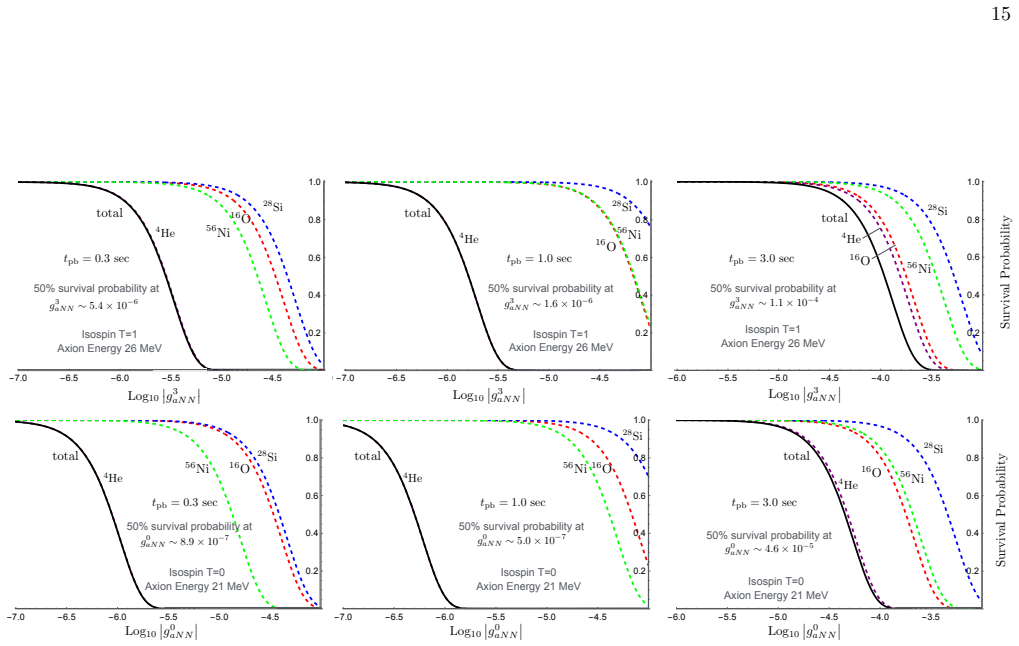
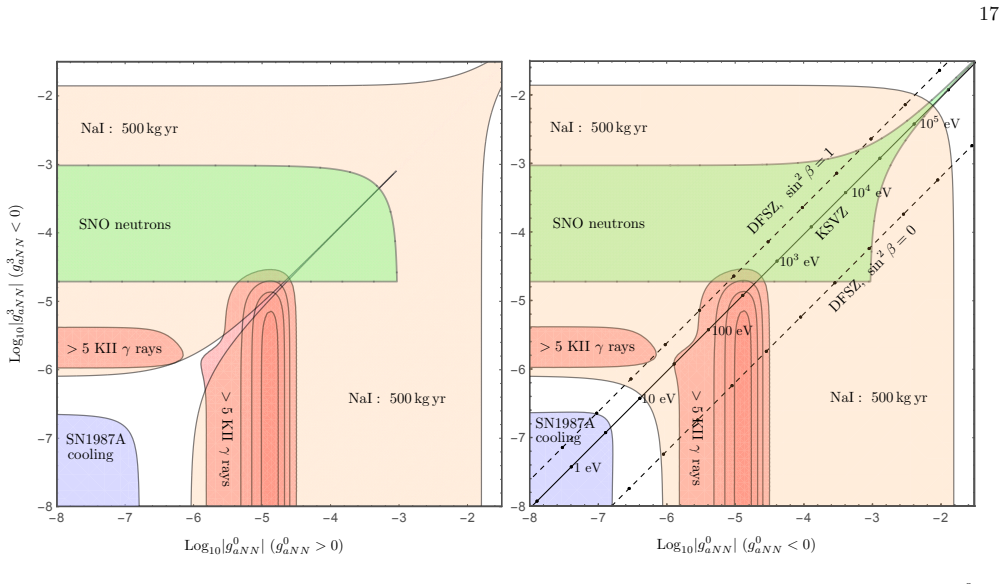
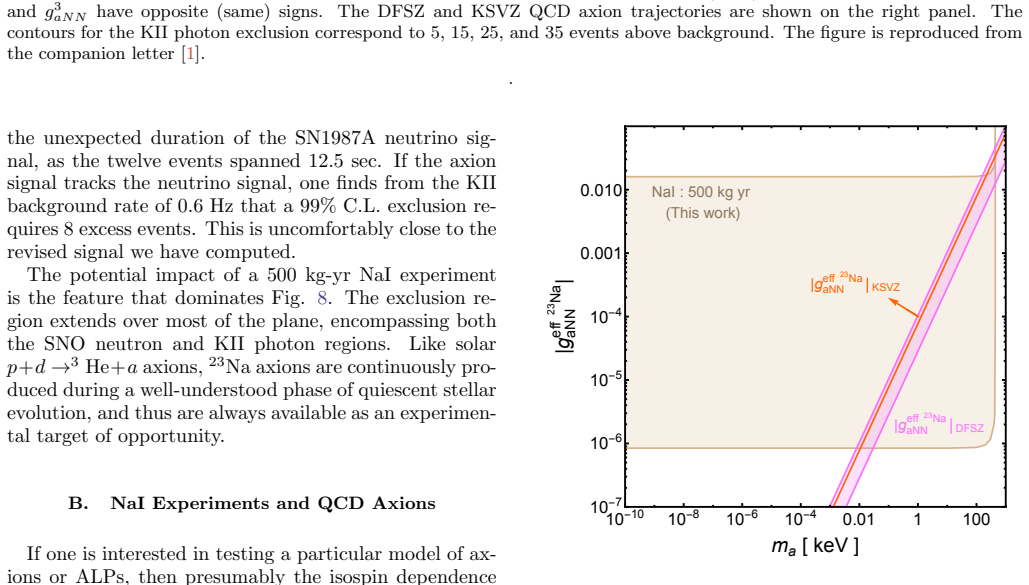
The "Turner window" corresponds to axions with masses $\gtrsim$ 1 eV that have sufficiently strong couplings to matter to evade limits from the cooling of SN1987A. This window, through which the trajectories for the KSVZ and DFSZ QCD axions run, has been thought to be largely closed because of (1) the floor established by SN1987A cooling, (2) the absence of SN1987A-associated photons in the Kamioka II detector, and (3) the limit on neutrons produced by solar axions in the Sudbury Neutrino Observatory. We show that a more complete treatment of the axion opacity in SN1987A, significantly weakens (2). Consequently, for axion or axion-like particles with hadronic couplings, $g_{ann}$ and $g_{app}$, significant regions within the Turner window now become viable. We describe a new opportunity to constrain such hadronically coupled axions via their resonant absorption in NaI detectors. The source is the Milky Way's carbon-burning stars -- the progenitors of ONeMg white dwarfs as well as electron-capture and core-collapse supernovae -- which synthesize significant quantities of $^{23}$Na, keeping it at temperatures $\sim 10^9$K for periods up to tens of thousands of years. $^{23}$Na acts as a thermal pump to convert stellar energy into axions, which arrive at the Earth as a thermally broadened line at 440 keV. These axions can be detected via resonant absorption in NaI, with the needed detector arrays already in place, developed by DAMA/LIBRA and other collaborations to search for the elastic scattering of light WIMPs. In axion detection, NaI serves as both the target, producing $\gamma$'s following resonant absorption, and the detector for those $\gamma$'s. With current array masses and backgrounds, we find that the coupling range $|g_{app}| \sim 10^{-6.5}$--$10^{-2}$ can be covered after two years of data, including QCD axions with $m_a \gtrsim 10$ eV.
Editorial analysis
A structured set of objections, weighed in public.
Referee Report
Summary. The paper claims that a more complete treatment of axion opacity in SN1987A significantly weakens the prior limit from non-observation of associated photons in the Kamioka II detector, thereby reopening viable regions of the Turner window for axions with hadronic couplings g_ann and g_app. It proposes detecting such axions via resonant absorption on 23Na in NaI detectors, sourced from carbon-burning stars in the Milky Way that produce a thermally broadened 440 keV axion line, projecting that existing DAMA/LIBRA-style arrays can cover |g_app| ∼ 10^{-6.5}--10^{-2} after two years, including QCD axions with m_a ≳ 10 eV.
Significance. If the opacity reanalysis is quantitatively validated and the NaI sensitivity projections are accurate, the result would reopen a previously excluded window for eV-scale QCD axions and demonstrate a practical use of existing dark-matter infrastructure for axion searches, potentially motivating new experimental analyses and refinements to supernova axion transport models.
major comments (1)
- [SN1987A opacity reanalysis] The central claim that the Turner window regions become viable rests on the assertion (in the abstract and introduction) that a more complete axion opacity treatment in SN1987A weakens the Kamioka II photon bound sufficiently to allow |g_app| down to ∼10^{-6.5}. The manuscript must supply the explicit optical-depth calculation, escape-probability reduction factor, and comparison to prior work for the relevant core temperatures and densities; without this quantitative demonstration, the relaxation of the bound by the required order of magnitude is not established.
minor comments (2)
- [Detection prospects] The projected sensitivity range lacks explicit baseline comparisons to existing limits, background spectra, detection efficiencies, and statistical error estimates for the resonant absorption channel; these should be added to allow assessment of the two-year reach.
- [Introduction] The abstract states that the SNO neutron limit from solar axions remains but does not clarify whether the revised opacity treatment affects any related stellar bounds; a brief statement on the status of all three original constraints would improve clarity.
Simulated Author's Rebuttal
We thank the referee for their careful reading of the manuscript and for identifying the need for greater explicitness in the SN1987A opacity analysis. We agree that a more detailed quantitative presentation will strengthen the paper and will revise the manuscript to include it.
read point-by-point responses
-
Referee: The central claim that the Turner window regions become viable rests on the assertion (in the abstract and introduction) that a more complete axion opacity treatment in SN1987A weakens the Kamioka II photon bound sufficiently to allow |g_app| down to ∼10^{-6.5}. The manuscript must supply the explicit optical-depth calculation, escape-probability reduction factor, and comparison to prior work for the relevant core temperatures and densities; without this quantitative demonstration, the relaxation of the bound by the required order of magnitude is not established.
Authors: We agree that the current presentation would benefit from a more explicit and self-contained demonstration of the opacity calculation. In the revised manuscript we will add a dedicated subsection (or appendix) that computes the axion optical depth in the SN1987A core at the relevant temperatures (∼30–50 MeV) and densities, incorporating the full set of absorption and scattering channels. We will tabulate and plot the escape-probability reduction factor versus |g_app|, and we will overlay a direct comparison with the opacity treatment employed in the original Kamioka II analyses. This will quantitatively establish the order-of-magnitude relaxation of the photon bound down to |g_app|∼10^{-6.5}. The essential new element is that, once resonant absorption and re-emission are included, axions remain trapped at higher couplings but still diffuse out on timescales shorter than the neutrino burst, an effect not fully captured in earlier free-streaming or simplified-trapping approximations. revision: yes
Circularity Check
No circularity; central claims rest on external SN1987A data and independent opacity reanalysis
full rationale
The paper's derivation begins from established SN1987A cooling bounds, Kamioka II non-observation, and SNO neutron limits, then asserts a revised axion opacity calculation that weakens only the photon bound. This reanalysis is framed as a new treatment of external astrophysical inputs rather than a fit to the paper's own parameters or a self-citation chain. The subsequent NaI detection reach is a forward calculation from carbon-burning stellar models and existing detector masses/backgrounds, producing a predicted sensitivity range without renaming or self-defining the target couplings. No load-bearing step reduces by construction to the paper's inputs; the argument remains falsifiable against the cited observations.
Axiom & Free-Parameter Ledger
axioms (3)
- domain assumption Axions with hadronic couplings g_ann and g_app interact with nuclear matter in supernovae and stars
- domain assumption Carbon-burning stars maintain 23Na at ~10^9 K long enough to produce a detectable 440 keV axion flux
- domain assumption Resonant absorption of axions in NaI produces detectable gamma rays with the same crystal serving as both target and detector
Reference graph
Works this paper leans on
- [1]
-
[2]
W. C. Haxton, X. Liu, A. McCutcheon, and A. Ray, Phys. Rev. Lett.135, 222701 (2025)
2025
-
[3]
W. C. Haxton and K. Y. Lee, Phys. Rev. Lett.66, 2557 (1991)
1991
-
[4]
R. D. Peccei and H. R. Quinn, Phys. Rev. Lett.38, 1440 (1977)
1977
-
[5]
Weinberg, Phys
S. Weinberg, Phys. Rev. Lett.40, 223 (1978)
1978
-
[6]
Wilczek, Phys
F. Wilczek, Phys. Rev. Lett.40, 279 (1978)
1978
-
[7]
A. Caputo and G. Raffelt, PoSCOSMICWISPers, 041 (2024), arXiv:2401.13728 [hep-ph]
-
[8]
Moriyama, Phys
S. Moriyama, Phys. Rev. Lett.75, 3222 (1995)
1995
-
[9]
Krcmar, Z
M. Krcmar, Z. Krecak, M. Stipcevic, A. Ljubicic, and D. A. Bradley, Phys. Letts. B442, 38 (1998)
1998
-
[10]
Namba, Physics Letters B645, 398 (2007)
T. Namba, Physics Letters B645, 398 (2007)
2007
-
[11]
A. V. Derbin, V. N. Muratova, D. A. Semenov, and E. V. Unzhakov, Physics of Atomic Nuclei74, 596 (2011)
2011
-
[12]
collaboration (S
C. collaboration (S. Andriamonje et al.), Journal of Cos- mology and Astroparticle Physics2009(12), 002. 22
-
[13]
F. Alessandria et al. (CUORE), JCAP05, 007, arXiv:1209.2800 [hep-ex]
-
[14]
E. Aprile et al. (XENON), Phys. Rev. D102, 072004 (2020), arXiv:2006.09721 [hep-ex]
-
[15]
L. Di Luzio et al., Eur. Phys. J. C82, 120 (2022), arXiv:2111.06407 [hep-ph]
- [16]
- [17]
-
[18]
J. E. Kim, Phys. Rev. Lett.43, 103 (1979)
1979
-
[19]
Shifman, A
M. Shifman, A. Vainshtein, and V. Zakharov, Nuclear Physics B166, 493 (1980)
1980
-
[20]
M. Dine, W. Fischler, and M. Srednicki, Physics Letters B104, 199 (1981)
1981
-
[21]
A. P. Zhitnitskii, Sov. J. Nucl. Phys. (Engl. Transl.); (United States)31:2(1980)
1980
- [22]
-
[23]
F. T. Avignone III, C. Baktash, W. C. Barker, F. P. Calaprice, R. W. Dunford, W. C. Haxton, D. Kahana, R. T. Kouzes, H. S. Miley, and D. M. Moltz, Phys. Rev. D37, 618 (1988)
1988
-
[24]
H. Saio, D. Nandal, G. Meynet, and S. Ekst¨ om, MNRAS 526, 2765 (2023)
2023
-
[25]
Maruyama, private communication
R. Maruyama, private communication
-
[26]
Amar´ e, J
J. Amar´ e, J. Apilluelo, S. Cebri´ an, D. Cintas, I. Coarasa, E. Garc´ ıa, M. Mart´ ınez, Y. Ortigoza, A. O. de Sol´ orzano, T. Pardo, J. Puimed´ on, M. L. Sarsa, and C. Seoane, Phys. Rev. Lett.135, 051001 (2025)
2025
- [27]
-
[28]
R. Bernabei, P. Belli, V. Caracciolo, R. Cerulli, V. Merlo, F. Cappella, A. d’Angelo, A. Incicchitti, C. J. Dai, X. H. Ma, X. D. Sheng, F. Montecchia, and Z. P. Ye, arXiv e- prints , arXiv:2110.04734 (2021), arXiv:2110.04734 [hep- ph]
-
[29]
Kim, arXiv e-prints , arXiv:1511.00023 (2015), arXiv:1511.00023 [physics.ins-det]
K. Kim, arXiv e-prints , arXiv:1511.00023 (2015), arXiv:1511.00023 [physics.ins-det]
-
[30]
Alner, H
G. Alner, H. Ara´ ujo, G. Arnison, J. Barton, A. Be- wick, C. Bungau, B. Camanzi, M. Carson, D. Davidge, G. Davies, J. Davies, E. Daw, J. Dawson, C. Duffy, T. Durkin, T. Gamble, S. Hart, R. Hollingworth, G. Homer, A. Howard, I. Ivaniouchenkov, W. Jones, M. Joshi, J. Kirkpatrick, V. Kudryavtsev, T. Lawson, V. Lebedenko, M. Lehner, J. Lewin, P. Lightfoot, I...
2005
-
[31]
J. J. Choi, C. Ha, E. J. Jeon, J. Y. Kim, K. W. Kim, S. H. Kim, S. K. Kim, Y. D. Kim, Y. J. Ko, B. C. Koh, S. H. Lee, I. S. Lee, H. Lee, H. S. Lee, J. S. Lee, Y. M. Oh, and B. J. Park (NEON Collaboration), Phys. Rev. Lett.134, 021802 (2025)
2025
-
[32]
Milligan, P
L. Milligan, P. Urquijo, E. Barberio, V. Bashu, L. Bignell, I. Bolognino, S. Chhun, F. Dastgiri, T. Fruth, G. Fu, G. Hill, Y. Hua, R. James, K. Janssens, S. Kapoor, G. Lane, K. Leaver, P. McGee, L. McKie, J. McKenzie, P. McNamara, W. Melbourne, M. Mews, W. Ng, K. Rule, Z. Slavkovsk´ a, O. Stanley, A. Stuchbery, B. Suerfu, G. Taylor, D. Tempra, T. Tunningl...
-
[33]
Donnelly and W
T. Donnelly and W. Haxton, Atomic Data and Nuclear Data Tables23, 103 (1979)
1979
-
[34]
Moln´ ar, M
L. Moln´ ar, M. Joyce, and S.-C. Leung, Research Notes of the AAS7, 119 (2023)
2023
-
[35]
Joyce, S.-C
M. Joyce, S.-C. Leung, L. Moln´ ar, M. Ireland, C. Kobayashi, and K. Nomoto, The Astrophysical Jour- nal902, 63 (2020)
2020
- [36]
-
[37]
2013, ApJS, 208, 4, doi: 10.1088/0067-0049/208/1/4 10
B. Paxton et al., Astrophys. J. Suppl.208, 4 (2013), arXiv:1301.0319 [astro-ph.SR]
work page internal anchor Pith review arXiv 2013
- [38]
- [39]
- [40]
-
[41]
Yu and E
G. Yu and E. Jeon, private communication
-
[42]
N. Abgrall et al. (LEGEND), AIP Conf. Proc.1894, 020027 (2017), arXiv:1709.01980 [physics.ins-det]
-
[43]
K.-P. Gradwohl, O. Moras, J. Janicsk´ o-Cs´ athy, S. Sch¨ onert, and R. R. Sumathi, JINST15(12), P12010, arXiv:2009.07585 [physics.ins-det]
-
[44]
Suerfu, M
B. Suerfu, M. Wada, W. Peloso, M. Souza, F. Calaprice, J. Tower, and G. Ciampi, Phys. Rev. Res.2, 013223 (2020)
2020
-
[45]
Calaprice, S
F. Calaprice, S. Copello, I. Dafinei, D. D’Angelo, G. D’Imperio, G. Di Carlo, M. Diemoz, A. Di Giacinto, A. Di Ludovico, A. Ianni, M. Iannone, F. Marchegiani, A. Mariani, S. Milana, S. Nisi, F. Nuti, D. Orlandi, V. Pettinacci, L. Pietrofaccia, S. Rahatlou, M. Souza, B. Suerfu, C. Tomei, C. Vignoli, M. Wada, and A. Zani, Phys. Rev. D104, L021302 (2021)
2021
-
[46]
Burlac and G
N. Burlac and G. Salamanna (LEGEND), Nucl. Instrum. Meth. A1048, 167943 (2023)
2023
-
[47]
Bhusal, N
A. Bhusal, N. Houston, and T. Li, Phys. Rev. Lett.126, 091601 (2021)
2021
-
[48]
Raffelt and L
G. Raffelt and L. Stodolsky, Physics Letters B119, 323 (1982)
1982
-
[49]
Rupak, Nuclear Physics A678, 405 (2000)
G. Rupak, Nuclear Physics A678, 405 (2000)
2000
-
[50]
Engel, D
J. Engel, D. Seckel, and A. C. Hayes, Phys. Rev. Lett. 65, 960 (1990)
1990
-
[51]
Hirata, T
K. Hirata, T. Kajita, M. Koshiba, M. Nakahata, Y. Oyama, N. Sato, A. Suzuki, M. Takita, Y. Tot- suka, T. Kifune, T. Suda, K. Takahashi, T. Tanimori, K. Miyano, M. Yamada, E. W. Beier, L. R. Feldscher, S. B. Kim, A. K. Mann, F. M. Newcomer, R. Van, W. Zhang, and B. G. Cortez, Phys. Rev. Lett.58, 1490 (1987)
1987
-
[52]
R. M. Bionta, G. Blewitt, C. B. Bratton, D. Casper, A. Ciocio, R. Claus, B. Cortez, M. Crouch, S. T. Dye, S. Errede, G. W. Foster, W. Gajewski, K. S. Ganezer, M. Goldhaber, T. J. Haines, T. W. Jones, D. Kiel- czewska, W. R. Kropp, J. G. Learned, J. M. LoSecco, J. Matthews, R. Miller, M. S. Mudan, H. S. Park, L. R. Price, F. Reines, J. Schultz, S. Seidel, ...
1987
-
[53]
N. Bar, K. Blum, and G. D’Amico, Phys. Rev. D101, 123025 (2020)
2020
-
[54]
Lella, P
A. Lella, P. Carenza, G. Co’, G. Lucente, M. Giannotti, A. Mirizzi, and T. Rauscher, Phys. Rev. D109, 023001 (2024)
2024
-
[55]
W. C. Haxton, H. T. Janka, et al., (2026), work in progress
2026
-
[56]
Tornow, N
W. Tornow, N. Czakon, C. Howell, A. Hutcheson, J. Kel- ley, V. Litvinenko, S. Mikhailov, I. Pinayev, G. Weisel, and H. Wita la, Physics Letters B574, 8 (2003)
2003
-
[57]
Brown and A
G. Brown and A. Green, Nuclear Physics75, 401 (1966)
1966
-
[58]
W. C. Haxton and C. Johnson, Phys. Rev. Lett.65, 1325 (1990)
1990
-
[59]
Warburton, B
E. Warburton, B. Brown, and D. Millener, Physics Let- ters B293, 7 (1992)
1992
-
[60]
Carenza, G
P. Carenza, G. Co’, M. Giannotti, A. Lella, G. Lucente, A. Mirizzi, and T. Rauscher, Phys. Rev. C109, 015501 (2024)
2024
-
[61]
K. S. Hirata, T. Kajita, M. Koshiba, M. Nakahata, Y. Oyama, N. Sato, A. Suzuki, M. Takita, Y. Tot- suka, T. Kifune, T. Suda, K. Takahashi, T. Tanimori, K. Miyano, M. Yamada, E. W. Beier, L. R. Feldscher, W. Frati, S. B. Kim, A. K. Mann, F. M. Newcomer, R. Van Berg, W. Zhang, and B. G. Cortez, Phys. Rev. D 38, 448 (1988)
1988
-
[62]
P., Wongwathanarat, A., Janka, H.-Th., M¨ uller, E., Ertl, T., and Woosley, S
Utrobin, V. P., Wongwathanarat, A., Janka, H.-Th., M¨ uller, E., Ertl, T., and Woosley, S. E., A&A624, A116 (2019)
2019
- [63]
-
[64]
B. A. Brown and W. A. Ricter, Phys. Rev. C74, 034315 (2006)
2006
-
[65]
Honma, T
M. Honma, T. Otsuka, B. A. Brown, and T. Mizusaki, Phys. Rev. C69, 034335 (2004)
2004
-
[66]
Elliott and A
J. Elliott and A. Jackson, Nuclear Physics A121, 279 (1968)
1968
-
[67]
Ceuleneer, P
R. Ceuleneer, P. Vandepeutte, and C. Semay, Phys. Rev. C38, 2335 (1988)
1988
-
[68]
Tanner, G
N. Tanner, G. Thomas, and E. Earle, Nuclear Physics 52, 45 (1964)
1964
-
[69]
Bacca, N
S. Bacca, N. Barnea, G. Hagen, G. Orlandini, and T. Pa- penbrock, Phys. Rev. Lett.111, 122502 (2013)
2013
-
[70]
Eramzhyan, B
R. Eramzhyan, B. Ishkhanov, I. Kapitonov, and V. Neu- datchin, Physics Reports136, 229 (1986)
1986
-
[71]
G. G. Raffelt and D. S. P. Dearborn, Phys. Rev. D36, 2211 (1987)
1987
-
[72]
Fukugita, S
M. Fukugita, S. Watamura, and M. Yoshimura, Phys. Rev. D26, 1840 (1982)
1982
-
[73]
D. A. Dicus, E. W. Kolb, V. L. Teplitz, and R. V. Wag- oner, Phys. Rev. D22, 839 (1980)
1980
discussion (0)
Sign in with ORCID, Apple, or X to comment. Anyone can read and Pith papers without signing in.