Recognition: unknown
Specially Embedding a Composite Axion Model
Pith reviewed 2026-05-07 15:36 UTC · model grok-4.3
The pith
A special embedding of the confining gauge groups for a composite axion and QCD into a larger product group sets the ultraviolet domain wall number to one and lets small instantons supply a bias that destabilizes walls.
A machine-rendered reading of the paper's core claim, the machinery that carries it, and where it could break.
Core claim
By considering a special embedding of the confining gauge group responsible for the composite axion as well as QCD into a larger product gauge group, the domain wall number is essentially set to unity in the ultraviolet theory. Small instanton effects associated with the UV gauge dynamics induce a controlled explicit breaking of the residual discrete symmetry, providing a bias term in the axion potential. As a result, the domain walls become unstable and decay sufficiently quickly, while the axion solution to the strong CP problem remains intact.
What carries the argument
The special embedding of the axion and QCD confining groups into a larger product gauge group, which fixes the UV domain wall number at one and permits UV instantons to generate a tunable bias term without shifting the axion vacuum.
If this is right
- Domain walls decay fast enough to avoid overclosing the universe in the post-inflationary regime.
- The axion remains a viable dark matter candidate within a calculable range of parameters set by the embedding scale and instanton strength.
- Exotic hadrons produced by the composite dynamics decay into standard-model particles in patterns that can be tested at colliders.
- The strong CP problem is solved by the composite axion without requiring pre-inflationary dynamics or additional discrete symmetries.
Where Pith is reading between the lines
- The same embedding technique could be applied to other composite axion constructions that currently suffer from domain wall numbers greater than one.
- If the product gauge group is part of a larger unification, the bias term might receive additional contributions from even higher-scale instantons, altering the required tuning window.
- Collider signals from the exotic hadrons could be correlated with the axion dark matter density to provide a joint test of the framework.
- The mechanism suggests that other discrete-symmetry problems in axion models might be addressable by analogous UV embeddings rather than by explicit breaking operators.
Load-bearing premise
The chosen product gauge group embedding can be realized without introducing new light states or spoiling the confinement dynamics that generate the composite axion, while still allowing the small instanton bias to be tuned small enough not to shift the axion minimum away from the CP-conserving point.
What would settle it
A direct cosmological search or simulation that finds persistent, overclosing domain walls from a post-inflationary composite axion whose UV completion matches the proposed embedding, or an observation that the axion minimum is displaced from the CP-conserving point at a level inconsistent with the model's instanton-generated bias.
Figures
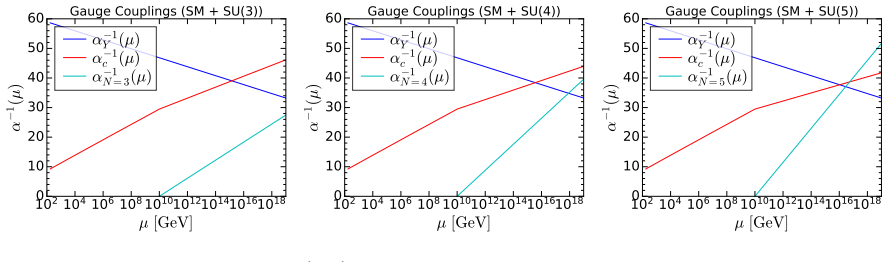


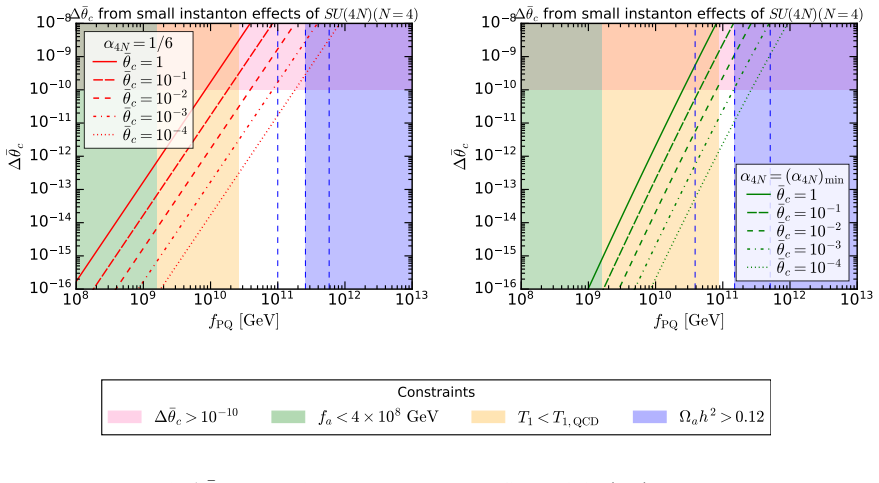

read the original abstract
We present a novel framework of the post-inflationary composite axion to address the strong CP problem without the cosmological domain wall problem. Conventional composite axion models lead to the domain wall number greater than one, producing stable axion domain walls that overclose the Universe. We show that by considering a special embedding of the confining gauge group responsible for the composite axion as well as QCD into a larger product gauge group, the domain wall number is essentially set to unity in the ultraviolet (UV) theory. In this setup, small instanton effects associated with the UV gauge dynamics induce a controlled explicit breaking of the residual discrete symmetry, providing a bias term in the axion potential. As a result, the domain walls become unstable and decay sufficiently quickly, while the axion solution to the strong CP problem remains intact. We construct an explicit realization of this framework, identify a viable parameter region and analyze the axion dark matter abundance. Decays of exotic hadrons from the composite dynamics are also investigated. Our special-embedding UV completion renders the domain wall problem in composite axion models cosmologically harmless.
Editorial analysis
A structured set of objections, weighed in public.
Referee Report
Summary. The manuscript proposes a UV completion for post-inflationary composite axion models that solves the strong CP problem while avoiding the domain wall problem. By embedding the confining gauge group for the composite axion and QCD into a larger product gauge group, the domain wall number is set to unity at the UV level. Small instanton effects from the UV gauge dynamics then generate a controlled bias term that explicitly breaks the residual discrete symmetry, rendering domain walls unstable and cosmologically harmless without shifting the axion minimum away from the CP-conserving point. An explicit model realization is constructed, a viable parameter region is identified, the axion dark matter abundance is analyzed, and decays of exotic hadrons are investigated.
Significance. If the quantitative requirements on the bias term hold, the special-embedding approach provides a gauge-theoretic mechanism to control both N_DW and the explicit breaking scale in composite axion models, potentially making post-inflationary composite axions viable without additional fine-tuning or late-time entropy production. The construction of an explicit realization together with DM abundance and hadron decay phenomenology adds concrete testability.
major comments (2)
- [explicit model construction and axion potential section] The central claim that the UV instanton bias lies in the narrow window (sufficient to destabilize domain walls before they dominate the energy density, yet small enough that the induced shift in the axion minimum remains ≪ 10^{-10}) is load-bearing. The manuscript must provide an explicit calculation of the instanton action, the resulting bias potential, and a numerical demonstration that this window is populated for the chosen embedding scale and gauge couplings (see the parameter-region analysis).
- [model construction] The assumption that the product-gauge embedding introduces no additional light states that modify the beta functions, confinement dynamics, or anomaly coefficients used to set N_DW = 1 must be verified by computing the full fermion and scalar spectrum below the UV cutoff. Even one extra light state would alter both the IR axion decay constant and the instanton suppression factor.
minor comments (2)
- [model construction] Clarify the notation for the UV gauge factors and their embedding into the product group; a table summarizing the representations and anomaly coefficients would improve readability.
- [phenomenology] The discussion of exotic hadron decays would benefit from a brief comparison to existing LHC or cosmological bounds on long-lived particles.
Simulated Author's Rebuttal
We thank the referee for their thorough review and insightful comments on our manuscript. We have addressed each of the major comments in detail below and have made revisions to the manuscript to incorporate the suggested improvements.
read point-by-point responses
-
Referee: [explicit model construction and axion potential section] The central claim that the UV instanton bias lies in the narrow window (sufficient to destabilize domain walls before they dominate the energy density, yet small enough that the induced shift in the axion minimum remains ≪ 10^{-10}) is load-bearing. The manuscript must provide an explicit calculation of the instanton action, the resulting bias potential, and a numerical demonstration that this window is populated for the chosen embedding scale and gauge couplings (see the parameter-region analysis).
Authors: We agree that providing an explicit calculation strengthens the central claim. In the revised manuscript, we have included a detailed derivation of the instanton action for the UV gauge dynamics, explicitly computing the resulting bias potential. Furthermore, we present numerical results showing that for the embedding scales and gauge couplings in our viable parameter region, the bias term satisfies the required conditions: it is large enough to destabilize the domain walls prior to their dominating the energy density, while the shift in the axion minimum is kept well below 10^{-10}. These additions are incorporated into the axion potential section and the parameter analysis. revision: yes
-
Referee: [model construction] The assumption that the product-gauge embedding introduces no additional light states that modify the beta functions, confinement dynamics, or anomaly coefficients used to set N_DW = 1 must be verified by computing the full fermion and scalar spectrum below the UV cutoff. Even one extra light state would alter both the IR axion decay constant and the instanton suppression factor.
Authors: We appreciate this point and have verified the assumption in the revised version. We have computed the complete fermion and scalar spectrum below the UV cutoff for our explicit model realization. The results confirm that there are no additional light states that would affect the beta functions, confinement dynamics, or the anomaly coefficients determining N_DW. Consequently, the IR axion decay constant and instanton suppression factor remain as originally calculated. This verification is now detailed in the model construction section and supported by a new table listing the spectrum. revision: yes
Circularity Check
No significant circularity; central claims follow from explicit gauge embedding construction
full rationale
The paper proposes a novel product gauge group embedding for the composite axion and QCD sectors. The domain wall number is set to unity by the anomaly coefficients and representation choices under this embedding, which is constructed explicitly rather than fitted or defined tautologically. Small instanton bias terms are then derived from the UV gauge dynamics. No load-bearing self-citations, fitted inputs renamed as predictions, or ansatze smuggled via prior work appear in the derivation chain. The framework is self-contained as a model-building proposal with parameter analysis and explicit realization, independent of the target result by construction.
Axiom & Free-Parameter Ledger
axioms (2)
- domain assumption The confining dynamics of the composite axion sector and QCD can be consistently embedded into a larger product gauge group while preserving the desired low-energy spectrum.
- domain assumption Small instanton effects from the UV gauge factors generate a bias term that is parametrically smaller than the QCD contribution to the axion potential.
Reference graph
Works this paper leans on
-
[1]
R. D. Peccei and H. R. Quinn,CP Conservation in the Presence of Instantons, Phys. Rev. Lett.38(1977) 1440
1977
-
[2]
Weinberg,A New Light Boson?,Phys
S. Weinberg,A New Light Boson?,Phys. Rev. Lett.40(1978) 223
1978
-
[3]
Wilczek,Problem of StrongPandTInvariance in the Presence of Instantons, Phys
F. Wilczek,Problem of StrongPandTInvariance in the Presence of Instantons, Phys. Rev. Lett.40(1978) 279
1978
-
[4]
Preskill, M
J. Preskill, M. B. Wise and F. Wilczek,Cosmology of the Invisible Axion,Phys. Lett. B120(1983) 127
1983
-
[5]
L. F. Abbott and P. Sikivie,A Cosmological Bound on the Invisible Axion,Phys. Lett. B120(1983) 133
1983
-
[6]
Dine and W
M. Dine and W. Fischler,The Not So Harmless Axion,Phys. Lett. B120(1983) 137
1983
-
[7]
J. E. Kim,A COMPOSITE INVISIBLE AXION,Phys. Rev. D31(1985) 1733
1985
-
[8]
Choi and J
K. Choi and J. E. Kim,DYNAMICAL AXION,Phys. Rev. D32(1985) 1828
1985
-
[9]
Randall,Composite axion models and Planck scale physics,Phys
L. Randall,Composite axion models and Planck scale physics,Phys. Lett. B284 (1992) 77
1992
-
[10]
M. Redi and R. Sato,Composite Accidental Axions,JHEP05(2016) 104 [1602.05427]
-
[11]
B. Lillard and T. M. P. Tait,A Composite Axion from a Supersymmetric Product Group,JHEP11(2017) 005 [1707.04261]
- [12]
- [13]
-
[14]
Y. Nakai and M. Suzuki,Axion Quality from Superconformal Dynamics,Phys. Lett. B816(2021) 136239 [2102.01329]
-
[15]
Vecchi,Axion quality straight from the GUT,Eur
L. Vecchi,Axion quality straight from the GUT,Eur. Phys. J. C81(2021) 938 [2106.15224]. 31
- [16]
-
[17]
R. Contino, A. Podo and F. Revello,Chiral models of composite axions and accidental Peccei-Quinn symmetry,JHEP04(2022) 180 [2112.09635]
-
[18]
S. Nakagawa, Y. Nakai, M. Yamada and Y. Zhang,Dynamics of superconformal axion: Quality and scalegenesis,Phys. Lett. B849(2024) 138447 [2309.06964]
- [19]
-
[20]
S. Nakagawa, Y. Nakai, J. Xu and Y. Zhang,High quality QCD axion via electric-magnetic duality,JHEP06(2025) 005 [2412.08931]
- [21]
-
[22]
T. Gherghetta, H. Murayama and P. Qu´ ılez,High-quality composite Pati-Salam axion,Phys. Rev. D112(2025) 095036 [2505.08866]
-
[23]
T. Gherghetta, H. Murayama, B. Noether and P. Qu´ ılez,A High-Quality Axion from Exact SUSY Chiral Dynamics,2508.21813
-
[24]
P. Agrawal, A. Hook, V. Loladze and M. Reig,Axion Quality Problem: Keep Calm and Baryon,2510.07366
- [25]
-
[26]
A. D. Linde,GENERATION OF ISOTHERMAL DENSITY PERTURBATIONS IN THE INFLATIONARY UNIVERSE,JETP Lett.40(1984) 1333
1984
-
[27]
Seckel and M
D. Seckel and M. S. Turner,Isothermal Density Perturbations in an Axion Dominated Inflationary Universe,Phys. Rev. D32(1985) 3178
1985
-
[28]
D. H. Lyth,A Limit on the Inflationary Energy Density From Axion Isocurvature Fluctuations,Phys. Lett. B236(1990) 408
1990
-
[29]
M. S. Turner and F. Wilczek,Inflationary axion cosmology,Phys. Rev. Lett.66 (1991) 5
1991
-
[30]
A. D. Linde,Axions in inflationary cosmology,Phys. Lett. B259(1991) 38. 32 [31]Planckcollaboration,Planck 2018 results. X. Constraints on inflation,Astron. Astrophys.641(2020) A10 [1807.06211]
work page internal anchor Pith review arXiv 1991
-
[31]
Sikivie,Of Axions, Domain Walls and the Early Universe,Phys
P. Sikivie,Of Axions, Domain Walls and the Early Universe,Phys. Rev. Lett.48 (1982) 1156
1982
- [32]
-
[33]
S. Nakagawa, Y. Nakai, Y.-C. Qiu, L. Wang and Y. Wang,High reheating temperature without axion domain walls,Phys. Lett. B873(2026) 140177 [2509.24812]
- [34]
-
[35]
Georgi,LIE ALGEBRAS IN PARTICLE PHYSICS
H. Georgi,LIE ALGEBRAS IN PARTICLE PHYSICS. FROM ISOSPIN TO UNIFIED THEORIES, vol. 54. Front.Phys., 1982
1982
-
[36]
Griest and M
K. Griest and M. Kamionkowski,Unitarity Limits on the Mass and Radius of Dark Matter Particles,Phys. Rev. Lett.64(1990) 615
1990
- [37]
-
[38]
Manohar and H
A. Manohar and H. Georgi,Chiral Quarks and the Nonrelativistic Quark Model, Nucl. Phys. B234(1984) 189
1984
-
[39]
D. J. E. Marsh,Axion Cosmology,Phys. Rept.643(2016) 1 [1510.07633]
work page Pith review arXiv 2016
-
[40]
G. Grilli di Cortona, E. Hardy, J. Pardo Vega and G. Villadoro,The QCD axion, precisely,JHEP01(2016) 034 [1511.02867]
-
[41]
C. Cs´ aki, M. Ruhdorfer and Y. Shirman,UV Sensitivity of the Axion Mass from Instantons in Partially Broken Gauge Groups,JHEP04(2020) 031 [1912.02197]
-
[42]
C. Cs´ aki, R. T. D’Agnolo, E. Kuflik and M. Ruhdorfer,Instanton NDA and applications to axion models,JHEP04(2024) 074 [2311.09285]
-
[43]
’t Hooft,Computation of the Quantum Effects Due to a Four-Dimensional Pseudoparticle,Phys
G. ’t Hooft,Computation of the Quantum Effects Due to a Four-Dimensional Pseudoparticle,Phys. Rev. D14(1976) 3432. 33
1976
-
[44]
C. W. Bernard,Gauge Zero Modes, Instanton Determinants, and QCD Calculations,Phys. Rev. D19(1979) 3013
1979
-
[45]
D. J. Gross, R. D. Pisarski and L. G. Yaffe,QCD and Instantons at Finite Temperature,Rev. Mod. Phys.53(1981) 43
1981
-
[46]
O. Wantz and E. P. S. Shellard,Axion Cosmology Revisited,Phys. Rev. D82 (2010) 123508 [0910.1066]
-
[47]
O. Wantz and E. P. S. Shellard,The Topological susceptibility from grand canonical simulations in the interacting instanton liquid model: Chiral phase transition and axion mass,Nucl. Phys. B829(2010) 110 [0908.0324]
-
[48]
D. H. Lyth,Estimates of the cosmological axion density,Phys. Lett. B275(1992) 279
1992
-
[49]
T. Hiramatsu, M. Kawasaki, K. Saikawa and T. Sekiguchi,Production of dark matter axions from collapse of string-wall systems,Phys. Rev. D85(2012) 105020 [1202.5851]
-
[50]
Axion dark matter from topological defects
M. Kawasaki, K. Saikawa and T. Sekiguchi,Axion dark matter from topological defects,Phys. Rev. D91(2015) 065014 [1412.0789]
work page Pith review arXiv 2015
-
[51]
P. Carenza, T. Fischer, M. Giannotti, G. Guo, G. Mart´ ınez-Pinedo and A. Mirizzi, Improved axion emissivity from a supernova via nucleon-nucleon bremsstrahlung, JCAP10(2019) 016 [1906.11844]
-
[52]
Abelet al., Measurement of the Permanent Electric Dipole Moment of the Neutron, Phys
C. Abel et al.,Measurement of the Permanent Electric Dipole Moment of the Neutron,Phys. Rev. Lett.124(2020) 081803 [2001.11966]
-
[53]
A. E. Nelson,Naturally Weak CP Violation,Phys. Lett. B136(1984) 387
1984
-
[54]
S. M. Barr,Solving the Strong CP Problem Without the Peccei-Quinn Symmetry, Phys. Rev. Lett.53(1984) 329
1984
-
[55]
S. M. Barr,A Natural Class of Nonpeccei-quinn Models,Phys. Rev. D30(1984) 1805
1984
-
[56]
M. Dine and P. Draper,Challenges for the Nelson-Barr Mechanism,JHEP08 (2015) 132 [1506.05433]. 34
-
[57]
K. Fujikura, Y. Nakai, R. Sato and M. Yamada,Baryon asymmetric Universe from spontaneous CP violation,JHEP04(2022) 105 [2202.08278]
-
[58]
S. Girmohanta, S. J. Lee, Y. Nakai and M. Suzuki,A natural model of spontaneous CP violation,JHEP12(2022) 024 [2203.09002]
-
[59]
Dine and N
M. Dine and N. Seiberg,String Theory and the Strong CP Problem,Nucl. Phys. B 273(1986) 109
1986
-
[60]
S. M. Barr and D. Seckel,Planck scale corrections to axion models,Phys. Rev. D 46(1992) 539
1992
-
[61]
Planck-Scale Physics and the Peccei-Quinn Mechanism
M. Kamionkowski and J. March-Russell,Planck scale physics and the Peccei-Quinn mechanism,Phys. Lett. B282(1992) 137 [hep-th/9202003]
work page Pith review arXiv 1992
-
[62]
M. Kamionkowski and J. March-Russell,Are textures natural?,Phys. Rev. Lett. 69(1992) 1485 [hep-th/9201063]
-
[63]
Solutions to the strong CP problem in a world with gravity
R. Holman, S. D. H. Hsu, T. W. Kephart, E. W. Kolb, R. Watkins and L. M. Widrow,Solutions to the strong CP problem in a world with gravity,Phys. Lett. B 282(1992) 132 [hep-ph/9203206]
work page Pith review arXiv 1992
-
[64]
R. Kallosh, A. D. Linde, D. A. Linde and L. Susskind,Gravity and global symmetries,Phys. Rev. D52(1995) 912 [hep-th/9502069]
- [65]
-
[66]
N. Yamatsu,Finite-Dimensional Lie Algebras and Their Representations for Unified Model Building,1511.08771
-
[67]
Yamatsu,Special Grand Unification,PTEP2017(2017) 061B01 [1704.08827]
N. Yamatsu,Special Grand Unification,PTEP2017(2017) 061B01 [1704.08827]. 35
discussion (0)
Sign in with ORCID, Apple, or X to comment. Anyone can read and Pith papers without signing in.