Recognition: unknown
Time-of-Flight Constraints on Neutrino Millicharge from Supernova Neutrinos in Galactic Magnetic Fields
Pith reviewed 2026-05-07 15:30 UTC · model grok-4.3
The pith
Millicharged neutrinos acquire a time delay in Galactic magnetic fields that scales identically to the mass-induced delay, allowing supernova observations to bound the neutrino charge.
A machine-rendered reading of the paper's core claim, the machinery that carries it, and where it could break.
Core claim
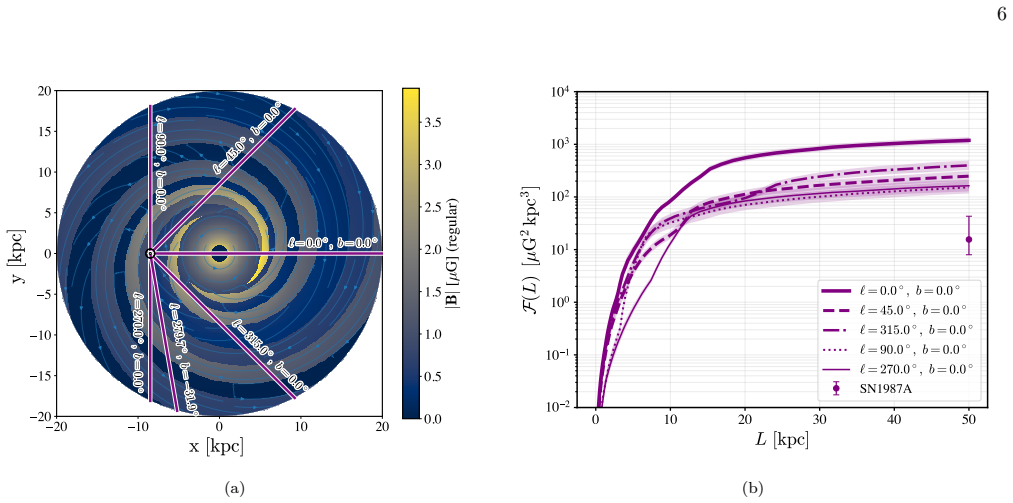
A millicharged neutrino propagating through magnetic fields experiences a small Lorentz-force deflection, which induces a geometric time delay. In the ultra-relativistic regime relevant for supernova neutrinos, this delay scales as q_ν² E_ν^{-2}, where q_ν and E_ν denote the neutrino millicharge and energy, respectively, and thus shares the same leading energy dependence as the standard time-of-flight delay induced by neutrino mass. Motivated by this similarity, we propose a framework to reinterpret supernova time-of-flight limits on neutrino mass as constraints on neutrino millicharge. We express both effects in terms of a common E_ν^{-2} dispersion coefficient and compute the millicharge-
What carries the argument
The line-of-sight-dependent magnetic delay kernel that integrates the Lorentz deflection of Galactic magnetic fields along the neutrino path to produce the millicharge contribution to observed time delay.
If this is right
- SN1987A data already constrains neutrino millicharge below roughly 10 to the minus 17 elementary charges.
- Next-generation detectors viewing Galactic bursts can reach the low 10 to the minus 19 level, with optimistic sightlines approaching 10 to the minus 20.
- When neutrino mass is nonzero the two contributions to the shared E^{-2} delay must be separated using additional information.
- The resulting bounds sit alongside other laboratory and astrophysical limits on neutrino millicharge in the literature.
Where Pith is reading between the lines
- Tighter three-dimensional maps of the Galactic magnetic field would shrink the uncertainty in the delay kernel and improve the charge bounds.
- The same reinterpretation technique could be tested on neutrinos from other astrophysical sources whose propagation paths cross known magnetic regions.
- Any future observation of excess E^{-2} delay beyond mass expectations would have to be checked against both millicharge and possible systematic errors in the field model.
Load-bearing premise
The magnetic field structure along the line of sight to the supernova can be modeled accurately enough that the delay kernel introduces no large systematic error from unknown turbulence or field details.
What would settle it
High-precision timing data from a future Galactic supernova whose energy-dependent arrival times match the mass-only prediction after subtraction of the expected magnetic kernel, without needing an extra millicharge term.
Figures


read the original abstract
A millicharged neutrino propagating through magnetic fields experiences a small Lorentz-force deflection, which induces a geometric time delay. In the ultra-relativistic regime relevant for supernova neutrinos, this delay scales as $q_\nu^2 E_\nu^{-2}$, where $q_\nu$ and $E_\nu$ denote the neutrino millicharge and energy, respectively, and thus shares the same leading energy dependence as the standard time-of-flight delay induced by neutrino mass. Motivated by this similarity, we propose a framework to reinterpret supernova time-of-flight limits on neutrino mass as constraints on neutrino millicharge. We express both effects in terms of a common $E_\nu^{-2}$ dispersion coefficient and compute the millicharge-induced contribution using a line-of-sight-dependent magnetic delay kernel, extending the original SN1987A uniform-field estimate. Applying this translation to existing SN1987A limits and to projected sensitivities for future Galactic core-collapse supernova observations, we obtain bounds ranging from the $\sim 10^{-17}\, e$ level for SN1987A to the low-$10^{-19}\, e$ regime for next-generation Galactic bursts, with optimistic combinations of detector sensitivity and Galactic sightline approaching $\sim 10^{-20}\, e$. We compare these results with other bounds in the literature and discuss how nonzero neutrino mass affects the interpretation.
Editorial analysis
A structured set of objections, weighed in public.
Referee Report
Summary. The manuscript proposes reinterpreting supernova neutrino time-of-flight limits on neutrino mass as constraints on neutrino millicharge. Both effects produce geometric delays scaling as E_ν^{-2} in the ultra-relativistic regime; the authors introduce a line-of-sight magnetic delay kernel that extends the uniform-field SN1987A treatment to compute the millicharge contribution along specific Galactic sightlines. Applying the translation to existing SN1987A mass limits and to projected sensitivities for future Galactic core-collapse supernovae yields millicharge bounds from ∼10^{-17} e to the low-10^{-19} e regime, with optimistic detector-plus-sightline combinations approaching ∼10^{-20} e. The paper also discusses the degeneracy that arises when neutrino mass is nonzero.
Significance. If the kernel is robust against magnetic-field modeling uncertainties, the framework supplies a novel and economical route to millicharge limits that leverages existing and forthcoming astrophysical data. The shared E^{-2} scaling is a clean observation, and the extension from uniform to line-of-sight fields is a natural technical step. The projected reach for next-generation bursts is potentially competitive with laboratory bounds and could be strengthened by improved detectors or better-constrained sightlines. The work therefore has clear value for the neutrino-physics community provided the systematic issues identified below are addressed.
major comments (2)
- [§3] §3 (magnetic delay kernel): the central translation from mass limits to millicharge bounds relies on the line-of-sight kernel, yet no quantitative propagation of Galactic B-field model variations (regular plus turbulent components) is performed. Different standard B-field realizations can alter the kernel by factors of several; because the extracted q_ν scales as the square root of the allowed delay, this directly affects the quoted 10^{-17}–10^{-20} e numbers and must be shown as a systematic band.
- [§4] §4 (application to SN1987A and future bursts): the manuscript states that both effects are expressed via a common E_ν^{-2} dispersion coefficient, but the explicit definition of that coefficient and the precise mapping from the kernel to the numerical bounds are not supplied. Without these equations the numerical results cannot be independently verified or reproduced from the input mass limits.
minor comments (2)
- [Abstract and §2] The abstract and §2 would benefit from a one-sentence statement of the principal assumptions entering the kernel (e.g., coherence length, neglect of energy losses).
- A short table comparing the new millicharge bounds with existing laboratory and astrophysical limits would improve readability and context.
Simulated Author's Rebuttal
We thank the referee for their thorough review and constructive comments on our manuscript. We address each major comment below and have revised the manuscript to incorporate the requested improvements for clarity and robustness.
read point-by-point responses
-
Referee: [§3] §3 (magnetic delay kernel): the central translation from mass limits to millicharge bounds relies on the line-of-sight kernel, yet no quantitative propagation of Galactic B-field model variations (regular plus turbulent components) is performed. Different standard B-field realizations can alter the kernel by factors of several; because the extracted q_ν scales as the square root of the allowed delay, this directly affects the quoted 10^{-17}–10^{-20} e numbers and must be shown as a systematic band.
Authors: We agree that a quantitative assessment of uncertainties from Galactic magnetic field model variations is essential. In the revised manuscript, we will compute the line-of-sight magnetic delay kernel for several standard B-field realizations (incorporating both regular and turbulent components) and present the resulting variation as a systematic band. This band will be propagated to the millicharge bounds, which depend on the square root of the allowed delay, and displayed alongside the central values in §3 and §4. revision: yes
-
Referee: [§4] §4 (application to SN1987A and future bursts): the manuscript states that both effects are expressed via a common E_ν^{-2} dispersion coefficient, but the explicit definition of that coefficient and the precise mapping from the kernel to the numerical bounds are not supplied. Without these equations the numerical results cannot be independently verified or reproduced from the input mass limits.
Authors: We thank the referee for highlighting this omission. In the revised manuscript, we will explicitly define the common E_ν^{-2} dispersion coefficient and provide the full set of equations that map the magnetic delay kernel to the millicharge bounds. These additions will allow direct reproduction of the numerical results from the input SN1987A mass limits and the kernel values, and will be placed in §4. revision: yes
Circularity Check
No significant circularity: reinterpretation applies independent observational limits via shared scaling and external B-field kernel
full rationale
The derivation takes existing SN1987A time-of-flight upper limits on delay (from prior observations) as input, notes the shared E_ν^{-2} dependence between mass and millicharge effects, and translates them using a computed line-of-sight magnetic delay kernel derived from Galactic B-field models. This produces millicharge bounds without re-fitting the supernova data, without defining the kernel from the output bounds, and without load-bearing self-citations that reduce the central claim to prior author work. Future projections similarly scale from assumed detector sensitivities and sightlines rather than fitting the same inputs. The chain remains self-contained against external benchmarks; no step equates output to input by construction.
Axiom & Free-Parameter Ledger
free parameters (1)
- magnetic delay kernel parameters
axioms (2)
- domain assumption Ultra-relativistic regime applies to supernova neutrinos so that both mass and millicharge delays scale as E_ν^{-2}
- standard math Lorentz force on millicharged neutrino produces a geometric time delay proportional to q_ν²
Reference graph
Works this paper leans on
-
[1]
For each sampled parameter set, we recompute the corresponding contribution to the effec- tive field strengthB2 eff(L, ℓ, b), and hence to the regular part of the time delay kernel
Regular component To estimate the uncertainty on the regular field con- tribution to the kernel, we sample the JF12 regular field parameters around their published best fit values using independent Gaussian draws with widths given by the quoted1σerrors. For each sampled parameter set, we recompute the corresponding contribution to the effec- tive field st...
-
[2]
Stochastic components For the stochastic components, the time delay kernel depends on a transverse field variance together with a correlation length along the line-of-sight given by Eq. A30. In practice, this integral is evaluated numerically from the transverse correlation function estimated along the line-of-sight. For the turbulent field, we use theCRP...
-
[3]
Quantization of electric charge from anomaly constraints and a majo- rana neutrino,
K. S. Babu and Rabindra N. Mohapatra, “Quantization of electric charge from anomaly constraints and a majo- rana neutrino,” Phys. Rev. D41, 271–277 (1990)
1990
-
[4]
Robert Foot, H. Lew, and R. R. Volkas, “Electric charge quantization,” J. Phys. G19, 361–372 (1993), [Erratum: J.Phys.G 19, 1067 (1993)], arXiv:hep-ph/9209259
-
[5]
Charge Quantization in the Standard Model and Some of its Extensions,
R. Foot, G. C. Joshi, H. Lew, and R. R. Volkas, “Charge Quantization in the Standard Model and Some of its Extensions,” Modern Physics Letters A5, 2721–2731 (1990)
1990
-
[6]
SimplestZ ′ model,
Xiao-Gang He, G. C. Joshi, H. Lew, and R. R. Volkas, “SimplestZ ′ model,” Phys.Rev.D44,2118–2132(1991)
1991
-
[7]
Y. Fukudaet al.(Super-Kamiokande), “Evidence for os- cillation of atmospheric neutrinos,” Phys. Rev. Lett.81, 1562–1567 (1998), arXiv:hep-ex/9807003
-
[8]
Q. R. Ahmadet al.(SNO), “Direct evidence for neutrino flavor transformation from neutral current interactions in the Sudbury Neutrino Observatory,” Phys. Rev. Lett. 89, 011301 (2002), arXiv:nucl-ex/0204008
-
[9]
First results from Kam- LAND: Evidence for reactor anti-neutrino disappear- ance,
K. Eguchiet al.(KamLAND), “First results from Kam- LAND: Evidence for reactor anti-neutrino disappear- ance,” Phys. Rev. Lett.90, 021802 (2003), arXiv:hep- ex/0212021
-
[10]
Carlo Giunti and Alexander Studenikin, “Neutrino elec- tromagneticinteractions: awindowtonewphysics,” Rev. Mod. Phys.87, 531 (2015), arXiv:1403.6344 [hep-ph]
-
[11]
Sudip Jana, Michael Klasen, and Vishnu P. K, “How Charged Can Neutrinos Be?” (2025), arXiv:2504.20044 [hep-ph]
-
[12]
Electromagnetic properties and de- cays of Dirac and Majorana neutrinos in a general class of gauge theories,
Robert E. Shrock, “Electromagnetic properties and de- cays of Dirac and Majorana neutrinos in a general class of gauge theories,” Nuclear Physics B206, 359–379 (1982)
1982
-
[13]
Elec- tromagnetic properties of neutrinos,
C. Broggini, C. Giunti, and A. Studenikin, “Elec- tromagnetic properties of neutrinos,” Advances in High Energy Physics2012, 459526 (2012), https://onlinelibrary.wiley.com/doi/pdf/10.1155/2012/459526
-
[14]
Neutrino Electromagnetic Prop- erties,
Carlo Giunti, Konstantin Kouzakov, Yu-Feng Li, and Alexander Studenikin, “Neutrino Electromagnetic Prop- erties,” Ann. Rev. Nucl. Part. Sci.75, 1–33 (2025), arXiv:2411.03122 [hep-ph]
-
[15]
Two U(1)’s and Epsilon Charge Shifts,
Bob Holdom, “Two U(1)’s and Epsilon Charge Shifts,” Phys. Lett. B166, 196–198 (1986)
1986
-
[16]
Limits on neutrino electromagnetic prop- erties: An update,
G. G. Raffelt, “Limits on neutrino electromagnetic prop- erties: An update,” Phys. Rept.320, 319–327 (1999)
1999
-
[17]
Updated bounds on milli-charged particles,
Sacha Davidson, Steen Hannestad, and Georg Raffelt, “Updated bounds on milli-charged particles,” Journal of High Energy Physics2000, 003 (2000), arXiv:hep- ph/0001179 [hep-ph]
-
[18]
Jiunn-Wei Chen, Hsin-Chang Chi, Hau-Bin Li, C. P. Liu, Lakhwinder Singh, Henry T. Wong, Chih-Liang Wu, and Chih-Pan Wu, “Constraints on millicharged neutri- nos via analysis of data from atomic ionizations with ger- manium detectors at sub-keV sensitivities,” Phys. Rev. D 90, 011301 (2014), arXiv:1405.7168 [hep-ph]
-
[19]
M. Atzori Corona, W. M. Bonivento, M. Cadeddu, N. Cargioli, and F. Dordei, “New constraint on neutrino magnetic moment and neutrino millicharge from LUX- ZEPLIN dark matter search results,” Phys. Rev. D107, 053001 (2023), arXiv:2207.05036 [hep-ph]
-
[20]
Light new physics and neutrino electro- magnetic interactions in XENONnT,
Amir N. Khan, “Light new physics and neutrino electro- magnetic interactions in XENONnT,” Phys. Lett. B837, 137650 (2023), arXiv:2208.02144 [hep-ph]
-
[21]
New bounds on neutrino electric millicharge from GEMMA experiment on neutrino magnetic moment,
Victor B. Brudanin, Dmitry V. Medvedev, Alexander S. Starostin, and Alexander I. Studenikin, “New bounds on neutrino electric millicharge from GEMMA experiment on neutrino magnetic moment,” Nucl. Part. Phys. Proc. 273-275, 2605–2608 (2016), arXiv:1411.2279 [hep-ph]
-
[22]
Neutrino charge constraints from scattering to the weak gravity conjecture to neutron stars,
Arindam Das, Diptimoy Ghosh, Carlo Giunti, and Arun Thalapillil, “Neutrino charge constraints from scattering to the weak gravity conjecture to neutron stars,” Phys. Rev. D102, 115009 (2020), arXiv:2005.12304 [hep-ph]
-
[23]
On the possibility of determining the upper limit of the neutrino mass by means of the flight time,
G. T. Zatsepin, “On the possibility of determining the upper limit of the neutrino mass by means of the flight time,” Pisma Zh. Eksp. Teor. Fiz.8, 333–334 (1968)
1968
-
[24]
Supernova SN 1987a: 18 Months Later,
David N. Schramm, “Supernova SN 1987a: 18 Months Later,” inDPF ’88: 1988 Meeting of the Division of Par- ticles & Fields of the APS(1989) pp. 599–622
1988
-
[25]
Bayesian analysis of neutrinos observed from supernova SN-1987A,
Thomas J. Loredo and Don Q. Lamb, “Bayesian analysis of neutrinos observed from supernova SN-1987A,” Phys. Rev. D65, 063002 (2002), arXiv:astro-ph/0107260
-
[26]
Neu- trino mass bound in the standard scenario for supernova electronic antineutrino emission,
G. Pagliaroli, F. Rossi-Torres, and F. Vissani, “Neu- trino mass bound in the standard scenario for supernova electronic antineutrino emission,” Astropart. Phys.33, 287–291 (2010), arXiv:1002.3349 [hep-ph]
-
[27]
John F. Beacom, R. N. Boyd, and A. Mezzacappa, “Black Hole Formation in Core Collapse Supernovae and Time-of-Flight Measurements of the Neutrino Masses,” Phys.Rev.D63,073011(2001),arXiv:astro-ph/0010398
-
[28]
Enrico Nardi and Jorge I. Zuluaga, “Constraints on neu- trino masses from a galactic supernova neutrino signal at present and future detectors,” Nucl. Phys. B731, 140– 163 (2005), arXiv:hep-ph/0412104. 13
-
[29]
AbsoluteνMass Measurement with the DUNE Experiment,
Federica Pompa, Francesco Capozzi, Olga Mena, and Michel Sorel, “AbsoluteνMass Measurement with the DUNE Experiment,” Phys. Rev. Lett.129, 121802 (2022), arXiv:2203.00024 [hep-ph]
-
[30]
George A. Parker and Michael Wurm, “Constraining the absolute neutrino mass with black hole-forming super- novae and scintillation detectors,” Phys. Rev. D109, 083041 (2024), arXiv:2311.10682 [astro-ph.HE]
-
[31]
Individual neutrino masses from a supernova,
Peter B. Denton and Yves Kini, “Individual neutrino masses from a supernova,” Phys. Rev. D111, 103006 (2025), arXiv:2411.13634 [hep-ph]
-
[32]
Prospective Constraints on Neutrino Masses from a Core-Collapse Supernova,
John Ellis, Hans-Thomas Janka, Nikolaos E. Mavro- matos, Alexander S. Sakharov, and Edward K. G. Sark- isyan, “Prospective Constraints on Neutrino Masses from a Core-Collapse Supernova,” Phys. Rev. D85, 105028 (2012), arXiv:1202.0248 [hep-ph]
-
[33]
Electric Charge of the Neutrinos from SN1987A,
G. Barbiellini and G. Cocconi, “Electric Charge of the Neutrinos from SN1987A,” Nature329, 21–22 (1987)
1987
-
[34]
Ronnie Jansson and Glennys R. Farrar, “A New Model of the Galactic Magnetic Field,” Astrophys. J.757, 14 (2012), arXiv:1204.3662 [astro-ph.GA]
-
[35]
New limits on extragalactic magnetic fields from ro- tation measures,
M. S. Pshirkov, P. G. Tinyakov, and F. R. Urban, “New limits on extragalactic magnetic fields from ro- tation measures,” Phys. Rev. Lett.116, 191302 (2016), arXiv:1504.06546 [astro-ph.CO]
-
[36]
Understanding and visualizing the statistical analysis of SN1987A neutrino data,
Marcos V. dos Santos and Pedro Cunha de Holanda, “Understanding and visualizing the statistical analysis of SN1987A neutrino data,” Eur. Phys. J. C82, 145 (2022), arXiv:2108.06448 [hep-ph]
-
[37]
Tests of relativity from SN1987A,
Michael J. Longo, “Tests of relativity from SN1987A,” Phys. Rev. D36, 3276–3277 (1987)
1987
-
[38]
A novel analytical model of the magnetic field configuration in the Galactic Center,
Mehmet Guenduez, Julia Becker Tjus, Katia Ferrière, and Ralf-Jürgen Dettmar, “A novel analytical model of the magnetic field configuration in the Galactic Center,” Astron. Astrophys.644, A71 (2020), arXiv:1906.05211 [astro-ph.GA]
-
[39]
Search for millicharged particles in reactor neutrino experiments: a probe of the PVLAS anomaly
S. N. Gninenko, N. V. Krasnikov, and A. Rubbia, “Search for millicharged particles in reactor neutrino ex- periments: A Probe of the PVLAS anomaly,” Phys. Rev. D75, 075014 (2007), arXiv:hep-ph/0612203
work page Pith review arXiv 2007
-
[40]
New bounds on neutrino electric millicharge from limits on neutrino magnetic moment,
Alexander Studenikin, “New bounds on neutrino electric millicharge from limits on neutrino magnetic moment,” EPL107, 21001 (2014), [Erratum: EPL 107, 39901 (2014), Erratum: Europhys.Lett. 107, 39901 (2014)], arXiv:1302.1168 [hep-ph]
-
[41]
M. Atzori Corona, M. Cadeddu, N. Cargioli, F. Dordei, C. Giunti, Y. F. Li, C. A. Ternes, and Y. Y. Zhang, “Impact of the Dresden-II and COHERENT neutrino scattering data on neutrino electromagnetic proper- ties and electroweak physics,” JHEP09, 164 (2022), arXiv:2205.09484 [hep-ph]
-
[42]
ShivaSankar K. A., Anirban Majumdar, Dimitrios K. Pa- poulias, Hemant Prajapati, and Rahul Srivastava, “Im- plications of first LZ and XENONnT results: A compar- ative study of neutrino properties and light mediators,” Phys.Lett.B839,137742(2023),arXiv:2208.06415[hep- ph]
-
[43]
Electromagnetic Properties of the neutrino,
Jeremy Bernstein, Malvin Ruderman, and Gerald Fein- berg, “Electromagnetic Properties of the neutrino,” Phys. Rev.132, 1227–1233 (1963)
1963
-
[44]
Laboratory constraint on the electric charge of the neutron and the neutrino,
Savely G. Karshenboim, “Laboratory constraint on the electric charge of the neutron and the neutrino,” Eur. Phys. J. D79, 28 (2025), arXiv:2406.19129 [hep-ph]
-
[45]
Millicharged neutrino with anomalous magnetic moment in rotating magnetized matter,
Alexander I. Studenikin and Ilya Tokarev, “Millicharged neutrino with anomalous magnetic moment in rotating magnetized matter,” Nucl. Phys. B884, 396–407 (2014), arXiv:1209.3245 [hep-ph]
-
[46]
New bounds on light millicharged particles from the tip of the red-giant branch,
Audrey Fung, Saniya Heeba, Qinrui Liu, Varun Muralid- haran, Katelin Schutz, and Aaron C. Vincent, “New bounds on light millicharged particles from the tip of the red-giant branch,” Phys. Rev. D109, 083011 (2024), arXiv:2309.06465 [hep-ph]
-
[47]
CRPropa 3.2: a pub- lic framework for high-energy astroparticle simulations,
S. Aerdkeret al.(CRPropa), “CRPropa 3.2: a pub- lic framework for high-energy astroparticle simulations,” PoSICRC2023, 1471 (2023), arXiv:2308.09532 [astro- ph.HE]
discussion (0)
Sign in with ORCID, Apple, or X to comment. Anyone can read and Pith papers without signing in.