Recognition: unknown
Blueberry and Green Pea galaxies live in low density environments
Pith reviewed 2026-05-07 15:05 UTC · model grok-4.3
The pith
Green Pea and Blueberry galaxies predominantly reside in isolated, low-density environments.
A machine-rendered reading of the paper's core claim, the machinery that carries it, and where it could break.
Core claim
GPs and BBs predominantly reside in isolated, low-density environments, suggesting that their intense starbursts are unlikely to be triggered by common environmental processes such as mergers or starburst cycles. Their low metallicities and weak clustering instead support scenarios in which recent starbursts are driven by internal processes or pristine gas accretion, reinforcing their role as nearby analogues of young, low-mass galaxies in the early Universe.
What carries the argument
Number of neighboring galaxies within a 5 Mpc radius, used as a proxy for environmental density after matching controls by stellar mass and specific star-formation rate with bootstrapping for robustness.
If this is right
- Galaxy clustering depends strongly on star-formation activity, with passive galaxies more clustered than high star-formation rate counterparts.
- GPs and BBs lie at the extreme low end of the clustering relation.
- Nearest neighbors of BBs tend to have lower masses than those of other dwarf galaxies.
- Low metallicities combined with weak clustering support internal or accretion-driven starburst scenarios.
- The galaxies serve as local analogues for high-redshift reionizing systems.
Where Pith is reading between the lines
- Star formation models for isolated dwarfs should prioritize internal feedback and gas accretion over interaction triggers.
- Selecting for low neighbor density could improve identification of additional local analogues to early-universe galaxies.
- Hydrodynamic simulations of isolated low-mass systems can be directly compared to these observed neighbor statistics.
Load-bearing premise
Counting neighbors within a fixed 5 Mpc radius after mass and sSFR matching fully captures the relevant large-scale environment without significant projection effects or incompleteness biases in the SDSS sample.
What would settle it
A spectroscopic survey showing GPs and BBs with neighbor counts equal to or higher than matched controls, after correcting for projection effects, would falsify the low-density claim.
Figures



read the original abstract
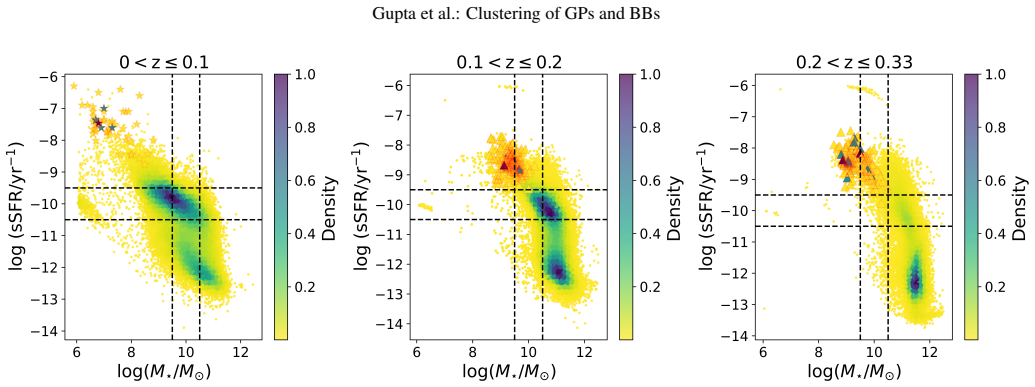
Little is currently known about the large-scale environments of Green Pea (GP) and Blueberry (BB) galaxies, which are low-mass, compact systems with extreme specific star-formation rates (sSFR). Their environments are inherently linked to their formation mechanism, and they may serve as crucial local analogues for high-redshift, reionizing galaxies. This paper aims to investigate the clustering properties of GPs and BBs, leveraging large-scale survey data to quantify their spatial distribution relative to the broader galaxy population. We here investigate a sample of these galaxies, consisting of 339 GPs $\rm (0.1 < z \le 0.33)$ and 56 BBs $\rm (0 < z \le 0.1)$, whose clustering properties we analyse relative to an extensive control sample derived from the SDSS MPA-JHU DR8 catalogue, binned by stellar mass and sSFR. We use the number of neighbours within a 5 Mpc radius as a proxy for environmental density, i.e. clustering, and employ a pair-matching and bootstrapping methodology to ensure statistical robustness. We observe that galaxy clustering depends strongly on star-formation activity, with passive galaxies being more clustered than their high star-formation rate counterparts, with GPs and BBs lying at the extreme end of this relation, exhibiting the lowest neighbour counts among all subsamples. The nearest neighbours of BBs also tend to have lower masses than other classes of dwarf galaxies. GPs and BBs predominantly reside in isolated, low-density environments, suggesting that their intense starbursts are unlikely to be triggered by common environmental processes such as mergers or starburst cycles. Their low metallicities and weak clustering instead support scenarios in which recent starbursts are driven by internal processes or pristine gas accretion, reinforcing their role as nearby analogues of young, low-mass galaxies in the early Universe.
Editorial analysis
A structured set of objections, weighed in public.
Referee Report
Summary. The manuscript analyzes the large-scale environments of 339 Green Pea galaxies (0.1 < z ≤ 0.33) and 56 Blueberry galaxies (z ≤ 0.1) from SDSS data. Using a control sample matched in stellar mass and specific star formation rate, it finds that GPs and BBs have the lowest number of neighbors within a 5 Mpc radius, indicating they reside in isolated, low-density environments. The authors conclude that their intense starbursts are unlikely triggered by environmental processes like mergers, favoring internal mechanisms or gas accretion, and positioning them as local analogues for high-redshift reionizing galaxies.
Significance. If the findings hold after addressing methodological details, this work would provide valuable observational constraints on the environments of extreme star-forming dwarf galaxies. It strengthens the case for internal drivers of starbursts in these systems and supports their analogy to early Universe galaxies, which could inform models of galaxy formation and reionization. The use of public survey data with mass/sSFR-matched controls and bootstrapping is a positive aspect of the analysis.
major comments (3)
- [Abstract] Abstract: The suggestion that starbursts are 'unlikely to be triggered by common environmental processes such as mergers' is not supported by the 5 Mpc neighbor count alone, since mergers and tidal interactions typically occur on scales << 1 Mpc (e.g., <200 kpc). No close-pair fractions, separation distributions, or small-scale statistics are reported to bridge this gap, undermining the central implication for formation mechanisms.
- [Methods] Methods (control sample construction and neighbor counting): The manuscript lacks sufficient detail on redshift-dependent selection effects, completeness corrections for the SDSS MPA-JHU catalogue, and how these are handled across the different redshift ranges of GPs and BBs. This is critical for the validity of the neighbor count comparisons and the claim of lowest densities.
- [Statistical analysis] Statistical analysis section: Details on the bootstrapping methodology, error propagation for neighbor counts, and the exact pair-matching procedure are not fully specified, making it difficult to assess the robustness of the claim that GPs and BBs exhibit the lowest neighbour counts among subsamples.
minor comments (2)
- Ensure all figures clearly label the control samples, redshift bins, and error bars for easy comparison with the GP/BB samples.
- Consider adding references to prior studies on GP/BB environments or merger rates in low-mass galaxies for better context.
Simulated Author's Rebuttal
We thank the referee for their constructive and detailed comments on our manuscript. These have identified key areas where additional clarity and precision are needed. We respond to each major comment below, indicating the revisions we will make to strengthen the paper.
read point-by-point responses
-
Referee: [Abstract] Abstract: The suggestion that starbursts are 'unlikely to be triggered by common environmental processes such as mergers' is not supported by the 5 Mpc neighbor count alone, since mergers and tidal interactions typically occur on scales << 1 Mpc (e.g., <200 kpc). No close-pair fractions, separation distributions, or small-scale statistics are reported to bridge this gap, undermining the central implication for formation mechanisms.
Authors: We appreciate this important distinction. Our analysis demonstrates that GPs and BBs have the lowest large-scale neighbor densities (within 5 Mpc) among mass- and sSFR-matched samples, which we interpret as evidence that their environments are not conducive to the frequent interactions expected in denser regions. We agree that this does not constitute direct measurement of close-pair statistics on <<1 Mpc scales. In the revised manuscript we will adjust the abstract and conclusions to state that the observed low large-scale densities make triggering by environmental processes associated with dense environments (such as mergers in groups) unlikely, while explicitly noting that a dedicated close-pair analysis lies outside the scope of the present work but would be a valuable extension. revision: partial
-
Referee: [Methods] Methods (control sample construction and neighbor counting): The manuscript lacks sufficient detail on redshift-dependent selection effects, completeness corrections for the SDSS MPA-JHU catalogue, and how these are handled across the different redshift ranges of GPs and BBs. This is critical for the validity of the neighbor count comparisons and the claim of lowest densities.
Authors: We acknowledge that the Methods section would benefit from greater explicitness on these points. In the revised version we will expand the description to cover: (i) the redshift-dependent completeness and selection functions of the SDSS MPA-JHU DR8 catalogue, (ii) how the control samples are constructed separately within the BB (z ≤ 0.1) and GP (0.1 < z ≤ 0.33) redshift intervals to match stellar mass and sSFR while respecting these selection effects, and (iii) any handling of SDSS-specific biases (e.g., fiber collisions) in the neighbor-counting procedure. These details were present in our internal analysis but were not stated with sufficient clarity. revision: yes
-
Referee: [Statistical analysis] Statistical analysis section: Details on the bootstrapping methodology, error propagation for neighbor counts, and the exact pair-matching procedure are not fully specified, making it difficult to assess the robustness of the claim that GPs and BBs exhibit the lowest neighbour counts among subsamples.
Authors: We agree that full reproducibility requires these specifications. We will add a dedicated paragraph detailing: the bootstrapping implementation (including the number of resamples and the method for deriving uncertainties on the mean neighbor counts), the error propagation (combining Poisson counting errors with bootstrap variance), and the precise pair-matching tolerances (e.g., ±0.1 dex in log M* and ±0.2 dex in log sSFR). These additions will allow readers to evaluate the robustness of the result that GPs and BBs show the lowest neighbor counts. revision: yes
Circularity Check
Direct observational comparison with no circular derivations
full rationale
The paper performs a direct empirical comparison of neighbor counts within a 5 Mpc radius using public SDSS MPA-JHU DR8 data, after explicit mass and sSFR matching plus bootstrapping. No equations, fitted parameters, or self-citations are invoked that reduce the reported neighbor counts or clustering conclusions to inputs by construction. The density proxy is chosen and applied uniformly to all subsamples, and the interpretation regarding merger triggers is presented as a suggestion rather than a derived result. The analysis is self-contained against external survey benchmarks with no self-referential loops.
Axiom & Free-Parameter Ledger
free parameters (1)
- 5 Mpc neighbor radius
axioms (1)
- domain assumption Redshift provides a reliable distance measure for neighbor counting at z < 0.33
Reference graph
Works this paper leans on
-
[1]
N., Adelman-McCarthy, J
Abazajian, K. N., Adelman-McCarthy, J. K., Agüeros, M. A., et al. 2009, ApJS, 182, 543 Adamcová, B., Svoboda, J., Kyritsis, E., et al. 2024, A&A, 691, A27
2009
-
[2]
2011, ApJS, 193, 29
Aihara, H., Allende Prieto, C., An, D., et al. 2011, ApJS, 193, 29
2011
-
[3]
B., Casey, C
Akins, H. B., Casey, C. M., Allen, N., et al. 2023, ApJ, 956, 61
2023
-
[4]
D., Allende Prieto, C., et al
Alam, S., Albareti, F. D., Allende Prieto, C., et al. 2015, ApJS, 219, 12
2015
-
[5]
J., & Scott, P
Asplund, M., Grevesse, N., Sauval, A. J., & Scott, P. 2009, ARA&A, 47, 481
2009
-
[6]
L., Navarro, J
Balogh, M. L., Navarro, J. F., & Morris, S. L. 2000, ApJ, 540, 113
2000
-
[7]
G., Kocevski, D
Barro, G., Pérez-González, P. G., Kocevski, D. D., et al. 2024, ApJ, 963, 128
2024
-
[8]
N., Kauffmann, G., Heckman, T
Best, P. N., Kauffmann, G., Heckman, T. M., et al. 2005, MNRAS, 362, 25
2005
-
[9]
L., Watson, M
Birchall, K. L., Watson, M. G., & Aird, J. 2020, MNRAS, 492, 2268
2020
-
[10]
Blanton, M. R. & Moustakas, J. 2009, ARA&A, 47, 159
2009
-
[11]
S., Schlegel, D
Bolton, A. S., Schlegel, D. J., Aubourg, É., et al. 2012, AJ, 144, 144
2012
-
[12]
G., Svoboda, J., Stern, D., et al
Boorman, P. G., Svoboda, J., Stern, D., et al. 2025, ApJ, 988, 157
2025
-
[13]
2024, A&A, 687, A137
Borkar, A., Grossová, R., Svoboda, J., et al. 2024, A&A, 687, A137
2024
-
[14]
Brinchmann, J., Charlot, S., White, S. D. M., et al. 2004, MNRAS, 351, 1151
2004
-
[15]
M., Satyapal, S., Abel, N
Cann, J. M., Satyapal, S., Abel, N. P., et al. 2019, ApJ, 870, L2
2019
-
[16]
2009, MNRAS, 399, 1191
Cardamone, C., Schawinski, K., Sarzi, M., et al. 2009, MNRAS, 399, 1191
2009
-
[17]
Chambers, K. C., Magnier, E. A., Metcalfe, N., et al. 2016, arXiv e-prints, arXiv:1612.05560
work page internal anchor Pith review arXiv 2016
- [18]
-
[19]
2025b, arXiv e-prints, arXiv:2510.02801
Chen, X., Ichikawa, K., Akiyama, M., et al. 2025b, arXiv e-prints, arXiv:2510.02801
-
[20]
K., Best, P
Cochrane, R. K., Best, P. N., Sobral, D., et al. 2018, MNRAS, 475, 3730
2018
-
[21]
L., Newman, J
Coil, A. L., Newman, J. A., Croton, D., et al. 2008, ApJ, 672, 153
2008
-
[22]
& Wechsler, R
Conroy, C. & Wechsler, R. H. 2009, ApJ, 696, 620
2009
-
[23]
L., Songaila, A., Hu, E
Cowie, L. L., Songaila, A., Hu, E. M., & Cohen, J. G. 1996, AJ, 112, 839
1996
-
[24]
J., Springel, V ., White, S
Croton, D. J., Springel, V ., White, S. D. M., et al. 2006, MNRAS, 365, 11 Davé, R. 2008, MNRAS, 385, 147
2006
-
[25]
1980, ApJ, 236, 351
Dressler, A. 1980, ApJ, 236, 351
1980
-
[26]
Dunn, O. J. 1964, Technometrics, 6, 241
1964
-
[27]
P., Cooper, M
Fillingham, S. P., Cooper, M. C., Pace, A. B., et al. 2016, MNRAS, 463, 1916
2016
-
[28]
Gallazzi, A., Charlot, S., Brinchmann, J., White, S. D. M., & Tremonti, C. A. 2005, MNRAS, 362, 41
2005
-
[29]
2025, MNRAS, 536, 905
Ge, X., Gu, Y .-Z., Lei, C.-L., & Zhang, X.-H. 2025, MNRAS, 536, 905
2025
-
[30]
R., Yan, R., & Tinker, J
Geha, M., Blanton, M. R., Yan, R., & Tinker, J. L. 2012, ApJ, 757, 85
2012
-
[31]
Ghodsi, L., Man, A. W. S., Donevski, D., et al. 2024, MNRAS, 528, 4393
2024
-
[32]
A., Heckman, T
Groves, B. A., Heckman, T. M., & Kauffmann, G. 2006, MNRAS, 371, 1559
2006
-
[33]
Gunn, J. E. & Gott, III, J. R. 1972, ApJ, 176, 1
1972
-
[34]
S., Shin, J., & Song, H
Hwang, H. S., Shin, J., & Song, H. 2019, MNRAS, 489, 339
2019
-
[35]
I., Guseva, N
Izotov, Y . I., Guseva, N. G., & Thuan, T. X. 2011, ApJ, 728, 161
2011
-
[36]
Jaskot, A. E. 2025, ARA&A, 63, 45
2025
-
[37]
M., White, S
Kauffmann, G., Heckman, T. M., White, S. D. M., et al. 2003, MNRAS, 341, 33
2003
-
[38]
Kauffmann, G., White, S. D. M., Heckman, T. M., et al. 2004, MNRAS, 353, 713
2004
-
[39]
C., Tate, J., Wong, O
Keel, W. C., Tate, J., Wong, O. I., et al. 2022, AJ, 163, 150
2022
-
[40]
Kennicutt, Jr., R. C. 1998, ARA&A, 36, 189
1998
-
[41]
J., Malhotra, S., Rhoads, J
Kim, K. J., Malhotra, S., Rhoads, J. E., & Yang, H. 2021, ApJ, 914, 2
2021
-
[42]
D., Finkelstein, S
Kocevski, D. D., Finkelstein, S. L., Barro, G., et al. 2025, ApJ, 986, 126
2025
-
[43]
2024, A&A, 688, A159
Kouroumpatzakis, K., Svoboda, J., Zezas, A., et al. 2024, A&A, 688, A159
2024
-
[44]
2023, A&A, 673, A16
Kouroumpatzakis, K., Zezas, A., Kyritsis, E., Salim, S., & Svoboda, J. 2023, A&A, 673, A16
2023
-
[45]
Kruskal, W. H. & Wallis, W. A. 1952, Journal of the American Statistical Asso- ciation, 47, 583
1952
-
[46]
E., Bezanson, R., et al
Labbe, I., Greene, J. E., Bezanson, R., et al. 2025, ApJ, 978, 92
2025
-
[47]
B., Tinsley, B
Larson, R. B., Tinsley, B. M., & Caldwell, C. N. 1980, ApJ, 237, 692
1980
-
[48]
C., Kennicutt, Jr., R
Lee, J. C., Kennicutt, Jr., R. C., Funes, S. J. J. G., Sakai, S., & Akiyama, S. 2009, ApJ, 692, 1305
2009
-
[49]
2002, MNRAS, 334, 673
Lewis, I., Balogh, M., De Propris, R., et al. 2002, MNRAS, 334, 673
2002
-
[50]
P., et al
Li, C., Kauffmann, G., Jing, Y . P., et al. 2006, MNRAS, 368, 21
2006
-
[51]
2014, ApJ, 782, 33
Lin, L., Jian, H.-Y ., Foucaud, S., et al. 2014, ApJ, 782, 33
2014
-
[52]
2025, arXiv e-prints, arXiv:2507.10659
Lin, X., Fan, X., Cai, Z., et al. 2025b, arXiv e-prints, arXiv:2507.10659
-
[53]
J., Schawinski, K., Slosar, A., et al
Lintott, C. J., Schawinski, K., Slosar, A., et al. 2008, MNRAS, 389, 1179
2008
-
[54]
McDonough, B., Curtis, O., & Brainerd, T. G. 2025, ApJ, 978, 67
2025
-
[55]
2015, MNRAS, 446, 299
Melioli, C., Brighenti, F., & D’Ercole, A. 2015, MNRAS, 446, 299
2015
-
[56]
& Domínguez Sánchez, H
Mezcua, M. & Domínguez Sánchez, H. 2024, MNRAS, 528, 5252
2024
-
[57]
C., & White, S
Mo, H., van den Bosch, F. C., & White, S. 2010, Galaxy Formation and Evolution
2010
-
[58]
L., Cooper, M., et al
Mostek, N., Coil, A. L., Cooper, M., et al. 2013, ApJ, 767, 89
2013
-
[59]
I., Croton, D
Muldrew, S. I., Croton, D. J., Skibba, R. A., et al. 2012, MNRAS, 419, 2670
2012
-
[60]
2018, MNRAS, 475, 624
Nelson, D., Pillepich, A., Springel, V ., et al. 2018, MNRAS, 475, 624
2018
-
[61]
2019, Computational Astrophysics and Cosmology, 6, 2
Nelson, D., Springel, V ., Pillepich, A., et al. 2019, Computational Astrophysics and Cosmology, 6, 2
2019
-
[62]
J., Balogh, M
Old, L. J., Balogh, M. L., van der Burg, R. F. J., et al. 2020, MNRAS, 493, 5987
2020
-
[63]
J., Kovaˇc, K., et al
Peng, Y .-j., Lilly, S. J., Kovaˇc, K., et al. 2010, ApJ, 721, 193
2010
-
[64]
2018, MNRAS, 473, 4077
Pillepich, A., Springel, V ., Nelson, D., et al. 2018, MNRAS, 473, 4077
2018
-
[65]
F., Schaye, J., et al
Pizzati, E., Hennawi, J. F., Schaye, J., et al. 2025, MNRAS, 539, 2910
2025
-
[66]
S., Kannappan, S
Polimera, M. S., Kannappan, S. J., Richardson, C. T., et al. 2022, ApJ, 931, 44
2022
-
[67]
C., Stierwalt, S., Patton, D
Privon, G. C., Stierwalt, S., Patton, D. R., et al. 2017, ApJ, 846, 74
2017
-
[68]
N., et al
Purkayastha, S., Kanekar, N., Chengalur, J. N., et al. 2022, ApJ, 933, L11
2022
-
[69]
2024, ApJ, 977, 68
Purkayastha, S., Kanekar, N., Kumari, S., et al. 2024, ApJ, 977, 68
2024
-
[70]
K., Ko, J., et al
Rhee, J., Yi, S. K., Ko, J., et al. 2024, ApJ, 971, 111
2024
-
[71]
E., Wold, I
Rhoads, J. E., Wold, I. G. B., Harish, S., et al. 2023, ApJ, 942, L14 Rihtaršiˇc, G., Biffi, V ., Fabjan, D., & Dolag, K. 2024, A&A, 683, A57
2023
-
[72]
2018, arXiv e-prints, arXiv:1806.10149
Rong, Y ., Yang, H., Zhang, H.-x., et al. 2018, arXiv e-prints, arXiv:1806.10149
-
[73]
M., Charlot, S., et al
Salim, S., Rich, R. M., Charlot, S., et al. 2007, ApJS, 173, 267
2007
-
[74]
2025, arXiv e-prints, arXiv:2511.08678
Samonski, H., Salim, S., & Salzer, J. 2025, arXiv e-prints, arXiv:2511.08678
-
[75]
2022, A&A, 665, L4
Schaerer, D., Marques-Chaves, R., Barrufet, L., et al. 2022, A&A, 665, L4
2022
-
[76]
Scott, D. W. 1979, Biometrika, 66, 605
1979
-
[77]
S., Steinhardt, C
Speagle, J. S., Steinhardt, C. L., Capak, P. L., & Silverman, J. D. 2014, ApJS, 214, 15
2014
-
[78]
2010, MNRAS, 401, 791
Springel, V . 2010, MNRAS, 401, 791
2010
-
[79]
2019, ApJ, 880, 144
Svoboda, J., Douna, V ., Orlitová, I., & Ehle, M. 2019, ApJ, 880, 144
2019
-
[80]
& Cen, R
Tonnesen, S. & Cen, R. 2014, ApJ, 788, 133
2014
discussion (0)
Sign in with ORCID, Apple, or X to comment. Anyone can read and Pith papers without signing in.