Recognition: unknown
Caught in the Cosmic Web: Environmental Impacts on the Halo Substructure Boosts to Dark Matter Annihilation Signals
Pith reviewed 2026-05-07 14:35 UTC · model grok-4.3
The pith
Dark matter annihilation boost factors from subhaloes vary with cosmic web environment at fixed halo mass.
A machine-rendered reading of the paper's core claim, the machinery that carries it, and where it could break.
Core claim
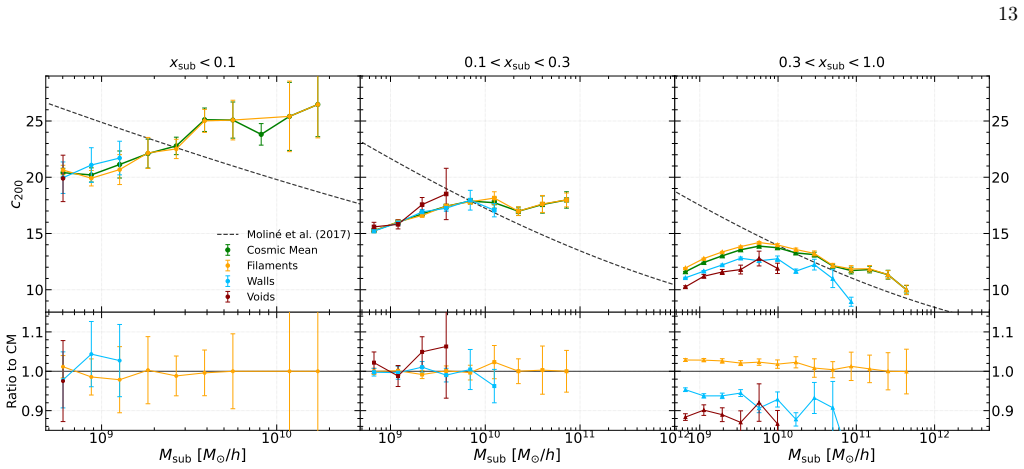
In the fiducial distance-dependent model, filament haloes show a mass-dependent transition from a ∼15% suppression at the low-mass end to a modest enhancement of ∼12% for massive hosts, wall haloes remain intermediate, while void haloes stay suppressed by roughly 30–33% across the explored host-mass range. These are deterministic predictions obtained by propagating environment-dependent ingredient ratios through two standard semi-analytic boost frameworks.
What carries the argument
The relative boost factor B(M, env)/B_CM(M), computed by propagating simulation-calibrated environment-dependent ratios for host concentrations, subhalo mass function, and Vmax–Rmax proxies through standard semi-analytic annihilation boost calculations.
Load-bearing premise
That simulation-calibrated environment-dependent ratios for host-halo concentrations, subhalo mass function, and Vmax–Rmax internal-structure proxies can be directly propagated through standard semi-analytic boost frameworks without introducing unaccounted biases or missing environmental interactions.
What would settle it
Direct comparison of the predicted relative boosts to outputs from high-resolution N-body simulations that tag haloes by environment at fixed mass and measure annihilation luminosity ratios, checking for the reported 15-to-12 percent filament transition and 30 percent void suppression.
Figures


read the original abstract
The annihilation of dark matter (DM) particles is expected to produce Standard Model particles, providing a potential indirect signature of DM. The clumpy substructure of DM haloes amplifies the expected annihilation signal, an effect commonly quantified by the subhalo boost factor. Standard semi-analytic models usually treat this boost as a universal function of host-halo mass, neglecting systematic variations induced by the large-scale environment. In this work, we extend this framework by incorporating the influence of the cosmic web on subhalo populations. Using simulation-calibrated, environment-dependent ratios for host-halo concentrations, the subhalo mass function, and internal-structure proxies of subhalos based on the $V_{\max}$--$R_{\max}$ relation, we compute environment-conditioned boost predictions for haloes residing in filaments, walls, and voids. Our main result is the boost factor at fixed host-halo mass, expressed relative to the cosmic-mean prediction, $B(M,\mathrm{env})/B_{\mathrm{CM}}(M)$. We find a clear environmental modulation: in the fiducial distance-dependent model, filament haloes show a mass-dependent transition from a $\sim 15\%$ suppression at the low-mass end to a modest enhancement of $\sim 12\%$ for massive hosts, wall haloes remain intermediate, while void haloes stay suppressed by roughly $30$--$33\%$ across the explored host-mass range. These results should be interpreted as deterministic model predictions obtained by propagating environment-dependent ingredient ratios through two standard semi-analytic boost frameworks. We provide an environment-aware prescription for subhalo boosts, together with modular environmental corrections that may also be useful in indirect-detection forecasts, strong-lensing mass modeling, and related halo-population applications.
Editorial analysis
A structured set of objections, weighed in public.
Referee Report
Summary. The paper extends standard semi-analytic models of the subhalo boost factor for dark matter annihilation by incorporating cosmic-web environment dependence. It propagates simulation-calibrated, environment-specific ratios for host-halo concentration, subhalo mass function, and Vmax–Rmax internal-structure proxies through two established boost integrators to obtain the ratio B(M, env)/B_CM(M). The central claim is a mass-dependent modulation: in the fiducial distance-dependent model, filament haloes transition from ~15% suppression at low mass to ~12% enhancement at high mass, wall haloes are intermediate, and void haloes remain suppressed by 30–33% across the host-mass range explored. The results are presented as deterministic predictions from this propagation, together with modular environmental correction prescriptions.
Significance. If the propagation procedure is shown to be robust, the work supplies a concrete, environment-aware correction to boost factors that could be directly adopted in indirect-detection forecasts, strong-lensing analyses, and halo-population modeling. The modular form of the corrections and the explicit framing as model predictions (rather than fitted results) are strengths that enhance usability and reproducibility.
major comments (1)
- [Propagation procedure and fiducial distance-dependent model results] The quantitative headline results (filament transition from ~15% suppression to ~12% enhancement; void suppression of 30–33%) are obtained by multiplying separate environment-dependent ratios for c(M,env), dN/dM_sub(env), and the Vmax–Rmax proxy before insertion into the boost integrators. Because these three quantities are measured from the same simulated haloes, their joint distribution within each environment may contain covariances that are not captured by the product of marginal ratios. No joint-distribution validation or covariance term is described, so the reported modulations could be biased at a level comparable to the effect sizes themselves. This assumption is load-bearing for the central claims.
minor comments (2)
- [Abstract] The abstract states that the results are 'deterministic model predictions obtained by propagating environment-dependent ingredient ratios,' which is appropriately cautious; however, the explored host-mass range should be stated explicitly in the abstract for immediate context.
- [Notation throughout] Notation for the cosmic-mean boost (B_CM(M)) is introduced clearly, but ensure that 'cosmic mean' versus 'CM' is used consistently in all figure labels and equations.
Simulated Author's Rebuttal
We thank the referee for their careful reading and constructive feedback. We address the major comment on the propagation procedure below.
read point-by-point responses
-
Referee: The quantitative headline results (filament transition from ~15% suppression to ~12% enhancement; void suppression of 30–33%) are obtained by multiplying separate environment-dependent ratios for c(M,env), dN/dM_sub(env), and the Vmax–Rmax proxy before insertion into the boost integrators. Because these three quantities are measured from the same simulated haloes, their joint distribution within each environment may contain covariances that are not captured by the product of marginal ratios. No joint-distribution validation or covariance term is described, so the reported modulations could be biased at a level comparable to the effect sizes themselves. This assumption is load-bearing for the central claims.
Authors: We appreciate the referee highlighting the potential impact of covariances among the environment-dependent ratios. Our framework deliberately propagates the marginal ratios for concentration, subhalo mass function, and Vmax–Rmax proxy separately before insertion into the boost integrators. This choice preserves modularity, transparency, and usability, allowing independent environmental corrections to be applied or extended by other users, consistent with the referee's note on the strengths of the modular form. The manuscript explicitly presents the results as deterministic model predictions obtained by this propagation rather than as direct measurements from joint distributions. While full covariances could in principle refine the precision, the simulation calibrations show that the primary environmental trends are captured at the marginal level, and the multiplicative structure aligns with the separable nature of the boost integrators. In the revised manuscript we will add a dedicated discussion of this assumption, including a qualitative assessment of its robustness based on the simulation statistics, and insert an explicit caveat in the results section. revision: partial
Circularity Check
No circularity: external simulation ratios propagated through standard frameworks
full rationale
The paper's central procedure is to take environment-dependent ratios for concentrations, subhalo mass functions, and Vmax-Rmax proxies that are calibrated from external simulations, then insert them into two pre-existing semi-analytic boost integrators to obtain B(M,env)/B_CM(M). This is explicitly described as 'deterministic model predictions obtained by propagating environment-dependent ingredient ratios' rather than any derivation or fit performed inside the present work. No equation reduces a claimed prediction to a quantity defined or fitted by the paper itself; the inputs remain independent of the output boost ratios. No self-citation is load-bearing for the quantitative claims, and the derivation chain is therefore self-contained against external benchmarks.
Axiom & Free-Parameter Ledger
axioms (1)
- domain assumption Standard semi-analytic boost frameworks remain accurate when supplied with environment-dependent ratios for concentration, subhalo mass function, and Vmax-Rmax proxies.
Reference graph
Works this paper leans on
-
[1]
annihilation lumi- nosity
and employ thenexus+framework, implemented within ourCaCTusalgorithm introduced in Paper I. The CaCTuspackage provides an optimized implementation of the multi-scalenexus+algorithm [60], enabling efficient segmentation of the cosmic web across a wide dynamic range. The code, along with detailed documentation, will be made publicly available in Naidoo et a...
2020
-
[2]
G. Bertone and D. Hooper, Reviews of Modern Physics 90, 045002 (2018), arXiv:1605.04909 [astro-ph.CO]
work page Pith review arXiv 2018
-
[3]
Planck 2018 results. VI. Cosmological parameters
Planck Collaboration, N. Aghanim, Y. Akrami, M. Ash- down, J. Aumont, C. Baccigalupi, M. Ballardini, A. J. Banday, R. B. Barreiro, N. Bartolo, S. Basak, R. Battye, K. Benabed, J.-P. Bernard, M. Bersanelli, P. Bielewicz, J. J. Bock, J. R. Bond, J. Borrill, F. R. Bouchet, F. Boulanger, M. Bucher, C. Burigana, R. C. Butler, E. Calabrese, J.-F. Cardoso, J. Ca...
work page internal anchor Pith review arXiv 2020
-
[4]
B. Carr and F. Kuhnel, arXiv e-prints , arXiv:2110.02821 (2021), arXiv:2110.02821 [astro-ph.CO]
-
[5]
G. Jungman, M. Kamionkowski, and K. Griest, Phys. Rep.267, 195 (1996), arXiv:hep-ph/9506380 [hep- ph]
-
[6]
Particle Dark Matter: Evidence, Candidates and Constraints
G. Bertone, D. Hooper, and J. Silk, Phys. Rep.405, 279 (2005), arXiv:hep-ph/0404175 [hep-ph]
work page Pith review arXiv 2005
-
[7]
T. Bringmann and C. Weniger, Physics of the Dark Uni- verse1, 194 (2012), arXiv:1208.5481 [hep-ph]
-
[8]
Roszkowski, E
L. Roszkowski, E. M. Sessolo, and S. Trojanowski, Re- ports on Progress in Physics81, 066201 (2018)
2018
-
[9]
S. J. Asztalos, L. J. Rosenberg, K. van Bibber, P. Sikivie, and K. Zioutas, Annual Review of Nuclear and Particle Science56, 293 (2006)
2006
-
[10]
D. J. E. Marsh, Phys. Rep.643, 1 (2016)
2016
- [11]
-
[12]
Kopp, arXiv e-prints , arXiv:2109.00767 (2021), arXiv:2109.00767 [hep-ph]
J. Kopp, arXiv e-prints , arXiv:2109.00767 (2021), arXiv:2109.00767 [hep-ph]
-
[13]
T. Marrodán Undagoitia and L. Rauch, Journal of Physics G Nuclear Physics43, 013001 (2016), arXiv:1509.08767 [physics.ins-det]
-
[14]
M. Battaglieri, A. Belloni, A. Chou, P. Cushman, B. Echenard, R. Essig, J. Estrada, J. L. Feng, B. Flaugher, P. J. Fox, P. Graham, C. Hall, R. Harnik, J. Hewett, J. Incandela, E. Izaguirre, D. McKinsey, M. Pyle, N. Roe, G. Rybka, P. Sikivie, T. M. P. Tait, N. Toro, R. Van De Water, N. Weiner, K. Zurek, E. Adelberger, A. Afanasev, D. Alexander, J. Alexande...
- [15]
-
[16]
Prada, MNRAS466, 4974 (2017), arXiv:1603.04057 [astro-ph.CO]
Á.Moliné, M.A.Sánchez-Conde, S.Palomares-Ruiz,and F. Prada, MNRAS466, 4974 (2017), arXiv:1603.04057 [astro-ph.CO]
- [17]
-
[18]
S. Colafrancesco, S. Profumo, and P. Ullio, A&A455, 21 (2006), arXiv:astro-ph/0507575 [astro-ph]
-
[19]
M. Kamionkowski, S. M. Koushiappas, and M. Kuhlen, Phys. Rev. D81, 043532 (2010), arXiv:1001.3144 [astro- ph.GA]
-
[20]
J. Pearson, H. Dickinson, S. Sinha, and S. Serjeant, arXiv e-prints , arXiv:2509.22609 (2025), arXiv:2509.22609 [astro-ph.CO]
-
[21]
J. R. Bond, L. Kofman, and D. Pogosyan, Nature380, 10.1038/380603a0 (1996)
-
[22]
S. D. M. White and M. J. Rees, MNRAS183, 10.1093/mnras/183.3.341 (1978)
-
[23]
Springel, MNRAS364, 1105 (2005), arXiv:astro- ph/0505010 [astro-ph]
V. Springel, MNRAS364, 1105 (2005), arXiv:astro- ph/0505010 [astro-ph]
-
[24]
Springel, Monthly notices of the royal astronomical society364, 1105 (2005)
V. Springel, Monthly notices of the royal astronomical society364, 1105 (2005)
2005
-
[25]
J. Zavala and C. S. Frenk, Galaxies7, 81 (2019), arXiv:1907.11775 [astro-ph.CO]
-
[26]
A. G. Doroshkevich, Astrophysics6, 320 (1970)
1970
-
[27]
Y. B. Zel’dovich, A&A5, 84 (1970)
1970
-
[28]
S. F. Shandarin and Y. B. Zeldovich, Reviews of Modern Physics61, 185 (1989)
1989
-
[29]
M. Cautun, R. van de Weygaert, B. J. T. Jones, and C. S. Frenk, MNRAS441, 2923 (2014), arXiv:1401.7866 [astro-ph.CO]
work page Pith review arXiv 2014
-
[30]
N. I. Libeskind, R. van de Weygaert, M. Cautun, B. Falck, E. Tempel, T. Abel, M. Alpaslan, M. A. Aragón-Calvo, J.E.Forero-Romero, R.Gonzalez, S.Got- tlöber, O. Hahn, W. A. Hellwing, Y. Hoffman, B. J. Jones, F. Kitaura, A. Knebe, S. Manti, M. Neyrinck, S. E. Nuza, N. Padilla, E. Platen, N. Ramachandra, A. Robotham, E. Saar, S. Shandarin, M. Steinmetz, R. S...
2018
- [31]
- [32]
-
[33]
and Hoffman, Yehuda and Crain, Robert A
O. Metuki, N. I. Libeskind, Y. Hoffman, R. A. Crain, and T. Theuns, MNRAS446, 10.1093/mnras/stu2166 (2015)
- [34]
-
[35]
P. Ganeshaiah Veena, M. Cautun, R. van de Wey- gaert, E. Tempel, B. J. T. Jones, S. Rieder, and C. S. Frenk, MNRAS481, 414 (2018), arXiv:1805.00033 [astro-ph.CO]
- [36]
-
[37]
P. Ganeshaiah Veena, M. Cautun, R. van de Weygaert, E. Tempel, and C. S. Frenk, MNRAS503, 2280 (2021), arXiv:2007.10365 [astro-ph.CO]
- [38]
- [39]
-
[40]
J. Diemand, M. Kuhlen, P. Madau, M. Zemp, B. Moore, D. Potter, and J. Stadel, Nature454, 735 (2008), arXiv:0805.1244 [astro-ph]
-
[41]
V. Springel, J. Wang, M. Vogelsberger, A. Ludlow, A. Jenkins, A. Helmi, J. F. Navarro, C. S. Frenk, and S. D. M. White, MNRAS391, 1685 (2008), arXiv:0809.0898 [astro-ph]
-
[42]
T. Ishiyama, F. Prada, A. A. Klypin, M. Sinha, R. B. Metcalf, E. Jullo, B. Altieri, S. A. Cora, D. Croton, S. de la Torre, D. E. Millán-Calero, T. Oogi, J. Ruedas, and C. A. Vega-Martínez, MNRAS506, 4210 (2021), arXiv:2007.14720 [astro-ph.CO]
-
[43]
N. Hiroshima, S. Ando, and T. Ishiyama, Phys. Rev. D 97, 123002 (2018), arXiv:1803.07691 [astro-ph.CO]
-
[44]
Boylan-Kolchin, J
M. Boylan-Kolchin, J. S. Bullock, and M. Kaplinghat, MNRAS415, L40 (2011), https://academic.oup.com/mnrasl/article- pdf/415/1/L40/54669362/mnrasl_415_1_l40.pdf
2011
- [45]
- [46]
- [47]
- [48]
-
[49]
Bergström, New Journal of Physics11, 105006 (2009), arXiv:0903.4849 [hep-ph]
L. Bergström, New Journal of Physics11, 105006 (2009), arXiv:0903.4849 [hep-ph]
-
[50]
Cirelli, Pramana79, 1021 (2012), arXiv:1202.1454 [hep-ph]
M. Cirelli, Pramana79, 1021 (2012), arXiv:1202.1454 [hep-ph]
-
[51]
T. Ishiyama and S. Ando, MNRAS492, 3662 (2020), arXiv:1907.03642 [astro-ph.CO]
- [52]
-
[53]
O. Metuki, N. I. Libeskind, and Y. Hoffman, MNRAS 460, 10.1093/mnras/stw979 (2016)
-
[54]
F. Jiang and F. C. V. D. Bosch, MNRAS458, 10.1093/mnras/stw439 (2016)
-
[55]
Ogiya, O
G. Ogiya, O. Hahn, and A. B. Hirschmann, Monthly No- tices of the Royal Astronomical Society503, 1233 (2021)
2021
-
[56]
Errani and J
R. Errani and J. F. Navarro, Monthly Notices of the Royal Astronomical Society505, 18 (2021)
2021
-
[57]
F. Markos Hunde, O. Newton, W. A. Hellwing, M. Bilicki, and K. Naidoo, A&A700, A65 (2025), arXiv:2409.09226 [astro-ph.CO]
-
[58]
Moliné, M
Á. Moliné, M. A. Sánchez-Conde, A. Aguirre-Santaella, T. Ishiyama, F. Prada, S. A. Cora, D. Croton, E. Jullo, R. B. Metcalf, T. Oogi, and J. Ruedas, MNRAS518, 157 (2022)
2022
-
[59]
S. Bose, W. A. Hellwing, C. S. Frenk, A. Jenkins, M. R. Lovell, J. C. Helly, and B. Li, MNRAS455, 318 (2016)
2016
- [60]
- [61]
-
[62]
E. Komatsu, K. M. Smith, J. Dunkley, C. L. Bennett, B. Gold, G. Hinshaw, N. Jarosik, D. Larson, M. R. Nolta, L. Page, D. N. Spergel, M. Halpern, R. S. Hill, A. Kogut, M. Limon, S. S. Meyer, N. Odegard, G. S. Tucker, J. L. Weiland, E. Wollack, and E. L. Wright, ApJS192, 18 (2011), arXiv:1001.4538 [astro-ph.CO]
work page Pith review arXiv 2011
-
[63]
M.Davis, G.Efstathiou, C.S.Frenk,andS.D.M.White, ApJ292, 10.1086/163168 (1985)
-
[64]
V. Springel, S. D. M. White, G. Tormen, and G. Kauff- mann, MNRAS328, 726 (2001), arXiv:astro-ph/0012055 [astro-ph]
- [65]
-
[66]
Nurmi, P
P. Nurmi, P. Heinämäki, J. Holopainen, P. Pi- hajoki, E. Saar, M. Einasto, and J. Einasto, in Galaxy Evolution across the Hubble Time, Vol. 235, edited by F. Combes and J. Palouš (2007) pp. 127–127
2007
-
[67]
N. A. Bond, M. A. Strauss, and R. Cen, MNRAS409, 156 (2010), https://academic.oup.com/mnras/article- pdf/409/1/156/6221724/mnras0409-0156.pdf
2010
-
[68]
Hoffman, O
Y. Hoffman, O. Metuki, G. Yepes, S. Got- tlöber, J. E. Forero-Romero, N. I. Libe- skind, and A. Knebe, MNRAS425, 2049 (2012), https://academic.oup.com/mnras/article- pdf/425/3/2049/3052482/425-3-2049.pdf
2049
-
[69]
D. Pomarède, Y. Hoffman, H. M. Courtois, and R. B. Tully, ApJ845, 55 (2017), arXiv:1706.03413 [astro- ph.CO]
-
[70]
J. E. Forero–Romero, Y. Hoffman, S. Gottlöber, A. Klypin, and G. Yepes, MNRAS396, 1815 (2009), https://academic.oup.com/mnras/article- pdf/396/3/1815/5804803/mnras0396-1815.pdf
2009
- [71]
-
[72]
Sousbie, MNRAS414, 350 (2011), https://academic.oup.com/mnras/article- pdf/414/1/350/3809858/mnras0414-0350.pdf
T. Sousbie, MNRAS414, 350 (2011), https://academic.oup.com/mnras/article- pdf/414/1/350/3809858/mnras0414-0350.pdf
2011
-
[73]
J. Feldbrugge, R. van de Weygaert, J. Hidding, and J. Feldbrugge, J. Cosmology Astropart. Phys.2018, 027 (2018), arXiv:1703.09598 [astro-ph.CO]. [73]CaCTusis currently being prepared for public release and is not yet available at the time of writing
- [74]
- [75]
- [76]
- [77]
-
[78]
V. Avila-Reese, P. Colín, S. Gottlöber, C. Firmani, and C. Maulbetsch, ApJ634, 51 (2005), arXiv:astro- ph/0508053 [astro-ph]
-
[79]
J. Diemand, M. Kuhlen, and P. Madau, ApJ667, 859 (2007), arXiv:astro-ph/0703337 [astro-ph]
- [80]
discussion (0)
Sign in with ORCID, Apple, or X to comment. Anyone can read and Pith papers without signing in.