Recognition: unknown
Orientation-Dependent Protein Binding at Nanoparticle Interfaces
Pith reviewed 2026-05-07 14:01 UTC · model grok-4.3
The pith
A framework combining united-atom models and molecular docking maps how proteins bind to nanoparticles at specific orientations.
A machine-rendered reading of the paper's core claim, the machinery that carries it, and where it could break.
Core claim
We combine coarse-grained united-atom models with molecular docking to generate orientation-resolved heatmaps of protein adsorption on SiO2 nanoparticles, where each angular bin specifies a distinct docked complex and reports binding propensity through minimum adsorption energy or docking score. Analysis of eight birch pollen allergen proteins shows encouraging agreement between the two computational approaches as quantified by Jensen-Shannon divergence, while highlighting limitations such as angular resolution and parameter refinement.
What carries the argument
Orientation-resolved heatmaps in which polar and azimuthal angles specify the relative protein-nanoparticle pose and the map value reports binding propensity via the minimum united-atom adsorption energy or docking score.
If this is right
- The approach supplies a quantitative link between coarse-grained energies and docking results that can improve predictions of protein adsorption at nanoparticle interfaces.
- Orientation-specific maps can identify preferred binding geometries for different proteins and support mechanistic understanding of interface interactions.
- Applications in nanomedicine and drug delivery gain a faster computational route to screen protein-nanoparticle complexes before detailed testing.
- Identified limits suggest that refining angular bins and interaction parameters will increase the reliability of the maps across more proteins.
Where Pith is reading between the lines
- If the maps prove consistent across wider protein sets, nanoparticle surfaces could be engineered to favor or avoid particular protein orientations and thereby control biological outcomes.
- The method might serve as an initial filter that reduces the number of cases requiring expensive full-atom simulations in studies of protein corona formation.
- Cases with weaker agreement between the two models point to a need for targeted experiments on those specific orientations to refine the framework.
Load-bearing premise
The lowest united-atom adsorption energy or docking score inside each angular bin gives a reliable measure of true binding preference without needing separate full-atom simulations or experiments to confirm every orientation.
What would settle it
Direct experimental measurement of binding probabilities for specific protein orientations on silica nanoparticles, or side-by-side comparison with full-atom molecular dynamics trajectories for the same protein-nanoparticle pairs, would show whether the heatmap values match observed distributions.
Figures


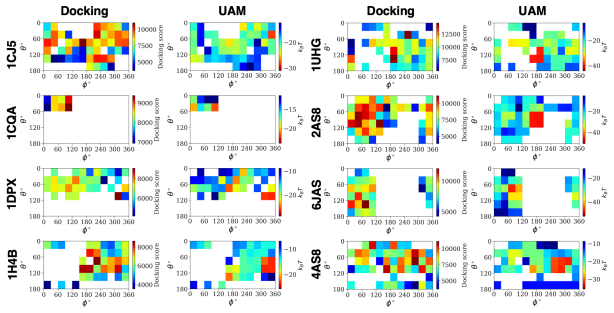


read the original abstract
Accurate quantification of protein-nanoparticle interactions is essential for applications in nanobiotechnology, nanomedicine, and drug delivery. Motivated by recent computational and experimental work, we combine coarse-grained united-atom (UA) models with molecular docking to characterize protein adsorption on SiO_2 nanoparticles. We construct orientation-resolved heatmaps in which polar and azimuthal angles uniquely specify the relative protein-nanoparticle pose, and the map amplitude reports binding propensity via the minimum UA adsorption energy or the docking score. Each angular bin corresponds to a distinct docked complex, enabling systematic comparison of binding geometries across models. To relate docking score landscapes to Boltzmann-averaged UA adsorption energetics, we analyze eight birch pollen allergen proteins previously studied experimentally. Similarity between the two orientational distributions is quantified using the Jensen-Shannon divergence (JSD). We find encouraging agreement between the two approaches in several cases, while also identifying limitations and routes for improvement, including optimized angular resolution and iterative refinement of interaction parameters. Overall, this framework provides a quantitative bridge between coarse-grained energetics and docking outputs at protein-nanoparticle interfaces, supporting improved predictive modeling and mechanistic insight into protein-nanoparticle binding landscapes.
Editorial analysis
A structured set of objections, weighed in public.
Referee Report
Summary. The manuscript develops a computational framework combining united-atom (UA) coarse-grained models with molecular docking to map orientation-dependent protein adsorption on SiO2 nanoparticles. Orientations are specified by polar and azimuthal angles, with binding propensity in each bin given by the minimum UA adsorption energy or docking score. For eight birch pollen allergen proteins, the resulting orientational distributions are compared via Jensen-Shannon divergence (JSD), with the abstract reporting encouraging agreement in several cases alongside noted limitations and suggested improvements such as optimized angular resolution and parameter refinement.
Significance. If the minimum-per-bin proxy is shown to correlate with physical binding propensities, the work supplies a practical bridge between efficient docking and more detailed UA energetics, enabling systematic orientation-resolved predictions relevant to nanobiotechnology. The quantitative use of JSD is a methodological strength, and the explicit discussion of limitations demonstrates appropriate caution. However, the absence of error bars, bin-selection details, and validation against Boltzmann-weighted integrals or experiments currently limits the strength of the central claim of agreement.
major comments (2)
- [Abstract] Abstract: the claim of 'encouraging agreement' between UA and docking orientational distributions rests on JSD comparisons whose quantitative values, uncertainties, and sensitivity to angular bin width are not reported. Without these, it is impossible to judge whether the observed similarity exceeds what would be expected from the shared use of minimum-per-bin statistics.
- [Abstract] Abstract (and implied Methods): the binding propensity is defined via the single lowest UA energy or docking score inside each angular bin. This choice treats the global minimum as a sufficient statistic for adsorption likelihood, but the manuscript provides no demonstration that it correlates with the orientation-resolved partition function (Boltzmann-weighted integral over poses and conformations within the bin). If intra-bin landscapes contain multiple shallow minima or significant entropy, both methods could agree on an artifact rather than the physical distribution, undermining the JSD-based claim for the eight proteins.
minor comments (2)
- [Abstract] The manuscript should include an explicit equation or pseudocode for the JSD calculation between the two heatmaps and state how the angular bins were chosen (e.g., equal-area or uniform in theta/phi).
- [Abstract] Clarify whether interaction parameters in the UA model were held fixed from prior work or adjusted after inspecting the docking results; any post-hoc refinement would require a separate validation set.
Simulated Author's Rebuttal
We thank the referee for the constructive and detailed feedback, which helps us clarify the scope and limitations of our computational framework. We respond to each major comment below, indicating planned revisions to the manuscript where appropriate.
read point-by-point responses
-
Referee: [Abstract] Abstract: the claim of 'encouraging agreement' between UA and docking orientational distributions rests on JSD comparisons whose quantitative values, uncertainties, and sensitivity to angular bin width are not reported. Without these, it is impossible to judge whether the observed similarity exceeds what would be expected from the shared use of minimum-per-bin statistics.
Authors: We agree that the abstract would benefit from greater quantitative detail. The full manuscript reports JSD values for all eight proteins in the Results section (with specific values ranging from approximately 0.04 to 0.28 for cases described as encouraging agreement), along with a brief sensitivity check to bin width in the Supplementary Material. In the revised version we will move key JSD numbers and the bin-width sensitivity discussion into the abstract itself. Because the minimum-per-bin procedure is deterministic, formal statistical uncertainties are not applicable; however, we will explicitly state this and report the range of JSD values obtained under modest changes in angular resolution to allow readers to assess robustness. revision: yes
-
Referee: [Abstract] Abstract (and implied Methods): the binding propensity is defined via the single lowest UA energy or docking score inside each angular bin. This choice treats the global minimum as a sufficient statistic for adsorption likelihood, but the manuscript provides no demonstration that it correlates with the orientation-resolved partition function (Boltzmann-weighted integral over poses and conformations within the bin). If intra-bin landscapes contain multiple shallow minima or significant entropy, both methods could agree on an artifact rather than the physical distribution, undermining the JSD-based claim for the eight proteins.
Authors: We acknowledge that the minimum-per-bin proxy is a computational simplification chosen to enable efficient mapping across many orientations and proteins. The manuscript already flags this as a limitation and lists “optimized angular resolution and iterative refinement of interaction parameters” as future improvements. In the revised Methods and Discussion we will add an explicit justification: for the strong-adsorption regime relevant to the experimental allergens, the lowest-energy pose within a bin typically dominates the local partition function. We will also insert a clearer caveat that entropic contributions from multiple shallow minima are not captured and could affect quantitative agreement. Because a full Boltzmann-weighted validation would require extensive additional sampling inside each bin, we treat this as a methodological limitation rather than a claim of exact equivalence. revision: partial
- Explicit numerical demonstration that the minimum-per-bin statistic correlates with the full orientation-resolved partition function (Boltzmann-weighted integral) for the eight proteins.
Circularity Check
No circularity: independent UA and docking outputs compared via JSD
full rationale
The paper constructs orientation heatmaps separately from minimum UA adsorption energies and from docking scores, then quantifies their similarity with Jensen-Shannon divergence across eight proteins. No equation or step reduces one landscape to a fitted parameter of the other, nor does any load-bearing claim rest on a self-citation chain; the reported agreement is an empirical observation between two distinct computational pipelines rather than a definitional equivalence or renamed input.
Axiom & Free-Parameter Ledger
free parameters (1)
- interaction parameters
axioms (1)
- domain assumption Coarse-grained united-atom models and docking scores both provide meaningful proxies for physical binding propensity when evaluated at discrete angular poses.
Reference graph
Works this paper leans on
-
[1]
Protein- nanoparticle interactions,
I. Lynch and K. Dawson, “Protein- nanoparticle interactions,”Nano Today, vol. 3, pp. 40–47, 2008
2008
-
[2]
Kinet- ics of the formation of a protein corona around nanoparticles,
V. Zhdanov and N.-J. Cho, “Kinet- ics of the formation of a protein corona around nanoparticles,”Mathe- matical Biosciences, vol. 282, pp. 82–90, 2016
2016
-
[3]
Un- derstanding protein-nanoparticle inter- actions leading to protein corona for- mation: In vitro - in vivo correlation study,
C. Marques, P. Maroni, L. Maurizi, O. Jordan, and G. Borchard, “Un- derstanding protein-nanoparticle inter- actions leading to protein corona for- mation: In vitro - in vivo correlation study,”International Journal of Biolog- ical Macromolecules, vol. 256, p. 128339, 2024
2024
-
[4]
A computational view on nanomaterial intrinsic and ex- trinsic features for nanosafety and sus- tainability,
G. Mancardi, A. Mikolajczyk, V. An- napoorani, A. Bahl, K. Blekos, J. Burkf, Y. C ¸ etin, K. Chairetakis, S. Dutta, L. Escorihuela,et al., “A computational view on nanomaterial intrinsic and ex- trinsic features for nanosafety and sus- tainability,”Materials Today, vol. 67, pp. 344–370, 2023
2023
-
[5]
Un- derstanding the nanoparticle–protein corona using methods to quantify ex- change rates and affinities of proteins for nanoparticles,
T. Cedervall, I. Lynch, S. Lindman, T. Bergg˚ ard, E. Thulin, H. Nilsson, K. A. Dawson, and S. Linse, “Un- derstanding the nanoparticle–protein corona using methods to quantify ex- change rates and affinities of proteins for nanoparticles,”Proceedings of the Na- tional Academy of Sciences, vol. 104, pp. 2050–2055, 2007
2050
-
[6]
Coarse master equations for binding kinetics of amyloid peptide dimers,
C. Leahy, R. Murphy, G. Hummer, E. Rosta, and N.-V. Buchete, “Coarse master equations for binding kinetics of amyloid peptide dimers,”The Journal of Physical Chemistry Letters, vol. 7, pp. 2676–2682, 2016
2016
-
[7]
Modelling bionano inter- actions and potential health risks for environmental nanoplastics: the case of functionalized polystyrene,
J. Subbotina, O. McElligott, and V. Lobaskin, “Modelling bionano inter- actions and potential health risks for environmental nanoplastics: the case of functionalized polystyrene,”Environ- mental Science: Nano, vol. 13, pp. 1568– 1587, 2026
2026
-
[8]
Multiscale physics-based in silico modelling of nanocarrier- assisted intravascular drug delivery,
N. Buchete, I. Cicha, S. Dutta, and P. Neofytou, “Multiscale physics-based in silico modelling of nanocarrier- assisted intravascular drug delivery,” Frontiers in Drug Delivery, vol. 4, p. 1362660, 2024
2024
-
[9]
Edito- rial: Modelling of intravascular drug de- livery using nanocarriers,
P. Neofytou and N.-V. Buchete, “Edito- rial: Modelling of intravascular drug de- livery using nanocarriers,”Frontiers in Drug Delivery, vol. 5, 2025
2025
-
[10]
Computer simulations of the dis- sociation mechanism of gleevec from abl kinase with milestoning,
B. Narayan, N.-V. Buchete, and R. El- ber, “Computer simulations of the dis- sociation mechanism of gleevec from abl kinase with milestoning,”The Jour- nal of Physical Chemistry B, vol. 125, pp. 5706–5715, 2021
2021
-
[11]
A hard- sphere model of protein corona for- mation on spherical and cylindrical nanoparticles,
I. Rouse and V. Lobaskin, “A hard- sphere model of protein corona for- mation on spherical and cylindrical nanoparticles,”Biophysical Journal, vol. 120, pp. 4457–4471, 2021
2021
-
[12]
Multiscale modelling of biomolecular corona formation on metal- lic surfaces,
P. Amini, I. Rouse, J. Subbotina, and V. Lobaskin, “Multiscale modelling of biomolecular corona formation on metal- lic surfaces,”Beilstein Journal of Nan- otechnology, vol. 15, pp. 215–229, 2024
2024
-
[13]
Modelling bionano inter- actions and potential health risks for environmental nanoplastics: the case of functionalized polystyrene,
J. Subbotina, O. McElligott, and V. Lobaskin, “Modelling bionano inter- actions and potential health risks for environmental nanoplastics: the case of functionalized polystyrene,”Environ- mental Science: Nano, 2026. 10
2026
-
[14]
Milk protein adsorption on metallic iron surfaces,
P. Mosaddeghi Amini, J. Subbotina, and V. Lobaskin, “Milk protein adsorption on metallic iron surfaces,”Nanomateri- als, vol. 13, p. 1857, 2023
2023
-
[15]
Computational modelling of bionano interface,
V. Lobaskin, J. Subbotina, and I. Rouse, “Computational modelling of bionano interface,”Europhysics Letters, vol. 143, p. 57001, 2023
2023
-
[16]
UA- NanoDock: A web-based UnitedAtom multiscale nanodocking tool for predict- ing protein adsorption onto nanoparti- cles,
J. Subbotina, P. Kolokathis, A. Tsouma- nis, N. Sidiropoulos, I. Rouse, I. Lynch, V. Lobaskin, and A. Afantitis, “UA- NanoDock: A web-based UnitedAtom multiscale nanodocking tool for predict- ing protein adsorption onto nanoparti- cles,”Journal of Chemical Information and Modeling, vol. 65, pp. 3142–3153, 2025
2025
-
[17]
Comp- SafeNano project: NanoInformatics approaches for safe-by-design nanoma- terials,
D. Zouraris, A. Mavrogiorgis, A. Tsoumanis, L. Saarim¨ aki, G. del Giu- dice, A. Federico, A. Serra, D. Greco, I. Rouse, J. Subbotina,et al., “Comp- SafeNano project: NanoInformatics approaches for safe-by-design nanoma- terials,”Computational and Structural Biotechnology Journal, vol. 29, pp. 13– 28, 2025
2025
-
[18]
In silico prediction of protein binding affinities onto core–shell PEGylated no- ble metal nanoparticles for rational de- sign of drug nanocarriers,
J. Subbotina, I. Rouse, and V. Lobaskin, “In silico prediction of protein binding affinities onto core–shell PEGylated no- ble metal nanoparticles for rational de- sign of drug nanocarriers,”Nanoscale, vol. 15, pp. 13371–13383, 2023
2023
-
[19]
Protein corona finger- printing predicts the cellular interaction of gold and silver nanoparticles,
C. Walkey, J. Olsen, F. Song, R. Liu, H. Guo, D. Olsen, Y. Cohen, A. Emili, and W. Chan, “Protein corona finger- printing predicts the cellular interaction of gold and silver nanoparticles,”ACS Nano, vol. 8, pp. 2439–2455, 2014
2014
-
[20]
Computational predic- tion and experimental analysis of the nanoparticle-protein corona: Showcas- ing an in vitro-in silico workflow provid- ing FAIR data,
I. Hasenkopf, R. Mills-Goodlet, L. John- son, I. Rouse, M. Geppert, A. Duschl, D. Maier, V. Lobaskin, I. Lynch, and M. Himly, “Computational predic- tion and experimental analysis of the nanoparticle-protein corona: Showcas- ing an in vitro-in silico workflow provid- ing FAIR data,”Nano Today, vol. 46, p. 101561, 2022
2022
-
[21]
Interactions of nanoparticles and biosystems: Microenvironment of nanoparticles and biomolecules in nanomedicine,
C. Aur´ ıa-Soro, T. Nesma, P. Juanes- Velasco, A. Landeira-Vi˜ nuela, H. Fidalgo-Gomez, V. Acebes- Fernandez, R. Gongora, M. Parra, R. Manzano-Roman, and M. Fuentes, “Interactions of nanoparticles and biosystems: Microenvironment of nanoparticles and biomolecules in nanomedicine,”Nanomaterials, vol. 9, p. 1365, 2019
2019
-
[22]
Structure and interac- tion of nanoparticle–protein complexes,
S. Kumar, I. Yadav, V. Aswal, and J. Kohlbrecher, “Structure and interac- tion of nanoparticle–protein complexes,” Langmuir, vol. 34, pp. 5679–5695, 2018
2018
-
[23]
Modelling and predicting the biological effects of nanomaterials,
D. Winkler, F. Burden, B. Yan, R. Weissleder, C. Tassa, S. Shaw, and V. Epa, “Modelling and predicting the biological effects of nanomaterials,”SAR and QSAR in Environmental Research, vol. 25, pp. 161–172, 2014
2014
-
[24]
A nanoinformatics decision support tool for the virtual screening of gold nanoparticle cellular association using protein corona fingerprints,
A. Afantitis, G. Melagraki, A. Tsouma- nis, E. Valsami-Jones, and I. Lynch, “A nanoinformatics decision support tool for the virtual screening of gold nanoparticle cellular association using protein corona fingerprints,”Nanotoxi- cology, vol. 12, pp. 1148–1165, 2018
2018
-
[25]
A semi-automated workflow for fair ma- turity indicators in the life sciences,
A. Ammar, S. Bonaretti, L. Winckers, J. Quik, M. Bakker, D. Maier, I. Lynch, J. van Rijn, and E. Willighagen, “A semi-automated workflow for fair ma- turity indicators in the life sciences,” Nanomaterials, vol. 10, p. 2068, 2020. 11
2068
-
[26]
Poly(ε-caprolactone)-based nanocom- posites: Influence of compatibilization on properties of poly(ε-caprolactone)- silica nanocomposites,
M. Avella, F. Bondioli, V. Can- nillo, E. Di Pace, M. Errico, A. Fer- rari, B. Focher, and M. Malinconico, “Poly(ε-caprolactone)-based nanocom- posites: Influence of compatibilization on properties of poly(ε-caprolactone)- silica nanocomposites,”Composites Sci- ence and Technology, vol. 66, pp. 886– 894, 2006
2006
-
[27]
Conformational dynamics of human IAPP monomers,
R. Murphy, J. Conlon, T. Mansoor, S. Luca, S. Vaiana, and N.-V. Buchete, “Conformational dynamics of human IAPP monomers,”Biophysical Chem- istry, vol. 167, pp. 1–7, 2012
2012
-
[28]
Nano- SolveIT project: Driving nanoinformat- ics research to develop innovative and integrated tools for in silico nanosafety assessment,
A. Afantitis, G. Melagraki, P. Isigonis, A. Tsoumanis, D. Varsou, E. Valsami- Jones, A. Papadiamantis, L. Ellis, H. Sarimveis, P. Doganis,et al., “Nano- SolveIT project: Driving nanoinformat- ics research to develop innovative and integrated tools for in silico nanosafety assessment,”Computational and Struc- tural Biotechnology Journal, vol. 18, pp. 583–602, 2020
2020
-
[29]
Patch- Dock and SymmDock: servers for rigid and symmetric docking,
D. Schneidman-Duhovny, Y. Inbar, R. Nussinov, and H. Wolfson, “Patch- Dock and SymmDock: servers for rigid and symmetric docking,”Nucleic Acids Research, vol. 33, pp. W363–W367, 2005
2005
-
[30]
Molecular docking, a tool to determine interaction of CuO and TiO2 nanoparticles with hu- man serum albumin,
S. Chibber and I. Ahmad, “Molecular docking, a tool to determine interaction of CuO and TiO2 nanoparticles with hu- man serum albumin,”Biochemistry and Biophysics Reports, vol. 6, pp. 63–67, 2016
2016
-
[31]
The need for improved methodology in protein corona analy- sis,
M. Mahmoudi, “The need for improved methodology in protein corona analy- sis,”Nature Communications, vol. 13, p. 49, 2022
2022
-
[32]
The interpre- tation of protein structures: Estimation of static accessibility,
B. Lee and F. Richards, “The interpre- tation of protein structures: Estimation of static accessibility,”Journal of Molec- ular Biology, vol. 55, pp. 379–400, 1971
1971
-
[33]
Multiscale modelling of bionano interface,
H. Lopez, E. Brandt, A. Mirzoev, D. Zhurkin, A. Lyubartsev, and V. Lobaskin, “Multiscale modelling of bionano interface,” inModelling the Toxicity of Nanoparticles(L. Tran, M. Ba˜ nares, and R. Rallo, eds.), pp. 173–206, Springer International Publishing, 2017
2017
-
[34]
Biophysical descriptors of nanoparticle protein coronas,
V. Karunakaran Annapoorani, S. Dutta, O. Ajia, O. Petrisor, V. Lobaskin, and N.-V. Buchete, “Biophysical descriptors of nanoparticle protein coronas,”The Journal of Physical Chemistry Letters, pp. 11356–11364, 2025
2025
-
[35]
A multiscale model of protein adsorption on a nanoparticle surface,
D. Power, I. Rouse, S. Poggio, E. Brandt, H. Lopez, A. Lyubart- sev, and V. Lobaskin, “A multiscale model of protein adsorption on a nanoparticle surface,”Modelling and Simulation in Materials Science and Engineering, vol. 27, p. 084003, 2019
2019
-
[36]
Coarse- grained model of adsorption of blood plasma proteins onto nanoparticles,
H. Lopez and V. Lobaskin, “Coarse- grained model of adsorption of blood plasma proteins onto nanoparticles,” The Journal of Chemical Physics, vol. 143, p. 243138, 2015
2015
-
[37]
Optimization of the additive CHARMM all-atom protein force field targeting improved sampling of the back- boneϕ,ψand side-chainχ 1 andχ 2 dihe- dral angles,
R. Best, X. Zhu, J. Shim, P. Lopes, J. Mittal, M. Feig, and A. MacK- erell, “Optimization of the additive CHARMM all-atom protein force field targeting improved sampling of the back- boneϕ,ψand side-chainχ 1 andχ 2 dihe- dral angles,”Journal of Chemical The- ory and Computation, vol. 8, pp. 3257– 3273, 2012
2012
-
[38]
Efficient unbound docking of rigid molecules,
D. Duhovny, R. Nussinov, and H. Wolf- son, “Efficient unbound docking of rigid molecules,” inProceedings of the 2nd 12 Workshop on Algorithms in Bioinfor- matics (WABI), pp. 185–200, Springer, 2002
2002
-
[39]
On the Jensen–Shannon symmetrization of distances relying on abstract means,
F. Nielsen, “On the Jensen–Shannon symmetrization of distances relying on abstract means,”Entropy, vol. 21, p. 485, 2019
2019
-
[40]
Similarity-based methods for word sense disambiguation,
I. Dagan, L. Lee, and F. Pereira, “Similarity-based methods for word sense disambiguation,” inProceedings of the 35th Annual Meeting of the As- sociation for Computational Linguistics and Eighth Conference of the European Chapter of the Association for Computa- tional Linguistics, Association for Com- putational Linguistics, 1997
1997
-
[41]
A new metric for probability distributions,
D. Endres and J. Schindelin, “A new metric for probability distributions,” IEEE Transactions on Information The- ory, vol. 49, pp. 1858–1860, 2003
2003
-
[42]
A new class of metric divergences on probabil- ity spaces and its applicability in statis- tics,
F. ¨Osterreicher and I. Vajda, “A new class of metric divergences on probabil- ity spaces and its applicability in statis- tics,”Annals of the Institute of Statis- tical Mathematics, vol. 55, pp. 639–653, 2003
2003
-
[43]
Jensen- Shannon divergence and Hilbert space embedding,
B. Fuglede and F. Topsoe, “Jensen- Shannon divergence and Hilbert space embedding,” inProceedings of the In- ternational Symposium on Information Theory (ISIT), p. 31, 2004
2004
-
[44]
A metric for distributions with appli- cations to image databases,
Y. Rubner, C. Tomasi, and L. Guibas, “A metric for distributions with appli- cations to image databases,” inPro- ceedings of the Sixth International Con- ference on Computer Vision (ICCV), pp. 59–66, 1998
1998
-
[45]
Biologic effects of nanoparticle-allergen conjugates: time- resolved uptake using an in vitro lung epithelial co-culture model of A549 and THP-1 cells,
B. Grotz, M. Geppert, R. Mills-Goodlet, S. Hofer, N. Hofst¨ atter, C. Asam, A. Feinle, K. Kocsis, T. Berger, O. Diwald,et al., “Biologic effects of nanoparticle-allergen conjugates: time- resolved uptake using an in vitro lung epithelial co-culture model of A549 and THP-1 cells,”Environmental Science: Nano, vol. 5, pp. 2184–2197, 2018
2018
-
[46]
Orientational potentials ex- tracted from protein structures improve native fold recognition,
N.-V. Buchete, J. Straub, and D. Thiru- malai, “Orientational potentials ex- tracted from protein structures improve native fold recognition,”Protein Sci- ence, vol. 13, pp. 862–874, 2004
2004
-
[47]
Orientation-dependent coarse- grained potentials derived by statis- tical analysis of molecular structural databases,
N. Buchete, J. Straub, and D. Thiru- malai, “Orientation-dependent coarse- grained potentials derived by statis- tical analysis of molecular structural databases,”Polymer, vol. 45, pp. 597– 608, 2004
2004
-
[48]
Continuous anisotropic repre- sentation of coarse-grained potentials for proteins by spherical harmonics synthe- sis,
N. Buchete, J. Straub, and D. Thiru- malai, “Continuous anisotropic repre- sentation of coarse-grained potentials for proteins by spherical harmonics synthe- sis,”Journal of Molecular Graphics and Modelling, vol. 22, pp. 441–450, 2004
2004
-
[49]
Anisotropic coarse-grained statistical potentials improve the ability to identify nativelike protein structures,
N. Buchete, J. Straub, and D. Thiru- malai, “Anisotropic coarse-grained statistical potentials improve the ability to identify nativelike protein structures,”The Journal of Chemical Physics, vol. 118, pp. 7658–7671, 2003
2003
-
[50]
Development of novel statistical potentials for protein fold recognition,
N. Buchete, J. Straub, and D. Thiru- malai, “Development of novel statistical potentials for protein fold recognition,” Current Opinion in Structural Biology, vol. 14, pp. 225–232, 2004. 13 1 Supplemental Material: Orientation-Dependent Protein Binding at Nanoparticle Interfaces Vigneshwari Karunakaran Annapoorani1,2, Ian Rouse1,2, Vladimir Lobaskin1,2, N...
2004
discussion (0)
Sign in with ORCID, Apple, or X to comment. Anyone can read and Pith papers without signing in.