Recognition: unknown
Stochastic Frontier meets Breakdown Frontier
Pith reviewed 2026-05-07 13:54 UTC · model grok-4.3
The pith
Stochastic frontier models yield an identified set and breakdown frontier for average inefficiency when baseline assumptions are relaxed.
A machine-rendered reading of the paper's core claim, the machinery that carries it, and where it could break.
Core claim
By elaborating relaxations of the baseline assumptions in stochastic frontier models, the identified set for the average inefficiency of a production unit is characterized, and the breakdown frontier for that parameter is derived from the relaxed model.
What carries the argument
The breakdown frontier computed from the identified set under relaxed stochastic frontier assumptions, which quantifies the robustness of the average inefficiency parameter.
If this is right
- The identified set for average inefficiency remains bounded under controlled relaxations of distributional and independence assumptions.
- The breakdown frontier gives the exact degree of assumption violation at which a target inefficiency value ceases to be compatible with the data.
- Application to standard production datasets produces concrete bounds and frontiers that practitioners can inspect.
- Open code allows direct replication and extension of the sensitivity procedures to other frontier datasets.
Where Pith is reading between the lines
- The same relaxation-plus-breakdown approach could be applied to other limited-dependent-variable models in production economics to test robustness of efficiency scores.
- Policy conclusions that rely on point estimates of average inefficiency would need to be qualified by the width of the identified set and the location of the breakdown frontier.
Load-bearing premise
Relaxations of the baseline assumptions in stochastic frontier models still allow a well-defined identified set for average inefficiency from which a breakdown frontier can be derived.
What would settle it
Finding that under a specific relaxation the identified set for average inefficiency becomes the entire real line or empty would show that no breakdown frontier can be obtained.
Figures


read the original abstract
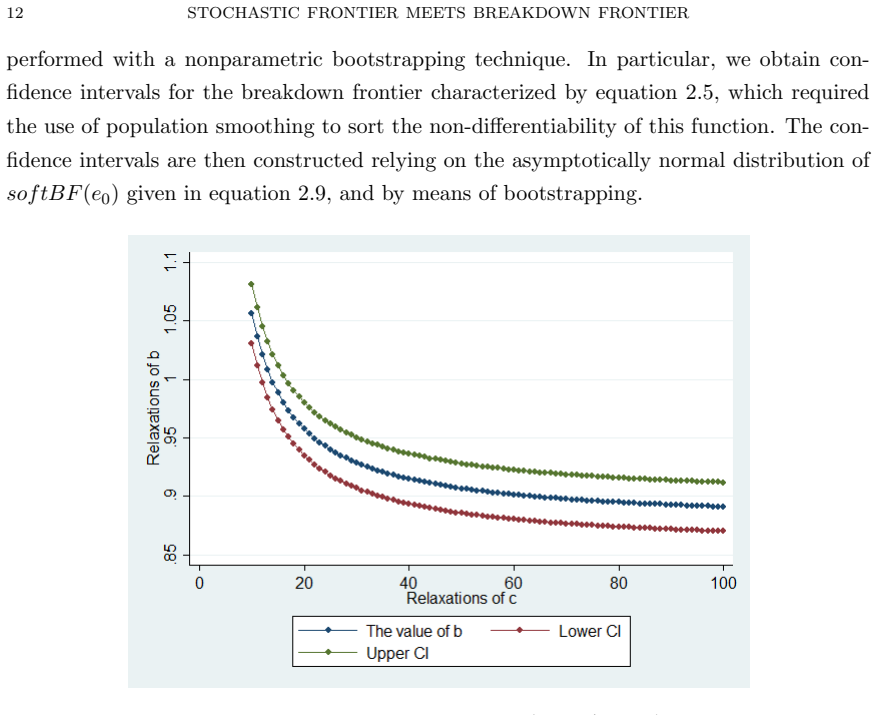
This paper studies sensitivity analysis of Stochastic Frontier Models. We elaborate relaxations of the baseline assumptions in the Stochastic Frontier Models and characterize the identified set under this relaxations. Furthermore, we derive the breakdown frontier for a relevant parameter of interest, the average inefficiency of a production unit. We show an application of the procedures on a well known dataset, and make the code available for the interested practitioner.
Editorial analysis
A structured set of objections, weighed in public.
Referee Report
Summary. The paper develops a sensitivity analysis for stochastic frontier models (SFMs) by relaxing standard assumptions on the distributions of the inefficiency and noise terms as well as their independence. It characterizes the identified set for the average inefficiency parameter under these relaxations and derives the breakdown frontier for that parameter. The framework is applied to a standard dataset with accompanying code made available.
Significance. If the identification results hold, the approach supplies a practical tool for assessing robustness of inefficiency estimates to key SFM assumptions, which are often strong in applied work. The provision of reproducible code is a clear strength that facilitates adoption and verification by practitioners.
major comments (2)
- [Section on relaxations and identified set] The characterization of the identified set under the relaxed assumptions (detailed in the section on relaxations) must be shown to be sharp; without an explicit statement of the support conditions or the optimization problem used to obtain the bounds, it is unclear whether the reported set is the tightest possible.
- [Breakdown frontier derivation] In the derivation of the breakdown frontier for average inefficiency, the mapping from the relaxed model to the frontier value should be derived explicitly rather than asserted; if the frontier is obtained by solving a linear program or similar, the objective and constraints need to be stated so that readers can verify it does not reduce to a fitted quantity by construction.
minor comments (3)
- [Abstract] The abstract would benefit from naming the specific relaxations considered (e.g., independence, distributional families) rather than referring only to 'baseline assumptions.'
- [Empirical illustration] In the empirical application, report the width of the identified set and the breakdown point explicitly in a table alongside the point estimates from the baseline SFM.
- [Model setup] Notation for the inefficiency term and the average inefficiency parameter should be introduced once and used consistently; avoid redefining symbols across sections.
Simulated Author's Rebuttal
We thank the referee for the careful reading of our manuscript and the constructive comments. We address each major comment below and will make the suggested clarifications in the revised version.
read point-by-point responses
-
Referee: [Section on relaxations and identified set] The characterization of the identified set under the relaxed assumptions (detailed in the section on relaxations) must be shown to be sharp; without an explicit statement of the support conditions or the optimization problem used to obtain the bounds, it is unclear whether the reported set is the tightest possible.
Authors: We appreciate the referee highlighting the need for greater explicitness. The identified set is constructed as all values of average inefficiency consistent with the observed data moments under the stated relaxations on the marginal distributions of u and v and their joint dependence. To confirm sharpness, we will revise the section to state the support conditions explicitly (u ≥ 0 almost surely and v with finite first and second moments) and to present the bounds as the solution to the linear program that extremizes E[u] subject to the moment constraints implied by the data and the relaxation parameters. This formulation will be added to the revised manuscript. revision: yes
-
Referee: [Breakdown frontier derivation] In the derivation of the breakdown frontier for average inefficiency, the mapping from the relaxed model to the frontier value should be derived explicitly rather than asserted; if the frontier is obtained by solving a linear program or similar, the objective and constraints need to be stated so that readers can verify it does not reduce to a fitted quantity by construction.
Authors: We agree that an explicit mapping improves verifiability. The breakdown frontier is obtained by finding the minimal relaxation parameter such that a target value of average inefficiency lies inside the identified set. This is implemented as a linear program minimizing the relaxation parameter subject to the adjusted moment constraints and support restrictions. We will expand the derivation section to state the objective and all constraints explicitly, allowing readers to confirm that the frontier is derived from the identification analysis rather than imposed by construction. revision: yes
Circularity Check
No significant circularity detected
full rationale
The paper relaxes baseline assumptions in stochastic frontier models, characterizes the identified set for average inefficiency under those relaxations, and derives the breakdown frontier for the parameter of interest. This follows standard partial-identification sensitivity analysis without any step reducing by construction to a fitted input, self-definition, or load-bearing self-citation. No equations are presented that equate a prediction to its own inputs, and the approach supplies code for the empirical illustration, rendering the derivation self-contained against external benchmarks.
Axiom & Free-Parameter Ledger
Reference graph
Works this paper leans on
-
[1]
Adams, R. M., A. N. Berger, and R. C. Sickles (1999). Semiparametric approaches to stochastic panel frontiers with applications in the banking industry.Journal of Business & Economic Statistics 17(3), 349–358. Aguirre, E., F. Garc´ ıa Su´ arez, and G. Sicilia (2024a). Technical efficiency in beef cattle farming in uruguay: Insights from census data.Agroci...
1999
-
[2]
Garc´ ıa Su´ arez, and G
Aguirre, E., F. Garc´ ıa Su´ arez, and G. Sicilia (2024b). Technological frontier in uruguay’s beef cattle production: An analysis of technical efficiency and its main drivers.Agribusi- ness. Aigner, D., C. K. Lovell, and P. Schmidt (1977). Formulation and estimation of stochastic frontier production function models.Journal of econometrics 6(1), 21–37. Be...
1977
-
[3]
Schmidt, and R
Cornwell, C., P. Schmidt, and R. C. Sickles (1990). Production frontiers with cross-sectional and time-series variation in efficiency levels.Journal of econometrics 46(1-2), 185–200. Fang, Z. and A. Santos (2019). Inference on directionally differentiable functions.The Review of Economic Studies 86(1), 377–412. Ferrier, G. D. and C. K. Lovell (1990). Meas...
1990
-
[4]
Lanfranco, B. and I. Buffa (2013). Eficiencia t´ ecnica de la invernada en uruguay: Un an´ alisis de fronteras de producci´ on.Serie T´ ecnica, 109–128. Malikov, E., S. C. Kumbhakar, and M. G. Tsionas (2016). A cost system approach to the stochastic directional technology distance function with undesirable outputs: The case of us banks in 2001–2010.Journa...
discussion (0)
Sign in with ORCID, Apple, or X to comment. Anyone can read and Pith papers without signing in.